
 Worksheets
Physical Science Part 2 Exam Study Guide
Total questions: 79
Worksheet time: 40mins
What is a lens? Fill in the blank: A lens is a __________ material with a curved surface that reflects light rays.
transparent
opaque
metallic
reflective
What does a convex lens do? Fill in the blank: A convex lens __________ light rays to form images.
focuses
scatters
blocks
reflects
A concave lens is:
a lens that is thicker at the center than at the edges
a lens that is thinner at the center than at the edges
a lens that converges light rays
a lens that forms only real images
Fill in the blank: The ______ is the inner lining of the eye converting light into electrical signals that the brain interprets; it contains rods and cones.
Retina
Cornea
Lens
Iris
Fill in the blank: The ______ is the colored ring of muscle that controls the size of the pupil.
Iris
Cornea
Retina
Lens
Fill in the blank: The ______ carries signals generated by rods and cones to your brain.
Optic nerve
Cornea
Retina
Lens
Fill in the blank: The ______ is the transparent covering on the eyeball where light enters the eye.
Cornea
Retina
Lens
Iris

Where is the image formed in the eye?
Image is formed at the retina.
Image is formed at the cornea.
Image is formed at the iris.
Image is formed at the lens.
Fill in the blank: A telescope uses ______ and lenses to gather more light from far away objects than the eye does.
mirror
prism
filter
antenna
Fill in the blank: A microscope uses two ______ lenses with short focal lengths to magnify small, close objects.
convex
concave
cylindrical
planar
Describe the functions of the three main sections of the ear.
The outer ear collects sound waves and funnels them into the ear canal and to the eardrum, which then vibrates. The middle ear transmits the waves, or vibrations, inward by means of three small bones. The inner ear contains the liquid-filled cochlea, which is lined with hair like cells that sway as a result of the vibrations. Nerves carry the information to the brain.
The outer ear amplifies electrical signals, the middle ear produces sound waves, and the inner ear filters out background noise before sending signals to the brain.
The outer ear creates sound waves, the middle ear absorbs them, and the inner ear stores them for later use.
The outer ear detects light, the middle ear processes taste, and the inner ear controls balance only.
What is the term for the following definition: type of matter with a fixed composition that cannot be separated by physical means?
Substance
Mixture
Solution
Element
What is the term for the following definition: substance made up of atoms with same identity?
Element
Compound
Mixture
Solution
What is the term for the following definition: atoms of two or more different elements combined?
Compound
Element
Mixture
Molecule
Fill in the blank: ________ are materials made of two or more substances that can be separated by physical means.
Mixture
Element
Compound
Solution
Fill in the blank: ________ is a homogeneous mixture of particles so small that they cannot even be seen with a microscope and will never settle to the bottom of their container.
Solution
Suspension
Colloid
Emulsion
Fill in the blank: ________ is a type of mixture with particles that are larger than those in solution, but still too light to settle out.
Colloid
Solution
Suspension
Element
Fill in the blank: ________ is a heterogeneous mixture containing a liquid in which visible particles settle.
Suspension
Solution
Colloid
Emulsion
Fill in the blank: Matter is ____________.
anything that has mass and takes up space
a type of energy that moves in waves
only found in living things
something that cannot be seen or touched
Which of the following best describes the characteristics of solids?
A) Indefinite shape and definite volume; particles can move past each other
B) Definite shape and definite volume; particles closely packed in geometric arrangement
C) Indefinite shape and indefinite volume; particles spread out
D) Definite shape and indefinite volume; particles loosely packed
Which of the following best describes the characteristics of liquids?
Definite shape and definite volume; particles closely packed in geometric arrangement
Indefinite shape and indefinite volume; particles spread out
Indefinite shape and definite volume; particles can move past each other
Definite shape and indefinite volume; particles loosely packed
Which of the following best describes the characteristics of gases?
Definite shape and definite volume; particles closely packed in geometric arrangement
Indefinite shape and definite volume; particles can move past each other
Indefinite shape and indefinite volume; particles spread out
Definite shape and indefinite volume; particles loosely packed
Fill in the blank: The melting point is the ____________.
temperature at which a solid melts
temperature at which a liquid boils
temperature at which a gas condenses
temperature at which a liquid freezes
Fill in the blank: The freezing point is the ____________.
temperature at which a liquid freezes
temperature at which a liquid boils
point where a solid evaporates
temperature at which a gas condenses
Fill in the blank: The boiling point is the ____________.
temperature at which liquid begins to vaporize
temperature at which solid melts
temperature at which gas condenses
temperature at which liquid freezes
Fill in the blank: The condensation point is the ____________.
temperature at which a gas condenses
temperature at which a solid melts
temperature at which a liquid boils
temperature at which a solid sublimates
Fill in the blank: Fluid is ____________.
anything that flows; liquid or gas
a solid that cannot change shape
a type of metal
a form of energy
Fill in the blank: Buoyancy is the ____________.
ability of a fluid to exert an upward force on an object immersed in it
tendency of objects to sink in a fluid
force that pulls objects downward in a fluid
process of dissolving solids in a liquid
Fill in the blank: Pascal’s Principle states that ____________.
pressure applied to a fluid is transmitted unchanged throughout the fluid
the volume of a gas is inversely proportional to its pressure
energy cannot be created or destroyed, only transformed
the buoyant force on an object is equal to the weight of the fluid displaced
Fill in the blank: Bernoulli’s principle states that as the velocity of a fluid increases, ____________.
the pressure exerted by the fluid decreases
the density of the fluid increases
the temperature of the fluid increases
the viscosity of the fluid increases
Fill in the blank: Boyle’s Law states that as the volume of the gas decreases, ____________, provided the temperature does not change.
the pressure of a gas increases
the temperature of a gas increases
the mass of a gas increases
the pressure of a gas decreases
Fill in the blank: Archimedes Principle states that the buoyant force on an object is equal to ____________.
the weight of fluid displaced by the object
the volume of the object
the mass of the object
the density of the fluid
Fill in the blank: Charles’ Law states that as temperature increases, ____________, provided pressure remains constant.
the volume increases
the pressure decreases
the mass increases
the density increases
Which of the following best describes the differences among solutions, colloids, and suspensions?
Solutions have particles that are evenly distributed and do not settle, colloids have intermediate-sized particles that do not settle, and suspensions have large particles that settle out over time.
Solutions and colloids both have particles that settle out, while suspensions do not.
Colloids and suspensions both have particles that are evenly distributed, while solutions do not.
Suspensions have the smallest particles, colloids have the largest, and solutions are intermediate.
Fill in the blank: An ______ is the smallest piece of matter that still has the properties of the element.
atom
molecule
cell
compound
Fill in the blank: ______ are positively charged particles.
Protons
Neutrons
Electrons
Photons
Fill in the blank: ______ are neutral or have no charge.
Neutrons
Protons
Electrons
Ions
Fill in the blank: ______ are negatively charged particles.
Electrons
Protons
Neutrons
Photons
Fill in the blank: The ______ is located in the very small center of the atom and consists of protons and neutrons.
nucleus
electron cloud
valence shell
isotope
Atomic mass: ________
composed mostly of protons and neutrons in the nucleus; aka mass number
the number of electrons in an atom
the number of energy levels in an atom
the total charge of the atom
Atomic number: ________
the number of protons in an atom; identifies the element
the number of neutrons in an atom; determines isotope
the sum of protons and neutrons; atomic mass
the number of electrons in an atom; determines charge
Isotopes: ________
atoms of the same element that have different numbers of neutrons
atoms of different elements that have the same number of neutrons
atoms of the same element that have different numbers of protons
atoms of different elements that have the same number of protons
Average atomic mass: ________
weighted average mass of an element’s isotopes
sum of protons and neutrons in an atom
number of electrons in an atom
mass of the most abundant isotope
Periodic table: ________
organized by increasing atomic number
organized by increasing atomic mass
organized by alphabetical order
organized by color
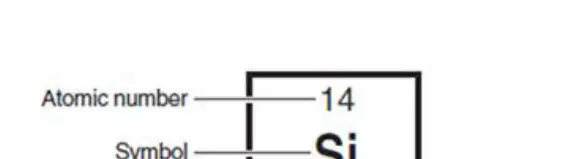
Refer to the diagram of the periodic table entry for Silicon. What is the atomic number of Silicon?
14
12
16
20
Fill in the blank: Metals are ______ conductors of heat and electricity and are located to the left of the stair step.
good
poor
insulating
weak
Fill in the blank: Transition elements are the most familiar metals because they often occur in nature ______.
uncombined
as gases
as liquids
in compounds
Fill in the blank: Inner transition metals include the ______ series and actinide series, and are listed below the main table.
lanthanide
alkali
halogen
noble gas
Fill in the blank: Nonmetals are poor conductors of electricity and heat, are usually gases or brittle solids, and are located to the ______ of the stair step.
right
left
top
bottom
Fill in the blank: Metalloids have metallic and non-metallic properties and make up the ______.
stair step
transition metals
alkali metals
halogen group
Fill in the blank: A ______ is a substance made of the combined atoms of two or more elements.
compound
element
mixture
atom
Fill in the blank: A ______ tells what elements a compound contains and the exact number of the atoms of those elements.
chemical formula
atomic number
isotope symbol
periodic table
Fill in the blank: A ______ represents the number of units of each substance; written in front of the chemical formula.
coefficient
element
isotope
compound
Fill in the blank: A ______ represents the number of atoms in a molecule of a particular element; written at the bottom of an element.
subscript
superscript
coefficient
symbol
Fill in the blank: A ______ represents the oxidation number or how many electrons have been gained or lost; written at the top of an element.
superscript
subscript
coefficient
isotope
Fill in the blank: A chemical bond is the ________ that holds together the atoms in a substance.
force
liquid
color
sound
Fill in the blank: An ion is a ________ or ________ charged atom.
positively, negatively
neutral, stable
large, small
hot, cold
Fill in the blank: A covalent bond ________ electrons, forms multiple bonds, and occurs between a ________ and a ________.
shares, nonmetal, nonmetal
transfers, metal, nonmetal
shares, metal, metal
transfers, nonmetal, nonmetal
Fill in the blank: An ionic bond ________ or ________ electrons, is the attraction between opposite charges, and occurs between a ________ and a ________.
loses, gains, metal, nonmetal
shares, loses, nonmetal, metal
gains, shares, metal, metal
loses, shares, nonmetal, nonmetal
Fill in the blank: A chemical reaction is ____________.
a reaction in which one or more substances are changed into completely new substances
a process where substances only change their shape
a reaction that does not involve any change in substances
a process where substances are only mixed but not changed
Fill in the blank: The law of conservation of mass states that ____________.
total starting mass of all reactant is equal to the total mass of all products
energy is created during a chemical reaction
mass can be destroyed in a chemical reaction
the mass of products is always greater than the mass of reactants
Fill in the blank: A catalyst ____________.
speeds up a chemical reaction
slows down a chemical reaction
is consumed in a chemical reaction
prevents a chemical reaction from occurring
Fill in the blank: An inhibitor ____________.
prevents or slows a chemical reaction; interferes with the catalyst
increases the rate of a chemical reaction; acts as a catalyst
is always consumed in a reaction; forms new products
only works at high temperatures; speeds up reactions
Compare a covalent bond and an ionic bond.
A covalent bond involves sharing of electrons, while an ionic bond involves transfer of electrons.
A covalent bond involves transfer of electrons, while an ionic bond involves sharing of electrons.
Both covalent and ionic bonds involve sharing of electrons.
Both covalent and ionic bonds involve transfer of electrons.
Fill in the blank: A ______ is a mixture that has the same composition, color, density, and taste throughout.
Solution
Suspension
Colloid
Emulsion
Fill in the blank: A ______ is the substance being dissolved.
Solute
Solvent
Solution
Suspension
Fill in the blank: A ______ is the substance doing dissolving.
Solvent
Solute
Mixture
Compound
Fill in the blank: Saturated means _________?
contains all solute it can hold at a given temperature
contains no solute at all
can dissolve more solute at the same temperature
is always a solid at room temperature
Fill in the blank: Unsaturated means _________?
able to dissolve more solute at a given temperature
unable to dissolve any more solute at a given temperature
containing the maximum amount of solute possible
a solution that is supersaturated
Fill in the blank: Supersaturated means _________?
contains more solute than a saturated one; unstable
contains less solute than a saturated one; stable
contains only solvent; very stable
contains equal solute as a saturated one; neutral
Fill in the blank: An acid ________ in solution.
produces hydrogen ions
produces hydroxide ions
produces oxygen gas
produces water molecules
Fill in the blank: A base is a substance that ________ in solution.
produces hydroxide ions
produces hydrogen ions
neutralizes acids by producing salt
dissolves metals
Which of the following is a property of acids?
Tastes bitter
Feels slippery
Tastes sour
Crystalline solid
Which of the following is a property of bases?
Tastes sour
Feels slippery
React with indicators to produce a color change
Electrolytes
Acids are electrolytes.
True
False
Bases taste bitter.
True
False
Both acids and bases are corrosive.
True
False
Acids react with indicators to produce a color change.
True
False
Bases are crystalline solids.
True
False

