
 Worksheets
Waves plus 11 review
Total questions: 47
Worksheet time: 24mins
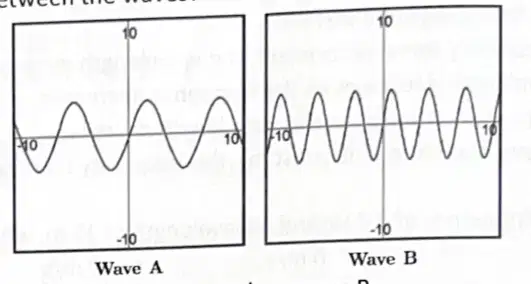
The two waves are traveling at the same speed. Which statement best describes the difference between the waves?
Wave A has a higher frequency than wave B.
Wave A has a lower frequency than wave B.
Wave A has a higher amplitude than wave B.
Wave A has a lower amplitude than wave B.
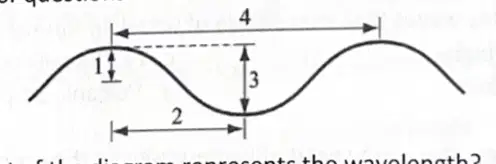
Which numbered part of the diagram represents the wavelength?
1
2
3
4
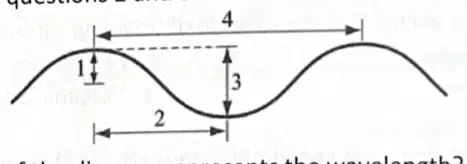
Which numbered part of the diagram represents the amplitude?
1
2
3
4
What is the name given to formula P₄0₁₀?
Phosphorus oxide
Tetraphosphorus decoxide
Phosphorus decoxide
Tetraphosphorus oxide
A wave has a frequency of 4.0 Hz. If it is traveling at a velocity of 20 m/s, what is the wavelength of the wave?
80 m
16 m
5.0 m
0.2 m
A certain wave has compression and rarefactions. How should this wave be classified?
Longitudinal wave
Surface wave
Transverse wave
Electromagnetic wave
Which of the following values would represent the pH of an acid?
10
7
9
6
Which has the longest wavelength?
Red light
Green light
Violet light
Yellow light
Which of the following best describes the relationship between frequency and wavelength of electromagnetic waves?
If the frequency remains constant, the wavelength increases.
The wavelength decreases as the frequency decreases.
The frequency increases as the wavelength decreases.
If the wavelength remains constant, the frequency increases.
If a wave has a frequency of 0.4 Hz and a wavelength of 15 m, what is its velocity?
0.2 m/s
6.0 m/s
38 m/s
60 m/s
Which characteristic of sound makes it possible for bats to fly in the dark without hitting objects?
Refraction
Reflection
Conduction
Amplification
Which generates waves that are capable of traveling through a vacuum?
A light bulb
A speaker
Earthquake activity
Volcanic eruption
What type of wave is produced when the frequency of visible light wave is increased?
Infrared
Radio
Ultraviolet
Microwave
What happens to the path of a light ray as it passes from air into water at an angle?
Its path widens
Its path bends
Its path becomes shorter
Its path continues in a straight line
Which of these types of electromagnetic radiation has the lowest frequency?
Visible light
X-ray
Gamma ray
Radio wave
What is the name given to the formula KCI?
Potassium chlorine
Potassium dichloride
Potassium chloride
Potassium chlorate
Which of these uses sound waves to locate underwater objects?
Radar
Sonar
Telescopes
Microscopes
What is the frequency of a wave that travels 20 m/s with a wavelength of 200 meters?
0.10 Hz
4.0 Hz
10 Hz
4000 Hz
Which reaction is an accurate example of synthesis?
2H2O→ 2H2 + O2
2Fe2O3 + 3C→ 4Fe +3CO2
Na2CO3→ Na2O + C₂
2Mg + O2→ 2MgO
Which of the following is an insulator?
Iron
Plastic
Steel
Copper
Which change in wave properties increases wave amplitude?
Greater wavelength
Decreased frequency
Increased height
Shortened wavelength
Which of the following changes in wave properties is a result of an increase in wavelength?
Higher crests
Lower frequency
Reduced height
Faster movement
Which of the following atoms has six valence electrons?
Magnesium (Mg)
Sulfur (S)
Silicon (Si)
Argon (Ar)
If a force of 10 N is applied to an object with a mass of 2 kg, the object will accelerate at
5 m/s²
12 m/s²
10 m/s²
20 m/s²
Infrared rays have a shorter wavelength than
Radio waves
Ultraviolet rays
Gamma rays
X-rays
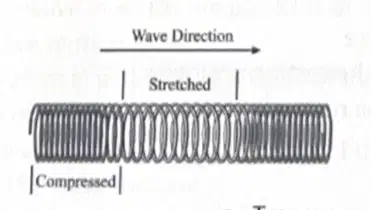
The figure shows a spring with a wave traveling through it. Which type of wave is illustrated?
Sound
Longitudinal
Transverse
Electromagnetic
Which of these uses radio waves to detect the speed of an approaching hurricane?
Radar
Sonar
Telescopes
Microscopes
Which of the following best describes the relationship between frequency and wavelength of electromagnetic waves?
If the frequency remains constant, the wavelength increases
The wavelength decreases as the frequency decreases
The frequency increases as the wavelength decreases
If the wavelength remains constant, the frequency increases
If an object gains electrons, then the net charge of the object would be
Stable
Positive
Negative
Neutral
Sonar equipment sends sound waves into deep water and measures
The time delay of the reflected waves to return
Refraction of the transmitted wave
Interference of the transmitted and reflected waves
Only the direction of the reflected wave
What property of electromagnetic waves makes it possible to use these waves to transmit information between a space shuttle and NASA mission control centers on the ground?
Electromagnetic waves are transverse waves.
Electromagnetic waves have very low velocity
Electromagnetic waves are all visible to human eyes
Electromagnetic waves can travel through a vacuum.
A student shakes the end of a rope with a frequency of 1.5 Hz, causing waves with a wavelength of 0.8 m to travel along the rope. What is the velocity of the waves?
1.9 m/s
1.6 m/s
1.2 m/s
0.53 m/s
Which molecule is correctly paired with the type of bond that holds the atoms together?
CaO - metallic bond
KCI-ionic bond
SO2- metallic bond
MgCl2 - covalent bond
To find amplitude, measure
A) From a trough to the resting position
B) From a crest to the resting position
Neither A nor В
Both A and B
Which wave causes the medium to vibrate only in a direction parallel to the wave's motion?
A longitudinal wave
A transverse wave
A surface wave
None of the above
Which of the following occurs as a light wave bends when it passes from one medium into another?
Reflection
Refraction
Destructive Interference
Constructive Interference
Which wave interaction best explains glares on the windshield of car?
Diffraction
Interference
Reflection
Refraction
The visible colors listed from shortest to longest wavelength are violet, blue, green, yellow, orange, and red. Which of the following accurately compares the frequency of these colors using this information?
Blue has a higher frequency than violet
Blue has a higher frequency than green
Orange has a lower frequency than red
Violet has a lower frequency than yellow
As wave frequency is increased, wave energy
Stays constant
Is unaffected
Increases
Decreases
Which of the following describes diffraction?
The bouncing back of waves as they meet a surface.
The bending of waves as they pass from one medium to another.
The bending of waves as they pass an edge or an opening.
The combining of two waves that meet at a point
During a baseball game, fans in the stands create a 'wave' by standing up from their chairs when the wave arrives at their location. Which sentence classifies this type of wave and its particle's motions?
It is a transverse wave in which the particles of the wave move in a direction parallel to the wave motion.
It is a longitudinal wave in which the particles of the wave move in a direction parallel to the wave motion.
It is a transverse wave in which the particles of the wave move in a direction perpendicular to the wave motion.
It is a longitudinal wave in which the particles of the wave move in a direction perpendicular to the wave motion.
What is the speed of a 2 Hz wave that has a wavelength of 10 m?
5 m/s
8 m/s
12 m/s
20 m/s
What do any two samples of the element mercury (Hg) have in common?
The same atomic number
The same volume
The same number of neutrons
The same number of electrons
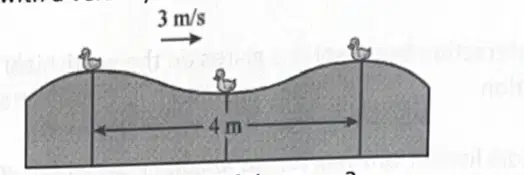
The illustration below shows three toy ducks floating on water, moving up and down travels to the right with a velocity of 3 m/s. Which of the following is the frequency of the wave?
0.75 Hz
1.33 Hz
1.5 Hz
6.0 Hz
When a pencil is placed in a cup of water, the pencil looks bent. What does this demonstration show?
Reflection
Refraction
Interference
Diffraction
What is the speed of a car that goes 10 meters in 3.4 seconds?
0.34 m/s
2.94 m/s
6.6 m/s
13.4 m/s
Which of the following electromagnetic waves has a longer wavelength than visible light?
Infrared
Gamma
X-ray
Ultraviolet

