
 Worksheets
Key Terms
Total questions: 100
Worksheet time: 3600secs
What are established guidelines that dictate how family members interact and behave called?
Rules
Habits
Opinions
Suggestions
What is the family's tendency to maintain stability, even in the face of change, called?
Homeostasis
Equilibrium
Dissonance
Adaptation
Which of the following is an example of a family rule?
Always eat dinner together
Ignore each other
Never talk
Stay out late every night
Which of the following is an example of homeostasis in a family?
The family resists changes such as a divorce or relocation
The family moves frequently
The family never eats together
The family ignores each other's needs

According to the Family Rules list, what should you do before yourself?
Think of others before yourself
Always eat dessert first
Ignore the needs of others
Put yourself first in every situation

According to the Family Rules list, what kind of words should you use?
Use kind words
Use loud words
Use mean words
Use silly words

Which of the following is one of Murray Bowen's Eight Concepts in Family Systems Theory?
Differentiation of Self
Operant Conditioning
Classical Conditioning
Cognitive Dissonance

Which of the following is one of Murray Bowen's Eight Concepts in Family Systems Theory?
Triangles
Reinforcement Schedules
Attachment Styles
Social Learning
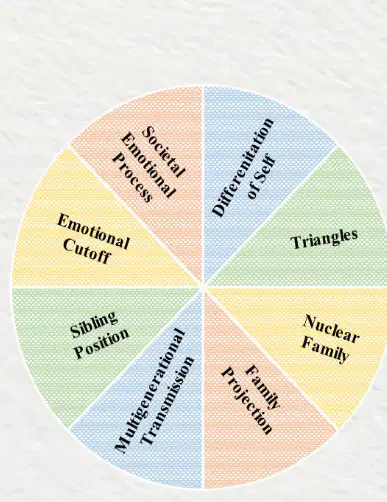
Which of the following is one of Murray Bowen's Eight Concepts in Family Systems Theory?
Nuclear Family Emotional System
Operant Conditioning
Self-Actualization
Groupthink

Which of the following is one of Murray Bowen's Eight Concepts in Family Systems Theory?
Family Projection Process
Social Facilitation
Cognitive Dissonance
Group Polarization
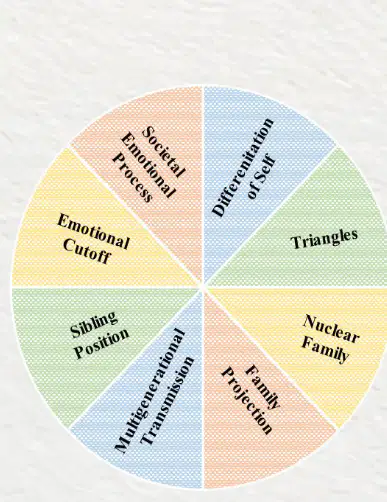
Which of the following is one of Murray Bowen's Eight Concepts in Family Systems Theory?
Multigenerational Transmission Process
Social Loafing
Operant Conditioning
Self-Efficacy

Which of the following is one of Murray Bowen's Eight Concepts in Family Systems Theory?
Emotional Cutoff
Social Identity Theory
Learned Helplessness
Groupthink

Which of the following is one of Murray Bowen's Eight Concepts in Family Systems Theory?
Sibling Position
Social Exchange Theory
Self-Determination Theory
Social Loafing

Which of the following is one of Murray Bowen's Eight Concepts in Family Systems Theory?
Societal Emotional Process
Social Facilitation
Attachment Styles
Group Polarization
What is the ability to separate one's own emotions from the emotions of the family unit called?
Differentiation of Self
Emotional Fusion
Family Projection
Enmeshment
Which concept describes a three-person relationship system that stabilizes family tension?
Triangles
Dyads
Subsystems
Boundaries
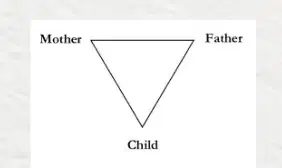
Look at the diagram showing a triangle with 'Mother', 'Father', and 'Child' at each point. Which concept does this diagram represent?
Differentiation of Self
Triangles
Family Projection Process
Emotional Cutoff
What is the Nuclear Family Emotional Process? Patterns of emotional functioning that ______ in families, often leading to stress and conflict.
repeat
disappear
weaken
improve

What is the Family Projection Process? Parents ______ their emotional concerns onto their children, affecting their self-perception.
transfer
ignore
hide
deny
What is the Multigenerational Transmission Process? The Multigenerational Transmission Process refers to emotional patterns and behaviors that are ________ through generations.
passed down
ignored
eliminated
forgotten
Which of the following is an example of the Multigenerational Transmission Process?
An adult child who avoids visiting their parents due to unresolved past conflicts.
A family with a history of conflict avoidance may continue this pattern across generations.
A person who enjoys spending time with friends.
A student who studies alone.
What is Emotional Cutoff? Emotional Cutoff occurs when family members reduce or ________ emotional contact to manage stress.
eliminate
increase
ignore
celebrate
Which of the following is an example of Emotional Cutoff?
A family with a history of conflict avoidance may continue this pattern across generations.
An adult child who avoids visiting their parents due to unresolved past conflicts.
A person who enjoys spending time with friends.
A student who studies alone.

According to Murray’s Eight Concepts, what does 'Sibling Position' influence in a family?
Economic status
Personality and family roles
Cultural values
Education level
According to Murray’s Eight Concepts, how do social and cultural influences shape family behavior?

Which of the following is an example of the Societal Emotional Process from Murray’s Eight Concepts?
The oldest child takes on leadership responsibilities
Economic hardship may cause stress that impacts family relationships
The youngest child is more carefree
The only child is independent
When we look at a family, it’s easy to focus only on what happens ______ their home.
inside
outside
above
beyond
Families are influenced by many ______ outside their doors—friends, schools, jobs, laws, even the economy.
factors
rooms
colors
animals
In social work, what is the term used to describe the idea that families are influenced by many systems?
Social perspective
Ecological perspective
Economic perspective
Family perspective
According to the passage, families are only influenced by what happens inside their home.
True
False
Today, we are going to explore the idea that families live inside many different systems that ______ who they are.
shape
ignore
destroy
forget
Why do social workers need to consider more than just what happens inside the family when helping families?

What outside ________ are families experiencing?
pressures
colors
seasons
vehicles

How are families affected by their neighborhoods, workplaces, schools, and culture?
These factors can influence the experiences and challenges that families face.
Families are not affected by any external factors.
Only workplaces have an impact on families, not neighborhoods or schools.
Culture has no influence on family experiences.

How has time and ________ shaped families' experiences?
history
weather
money
technology
Understanding ecological systems helps social workers ________ for families, build on their strengths, and support their growth.
advocate
compete
ignore
isolate
In the 1970s, who introduced the groundbreaking ecological systems theory that transformed the study of human development?
Urie Bronfenbrenner
Jean Piaget
Erik Erikson
Lev Vygotsky
What does Bronfenbrenner's ecological systems theory provide a framework for understanding?
How a person's development is shaped by their interactions with various environmental systems.
The genetic basis of human intelligence.
The stages of moral development in children.
The process of language acquisition in early childhood.
According to Bronfenbrenner's theory, development is shaped by interactions with which of the following?
Only the individual's thoughts
Various environmental systems
Only family members
Only school settings
Bronfenbrenner's theory focuses solely on the individual, ignoring the influence of surrounding environments.
True
False
Complete the quote from Bronfenbrenner's theory: "You cannot understand a child—or a family—without understanding (a) around them."

According to Bronfenbrenner, which system refers to the immediate environment that influences every person and family?
Microsystem
Exosystem
Macrosystem
Chronosystem

Which ecological system involves connections between environments?
(a)
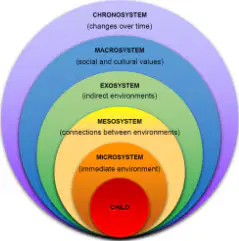
Which ecological system is described as involving indirect environments?
(a)

Which system is defined as the larger cultural and social context in Bronfenbrenner's model?
Macrosystem
Microsystem
Mesosystem
Exosystem

What does the chronosystem in Bronfenbrenner's ecological systems theory refer to?
Time and historical changes
Family relationships
Peer group influences
School environment
Each system in Bronfenbrenner's ecological model works together to shape how families function and survive.
True
False
How many ecological systems did Bronfenbrenner identify that influence every person and family?
Five
Three
Four
Six

What is the immediate environment in which an individual spends most of their time and engages in face-to-face interactions called?
Microsystem
Ecosystem
Macrosystem
Chronosystem

The microsystem is the environment the family directly interacts with every day.
True
False
Which of the following are included in the microsystem?
Teachers
All of the above
Family
Friends
Classmates

According to the information on Microsystem Examples, what is often the primary microsystem for an individual, especially in childhood?
School
Family
Community
Workplace
According to the Microsystem Examples, the quality of relationships within the family, such as parental support, ________, discipline, and communication, plays a critical role in shaping the individual's development.
affection
competition
neglect
indifference

According to the Microsystem Examples, school involves interactions with which of the following?
Neighbors and friends
Teachers, classmates, and other school staff
Family members
Community leaders
According to the Microsystem Examples, the school environment influences academic achievement, ________ skills, and behavioral development.
social
mechanical
culinary
athletic

What role do peer groups play in an individual's social development according to the Microsystem Examples?
Peer groups provide socialization opportunities and influence an individual's social development, behaviors, and attitudes.
Peer groups have no impact on an individual's social development or behavior.
Peer groups only affect academic performance, not social development.
Peer groups are only important during adulthood, not childhood.

According to the Microsystem Examples, what are the characteristics of a neighborhood that contribute positively to an individual's development?
Safe, supportive, and resource-rich neighborhoods contribute positively to an individual's development.
Noisy, crowded, and unsafe neighborhoods contribute positively to an individual's development.
Neglected, isolated, and resource-poor neighborhoods contribute positively to an individual's development.
Competitive, stressful, and unfriendly neighborhoods contribute positively to an individual's development.

According to the slide on Microsystem Examples, participation in sports teams, clubs, religious groups, and other activities forms part of the ________.
microsystem
exosystem
macrosystem
chronosystem

What do extracurricular activities provide according to the Microsystem Examples slide?
Opportunities for learning, skill development, and social interaction
Only physical exercise
Only religious education
Only academic knowledge
The mesosystem is made up of the _______ between parts of a family's microsystem.
relationships
boundaries
conflicts
distances
In other words, the mesosystem is about how the different parts of a person's life _______ with each other.
interact
ignore
separate
compete
Strong, healthy mesosystem connections often create a _______ network.
support
fragile
isolated
weak

Weak or negative mesosystem connections can create conflict for families.
True
False

What is an example of Family-School Interaction in the mesosystem?
Parent-teacher conferences, communication between parents and teachers, and parental involvement in school activities.
Children playing with their neighbors in the community park.
A child's genetic predisposition to certain behaviors.
The influence of mass media on a child's attitudes and beliefs.

How can positive interactions between family and school enhance a child's development?
They can enhance a child's educational experience and development.
They can limit a child's exposure to new ideas.
They can reduce a child's motivation to learn.
They can create confusion about learning goals.

What is an example of Family-Peer Group Interaction in the mesosystem?
Parents setting up playdates or getting to know their child's friends.
A teacher assigning homework to students.
A child watching television alone at home.
A parent attending a work meeting.

Family-Peer Group Interaction can impact a child's social development.
True
False

What is the connection between a school and the surrounding community, such as partnerships with local businesses, community programs, or extracurricular activities, called?
School-Community Interaction
School-Internal Affairs
Student-Teacher Relationship
Classroom Management
Mesosystem Examples: Interactions between a student's peer group and school environment, such as friendships formed at school, group projects, and participation in school clubs or teams, contribute to social and ________ development.
academic
physical
technological
nutritional
What does the exosystem consist of?
The exosystem consists of social settings and institutions that an individual does not directly interact with but which have a significant impact on their immediate environments (microsystems).
The exosystem consists of the immediate relationships and activities that an individual directly participates in, such as family and school.
The exosystem consists of the cultural values, laws, and customs that shape society as a whole.
The exosystem consists of the biological and physical environment surrounding the individual, such as climate and geography.
The exosystem directly influences the individual's development.
True
False
How do exosystem settings influence an individual's development?
Families may not even ______ how much these forces shape their lives.
realize
forget
ignore
predict
What does the exosystem teach us about indirect experiences?

According to the information on Exosystem Examples, how can a parent's job impact a child's development?
It can affect the parent's availability and emotional state, influencing the child's home environment and emotional well-being.
It has no effect on the child's development.
It only affects the parent's income.
It only affects the child's education.
Based on the Exosystem Examples, what is one way community services can impact an individual?
By providing support and resources to their family and community.
By increasing their job stress.
By reducing their availability.
By affecting only their education.

What is an example of mass media that can indirectly shape an individual's attitudes, beliefs, and behaviors?
Television
Social media
Internet
All of the above

Social networks and support systems of family members, such as friends, extended family, and colleagues, can influence the individual.
True
False
A parent's social support can affect their _______ practices and the overall family environment.
parenting
eating
sleeping
shopping

According to the example of exosystem influences, what are some areas that government policies can affect?
Educational systems, healthcare availability, and community safety.
Personal hobbies, favorite colors, and music preferences.
Individual dreams, private thoughts, and emotions.
Pet ownership, fashion trends, and movie releases.

Policies and decisions made at the local, state, or national level can affect which of the following?
Educational systems
Healthcare availability
Community safety
All of the above
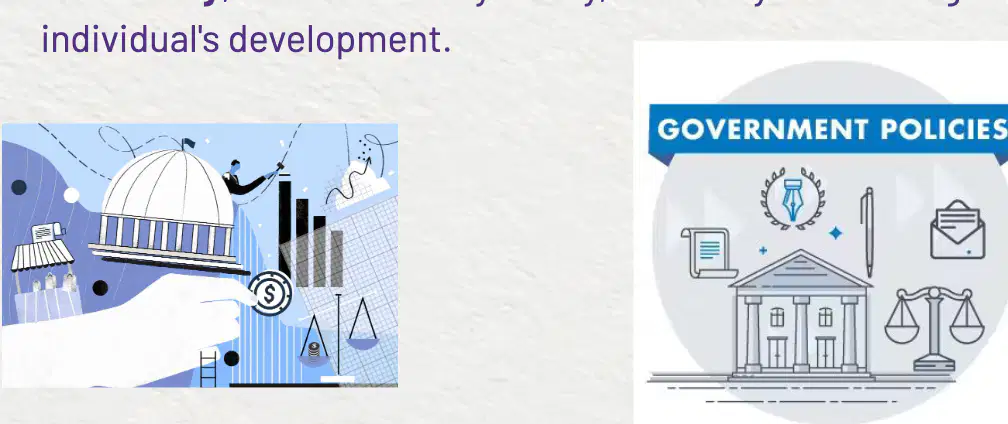
How do government policies indirectly influence an individual's development according to the exosystem example?
By directly controlling individual behavior
Through their impact on institutions that affect the individual
By personal interactions with the individual
By genetic inheritance
What is the macrosystem?
The innermost layer of society
The outermost layer of society that includes cultural values, customs, societal norms, political systems, and laws
The immediate family environment
The school system
Macrosystems shape what is considered ________, "acceptable," or "important" in a society.
normal
unique
temporary
unusual
Families only live in houses, not inside beliefs, traditions, and laws.
True
False
Which of the following is NOT included in the macrosystem?
Cultural values
Societal norms
Political systems
Personal hobbies
The macrosystem is the ________ layer that includes cultural values, customs, societal norms, political systems, and laws.
innermost
outermost
middle
smallest
What are cultural values and beliefs? The dominant cultural values, beliefs, and ideologies of a society shape how individuals perceive the world and interact with it.
The dominant cultural values, beliefs, and ideologies of a society shape how individuals perceive the world and interact with it.
The dominant cultural values, beliefs, and ideologies of a society have no impact on how individuals perceive the world and interact with it.
The dominant cultural values, beliefs, and ideologies of a society only affect government policies, not individual perceptions.
The dominant cultural values, beliefs, and ideologies of a society are unrelated to how individuals interact with the world wrongs
Which of the following is included in cultural values and beliefs?
Attitudes towards education, work, family, and gender roles
Weather patterns
Economic policies
None of the above
What are societal norms? Societal norms and expectations guide behavior and set _______ for what is considered acceptable within a culture.
standards
punishments
rewards
punctuality
Societal norms influence everything from child-rearing practices to social interactions.
True
False

What are the economic conditions of a society, such as wealth distribution, employment rates, and economic policies, collectively known as?
Economic Systems
Social Hierarchies
Political Structures
Cultural Norms

Laws, regulations, and political ideologies that influence education, healthcare, and civil rights are part of which type of macrosystem?
Legal & Political Systems
Economic Systems
Technological Systems
Cultural Systems
What are cultural customs?
Traditions, rituals, and practices passed down through generations that shape socialization and cultural identity
Scientific experiments
Modern technology trends
Economic policies
Cultural customs are passed down through ________ and play a role in shaping the socialization process and the development of cultural identity.
generations
governments
technologies
currencies

These images represent cultural customs by:
Showing traditional clothing and activities
Displaying modern technology
Depicting natural landscapes
Illustrating scientific experiments
The chronosystem refers to how ______ and major life transitions impact families.
time
culture
location
education
Which of the following does the chronosystem include?
Only personal life events
Only historical moments
Both personal life events and historical moments
Neither personal nor historical events

Families evolve and adapt over time. Change is constant!
True
False

Which of the following is NOT an example of a life transition mentioned as part of the chronosystem?
Starting school
Graduating
Buying a car
Retiring

