wayground logo

Free Printable Worksheets

Font size

S
M
L
XL
Worksheets

7th grade pre school

Total questions: 100

Worksheet time: 1hrs 26mins

Name
Class
Date
1.
Element or Compound?
H2O
a)
Element
b)
Compound
2.
Which statement best describes an element?
a)
made from mixture 
b)
thousands in the world
c)
pure, made of only one atom
d)
can be separated 
3.

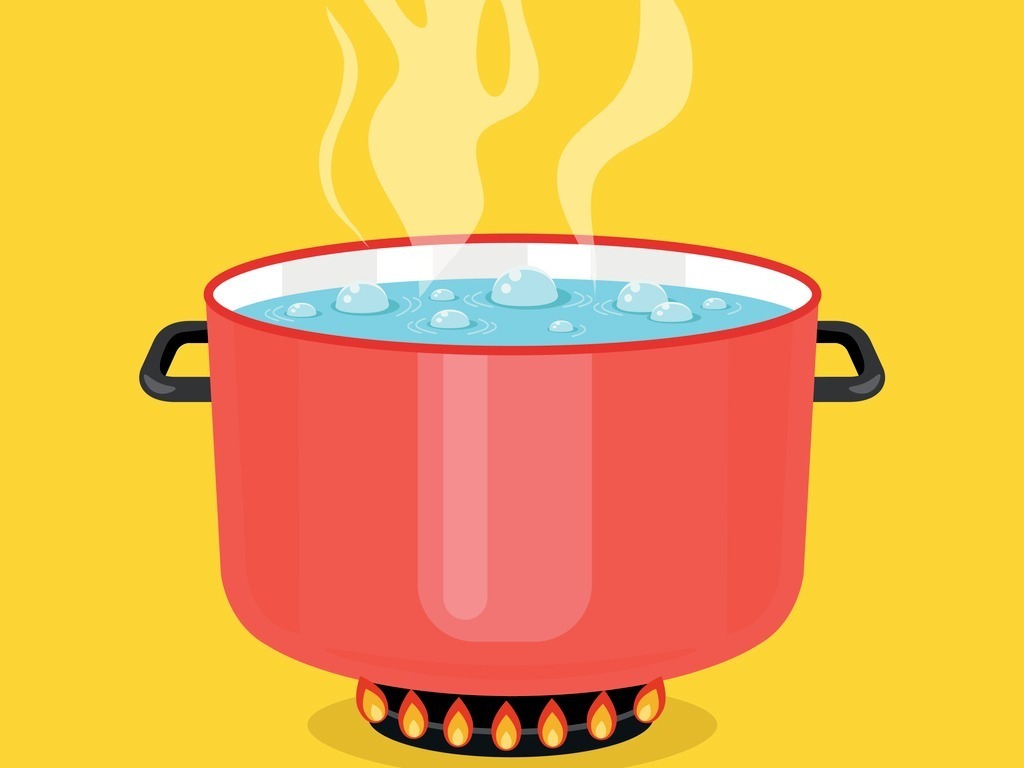
What is happening at the boiling point?

a)

liquid to gas

b)

solid to liquid

c)

gas to liquid

d)

liquid to solid

4.

The state of matter where particles are very spread out and moving quickly.

a)

gas

b)

liquid

c)

solid

d)

Helium

5.

Molecules in a solid look like:

a)
b)
c)
d)
6.

What do gases and liquids have in common?

a)

Both have definite shape

b)

Both take the shape of its container

c)

Both have definite volume

d)

Both do not have definite volume

7.

What do liquids and solids have in common?

a)

Both have definite volume

b)

Both have definite shape

c)

Both take the shape of its container

d)

Both can be compressed

8.

A hypothesis is...

a)

an educated guess

b)

data collected using your senses

c)

observation based on numbers

9.

The flowers are green and blue.

a)

Qualitative Observation

b)

Quantitative Observation

c)

Inference

d)

Hypothesis

10.

What is a change in which a new substance is NOT formed?

a)

physical change

b)

chemical change

c)

color change

d)

physical property

11.
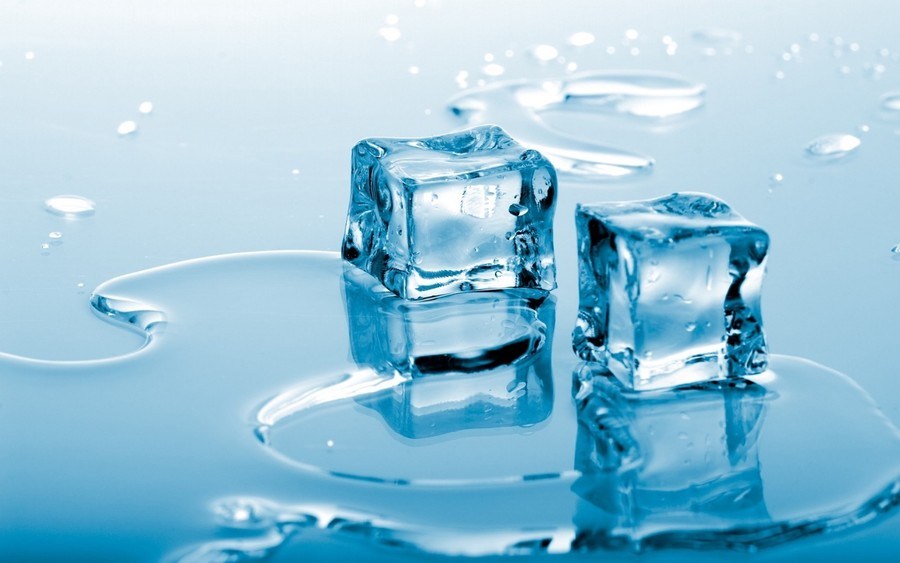
Water freezing into ice is an example of a...
a)
Physical Change
b)
Chemical Change
12.
Physical or Chemical Change?  Iron rusts
a)
Physical Change
b)
Chemical Change
13.

A scientific observation is:

a)

Based on facts

b)

based on your personal beliefs

c)

Based on opinions

d)

Based on a rumor you heard in the bathroom

14.

Condensation

a)

A gas changes into a liquid

b)

A liquid changes into a gas

c)

A solid changes into a liquid

d)

A liquid changes into a solid

15.

How do you know that rusting is a chemical change?

a)

it changes color

b)

atoms were rearranged to form a new substance

c)

we just know

d)

the rust

16.

Atoms consist of parts called protons, neutrons, and___________________.

a)

electrons

b)

haptons

c)

neptons

d)

wontons

17.

Each electron has a ________________ electrical charge.

a)

positive

b)

neutral

c)

negative

d)

shocking

18.

Each proton has a ______________ electrical charge.

a)

positive

b)

negative

c)

neutral

d)

shocking

19.

Each neutron has an electrically _________________ charge.

a)

positive

b)

negative

c)

neutral

d)

shocking

20.

What two words should be in your hypothesis?

a)

I think

b)

If ...then...

c)

It will

d)

No idea

21.

Choose the correctly written hypothesis for "What is the effect of putting Pam Cooking Spray on the bottom of a sled?"

a)

I think the sled will slide faster.

b)

If I put Pam Cooking Spray on the bottom of my sled, then I will win the race."

c)

If I put Pam Cooking Spray on the bottom of my sled, then I will slide faster.

22.
This part of the experiment serves as a basis of comparison; the one variable being tested has been omitted. 
a)
experimental group
b)
control group
c)
data
d)
variables
23.
Liquids are described as having a 
a)
definite shape and indefinite volume
b)
indefinite shape and indefinite volume
c)
definite shape and definite volume
d)
indefinite shape and definite volume
24.

Which point has the most potential energy?

a)

G

b)

F

c)

B

d)

A

25.

Potential energy depends on ______ and _______.

a)

height, mass

b)

weight, mass

c)

speed, mass

d)

height, speed

26.
How do molecules at warm temperatures differ from molecules at cool temperatures? 
a)
a.  At warm temperatures, molecules move around more
b)
b.  At warm temperatures, molecules grow in siz
c)
c.  At warm temperatures, molecules exchange electrons more easil
d)
d.  At warm temperatures, molecules combine with each other more easil
27.

If thermal energy is increasing, what is happening to the kinetic energy.

a)

Kinetic energy would be decreasing

b)

Kinetic energy would stay the same

c)

Kinetic energy would be increasing

28.

A group of friends gather around a fire to stay warm. This is an example of ________.

a)

conduction

b)

convection

c)

radiation

29.

Why do we use this device

a)

To measure volume of irregular objects

b)

To measure mass of irregular objects

c)

to measure volume of regular objects

d)

to measure....... I don't know

30.
What is the volume of Object X?
a)
10.0 cm3
b)
15.0 cm3
c)
20.0 cm3
d)
25.0 cm3
31.

Which of the following is NOT an example of chemical change?

a)

sour milk

b)

burning wood

c)

breaking a pencil

d)

rust

32.

What is atomic number ?

a)

Number of Protons

b)

Number of Electrons

c)

Number of Protons and Electrons

d)

Number of Protons and Neutrons

33.

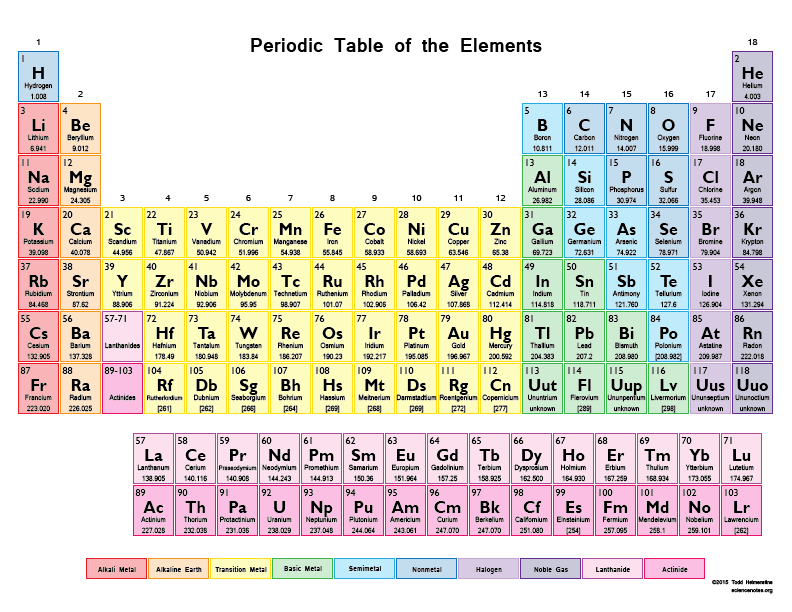
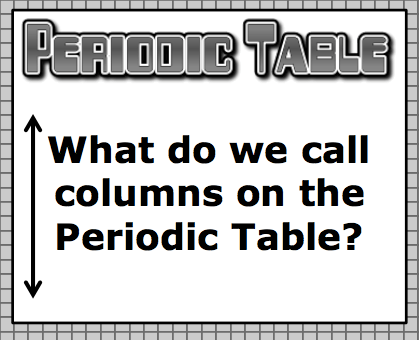
What is the atomic number of Barium, Ba? (enlarge the periodic table)

a)

20

b)

38

c)

56

d)

88

34.
Which of these is not a noble gas?
a)
Helium
b)
Argon
c)
Nitrogen
d)
Krypton
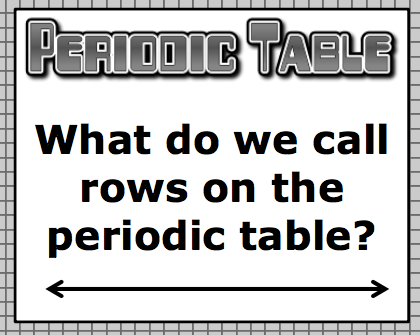
35.
a)
Periods
b)
Groups
36.
a)
Periods
b)
Groups
37.

Fossil fuels were formed from ____.

a)

the remains of once living organisms.

b)

the earth.

c)

solids, liquids, and gases, made millions of years ago.

d)

sun and water.

38.
Fossil fuels are classified as nonrenewable because they.......
a)
require expensive equipment
b)
take millions of years to replace
c)
can be found all over 
d)
provide all the energy we use
39.
As you approach the center of the earth what happens to the temperature, pressure , and density.
a)
They all increase
b)
They all decrease
c)
They remain the same
d)
They disappear
40.
The image illustrates what type of boundary?
a)
Divergent
b)
Convergent
c)
Transform
d)
Emergent
41.

The arrows in the asthenosphere represent

a)

Conduction

b)

Radiation

c)

Convection

42.

What process is represented by the oceanic crust sinking below the continental crust

a)

Subduction

b)

Translocation

c)

Submission

43.

What is represented in picture that is often associated with earthquakes on the ocean floor?

a)

Storm Surge

b)

High Tide

c)

Tsunami

44.
Air pressure is usually highest when the air is
a)
cool and humid
b)
cool and dry
c)
warm and humid
d)
warm and dry
45.
The weather characteristics of air masses result primarily from their
a)
geographic origin
b)
size and shape
c)
rate of movement
d)
direction of movement
46.
Which type of air mass most likely has high humidity and high temperature?
a)
cP
b)
cT
c)
mT
d)
mP
47.
An air mass entering Alaska from the northern Pacific Ocean would most likely be labeled on a weather map as
a)
cP
b)
cT
c)
mP
d)
mT
48.
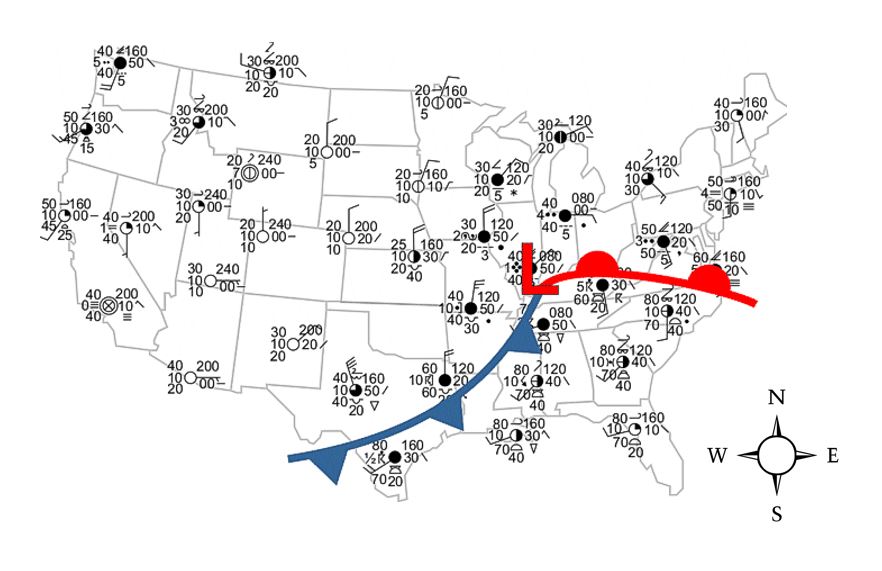
What type of storm front is this?
a)
Warm Front
b)
Cold Front
c)
Occluded Front
d)
Stationary Front
49.
What type of storm front if this?
a)
Warm Front
b)
Cold Front
c)
Stationary Front
d)
Occluded Front
50.
What direction is the warm front moving on the map? 
a)
North
b)
South
c)
East
d)
West
51.
When two different air masses collide...
a)
A front forms
b)
They casually become one
c)
A new planet evolves
d)
Dinosaurs become extinct
52.
Jet stream winds over the United States generally move from
a)
east to west
b)
north to south 
c)
west to east
d)
south to north 
53.
An air mass classified as mP usually forms over which type of Earth surface? 

a)
warm land
b)
warm ocean
c)
cool land
d)
cool ocean
54.
Which front will most likely pass over location A during the next two hours? 
a)
warm
b)
stationary
c)
occluded
d)
cold
55.

How long does it take Earth to make one complete rotation? Select ALL answers that are correct.

a)

24 hours

b)

One year

c)

One hour

d)

One day

56.

From the Earth Sun will always looks like moving from ....

a)

North to South

b)

South to North

c)

East to West

d)

West to East

57.

Based on the diagram, which season would the northern hemisphere be experiencing?

a)

Winter

b)

Spring

c)

Summer

d)

Fall

58.
Which season has the least amount of daylight in the Northern Hemisphere?
a)
Winter
b)
Spring
c)
Summer 
d)
Fall
59.

Which date is represented by the following diagram?

a)

Dec 21

b)

Mar 21

c)

Jun 21

d)

Sep 23

60.
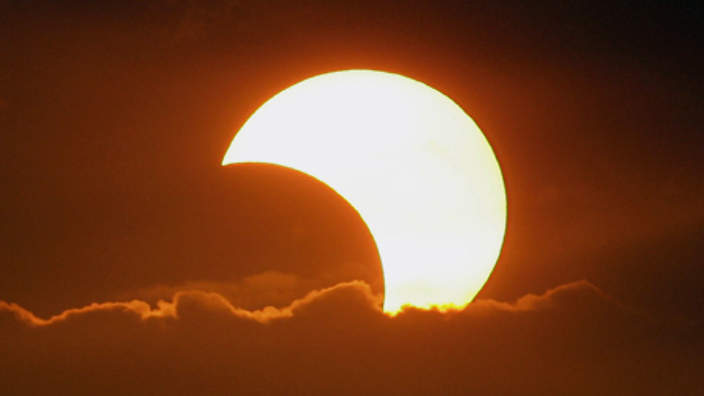
A solar eclipse only happens during a ________ moon.
a)
New
b)
Cresent
c)
Gibbous
d)
Full
61.
a)
solar eclipse
b)
lunar eclipse
62.
This image is an example of
a)
Lunar Eclipse
b)
Full Moon
c)
New Moon
d)
Solar Eclipse
63.
What is the center of our solar system?
a)
moon
b)
earth
c)
sun
d)
Jupiter
64.
What is the definition of orbit?
a)
the spinning of the earth on its axis
b)
when the lit part of the moon increases
c)
all of the planets, moon, and other space objects going around the sun
d)
the imaginary line that goes through the north and south poles that the earth spins on
65.

What factor causes one planet to have more gravity than other planets

a)

The planets mass

b)

The planets size

c)

Terrestrial planets have more gravity

d)

Gas giants have more gravity

66.

Galaxies are:

a)

gropus of Asteroids

b)

Groups of planets

c)

Groups of stars, gas and dust.

d)

Group of satellites

67.

The diagram shows an example of____?

a)

muscular system

b)

water system

c)

solar system

d)

skeletal system

68.
Identify C
a)
Crust
b)
Mantle
c)
Outer Core
d)
Inner Core
69.

(_______________)- Water (oceans, lakes, rivers, groundwater, glaciers)

a)

Geosphere

b)

Hydrosphere

c)

Atmosphere

d)

Biosphere

70.

A mineral's color when it is ground into powder.

a)

Structure

b)

Texture

c)

Luster

d)

Hardness

e)

Streak

71.

A measure of how easily a mineral can be scratched.

a)

Structure

b)

Texture

c)

Luster

d)

Hardness

e)

Streak

72.

Which mineral could Fluorite scratch?

a)

Diamond

b)

Calcite

c)

Quartz

d)

Apatite

73.
What mineral is used for pencils?
a)
Graphite
b)
Galena
c)
Magnetite
d)
Quartz
74.

The Earth's seasons are caused by the _____ of the Earth on its axis

a)

tilt

b)

revolution

c)

equinox

75.

Which phenomenon does the Moon affect on Earth?

a)

The seasons

b)

Tree growth

c)

Mountain erosion

d)

The tides

76.

What causes the moon to shine?

a)

The sun

b)

Its red-hot surface

c)

Pixie dust

d)

Electricity

77.

During the phases of the Moon, the Moon appears to change shape. This change in appearance is due to the moon…

a)

Physically changing size and shape

b)

Moving closer and then farther away from Earth

c)

Reflecting a different amount of light due to the position with Earth and the Sun.

d)

Having craters on its surface

78.
A severe storm that involves strong winds and forms over warm water is:
a)
tornado
b)
thunderstorm
c)
hurricane
d)
blizzard
79.
This severe weather involves lightning, rain, and forms from a cumulonimbus cloud.
a)
thunderstorm
b)
tornado
c)
hurricane
d)
blizzard
80.
Which weather tool measures air pressure?
a)
thermometer
b)
barometer
c)
anemometer
d)
psychrometer
81.
________________ are made of water vapor that condenses in the troposphere.
a)
dew
b)
clouds
c)
evaporation
d)
transpiration
82.
Warm air near the Earth’s surface rises and then cools and drops, this creates a _________________ in the atmosphere.
a)
run-off
b)
Greenhouse Effect
c)
convection current
d)
water cylce
83.
Where does a hurricane form?
a)
Over a cold body of water
b)
Over a warm body of water
c)
Over cold land
d)
Over warm land
84.
What kind of weather is usually associated with a low pressure system?
a)
Sunny weather
b)
Precipitation (rain, snow, etc.)
85.
What kind of weather is usually associated with a high pressure system?
a)
Sunny weather
b)
Precipitation (rain, snow, etc.)
86.
In what direction do winds always blow?
a)
From areas of high pressure to areas of low pressure
b)
From areas of low pressure to areas of high pressure
87.
What layer does weather occur in?
a)
mesosphere
b)
troposphere
c)
thermosphere
d)
stratosphere
88.
The blanket of gases that surrounds the Earth
a)
Lithosphere
b)
Atmosphere
c)
Hydrosphere
d)
Green House Effect
89.

What does this symbol represent?

a)

Cold Front

b)

Warm Front

c)

Stationary Front

d)

Occluded Front

90.

What does this symbol represent?

a)

Cold Front

b)

Warm Front

c)

Stationary Front

d)

Occluded Front

91.
Why do we always see the same side of the Moon? 
a)
The Moon's period of rotation is longer than its period of revolution around Earth.
b)
The Moon's period of rotation is shorter than its period of revolution around Earth.
c)
The Moon's period of rotation is the same as its period of revolution around Earth.
d)
The Moon does not rotate as it completes one revolution around Earth.
92.
State the relationship
a)
As the stretch distance increases, the amount of forces increases.
b)
As the stretch distance increases, the amount of force decreases.
c)
There is no relationship.
d)
There is an indirect relationship.
93.

For the following hypothesis, what is being MEASURED?

IF Plant A receives fertilizer, THEN it will grow larger than Plant B.

a)

plants

b)

fertilizer

c)

plant growth

d)

amount of soil

94.

For the following hypothesis, what is being TESTED?

IF Plant A receives fertilizer, THEN it will grow larger than Plant B.

a)

plants

b)

fertilizer

c)

plant growth

d)

amount of soil

95.

A possible explanation for why something happens is called ___.

a)

a variable

b)

an experiment

c)

a hypothesis

d)

an assumption

96.

The diagram represents a model of Earth’s surface and internal structure. Letters A, B, C, and D represent four different layers. Some depths below Earth’s surface are shown. Which Earth layer is inferred to be composed of solid nickel and iron?

a)

A

b)

B

c)

C

d)

D

97.
Compared to oceanic crust, continental crust is generally
a)
older and thinner
b)
older and thicker
c)
younger and thinner
d)
younger and thicker
98.
The movement of tectonic plates is inferred by many scientists to be driven by
a)
tidal motions in the hydrosphere
b)
density differences in the troposphere
c)
convection currents in the asthenosphere
d)
solidification in the lithosphere
99.

Why are chemical equations always balanced? Select ALL that apply.

a)

Matter cannot be created.

b)

Matter cannot be destroyed.

c)

Matter can only be rearranged/conserved.

d)

Matter doesn't matter.

100.

Which of the following is a common sign that a chemical change has occurred?

a)

A chemical has turned a different color, bubbled, and/or changed temperature.

b)

A chemical has changed to a different state of matter, such as a liquid to a solid.

c)

A chemical has changed size.

d)

A chemical has become a different shape.