
 Worksheets
Part 107 Weather Review
Total questions: 100
Worksheet time: 50mins
Which of the following is NOT a factor that can greatly influence sUAS performance and risk management?
Atmospheric pressure and stability
Wind and currents
Type of sUAS battery used
Precipitation
What is the major source of all weather?
The moon
The sun
The ocean
The Earth's core
Why does less atmospheric heating take place at the poles compared to the equator?
The sun is farther from the poles
Sunrays are more concentrated at the poles
Sunrays are less concentrated over a larger area at the poles
The poles have more vegetation
Which of the following surfaces is most likely to result in updrafts due to radiating a large amount of heat?
Water
Trees
Plowed ground
Grass
How can wind and currents affect sUAS performance during flight?
They have no effect on sUAS performance
They can affect performance and maneuverability in all phases of flight
They only affect performance during takeoff
They only affect performance during landing
What is a potential danger of obstructions on the ground with respect to wind?
They always block the wind completely
They can create rapidly changing wind speed and direction
They have no effect on wind
They make wind predictable
Why do convective currents pose a risk to remote PICs operating sUAS at low altitudes?
They make the air colder
They can cause turbulent air that affects control of the aircraft
They improve visibility
They reduce precipitation
What effect can high winds have on maintaining a geographical position in flight for an unmanned aircraft?
They make it easier to maintain position.
They may make it difficult to maintain position and consume more battery power.
They have no effect on flight.
They always improve aircraft control.
When operating close to a building, what can winds blowing against the building cause?
Downdrafts that sink the aircraft.
Updrafts that can result in ballooning or loss of positive control.
No effect on the aircraft.
Only turbulence with no change in altitude.
What happens to the wind as it flows down the leeward side of a mountain?
It becomes less turbulent and slows down.
It follows the contour of the terrain and becomes increasingly turbulent.
It stops completely.
It always creates updrafts.
What is a front in meteorological terms?
The area of highest temperature in a region.
The division line where an air mass with different properties advances upon a dissimilar air mass.
The center of a high-pressure system.
The lowest point in a valley.
Which of the following best describes a cold front?
The leading edge of an advancing warm air mass.
The leading edge of an advancing cold air mass, often accompanied by poor weather ahead of the front.
An area of high pressure.
The center of a cyclone.
Why should remote pilots be aware of terrain/object wind effects?
Because wind effects only occur at high altitudes.
Because wind effects can exist for some distance downwind of the actual terrain or object.
Because wind effects are always beneficial for flight.
Because wind effects are only present in valleys.
How do warm fronts typically move compared to cold fronts?
Warm fronts move faster than cold fronts.
Warm fronts move about half as fast as cold fronts.
Warm fronts and cold fronts move at the same speed.
Warm fronts do not move.
What is a ridge in meteorological terms?
An elongated area of low pressure.
An elongated area of high pressure.
The leading edge of a cold front.
The center of a cyclone.
What is air mass modification?
When an air mass remains unchanged as it moves.
When an air mass takes on the properties of a new underlying surface as it moves from its source region.
When a front becomes stationary.
When a cyclone forms.
What weather conditions are often associated with cold fronts?
Clear skies and calm winds.
Poor weather ahead of the front, wind shift, increased wind speeds, and sometimes thunderstorms, hail, and tornadoes.
Only light rain.
High temperatures and humidity.
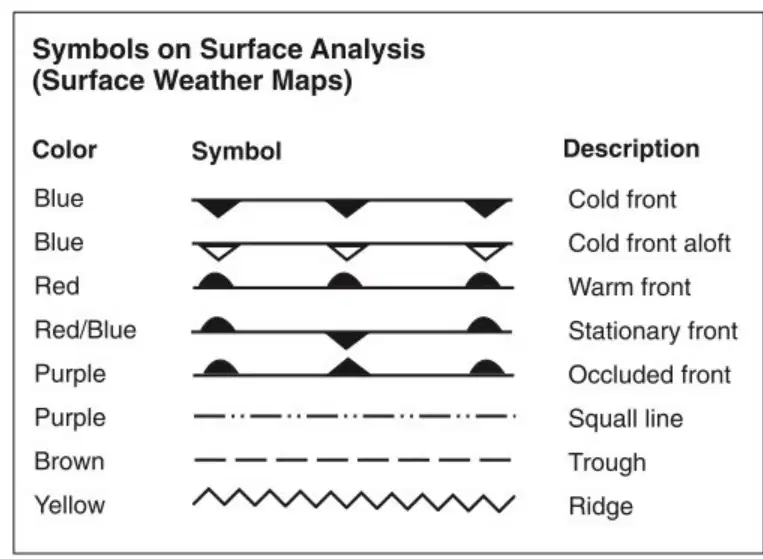
Which color and symbol combination on a surface weather map represents a warm front?
Blue with triangles
Blue with lines and triangles
Red with semicircles
Purple with alternating triangles and semicircles
What is the most easily recognizable discontinuity indicating the passage of a frontal boundary?
A shift in wind direction
A temperature change
A decrease in humidity
An increase in cloud cover
Which of the following best defines atmospheric stability?
The ability of the atmosphere to resist any upward or downward movement
The temperature at the surface of the Earth
The amount of precipitation in the atmosphere
The speed of the wind at high altitudes
What type of clouds and weather are typically associated with a stable air mass forced aloft?
Cumulus clouds, turbulence, and showery precipitation
Stratus clouds, calm air, steady precipitation, and poor visibility
Cirrus clouds and clear skies
Thunderstorms and high winds
Why is it important to determine the stability of the atmosphere for sUAS (small Unmanned Aircraft Systems) operations?
It affects the color of the sky
It determines the amount of sunlight
It impacts the local air mass stability, which can affect flight conditions
It changes the type of precipitation
A student observes a continuous decrease in pressure followed by an increase as a front passes. What does this indicate?
The presence of a ridge
The passage of a frontal boundary
The formation of a squall line
The development of a trough
If the ambient temperature lapse rate is much less than the dry adiabatic lapse rate, what can be inferred about the atmospheric stability?
The atmosphere is unstable
The atmosphere is stable
There is no effect on stability
The atmosphere is saturated
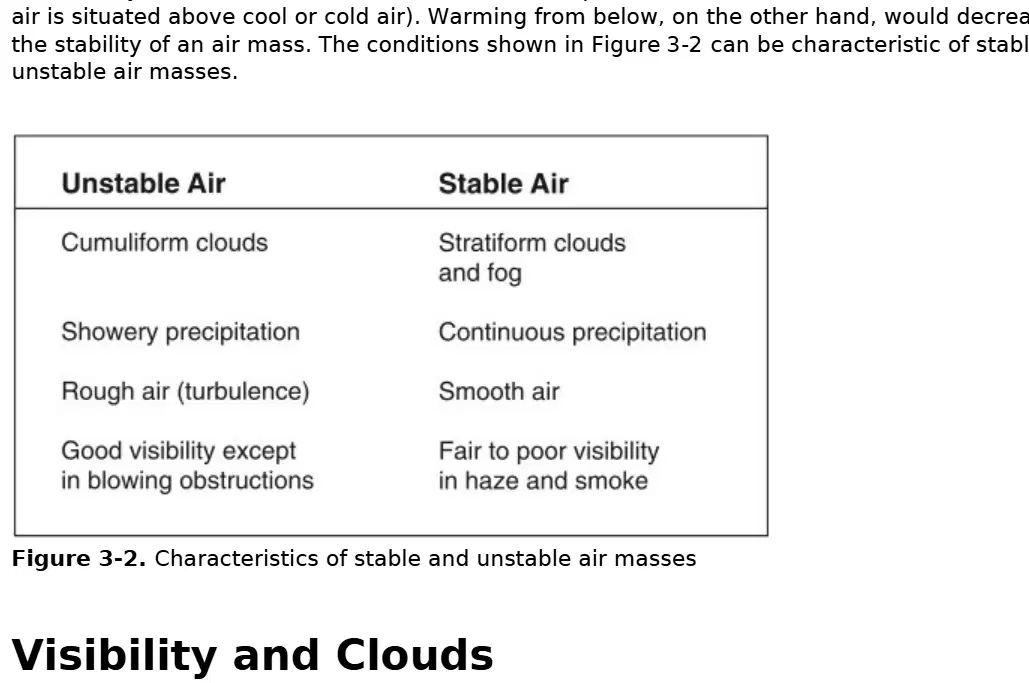
Which of the following is a characteristic of stable air?
Cumuliform clouds
Showery precipitation
Rough air (turbulence)
Stratiform clouds and fog
What is the minimum visibility required from the control station for a remote PIC to operate a small unmanned aircraft system (sUAS)?
1 statute mile (SM)
2 statute miles (SM)
3 statute miles (SM)
5 statute miles (SM)
According to the text, what should a remote PIC do if there is more than one local aviation reporting station near the operating area?
Choose the station with the highest visibility reading
Choose the closest station to the operating area
Choose the station most representative of the terrain surrounding the operating area
Ignore all stations and estimate visibility visually
Which of the following best describes the difference between stable and unstable air in terms of precipitation?
Stable air has showery precipitation, unstable air has continuous precipitation
Stable air has continuous precipitation, unstable air has showery precipitation
Both have the same type of precipitation
Stable air has no precipitation, unstable air has heavy precipitation
A remote pilot is preparing for flight and observes that a known point 3 SM away is visible. What does this indicate about the operational altitude available for use?
The operational altitude is limited to 100 feet AGL
The operational altitude is limited to 200 feet AGL
The operational altitude is at least 1,000 feet AGL if clouds are above the top
The operational altitude is not affected by visibility
Why is it important for the sUA not to be operated above any cloud?
It increases the risk of turbulence
It reduces the visibility between the sUA and the remote PIC
It causes continuous precipitation
It is required for fuel efficiency
Which of the following is NOT one of the three conditions necessary for the formation of a thunderstorm?
Sufficient water vapor
An unstable lapse rate
High atmospheric pressure
An initial lifting force (upward boost)
What are the three stages of a thunderstorm?
Cumulus, mature, dissipating
Stratus, cumulus, cirrus
Mature, declining, stable
Updraft, downdraft, virga
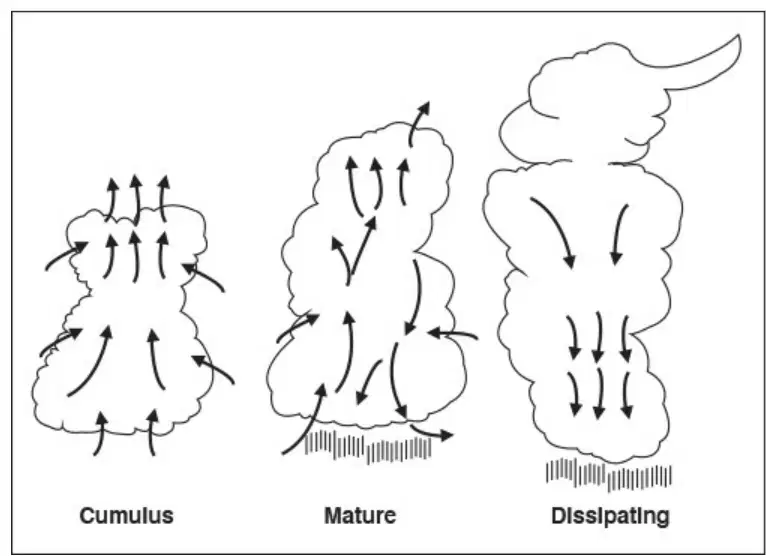
Which stage of a thunderstorm is characterized predominantly by downdrafts?
Cumulus stage
Mature stage
Dissipating stage
Virga stage
What is virga, as described in the context of thunderstorms?
Lightning that never reaches the ground
Precipitation that evaporates before reaching the ground
A type of cloud associated with thunderstorms
The initial lifting force in a thunderstorm
How can you estimate the distance to a thunderstorm using lightning and thunder?
Count the number of lightning flashes in one minute
Divide the number of thunderclaps by 10
Count the seconds between seeing lightning and hearing thunder, then divide by 5
Multiply the number of seconds between lightning and thunder by 2
Why might the method of counting seconds between lightning and thunder not be feasible during some storms?
The storm is too far away
There is frequent lightning or multiple storms
The thunder is too quiet to hear
The sky is too cloudy to see lightning
During which stage of a thunderstorm do updrafts and downdrafts both occur inside the cloud?
Cumulus stage
Mature stage
Dissipating stage
Virga stage
What is a good indicator of the severity of a thunderstorm?
The color of the clouds
The frequency of lightning
The amount of rain
The temperature drop
What is hail formed by inside thunderstorms?
The constant freezing, melting, and refreezing of water as it is carried about by the up- and downdrafts.
The condensation of water vapor at high altitudes.
The rapid cooling of rain as it falls to the ground.
The collision of ice crystals with dust particles.
Which type of thunderstorms generally produce the most intense hazard to aircraft?
Squall-line thunderstorms
Warm-front thunderstorms
Isolated thunderstorms
Coastal thunderstorms
What is a microburst?
A small-scale intense downdraft that spreads outward from the center in all directions near the ground.
A sudden increase in temperature during a thunderstorm.
A type of hail formation inside a thunderstorm.
A rotating column of air extending from a thunderstorm to the ground.
What is the main hazard associated with tornadoes for remote pilots?
The strong winds and debris generated by the vortex.
The increase in temperature at higher altitudes.
The formation of hail outside the storm center.
The accumulation of ice on the aircraft.
Which of the following is NOT an effect of structural icing on an sUAS?
Lift increases
Lift decreases
Thrust decreases
Drag increases
Why should remote pilots exercise extreme caution when operating in conditions that may generate thunderstorms?
Phenomena like hail, lightning, windshear, and microbursts can occur far from the storm center.
Thunderstorms only affect the immediate area below the clouds.
Only visible rain is dangerous to aircraft.
Thunderstorms never produce strong winds.
What is the necessary condition for structural icing to form on an aircraft?
Visible moisture and temperature below freezing
High altitude and clear skies
Warm temperatures and dry air
Strong winds and no precipitation
How long do the maximum intensity winds of a microburst typically last?
Approximately 2–4 minutes
More than 30 minutes
Less than 1 minute
About 20 minutes
What happens to the weight and stalling speed of a fixed-wing aircraft when structural icing occurs?
Both increase
Both decrease
Weight increases, stalling speed decreases
Weight decreases, stalling speed increases
What is fog primarily composed of?
Water droplets or ice crystals
Dust particles
Carbon dioxide gas
Pollen grains
Which type of fog forms when terrestrial radiation cools the ground, cooling the air in contact with it?
Advection fog
Radiation fog
Steam fog
Upslope fog
What is the main factor that makes fog prevalent in industrial areas?
High wind speeds
Abundance of condensation nuclei from combustion products
Low temperatures only
High humidity only
Which type of fog is most commonly associated with frontal activity and forms from drizzle or rain falling through cooler air?
Upslope fog
Steam fog
Precipitation-induced fog
Radiation fog
Why should remote pilots be cautious when conditions are conducive to the formation of fog?
Fog can increase aircraft speed
Fog can reduce visibility below the 3 SM minimum
Fog can improve communication signals
Fog can increase battery life
What is density altitude?
The altitude at which fog forms
The altitude corrected for non-standard temperature and pressure
The altitude above sea level
The altitude at which ice forms
How does a change in temperature and/or pressure from standard conditions affect sUAS performance?
It does not affect performance
It changes the air density, which affects performance
It only affects battery life
It only affects visibility
A remote pilot observes ice pellets at the surface. What does this indicate about the weather at a higher altitude?
There is freezing rain at a higher altitude
The temperature is above freezing at all altitudes
There is no precipitation at higher altitudes
There is only snow at higher altitudes
Which type of fog forms when warm, moist air moves over a colder ground or water surface?
Radiation fog
Advection fog
Steam fog
Upslope fog
What should a remote pilot do if it appears that ice is accumulating on the sUAS?
Continue flying as normal
Increase altitude
Recover the sUAS immediately to avoid loss of control
Decrease speed
What is the main purpose of obtaining a weather briefing before a flight as a remote PIC?
To ensure the remote PIC is aware of current and forecasted weather conditions
To check the aircraft's maintenance schedule
To review the flight path for obstacles
To confirm the identity of the remote PIC
Which website provides free, web-based aviation weather services without requiring registration?
NWS Aviation Weather Center (AWC) at aviationweather.gov
FAA.gov
NOAA.gov
weather.com
What does the abbreviation METAR stand for?
Aviation routine weather reports
Meteorological altitude readings
Mechanical error tracking and reporting
Monthly environmental temperature and rainfall
Which system is the primary surface weather observing system of the U.S.?
Automated Surface Observing System (ASOS)
Global Positioning System (GPS)
Automated Weather Observing System (AWOS)
Remote Piloted Aircraft System (RPAS)
What does the prefix "AUTO" in AWOS observations indicate?
The data is derived from an automated system
The report is for automobile weather only
The observation is made by a human
The data is outdated
Why should remote pilots familiarize themselves with abbreviations and symbols in weather reports?
To interpret weather information properly
To improve their flying skills
To reduce aircraft maintenance costs
To avoid air traffic control communication
For aviation purposes, what is considered the ceiling in weather reports?
The lowest broken or overcast layer, or vertical visibility into an obscuration
The highest cloud layer
The temperature at ground level
The altitude of the aircraft
What does the acronym TAF stand for in aviation weather reporting?
Terminal Aerodrome Forecast
Total Aviation Forecast
Technical Aeronautical Form
Terminal Altitude Forecast
Which of the following is NOT typically included in a surface aviation weather observation?
Runway visual range (RVR)
Type of report
Aircraft registration number
Temperature/dew point
What is the main purpose of automated weather sources like AWOS and ASOS?
To provide continuous up-to-date weather information
To control air traffic
To schedule airport maintenance
To manage airport security
According to the material, what is the benefit of surface observation reports for remote pilots?
They provide valuable information about individual airports around the country.
They help pilots file flight plans.
They are used to calculate fuel requirements.
They determine aircraft maintenance schedules.
Which of the following best describes the type of information included in a surface aviation weather observation? (DoK Level 2)
Weather conditions, station identifier, date and time, wind, visibility, RVR, weather phenomena, sky condition, temperature/dew point, altimeter reading, and applicable remarks
Flight schedules, aircraft types, and passenger numbers
Airport security protocols and emergency procedures
Aircraft maintenance logs and repair history
A remote pilot is planning a flight and needs up-to-date weather information for a specific airport. Which resource should they consult based on the material? (DoK Level 2)
Surface aviation weather observations
Aircraft maintenance records
Flight training manuals
Passenger manifests
Why might automated weather stations be particularly important for remote pilots operating in less populated areas? (DoK Level 3)
They provide continuous, up-to-date weather information even in areas with few human observers.
They can replace the need for air traffic controllers.
They offer flight training for new pilots.
They manage airport finances.
Which of the following best describes a METAR report?
An observation of current surface weather reported in a standard international format
A forecast of future weather conditions for a specific region
A summary of past weather events over a month
A report on oceanic weather patterns
What does the station identifier "KGGG" represent in a METAR report?
The type of weather event
The location of the reporting airport
The time of the report
The wind speed at the airport
How is the date and time of a METAR report typically depicted?
As a four-letter code
In a six-digit group followed by a "Z"
As a three-digit number
In alphabetical order
If a METAR report contains the modifier "COR," what does it indicate?
The report is for a military airport
The report was corrected and replaces an earlier report
The report is for a forecasted event
The report is for a non-automated station
Which of the following statements about wind reporting in METARs is correct?
Wind is always reported with three digits
If the wind is gusting, the letter "G" is used to indicate the peak gust recorded
Wind direction is not included in METAR reports
Wind speed is only reported in miles per hour
What does the visibility value "3/4 SM" in a METAR report indicate?
The wind speed is 3/4 knots
The temperature is 3/4 degrees Celsius
The prevailing visibility is three-fourths of a statute mile
The report was issued at 3:45 AM
Suppose you are given a METAR report with the station identifier "PHNL." Based on the information provided, which region is this report most likely from?
Alaska
Hawaii
Texas
California
A METAR report includes the remark "AO2." What does this indicate about the reporting station?
The station is located outside the United States
The station has a precipitation sensor
The report is a forecast
The station is not automated
Which of the following is the correct order for reporting sky condition in a METAR?
Type, amount, height
Height, amount, type
Amount, height, type
Type, height, amount
What does the qualifier "VC" indicate in a METAR weather report?
Weather is very clear
Weather phenomenon is in the vicinity of the airport
Visibility is clear
Clouds are variable
Which contraction is used to report a sky cover of 5/8–7/8 in a METAR?
SCT
OVC
BKN
FEW
What does the descriptor "TS" stand for in a METAR weather report?
Tornado
Thunderstorms
Temperature shift
Thick snow
If the temperature in a METAR is reported as M05, what does it mean?
5°C above zero
5°C below zero
5°F above zero
5°F below zero
A METAR report lists "RA" under precipitation. What weather phenomenon is being reported?
Rain
Hail
Snow
Drizzle
Which of the following is NOT a reportable contraction for sky condition in a METAR?
SCT
CLR
BKN
FOG
What is the meaning of the qualifier "MI" in a METAR weather report?
Moderate intensity
Shallow
Mist
Mountainous
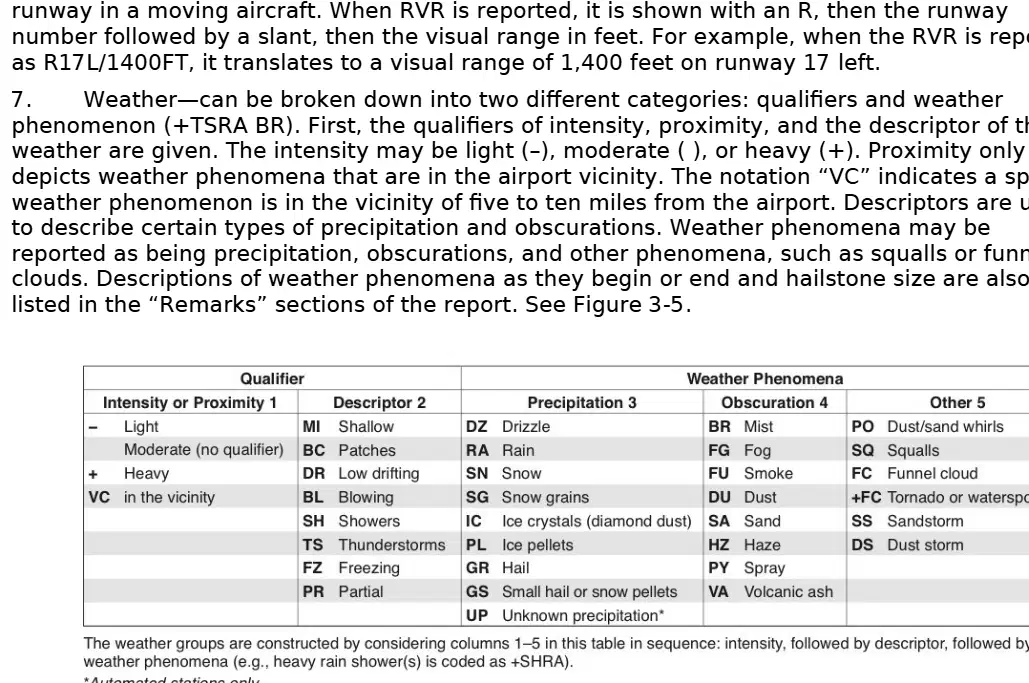
Which of the following is a descriptor for precipitation in a METAR?
BR
DZ
FG
SA
How is the amount of sky coverage reported in a METAR?
In tenths of the sky
In eighths of the sky
In quarters of the sky
In halves of the sky
What does the letter "A" indicate when reporting the altimeter setting in a METAR?
It precedes the four-digit number group representing inches of mercury ("Hg")
It indicates automated weather reporting
It denotes the presence of thunderstorms
It marks the end of the METAR report
What is "Zulu time" in aviation terminology?
Local time at the airport
UTC, which places the entire world on one time standard
The time of sunrise at the airport
The time of sunset at the airport
Which section of a METAR report always begins with the letters "RMK"?
Altimeter setting
Zulu time
Remarks
Visibility
What is the primary purpose of a Terminal Aerodrome Forecast (TAF)?
To provide a weather report for the entire country
To forecast weather conditions for the 5 SM radius around an airport
To report current weather at sea level
To summarize global weather patterns
Which of the following is NOT included in the sequential order of information in a TAF?
Type of report
ICAO station identifier
Runway length
Date and time of origin
A TAF is valid for which of the following time periods?
1 hour
6 hours
24 or 30 hours
48 hours
If a TAF is issued at 081125Z, what does the "08" represent?
The hour of issuance
The day of the month for the start of the TAF
The month of issuance
The year of issuance
Why might a remark such as "OCNL LTGICCG" appear in the remarks section of a METAR?
To indicate the presence of snow
To report occasional lightning in the clouds and from cloud to ground
To show the airport is closed
To indicate a change in runway direction
Which of the following is a weather advisory that pilots need to be familiar with for flight planning?
METAR
SIGMET
TAF
RMK
How often are 24 and 30 hour TAFs issued each day?
Once
Twice
Four times
Eight times
What does the five-digit wind group in a TAF forecast represent?
The direction and speed of the wind
The temperature and humidity
The visibility and cloud cover
The probability of precipitation

