
 Worksheets
Chemistry Final Exam Review
Total questions: 117
Worksheet time: 29hrs 15mins
You are conducting an experiment and find the volume of a substance to be 4.52 mL. If the known volume of the substance is 4.99 mL, find the percentage error in your measurement.
-10.4%
-9.42%
10.4%
9.42%
Which of the following statements about a chemical change is true?
A. A chemical change results in a change in energy AND a change in the amount of matter.
B. A chemical change results in a change in energy but not a change in the amount of matter.
C. A chemical change results in a change in the amount of matter but not a change in energy.
D. A chemical change results in neither a change in energy OR a change in the amount of matter.
How many significant figures are in the measurement 0.0051 mL?
2
3
4
5
The nucleus of an atom has all of the following characteristics EXCEPT that it
is positively charged.
contains nearly all of the atom’s volume.
is very dense.
contains nearly all of the atom’s mass.
How many valence electrons does an atom of aluminum typically have?
2
3
13
27
Which of the following elements would be the most reactive?
Bromine
Silicon
Nickel
Krypton
Anions have ____________ electrons and thus have a _____ charge.
lost; negative
gained; negative
lost; positive
gained; positive
Metals will ______ in reactivity as you move down and left in the periodic table. Nonmetals will ______ in reactivity as you move up and right.
increase; increase
decrease; increase
increase; decrease
decrease; decrease
Consider the periodic trend seen for ionic radius. Atoms that lose electrons tend to become ________. Atoms that gain electrons tend to become ________.
smaller; smaller
larger; smaller
smaller; larger
larger; larger
Which of the following groups of elements would most likely have the greatest electronegativity?
Halogens
Alkali metals
Alkaline earth metals
Transition metals
Which of the following groups of elements would most likely have the least electronegativity?
Halogens
Alkali metals
Alkaline earth metals
Transition metals
Identify the total amount of electrons in an element with this electron configuration: 1s²2s²2p⁶3s²3p³.
3
5
11
15
Identify the number of valence electrons in an element with this electron configuration: 1s²2s²2p⁶3s²3p³.
3
5
11
15
Identify the number of energy levels in an element with this electron configuration: 1s²2s²2p⁶3s²3p³.
1
2
3
5
Which of the following statements is true about O₂?
The two atoms share 4 electrons.
It has a double bond.
Its electronegativity difference is 0.
All of the above are true.
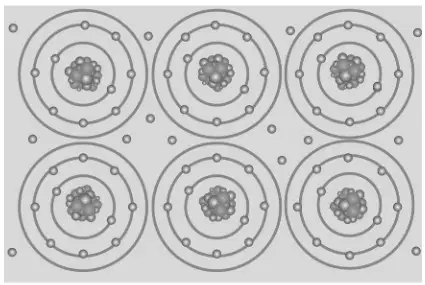
The picture below best represents a(n) __________ bond.
hydrogen
ionic
metallic
covalent
How many atoms of oxygen are represented in 2Pb(SO4)2?
2
4
8
16
33. Which of the following sentences correctly uses the terms atom, element, and compound to describe butane (C4H10)?
Butane is an atom made up of elements and compounds.
Butane is a compound made up of atoms of the elements carbon and hydrogen.
Butane is an element made up of compounds of atoms.
Butane is a compound made up of elements and atoms of oxygen and nitrogen.
34. Use the information provided and a periodic table to complete the chart on your answer sheet. Which element has the atomic number 17?
Oxygen
Chlorine
Sodium
Potassium
Draw a Bohr model for an atom of magnesium with a mass number of 24.
A Bohr model of magnesium-24 has 12 protons, 12 neutrons, and 12 electrons arranged in 3 energy levels.
A Bohr model of magnesium-24 has 24 protons, 12 neutrons, and 12 electrons arranged in 2 energy levels.
A Bohr model of magnesium-24 has 12 protons, 24 neutrons, and 12 electrons arranged in 2 energy levels.
A Bohr model of magnesium-24 has 12 protons, 12 neutrons, and 24 electrons arranged in 3 energy levels.
A nuclear reaction differs from a chemical reaction in that:
Nuclear reactions involve changes in the nucleus, while chemical reactions involve changes in electrons.
Nuclear reactions involve changes in electrons, while chemical reactions involve changes in the nucleus.
Both involve only changes in electrons.
Both involve only changes in the nucleus.
Which of the following lists the three types of nuclear reactions?
Fission, fusion, and radioactive decay
Combustion, oxidation, and reduction
Photosynthesis, respiration, and fermentation
Evaporation, condensation, and precipitation
An electron moves from the 2nd energy level to the 1st. This would be considered:
Absorption
Emission
Which of the following statements correctly identifies the error in the electron configuration for Bromine: 1s2 2s2 2p6 3s2 3d10 3p6 4s2 4p5, and provides the correct configuration?
The configuration is correct as written.
The 3d10 should come after 4s2; the correct configuration is 1s2 2s2 2p6 3s2 3p6 4s2 3d10 4p5.
The 4p5 should come before 4s2; the correct configuration is 1s2 2s2 2p6 3s2 3p6 4p5 4s2 3d10.
The 3d10 should be omitted; the correct configuration is 1s2 2s2 2p6 3s2 3p6 4s2 4p5.
Metals tend to form cations and nonmetals tend to form anions because:
Metals lose electrons easily while nonmetals gain electrons easily.
Metals gain electrons easily while nonmetals lose electrons easily.
Both metals and nonmetals lose electrons easily.
Both metals and nonmetals gain electrons easily.
On the periodic table, the atomic radii of elements tend to increase as you move down a group and left in a period. This pattern is seen because:
the number of energy levels increases down a group and effective nuclear charge decreases to the left in a period.
the number of protons increases down a group and electrons are added to the same energy level to the left in a period.
the atomic mass decreases down a group and increases to the left in a period.
the number of neutrons increases down a group and decreases to the left in a period.
The statement “bonding is a spectrum” means that:
All bonds are either purely ionic or purely covalent.
Bonding types exist on a continuous range between ionic and covalent.
Bonding only occurs in molecules with similar atoms.
Bonding is always unpredictable.
The difference between an ionic bond and a polar covalent bond is:
Ionic bonds involve the transfer of electrons, while polar covalent bonds involve unequal sharing of electrons.
Ionic bonds involve sharing of electrons, while polar covalent bonds involve transfer of electrons.
Both involve equal sharing of electrons.
Both involve transfer of protons.
Which of the following best describes the type of bond formed between carbon and fluorine in the compound they mostly form?
Ionic bond
Covalent bond
Metallic bond
Hydrogen bond

You have a compound that does NOT melt on the hot plate and is a GOOD conductor of electricity when dissolved in water. Which type of compound is it?
Ionic
Molecular (Covalent)
Metallic
Which compound would have a very low melting point?
sodium chloride
copper (II) sulfate
sulfur dioxide
aluminum
Which of the following is NOT an ionic compound:
NaCl
Cl2
CaF2
KOH
a negatively charged subatomic particle
proton
nucleus
atom
electron
neutron
a subatomic particle with no charge
proton
nucleus
atom
electron
neutron
Of the elements Fe, Na, Pt, and Ar, which is a nonmetal?
Fe
Na
Pt
Ar
Review Please!

How many protons are in this ion?
35
36
80
45
Review Please!
How many neutrons are in this ion?
35
36
80
45
Review Please!
How many electrons are in this ion?
35
36
80
45
Review Please!
Which of the following elements is in the same period as phosphorus?
carbon
magnesium
oxygen
Review Please!
Which of the following elements has the smallest atomic radius?
Bromine
Chlorine
Sulfur
Review Please!
How many valence electrons are in an atom of magnesium?
2
4
3
5
Name the compound Fe(NO3)2.
Iron (II) Nitrate
Iron (II) Nitrite
Iron (III) Nitrate
Iron (III) nitride
These values were recorded as the mass of products when a chemical reaction was carried out three separate times: 8.83 g; 8.84 g; 8.82 g. The mass of products from that reaction is
8.60 g. The values are
accurate, but not precise
precise, but not accurate
both accurate and precise
neither
Name the compound Fe(NO3)2.
Iron (II) Nitrate
Iron (II) Nitrite
Iron (III) Nitrate
Iron (III) nitride
The electron configuration of an element is [Kr] 4d6 5s1. To what group does this element belong?
4
5
7
9
The electron configuration of an element is [Kr] 4d6 5s1. To what group does this element belong?
4
5
7
9
Which coefficients correctly balance the formula equation
NH4NO2(s)® N2(g) + H2O(l)?
1 2 2
1 1 2
2 1 1
2 2 2
What is the formula for the compound formed by calcium ions and chloride ions?
CaCl
Ca2Cl
CaCl3
CaCl2
The energy required to remove an electron from an atom is the atom's
electron affinity
electron energy
electronegativity
ionization energy
In the reaction represented by the equation 2Al2O3 ® 4Al + 3O2, what is the mole ratio of aluminum to oxygen?
10:6
3:4
2:3
4:3
According to the kinetic-molecular theory, particles of matter
are in constant motion
have different shapes
have different colors
are always fluid
The greater the average kinetic energy of the particles in a sample of matter,
the higher the temperature is.
the lower the termperature is.
the more energy is absorbed by the sample in the form of heat.
the less energy is released by the sample in the form of heat.
What is the half-life of an isotope if 125 g of a 500 g sample of the isotope remain after 3.0 years?
1.5 years
2.5 years
3.5 years
4.5 years
What is the mass of 4.55 mol of C2H6?
0.151 g
115 g
137 g
661 g
What is the mass of 0.750 mol of nitrogen(N)?
(a)
How many formula units are in 12.88 moles of sodium chloride (NaCl)?
7.754 x 1024
3.890 x 1025
6.291 x 10²³
5.477 x 1024
What's the percent by mass of oxygen (O) in H2SO4?
65.25%
32.69%
16.31%
31.95%
How do we arrange the modern periodic table?
by atomic mass
by electron number
by atomic number
by element name
Why do ionic bonds form?
positive ions (cations) are attracted to negative ions (anions)
electrons are shared
the electrons are delocalized
the nuclei of each atom has a different number of neutrons
To balance chemical equations we must change the __________.
subscripts
types of elements
coefficients
Conservation Law
Ionic bonds form between ____________________.
metals and nonmetals
elements on the left and right side of the periodic table
nonmetals
elements on the right side of the periodic table
What is the oxidation number (charge) of Group 13?
+13
+3
-13
-3
How do we represent the charge of the cation in a bond that has a transition metal?
it is known already
Roman Numerals
we don't represent the charge
a superscript
What must we use to represent the number of atoms of one element when naming a covalent compound?
subscripts
coefficients
Roman Numerals
prefixes
If the volume of a gas decreases the pressure ___________________.
increases
stays the same
decreases
cannot be calculated
Evidence that a chemical reaction has occurred includes which of the following?
change in color
sudden temperature change
formation of a precipitate
a change of state
Sugar dissolving in water is an example of _____________.
a chemical change
melting
a physical change
none of the above
Where are the protons and neutrons located in the atom?
the protons are in the cloud while the neutrons are in the nucleus
the neutrons are in the nucleus while the protons are in the cloud
both protons and neutrons are in the nucleus
both protons and neutrons are in the cloud
Which of the following describe what a metal does wit its valence electrons in ionic bonding?
transfer
share
donate
give up
loose
Which is the correct Lewis structure for Nitrogen?


After distilling a sample, you find that you have two distinct components. What can be said about the original sample?
it is a compound
it is an element
it is a pure substance
it is a mixture
What is the relationship between wavelength and frequency of all waves on the electromagnetic spectrum?
Wavelength and frequency are directly related.
Wavelength and frequency are inversely related.
Wavelength and frequency are unrelated.
Wavelength and frequency are equal.
The optical portion of the electromagnetic spectrum above represents visible light (red, orange, yellow, green, blue, indigo, and violet). Which statement is correct about the optical portion of the spectrum?
The photons of red light have more energy than photons of violet light.
The photons of red light have equal energy as photons of violet light.
The photons of red light have less energy than photons of violet light.
The photons of violet light have less energy than photons of red light.
What atom matches this electron configuration?
1s2 2s2 2p6 3s2
Magnesium
Neon
Aluminum
Potassium
Which is the electron configuration for an oxygen atom?
1s22s22p63s23p64s2
1s22s22p6
1s22s22p4
1s22s22p63s23p6

How many valence electrons are represented here?
7
2
5
8
What is this element?
1s22s22p63s23p6
4s23d104p6
Argon
Bromide
Selenium
Krypton
A _______ is a neutral group of atoms that are held together by covalent bonds.
Molecule
Compound
Substance
Chemical compounds tend to form so that each atom, by gaining, losing, or sharing electrons, has an octet (8) of electrons in its highest occupied energy level.This is called the:
O'doyle Rules
Valence Rule
Aqua Rule
Octet Rule
Properties of Metals:
They generally have high melting points.
They are all liquids at room temperature except mercury
They are bad conductors of heat and electricity.
They are malleable & ductile
A scientist calculates the theoretical yield of an experiment to be 25.70g. They recover 12.76g. What is their percent yield?
49.65%
50.35%
65.21%
34.79%

82.3 g of Mg reacts with 57.9 g of N2 to form Mg3N2. Which is the limiting reagent?
Mg
N2
Mg3N2
What occurs during nuclear fission?
Larger atoms break apart into smaller ones.
Small atoms come together to form larger ones
Which type of nuclear reaction occurs on the sun?
Combustion
Fusion
Fission
Decomposition
N2 +3 H2 --> 2 NH3
If 5 moles of N2 are reacted according to the above reaction, how many moles of NH3 would be produced?
2.5 moles
5 moles
10 moles
15 moles

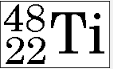
What is the symbol for a gamma ray?


What are the changes in nuclear structure as a result of fission and fusion?
The nucleus becomes larger in fission and smaller in fusion.
The nucleus becomes smaller in fission and larger in fusion.
The nucleus remains the same size in both fission and fusion.
The nucleus becomes unstable in fission and stable in fusion.

The diagram shows 2 hydrogen isotopes combining and producing helium and a neutron. What process is respresented by the diagram?
alpha decay
beta decay
fission
fusion
What is the time it takes for half of a radioactive substance to decay called?
Radioactive period
Half-life
Decay time
Nuclear breakdown

Uranium-238, the most prevalent isotope in uranium ore, has a half-life of 4.5 billion years and spontaneously decays by alpha emission to thorium-234. If a sample of uranium ore contains 1,000 grams of uranium-238, how long will it take for 875 grams to decay to thorium-234? (875 grams is how much that has been lost/decayed. So 1000-875 = ? Based on that, how many half lives have taken place)
4.5 billion years
9.0 billion years
13.5 billion years
18.0 billion years

If the half-life of iodine-131 is 8 days, how much of a 5.0g sample is left after 32 days?
2.5g
1.25g
0.625g
0.3125g

Potassium-40 has a half-life of 1.28 billion years. What is the age of a rock in which 87.5% of the potassium-40 atoms have decayed to argon-40?
1.28 billion years
2.56 billion years
3.84 billion years
7.68 billion years

What type of decay is shown in this equation?
alpha decay
beta decay
gamma emission
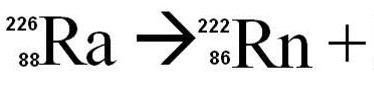
What particle completes this reaction?


85209At = ___ + 24He
614C = ___ + -10e

What type of decay type is shown by this generic equation?
alpha decay
beta decay
gamma emission
fission

What type of decay type is shown by this generic equation?
alpha decay
beta decay
gamma emission
fission

What type of decay type is shown by this generic equation?
alpha decay
beta decay
gamma emission
fission

6027Co = ___ + 0-1e
20985At = ___ + 42He
94Be + 11H → _____ + 42He

What particle completes this reaction?
42He
0-1 e
00Y
178O

What particle completes this reaction?
42He
0-1 e
00γ
178O

Mg(s) + HCl(aq) --> MgCl₂(aq) + H₂(g)
How many grams of HCl are consumed by the reaction of 2.50 moles of magnesium?
2NaOH(aq) + H2SO4(aq) --> 2H2O(l) + Na2SO4(aq)
How many grams of sodium sulfate will be formed if you start with 200 grams of sodium hydroxide?

