
 Worksheets
Final exam Revision-G11 chemistry
Total questions: 112
Worksheet time: 19hrs 40mins
When heat flows from system to the surroundings that is an example of an ________________ process.
exothermic
endothermic
What is calorimetry?
process of measuring kinetic and potential energy
process of measuring heat flow of chemical reactions
process of measuring pressure and temperature of a substance
What area of study in chemistry is concerned with the heat transfers that occur during chemical reactions?
stoichiometry
thermochemistry
inorganic chemistry
physical chemistry
1 food calorie = _______ chemistry calories
1000
1
500
4.184
What is the SI unit of heat and energy?
calorie
celsius
joule
The law of conservation of energy states that
in any chemical or physical change, energy cannot be created or destroyed, only changed in form.
heat changes occur during chemical and physical changes.
energy is the capacity to do work or to supply heat
there are two types of energy, kinetic and potential
What is the vocab term for the quantity of heat needed to raise the temperature of 1g of a substance by 1°C?
Joule
Specific Heat
Heat Capacity
calorie
How much ammonia (NH3) can be melted by the addition of 2 kJ of heat (ΔHfus = 5.66 kJ/mol)
.66 g
3.6 g
79.2 g
6.0 g
How many calories of heat are required to raise the temperature of 225g of Al from 20°C to 100°C? (specific heat of Al = 0.21 cal/g°C)
590 calories
3800 calories
38000 calories
85000 calories
A 100 g piece of heated steel cools from 50°C to 20°C. How much heat is released to the surroundings?
300 J of heat are released
300 cal of heat are released
The amount cannot be calculated because the heat capacity isn't known
The amount cannot be calculated because the system isn't closed
What process is exothermic?
condensation
melting
baking a cake
boiling
The specific heat of copper is 0.39 J/g °C. What is the temperature change when 100 Joules of heat is added to 20 grams?
12.82 °C
24.12°C
351 °C
Calculate the ∆H for the following reaction: 2H2O2 → 2H2O + 1 O2
You are given these two equations:
2H2 + O2 → 2H2O ∆H = -572 kJ
H2 + O2 → H2O2 ∆H = -188 kJ
∆H = -948 kJ
∆H = -196 kJ
∆H = -384 kJ
∆H = -188 kJ
Refer the the following question:
2N2 + 3H2 --> 2NH3 + 46 kJ
How much energy would be produced if only 14.0 g of nitrogen was reacted?
92 kJ
0.143 kJ
23 kJ
15 kJ
A + B + heat ---> AB; Delta H, enthalpy is
negative
positive
not enough information given
A reaction that releases heat is
endothermic
exothermic
exotic
a combustion reaction
How many calories are found in 516 Joules of energy?
(1cal = 4.184 J) Use correct sig figs
123.3 cal
123 cal
2158 cal
2160 cal
Match the definition below to the correct term.
The enthalpy change that takes place when one mole of a compound is formed from its elements in their standard states under standard conditions.
The enthalpy of neutralisation
The enthalpy of combustion
The enthalpy of formation
The enthalpy of reaction
How do you calculate Enthalpy of a reaction?
ΔH = ΔHproducts - ΔHreactants
ΔT = q / mC
ΔG = ΔH -TΔS
E = mc2
The enthalpy change for the reaction
C(s, graphite) + 1⁄2O2(g) --> CO(g) cannot be measured directly since some carbon dioxide is always formed in the reaction.
It can be calculated using Hess’s Law and the enthalpy changes of combustion of graphite and of carbon monoxide.
C(s, graphite) + O2(g) --> CO2 ΔH=-394 kJmol–1
CO(g) + 1⁄2O2(g) --> CO2 ΔH=-283 kJmol–1
The enthalpy change for the reaction of graphite with oxygen to give carbon monoxide is
-677 kJmol–1
-111 kJmol–1
+111 kJmol–1
+677 kJmol–1
Study the reaction below. Is it exothermic or endothermic?
H2 + Cl2 --> 2 HCl + 1845 kJ
Exothermic Reaction
Endothermic Reaction
ΔH value in an endothermic reaction is negative.
True
False
Hfinal > Hinitial means _____
change of enthalpy is positive and system absorbs heat
change of enthalpy is negative and system absorbs heat
change of enthalpy is positive and system loses heat
change of enthalpy is negative and system loses heat
Which of the following equations is enthalpy change of formation of carbon dioxide?
C(s) + O2(g) --> CO2(g)
CO(g) + 1/2O2 --> CO2(g)

Calculate the heat of RXN using the listed heats of formation.
NOTE: Fluorine gas = 0 kJ/mol
-1934.59 kJ
-1934.6 kJ
-1935 kJ
-1934 kJ

Use the given standard enthalpies of formation to determine the heat of reaction of the given chemical RXN.
NOTE: Na and hydrogen gas = 0 kJ
-282 kJ
-282.0 kJ
282 kJ
282.0 kJ

Calculate the standard enthalpy of formation for the RXN from the listed standard enthalpies of the substances involved.
-410.8 kJ
-411 kJ
410.8 kJ
411 kJ
The standard enthalpy of formation of propene is +20.6 kJ/mole. Calculate the heat of combustion of one mole of propene. The heats of formation of carbon dioxide gas and water liquid are -394 kJ/mole and -285.8 kJ/mole respectively.
NOTE: Diatomic molecule present in the RXN has 0 kJ standard enthalpy of formation.
-4120 kJ
-4120.0 kJ
4120 kJ
4120.0 kJ

Using Hess law, compute the thermochemical equation to know the total heat of RXN.
-3216.8 kJ
-136.8 kJ
3216 kJ
-136.8 J

Is the following exothermic or endothermic?
Endothermic
Exothermic
Calculate ΔH when 2 moles of ethanol (C2H5OH) reacts with excess oxygen according to the following thermochemical equation?
C2H5OH + 3O2 → 2CO2 + 3H2O ΔH = −1366.7 kJ
-2733.4 kJ
-683.35 kJ
-1366.7 kJ
-910.67 kJ
What will ΔH be if there is 1 mole of oxygen?
4Fe(s) + 3O2(g) --> 2Fe2O3(s) ΔH = –1500 kJ
-500 kJ
500 kJ
-750 kJ
-4500 kJ
P4 + 6Cl2 --> 4PCl3 + 2439 kJ
which of the following enthalpy changes represent the enthalpy change of formation?
Mg(s) + Cl2(g) → MgCl2(s)
Mg2+(g) + 2 Cl -(g) → MgCl2(aq)
O2(g) → 2 O(g)
2Mg (s) + O2(g) → 2MgO(S)

202.9 kJ
1256.3 kJ
363.1 kJ
Calculate ΔH° for the following reaction. The standard enthalpies of formation for the two reactants and two products are, in order, -1118, -110.5, -272, -393.5 (all in kJ/mol)
Fe3O4(s) + CO(g) →3FeO(s) + CO2(g)
-263 kJ
54 kJ
19 kJ
-50 kJ
Calculate the enthalpy of reaction (ΔH).
4CO2 (g) + 6H2O (g) → 2C2H6 (g) + 7O2 (g)
ΔHfo [CO2(g)] = -393.5 kJ
ΔHfo [H2O(g)] = -241.8 kJ
ΔHfo [C2H6(g)] = -84.7 kJ
550.6 kJ/mol
2855.4 kJ/mol
-550.6 kJ/mol
-3194.2 kJ/mol
Which would have the highest positional entropy?
Solid CO2
Liquid CO2
Gaseous CO2
If a process generates heat and is not spontaneous, which of the following is true?
Δ G < 0
Δ H > 0
Δ S < 0
Δ G = 0
Which combination of ΔH and ΔS NEVER has a spontaneous reaction?
+ΔH and +ΔS
+ΔH and -ΔS
-ΔH and -ΔS
-ΔH and +ΔS
1. Given the following information, calculate ΔG0 for the reaction below at 250C: (K = 0C + 273)
SnCl4(l) + 2 H20(l) → SnO2(S) + 4HCl(g),
ΔH0=133.0 kJ and ΔS0 =401.5 J/K
-252.6 kJ
-13.4 kJ
13.4 kJ
252.6 kJ
The thermodynamic quantity that expresses the degree of disorder in a system is _
entropy
internal energy
heat flow
enthalpy
bond energy
ΔS will be positive for the reaction
2H2 (g) + O2 (g) -> 2H2O (g)
2NO2 (g) -> N2O4 (g)
BaF2 (s) ->Ba2+ (aq) + 2F- (aq)
2Hg (l) + O2 (g) ->2HgO (s)
Which one of the following processes produces a decrease in the entropy of the system?
dissolution of solid KCl in water
mixing of two gases into one container
freezing water to form ice
melting ice to form water
For a reaction to be spontaneous under standard conditions at all temperatures, the signs of ΔHΟ and ΔSΟ must be __________ and __________, respectively.
+, +
+, -
-, +
-, -
+, 0
What does Gibbs Free Energy tell us?
How much energy is given off by a reaction.
The tendency of a reaction to become "random"
How spontaneous a reaction is.
Predict the signs of ΔH , ΔS and ΔG for the reaction:
Mg(s) --> Mg(g)
Δ H = - , Δ S = + and Δ G = - (all temperature)
Δ H = + , Δ S = + and Δ G = - (At all temperature)
Δ H = + , Δ S = + and Δ G = - (At low temperature)
Δ H = + , Δ S = + and Δ G = - (At high temperature)
Using the equations below:
C(s) + O2(g) → CO2(g) ∆H = –390 kJ
Mn(s) + O2(g) → MnO2(s) ∆H = –520 kJ
what is ∆H (in kJ) for the following reaction?
MnO2(s) + C(s) → Mn(s) + CO2(g)
910
130
-130
-910
Using the equations below
Cu(s) + 1/2O2(g) → CuO(s) ∆H = –156 kJ
2Cu(s) + O2(g) → Cu2O(s) ∆H = –170 kJ
what is the value of ∆H (in kJ) for the following reaction?
2CuO(s) → Cu2O(s) + 1/2O2(g)
142
15
-15
-142
Consider the following equations.
Mg(s) + O2(g) → MgO(s) ∆H = –602 kJ
H2(g) + O2(g) → H2O(g) ∆H = –242 kJ
What is the ∆H value (in kJ) for the following reaction?
MgO(s) + H2(g) → Mg(s) + H2O(g)
-844
-360
+360
+844
Hess' Law makes use of which principle to calculate the enthalpy change of a reaction?
The law of conservation of energy
The law of conservation of matter
The law that you will always find a lost item in the last place you look for it
Murphy's law

In order to find the enthalpy of combustion of C3H8 how must the enthalpy changes be arranged?
ΔH3 = ΔH1 + ΔH2
ΔH2 = ΔH3 - ΔH1
ΔH1 = ΔH2 - ΔH3
0 = ΔH1 + ΔH2 + ΔH3
List four factors that affects the rate of a reaction
temperature
concentration
surface area
volume
catalysts
A temperature increase causes the particles ......
to slow down
move faster
collide higher
in the right order
A temperature increase causes the particles ......
to slow down
move faster
collide higher
in the right order

Table 4 shows the total volume of gas evolved at different intervals for the dissociation of hydrogen peroxide.
What is the average rate of reaction in the second minute?
14.0 cm3 min-1
16.0 cm3 min-1
18.0 cm3 min-1
28.0 cm3 min-1

An experiment is carried out to study the effect of concentration on the rate of reaction between sodium thiosulphate and hydrochloric acid.
Graph of the concentration of sodium thiosulphate against 1/time is as shown.
Based on the graph, what is the value of t if the experiment is repeated using sodium
thiosulphate solution 0.025 mol dm-3.
32.3 s
50.0 s
0.020 s
0.031s

Diagram 4 shows the graph of volume of carbon dioxide gas against time when 5 g of marble chips is added to
50 cm3 of 0.2 mol dm-3 hydrochloric acid.
At what time the rate of reaction the highest?
t1
t2
t3
t4

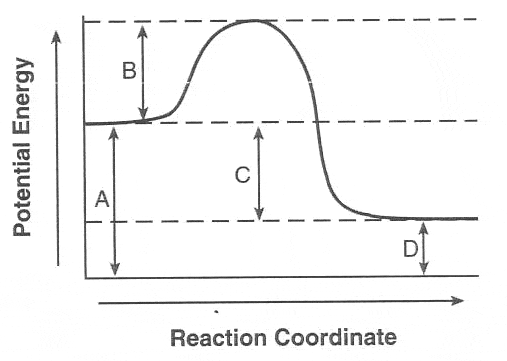
Diagram 12 shows an energy profile diagram. Ea is the activation energy for the decomposition of hydrogen peroxide.
P
Which of the following is the activation energy for the dissociation of hydrogen peroxide when manganese(IV) oxide is added?
P
Q
R
S
Which of the following explains the meaning of effective collision?
The collision where its energy is less than the activation energy
The collision that has a low energy
The collision which takes place before a reaction
The collision that causes a reaction
Which of the following is the meaning of activation energy?
The maximum energy that the particles need to produce effective collision
The amount of energy used by the particles during a collision
The minimum amount of energy that particles must have in order to react
The amount of kinetic energy of molecules during a collision
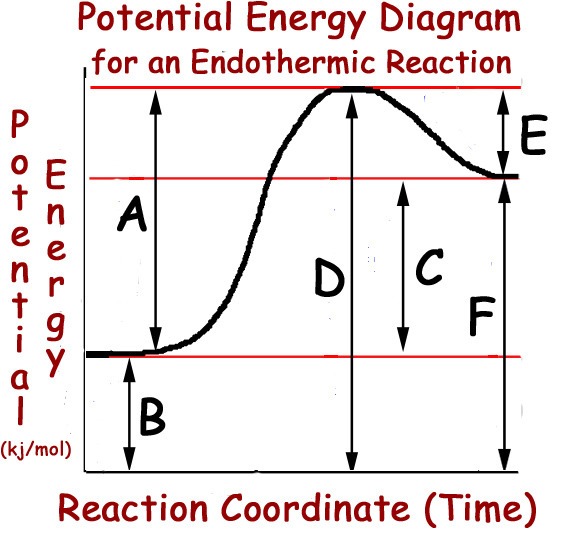
What type of reaction is this?
Endothermic
Exothermic
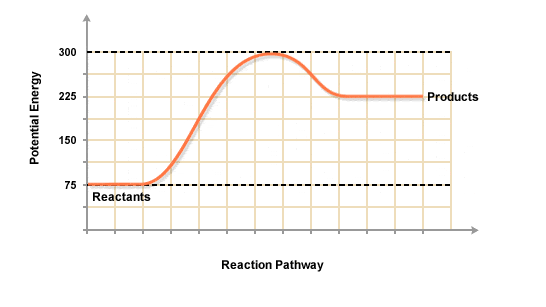
What is the energy of the activated complex?
75 kJ
225 kJ
300 kJ
50 kJ
What is the name given to a catalyst in the human body?
Biology
Catalyst
Chemical
Enzyme
The collisions which bring about a chemical reaction are called:
Consistent collisions
Normal collisions
Effective collisions

According to the information provided on this profile, the activation energy for the reaction:
0.5CO2(g) + H2O(g) → 0.5CH4(g) + O2(g)
would be
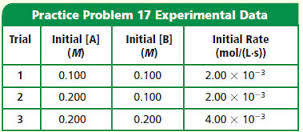
What is the order of reaction with respect to A?
What is the overall order of reaction?
What will happen to the rate of reaction if the concentration of A is doubled and the concentration of B is tripled?

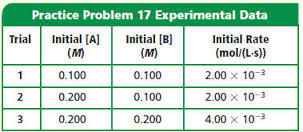

The rate constant for a second-order reaction is 0.15 M-1s-1. If the initial concentration of the reactant is 0.30 M, how long does it take for the concentration to decrease to 0.15 M? (2 sig figs with unit)
(a)
A compound decomposes by a first-order process. If 25.0% of the compound decomposes in 60.0 minutes, find the rate constant. (3 sig figs with unit)
(a)
Cyclopentane is unstable and decomposes by a first order reaction. The rate constant for this reaction is 9.5 s-1. What is the half-life of the reaction? (2 sig figs and unit)
(a)

The rate of the reaction 2A + B → C was measured at different concentrations of the reactants. Find the rate law if the results are as follows:
rate = k[A][B]
rate = k[A]2[B]
rate = k[A][B]2
rate = k[A]2[B]0
The rate law for a reaction is rate = k[Al2O3]2[NaOH]. What is the rate constant for this reaction if the reaction proceeds at an initial rate of 0.005 M/s when all of the reactants have initial concentrations of 0.02M? (3 sig figs and NO unit)
(a)

What is the rate law for the following?
A + 2B + C → D
rate = k[A][B][C]2
rate = k[B][C]
rate = k[A][B]2[C]
rate = k[B][C]2

Given the following information.
Rate = k[NH4+][NO2-]
Rate = k[NH4+]2[NO2-]2
Rate = k[NH4+]2[NO2-]
Rate = k[NH4+][NO2-]2
none of the above
What is collision theory?
Molecules must collide in the correct orientation with enough energy to bond.
Molecules need enough energy to collide and react.
Atoms constantly collide and react.
The minimum energy needed for atoms to react
The factor that will slow down the rate of a chemical reaction.
Manual stirring of the substance.
Placing substance in a hot water.
Placing products in iced water.
Placing reactants in an ice bath.
What does Gibbs Free Energy tell us?
How much energy is given off by a reaction.
The tendency of a reaction to become "random"
How spontaneous a reaction is.
What information do we need to perform a calculation of Gibbs Free Energy?
Enthalpy of the reaction.
Entropy of the reaction.
The temperature of the reaction in Kelvin.
All of the above are needed.
Which of the following would most likely lead to a spontaneous reaction.
A high negative enthalpy.
A low negative enthalpy.
A high positive enthalpy.
A low positive enthalpy.
Which combination of ΔH and ΔS NEVER has a spontaneous reaction?
+ΔH and +ΔS
+ΔH and -ΔS
-ΔH and -ΔS
-ΔH and +ΔS
For the process at 250C : I2(g) →I2(s). What are the signs for ΔG, ΔH and ΔS?
ΔG + ΔH - ΔS -
ΔG - ΔH - ΔS -
ΔG - ΔH + ΔS +
ΔG - ΔH + ΔS +
At what temperature would a given reaction become spontaneous if ΔH =+119kJ and ΔS=+263J/K.mol
452 K
2210 K
382 K
363 K
Which reaction has a +ΔS ?
AgNO3(aq) + NaCl(aq) → AgCl(s) + NaNO3(aq)
H2O(g) + CO2(g) → H2CO3(aq)
H2(g) + I2(g) → 2Hl(g)
C2H2O2(g) → 2CO(g) + H2(g)
Which sample has the lowest entropy?
1 mole of KNO3(l)
1 mole of KNO3(s)
1 mole of H2O(l)
1 mole of H2O(g)
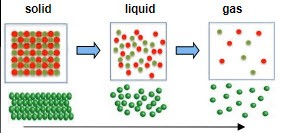
Entropy increases from solid, liquid to gas. Why?
Molecular disorder increases
Molecules increase in number from solid to gas
Molecules are heavier in solid
Molecules are more reactive
Given the change of phase: CO2(g) → CO2(s)
As CO2(g) changes to CO2(s), the entropy of the system
decreases
increases
remains the same
Entropy of a system increases when a reaction increases the number of particles.
True
False
Predict the entropy
change for this reaction
N2O4(g) → 2NO2(g)
ΔS = +ve and non spontaneous
ΔS = -ve and spontaneous
ΔS = -ve and non spontaneous
ΔS = +ve and spontaneous
Which of the reactions below has a negative ∆S?
CuCO3 (s) + 2HCl (aq) → CuCl2 (aq) + CO2 (g) + H2O (l)
C (s) + O2 (g) → CO2 (g)
CuO (s) + H2SO4 (aq) → CuSO4 (aq) + H2O (l)
BaCl2 (aq) + Na2SO4 (aq) → BaSO4 (s) + 2NaCl (aq)

