
 Worksheets
**GCA_ALL_U1 & U2 Questions
Total questions: 135
Worksheet time: 2hrs 15mins
I am a small body of rock, ice and dust that orbits the sun in a highly elliptical path and am sometime called a “dirty snowball”. What am I?
Comet
Meteoroid
Asteroid
Meteor
Meteorite
I am a rocky body that produces a streak of light as I burn up in our atmosphere and am sometimes called a shooting star. What am I?
Comet
Meteoroid
Asteroid
Meteor
Meteorite
I am a rocky body that moves through space and is smaller than an asteroid but can sometimes be found in the asteroid belt. What am I?
Comet
Meteoroid
Asteroid
Meteor
Meteorite
I have a hydrogen cloud, coma, and a nucleus. I am invisible except when near the sun. What am I?
Asteroid
Star
Meteor
Comet
What direction does a comet's tail point?
towards the Sun
it moves in all directions
away from the Sun
no one knows
What causes the tail of a comet to become visible?
Earth
Moon
Sun
Asteroid
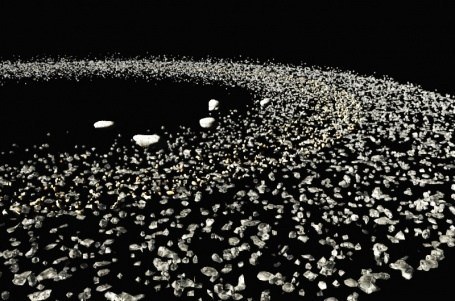
Almost Earth’s twin in size and mass, this planet has a very thick atmosphere and is the hottest planet in the solar system.
Venus
Mars
Mercury
Neptune
This cold, blue planet was discovered by a mathematical prediction instead of a telescope and has supersonic winds.
Neptune
Jupiter
Mars
Venus
This is the largest planet in the solar system and is famous for a century old storm called the the Great Red spot.
Saturn
Jupiter
Uranus
Venus
Most likely due to a massive collision, this planet rotates on its side.
Saturn
Venus
Neptune
Uranus

Which scientific instrument did Galileo use to discover the moons of Jupiter?
telescope
spyglass
microscope
magnifying glass

Who came up with this model?
Copernicus
Kepler
Galileo
Ptolemy

Which astronomer is responsible for the elliptical model of the solar system?
Copernicus
Newton
Aristotle
Kepler
Who improved the telescope and studied Jupiter's moons?
Galileo
Ptolemy
Brahe
Newton
Who came up with the idea of gravity?
Kepler
Newton
Aristotle
Galileo
Which astronomer first suggested that the sun is at the center of the solar system?
Aristotle
Ptolemy
Brahe
Copernicus
How many moons did Galileo discover orbiting Jupiter?
one
two
three
four

Newton
Why do the planets in our solar system orbit the sun?
because the sun is the brightest
because the sun was there first
because the sun has the most mass
because nothing can orbit planets

Who wrote the law of universal gravitation?
Newton
Galileo
Kepler
Edison

The force of attraction between objects that is due to their masses is -
acceleration
gravity
inertia
revolution
What keeps the planets in orbit around the sun?
gravity and inertia together
gravity
inertia
neither gravity or inertia
the tendency of an object to resist a change in its motion
acceleration
inertia
mass
frame of reference
What two things determine the gravity of an object?
mass & weight
mass & distance
density & mass
volume & distance
What would happen to the force of gravity when mass decreases?
the force of gravity would increase
the force of gravity would decrease
the force of gravity would remain the same
your mass does not influence gravity

Which model of the universe has the Earth at the center?
Heliocentric
Geocentric
Elliptical
Big Bang
Which model of the solar system is accepted today as accurate?
Geocentric
Heliocentric
Most scientists believe the Big Bang Theory explains which of the following questions?
How our planets and moons formed
How our universe began
How the sun turns hydrogen into helium
How fast light travels through space
Most distant galaxies show a red shift. This is considered evidence that the universe is ___.
getting cooler
expanding
condensing into a small point
swirling around


The classification of a galaxy is based on its observable characteristics. Which of these characteristics is used to classify galaxies?
shape
temperature
types of forces
chemical elements
What holds a galaxy together?
pressure
glue
gravity
planets
What does the Heliocentric system look like?


Imaginary line about which an object rotates is a(n) -
diameter.
radius.
pole.
axis.
What causes day and night?
the axis
Earth's revolution
Earth's rotation
Sun' rotation

As the Earth travels around the sun one complete time, it makes one -
revolution
rotation
day
month

In this diagram, the motion of the Earth can best be described as -
acceleration
gravity
revolution
rotation

In this diagram, the motion of the Earth can best be described as -
Gravity
Inertia
Revolution
Rotation
The path that an object takes as it moves around the Sun.
What is the shape of the orbit the planets have around the Sun?
For a solar eclipse to occur, the alignment must be ?
During what phase of the moon can a lunar eclipse occur?
You are less likely to see a total solar eclipse than a total lunar eclipse because
only people on the daytime side of Earth can see a solar eclipse.
the moon's shadow covers all of Earth during a solar eclipse.
the moon's umbra only covers a small area on Earth's surface.
new moon phases occur less often than full moon phases.
A total solar eclipse is visible from
only the dark side of Earth.
only within the moon's penumbra.
only within the moon's umbra.
all over Earth
During a total lunar eclipse, an observer on Earth would see
a new moon.
no change in the moon's brightness.
the moon turning a red color.
a first quarter moon.
What is the correct alignment during a total lunar eclipse?
Sun, moon, Earth
Sun, Earth, moon
Earth, Sun, moon
moon, Sun, Earth
The part of the shadow surrounding the darkest part of the shadow and producing a partial eclipse is the
axis

Which type of eclipse is shown in the diagram?
lunar eclipse
solar eclipse

Which type of eclipse is shown in the diagram?
A ___________ is the blocking of the Sun's light that occurs during a new moon when the moon's shadow falls on earth.
umbra
penumbra
A ___________ is the blocking of sunlight to the moon; occurs when the moon passes through earth's shadow.
umbra
penumbra


What type of tide when the sun, earth, and moon are at a 90 degree angle?
moon tide
spring tide
neap tide
tsunami tide
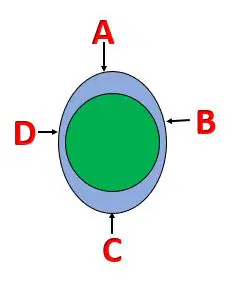
Where are the two high tides located in the diagram?
A and C
B and D
A and B
C and D
High tides are higher than normal and low tides are lower than normal during what type of tide?
neap tides
spring tides
tsunami tides
moon tides
Why does the moon's gravitational pull have more of an effect on tides than the sun's gravitational pull?
Spring tides occur during what moon phases?
1st and 3rd quarter
new moon and 1st quarter
new moon and full moon
waxing gibbous and waning crescent
Neap tides occur during what moon phases?
1st and 3rd quarter
new moon and 1st quarter
new moon and full moon
waxing gibbous and waning crescent
The moon moves around the Earth in what direction?
clockwise
counterclockwise
right
left

When the lit part of the moon is getting bigger, we call that ...
Waxing
Waning

When the lit part of the moon is getting smaller, we call that ...
Waxing
Waning
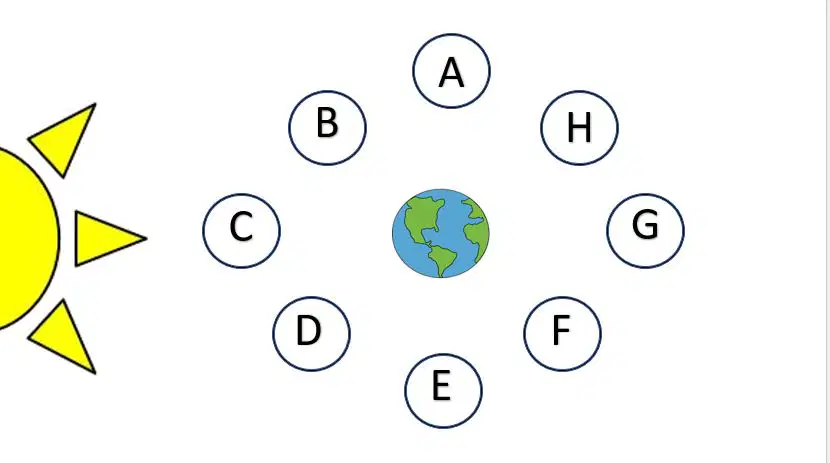
What moon phase is at location C?
3rd quarter
Full moon
New moon
waxing gibbous
What moon phase is at location G?
3rd quarter
Full moon
New moon
waxing gibbous
What moon phase is at location E?
3rd quarter
Full moon
New moon
1st quarter
What moon phase is at location A?
3rd quarter
Full moon
New moon
1st quarter
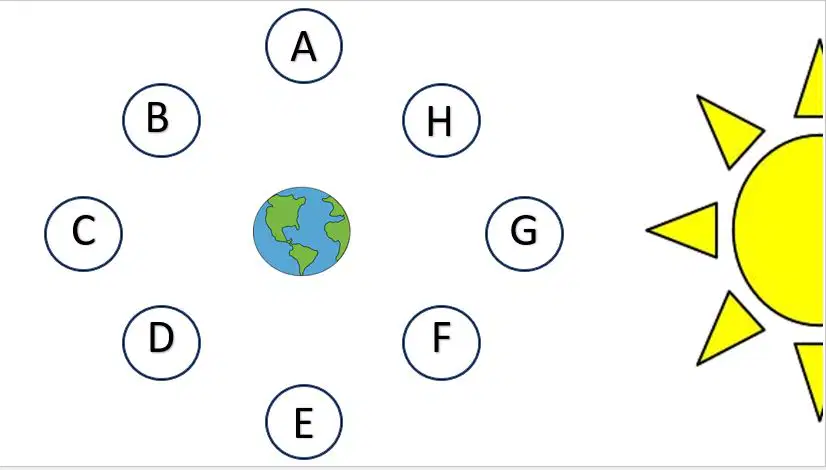
What moon phase is at location A?
3rd quarter
Full moon
New moon
1st quarter
What moon phase is at location G?
3rd quarter
Full moon
New moon
1st quarter
What moon phase is at location C?
3rd quarter
Full moon
New moon
1st quarter
What moon phase is at location B?
waning gibbous
waxing gibbous
waxing crescent
waning crescent
What moon phase is at location D?
waxing crescent
waning crescent
waxing gibbous
waning gibbous
In which direction does the Moon REVOLVE around the Earth?
clockwise
counter clockwise
some times it changes direction
it doesn't revolve
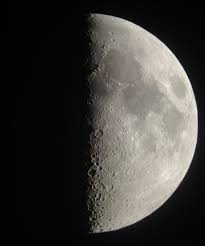
During this moon phase, we see half of the moon. What phase is this?
Quarter moon
Crescent moon
Why does the moon appear to change shape?
The Moon changes its actual shape throughout the course of the month.
As the Moon changes position, different amount of the moon is visible from Earth.
The season of the year determines the phase of the Moon.
The closer the Moon is to Earth, the more light the Moon reflects.
increasing light, growing in size
Losing light, shrinking in size

About how long is a lunar cycle?
two weeks
a month
6 weeks
6 months
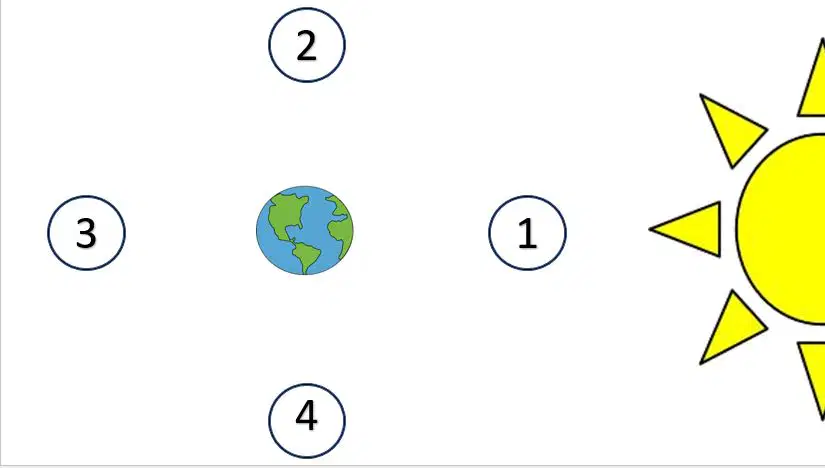

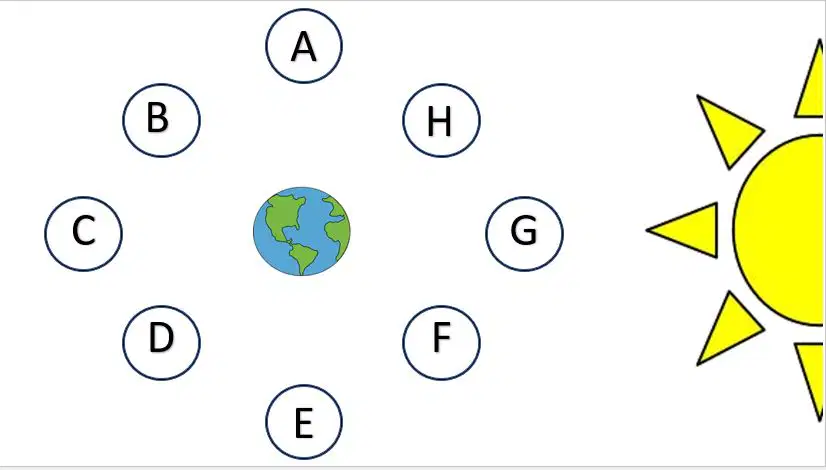
Name the phase of the moon for letter A
Full moon
First quarter
New moon
Third quarter
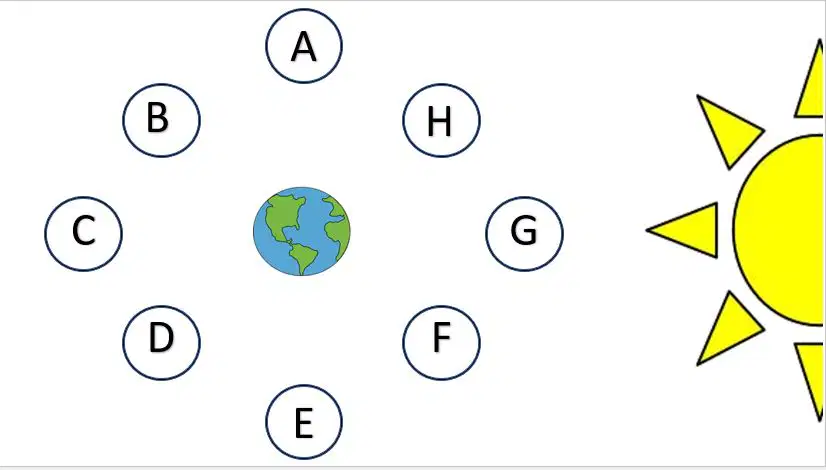
What moon phase is at location C?
new moon
1st quarter
full moon
3rd quarter
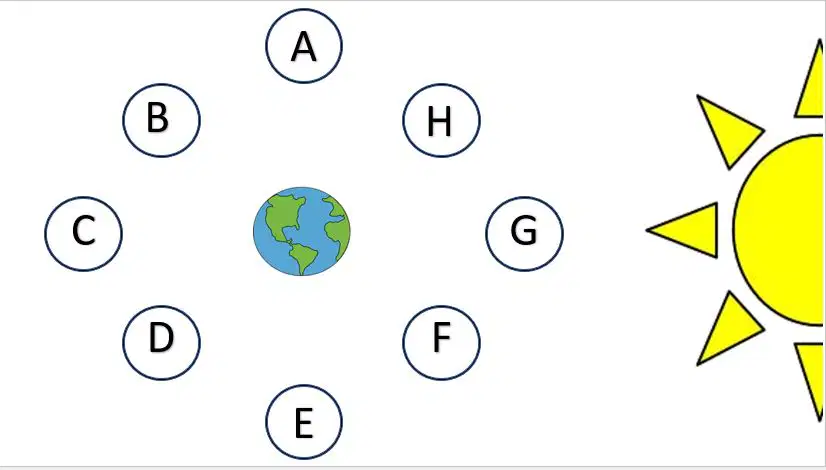
Name the phase of the moon for letter D.
Waning Gibbous
Waxing Gibbous
Waning Crescent
Waxing Crescent
Which of the following best describes the tilt of the earth when it is summer in the southern hemisphere?
The northern hemisphere is tilted toward the sun
The northern hemisphere is tilted away from the sun
The northern hemisphere is tilted neither toward or away from the sun
Why are you talking about the northern hemisphere when you asked about the southern hemisphere?


What causes day and night?
Earth's rotation on its axis
Earth's revolution around the Sun
Earth's distance from the Sun
Moon's revolution around Earth
What would seasons be like if Earth's axis were straight up and down?
Seasons would be the same as they are now
Seasons would be more extreme.
There would be no seasons.
none of the above
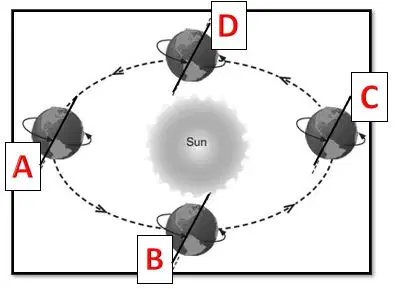
What season is the Northern Hemisphere having at location A?
summer
winter
fall
spring
What season is the Northern Hemisphere having at location C?
summer
winter
fall
spring

In winter, how is the Earth's axis pointed?
towards the sun
up
down
away from the sun

In summer, how is Earth's axis pointed?
towards the sun
up
down
away from the sun


What is the longest day of the year in the Northern Hemisphere?
summer solstice
winter solstice
fall equinox
spring equinox
What would happen to seasons if Earth's tilt was greater than 23.5?
They would be the same as they are now
Extreme seasons
no seasons

