
NEW
Font size
 Worksheets
EOC Review #1
Total questions: 77
Worksheet time: 39mins
Which part of a plant cell captures sunlight and converts the energy into food?
nucleus
chloroplast
cell membrane
cell wall

Which organelle stores hereditary material and coordinates the activities of the cell?
Organelle W
Organelle X
Organelle Y
Organelle Z
Which is a primary function of a vacuole in a cell?
enzyme production
protein synthesis
storage
reproduction
During which phase of the cell cycle does most cell growth occur?
Cytokinesis
Interphase
Prophase
Mitosis
Active transport and passive transport are two ways substances move across the cell membrane. Which of the following best describes the difference between them?
Active transport requires energy, while passive transport does not.
Passive transport requires energy, while active transport does not.
Both require energy to move substances across the membrane.
Neither requires energy to move substances across the membrane.
Water lilies float in water due to the waxy substance that is found on their leaves. The waxy substance is able to repel water, allowing the leaves to float. The waxy substance is an example of which organic compound?
Starch
Lipid
Carbohydrate
Protein
Which BEST describes the role of chloroplasts in energy conversion?
Chloroplasts convert chemical energy into radiant energy.
Chloroplasts excite photons of light energy and store them.
Chloroplasts convert oxygen and nutrients in order to drive metabolic activities.
Chloroplasts absorb light and convert it to chemical energy.
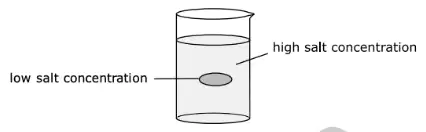
This diagram shows a red blood cell in a beaker that contains a solution with a higher salt concentration than that inside the red blood cell. What will happen to the red blood cell in this environment?
The size of the red blood cell will remain constant.
The red blood cell will swell at first and then shrink.
The red blood cell will swell from absorbing salt molecules.
The red blood cell will shrink from losing water molecules.
Which process can occur in both mitosis and meiosis?
fertilization
independent assortment
gene mutation
crossing over
How do some chemicals increase the risk of a person getting cancer?
by causing cell mutations
by causing a deficiency of vitamin D
by causing an increase of toxins in the skin
by causing a decrease in the immune response
Which of the following are two differences between the structure of DNA and RNA?
DNA is double-stranded and contains thymine; RNA is single-stranded and contains uracil.
DNA is single-stranded and contains uracil; RNA is double-stranded and contains thymine.
DNA contains ribose sugar and is single-stranded; RNA contains deoxyribose sugar and is double-stranded.
DNA and RNA both contain uracil and are double-stranded.
Using the following segment of DNA, what is the complementary mRNA strand? DNA sequence: ACTGGGCGAGTT
UGACCCGCUCAA
TGACCCGCTCAA
ACUGGGCGAGUU
UGTCCCGCTCAA
Which best explains enzyme specificity?
An enzyme reacts best at a certain pH.
An enzyme reacts best at a certain temperature.
An enzyme is able to react with only one substrate.
An enzyme is able to react with many different substrates.
A section of DNA has these bases: TAG CAG TAC Which mRNA sequence is produced from this DNA section?
ATC GTC ATG
AUG CUC AUG
AUG CUG AUC
UTC GTC UTG
How are the enzymes that nerve cells produce different from the enzymes that blood cells produce?
Nerve cells contain more ribosomes than blood cells.
Nerve cells contain more mitochondria than blood cells.
The genes that are activated in nerve cells are different from those activated in blood cells.
The molecules that nerve cells digest are more complex than those digested by blood cells.
Which would be a desirable trait scientists may want to create in a transgenic plant?
the ability to resist insects
the ability to grow less fruit
the ability to change color in the winter
the ability to use a lot of water
The difference between gametic and somatic mutations is:
Gametic mutations occur in reproductive cells and can be inherited, while somatic mutations occur in body cells and are not inherited.
Gametic mutations occur in body cells and are not inherited, while somatic mutations occur in reproductive cells and can be inherited.
Both gametic and somatic mutations occur only in reproductive cells.
Both gametic and somatic mutations are always inherited.
Gabrielle wonders why she has blue eyes while her parents and her brother all have brown eyes. What inference can be made?
Gabrielle’s parents’ genotypes are both heterozygous for brown eyes.
Gabrielle’s parents’ genotypes are both homozygous dominant for brown eyes.
Gabrielle’s parents’ genotypes are both homozygous recessive for brown eyes.
Gabrielle’s mother’s genotype is homozygous dominant for brown eyes, and her father’s genotype is heterozygous dominant for brown eyes.
What is the difference between the DNA of a dog and the DNA of a fly?
the type of sugar building blocks
the sequence of nucleotides
the strength of hydrogen bonds
the strength of covalent bonds
Which nucleic acid is correctly paired with its function?
mRNA: lines up amino acids at the ribosome
DNA: forms peptide bonds between amino acids
tRNA: moves genetic information from the nucleus to the ribosome
mRNA: moves genetic information from the nucleus to the ribosome
What is most likely to result when a mutation affects a DNA sequence?
The codons will be unable to create bonds with the enzymes.
The nucleic acids will be unable to create bonds with the ribosomes.
The amino acid sequence will be changed and a different protein will be formed.
The protein sequence will be changed and a different set of nucleic acids will be formed.
A change in the structure of a protein matters because:
It can alter the protein's function.
It increases the protein's size.
It makes the protein more colorful.
It has no effect on the protein.
Food provides calories needed by the body for energy. However, the body must use energy between meals when food is not consumed. What is the MOST likely response of the body when more energy is used than the calories consumed provide?
to increase blood flow to the limbs for energy production
to release energy from lipids stored throughout the body
to transform stored proteins into carbohydrates for energy
to contract muscles to create heat energy for the body
Which best summarizes the role of DNA in the production of proteins?
DNA moves to the cytoplasm to build proteins.
DNA transports amino acids to the ribosomes to make proteins.
DNA contains the instructions used to make proteins.
DNA breaks hydrogen bonds between amino acids.
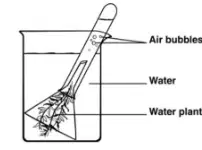
A student noticed that the freshwater plant, Elodea, produced bubbles when placed in direct light. What could the student most likely conclude?
Bubbles of carbon dioxide were produced as a result of photosynthesis.
Bubbles of oxygen were produced as a result of photosynthesis.
Bubbles of carbon dioxide were produced as a result of cellular respiration.
Bubbles of oxygen were produced as a result of cellular respiration.
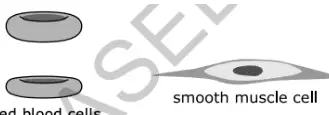
These diagrams show a variety of cells from the same organism. How can cells from the same organism have such different shapes and functions?
As each cell differentiates, the DNA changes so that each type of cell has different DNA once it reaches maturity.
Mutations in the cells’ nuclei lead to new combinations of DNA, resulting in different shapes and functions in the different types of cells.
During differentiation, different parts of the DNA in each type of cell are activated, resulting in the different structure and function of the cells.
During differentiation, different types of cells produce proteins which destroy the inactive DNA, leading to cell specialization.
Many poisons can enter the active site of enzymes essential for brain functioning. These poisons are never broken down and remain attached to the active site of the enzyme. Which best describes the effect this would have on the enzyme’s activity?
The enzyme activity would continue at its normal rate.
The enzyme would take longer to perform its normal functions.
The enzyme would be considered useless since its active site was blocked.
The enzyme would transfer its active site to another location and continue its normal activity.
Why must DNA replication have to occur before a cell can divide by mitosis?
to maintain the same number of chromosomes in the daughter cells as in the parent cell
to cause one of the cells produced to have double the number of chromosomes as the parent cell
to allow crossing over to occur in each of the cells produced
to cause all of the cells produced to have half the number of chromosomes as the parent cell
Which statement best explains how sweating during exercise maintains homeostasis?
It regulates mineral concentrations in cells.
It regulates body temperature.
It maintains water balance.
It maintains sugar balance in cells.
The chemical colchicine disrupts cell division. Which cell process would most likely stop if colchicine were added to a culture of human liver cells?
mitosis
meiosis
crossing over
active transport
What do both prokaryotic and eukaryotic cells contain?
membrane-bound organelles
linear chromosomes
cytoplasm
a nucleus
Crossing over and independent assortment increase genetic variation in meiotic cells by:
producing identical daughter cells
ensuring each gamete has the same genetic material
creating new combinations of alleles
preventing mutations from occurring
Which effect could a mutation in mRNA have on the production of proteins?
The protein produced will have extra genetic information.
The protein produced will be changed or altered.
The protein produced will produce excess nitrogen.
The protein produced will produce excess water.
How are mitosis and meiosis similar?
both have two cell divisions
both require DNA replication
both produce gametes
both involve crossing over
Genetically identical plants will produce either pink flowers or blue flowers, depending on the type of soil in which they are planted. What is most likely the explanation for the differences in flower color?
The flower-color gene is codominant.
Mutations alter the flower-color gene.
The flower-color gene is sex-linked.
Environmental factors affect flower color.
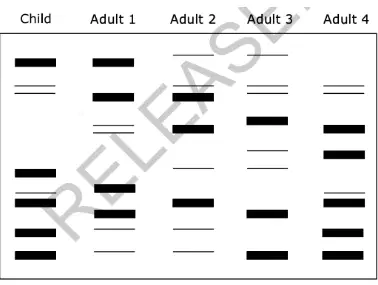
This diagram shows DNA fingerprints for a child and four adults. Which adult is most likely a parent of the child?
Adult 1
Adult 2
Adult 3
Adult 4
What would most likely be produced when a cell with eight chromosomes undergoes mitosis?
two cells with four chromosomes each
two cells with eight chromosomes each
four cells with four chromosomes each
four cells with eight chromosomes each
Which of the following best explains how genetic modification can be used to make transgenic organisms such as insulin producing bacteria, and identifies another transgenic organism that could benefit society?
By inserting the human insulin gene into bacteria, they can produce insulin; another example is golden rice, which is engineered to produce vitamin A.
By exposing bacteria to insulin, they learn to produce it; another example is cloning sheep for wool.
By mixing human and bacterial DNA randomly, insulin is produced; another example is breeding drought-resistant plants.
By feeding bacteria insulin, they adapt to make it; another example is using fish genes in cows for faster growth.
The nucleus contains DNA. Which statement BEST describes how DNA controls the working of the cell?
It codes for proteins.
It inhibits division of cells.
It helps in energy transformation.
It regulates traffic in and out of the cell.
The nucleus contains DNA. Which statement BEST describes how DNA controls the working of the cell?
It codes for proteins.
It inhibits division of cells.
It helps in energy transformation.
It regulates traffic in and out of the cell.
Which statement about the genes of specialized cells is true?
Each specialized cell in an organism contains a different set of genes.
All the specialized cells of an organism contain the exact same genes.
The specialized cells of an organism contain half as many genes as its unspecialized cells.
The specialized cells of an organism contain twice as many genes as its unspecialized cells.
Which molecules are joined together to make proteins?
fatty acids
nucleic acids
amino acids
acetic acids
Which word equation best represents the process of cellular respiration?
carbon dioxide + glucose → oxygen + water
carbon dioxide + water → glucose + oxygen
glucose + oxygen → carbon dioxide + water
oxygen + water → carbon dioxide + glucose
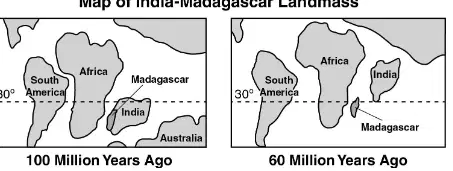
Genetic data suggest many frog species that live in Madagascar and India share a common ancestor that lived on the India-Madagascar landmass. Which statement BEST describes the divergence of frog species found in India and Madagascar?
Breeding preferences of the frogs prevents interbreeding between frogs, resulting in new species.
Geographic separation led to divergence in the gene pool, resulting in a new species at each location.
The frog species occupied different habitats within the same geographic areas, resulting in new species.
Different mating seasons led to the divergence of the gene pool, resulting in a new species at each location.
Why is DNA replication considered a semi-conservative process?
RNA will combine with DNA using the base pair rules during this process.
DNA replication must occur before mitosis to produce identical daughter cells.
DNA has two sides of complementary base pairs held together by weak bonds.
The new DNA molecules contain one strand of the original molecule and one new strand.
DNA replication must happen before cellular division because:
It ensures each daughter cell receives a complete set of genetic information.
It speeds up the process of cell division.
It prevents the cell from growing too large.
It allows the cell to use more energy.
Which statement best describes natural selection?
As the weather changes, organisms that are able to find shelter need less energy to live.
Organisms that eat only plants need less food than organisms that eat animals.
Organisms better adapted to their environment are more likely to reproduce and pass on their traits to their offspring.
Small organisms are more likely to survive than larger organisms.
Which example best demonstrates diffusion?
cellular movement
an amoeba engulfing a bacterium
the dispersal of dye in a beaker of water
a contractile vacuole removing excess water
Which sequence determines the specific amino acids that link together to form proteins?
the sequence of nuclei in RNA
the sequence of ribosomes in RNA
the sequence of nucleotides in DNA
the sequence of amino acids in DNA
If a frog’s skin cell has 26 chromosomes, how many chromosomes would be present in the frog’s gamete?
13
26
52
39
Serenity conducted an experiment to determine respiratory rates during different activities. She counted the number of breaths per minute. Serenity noted that the number of breaths increases as physical activity increases. Why is there an increase in the number of breaths per minute as activity increases?
As activity increases, more oxygen is exhaled.
As activity increases, breathing becomes more efficient.
As activity increases, the oxygen needs of cells increase.
As activity increases, the rate of the heart beating increases.
Tay-Sachs disease is a lethal, autosomal recessive genetic disorder. If both parents are heterozygous carriers of the disease, what are the chances of them having a child who is also a heterozygous carrier for Tay-Sachs?
25%
50%
75%
100%
Which recently developed technology has been used in determining the history of human ancestry?
fossil record
DNA sequencing
sonar imaging equipment
scanning electron microscopes
Which role do enzymes play in cells?
They are biobuffers that speed up chemical reactions.
They are biosubstrates that decrease chemical reactions.
They are biocatalysts that decrease the activation energy in chemical reactions.
They are biocatalysts that increase and decrease the activation energy in chemical reactions.
Which statement correctly compares aerobic and anaerobic respiration?
Anaerobic respiration occurs in the presence of oxygen but aerobic respiration does not.
Fermentation occurs during aerobic respiration but not during anaerobic respiration.
Aerobic respiration produces 36 ATP, while anaerobic respiration produces only 2 ATP.
Aerobic respiration produces 2 ATP, while anaerobic respiration produces 36 ATP.
A population of ground-dwelling animals is able to survive on food that is available on the forest floor but receives the best nutrition from fruit found in the canopy of trees. What adaptations will MOST likely become more common in the population if the availability of the food on the forest floor decreases? What processes would allow these adaptations to take place?
Longer limbs and climbing abilities; natural selection
Shorter limbs and burrowing abilities; genetic drift
Better camouflage for the forest floor; artificial selection
Larger body size for ground foraging; mutation only
Where is information stored that determines the function of a protein?
in the ribosome
in the mitochondria
in the nucleotide sequence of DNA
in the amino acid sequence of rRNA
Which explains why the nuclear membrane breaks down during mitosis?
So the cytoplasm can be divided.
So the chromosomes can be replicated.
So it makes it easier for the DNA to be mutated.
So the duplicated chromosomes can be separated into new cells.
A new trait that allows a more efficient release of energy from food appears in a fly population. The trait proves beneficial to survival and quickly spreads through the population. Which is the MOST likely origin of the new trait?
the combination of recessive genes in each generation
the mutation of a gene that results in an altered protein
the replication of a gene that produces an increase in RNA
the adaptation of a new genes to existing genes in the digestive system
Producers remove carbon from the atmosphere through which process, and how do producers, consumers, and decomposers return carbon to the atmosphere?
Photosynthesis; through respiration and decomposition
Respiration; through photosynthesis and combustion
Decomposition; through photosynthesis and respiration
Combustion; through photosynthesis and decomposition
Which type of substances serves as a catalyst for reactions that break large food molecules into smaller useful molecules?
enzymes
vitamins
lipids
Nucleotides
Natural selection CANNOT occur without
competition for unlimited resources.
gradual warming of Earth.
genetic variation in species.
asexual reproduction in species.
Which of the following BEST explains why different proteins contain a different number and a different sequence of amino acids?
a. Proteins are produced by different ribosomes.
b. Proteins are coded by genes with different nucleotide sequences.
c. Proteins are different because each codon codes for more than one amino acid.
d. Proteins combine in different ways based on the cellular need.
A female lizard develops a mutation in a gene. She has an offspring that expresses a new form of a hereditary trait. Based on these events, which of the following is true about the new trait?
It is caused by a genetic mutation and is heritable.
It is caused by environmental factors and is not heritable.
It is not related to genetics and cannot be inherited.
It is a temporary change and will not be passed to offspring.
Mosquito fish found on the islands of the Bahamas live in various isolated freshwater ponds that were once a single body of water. When several male and female mosquito fish are taken from two isolated ponds and placed into a single pond, the breeding preference of each mosquito fish is for fish from its own original pond. Which of these MOST likely resulted in this breeding preference?
Availability of food influenced the breeding preferences of the fish.
Competition for a suitable mate influenced the breeding preferences.
Predators in the pond influenced the breeding preferences of the fish.
Speciation due to reproductive isolation influenced the breeding preferences.
Some antibiotics used to treat infections in humans are also used to treat chickens, but some groups oppose this practice. The overuse of antibiotics will MOST likely influence the natural selection of which type of organisms?
chickens that naturally make the antibiotics
microbes that are resistant to the antibiotics
microbes that are susceptible to the antibiotics
chickens that are resistant to infection
The ability to roll the tongue in humans is coded by the dominant allele R. The inability to roll the tongue is coded by the recessive allele r. A man with an RR allele combination for the trait produces a zygote with a woman with an rr allele combination for the trait. Which allele combination could occur in the zygote?
RRrr
Rr
rr
RR
The cutting down of trees in the rainforest is leading to environmental degradation. Which of the following are reasons why it is better to leave the trees in place?
Trees help maintain biodiversity and prevent soil erosion.
Trees increase air pollution and reduce rainfall.
Trees make the soil infertile and attract pests.
Trees block sunlight and reduce plant growth.
What is the main benefit to using genetically modified organisms, even though their use has sparked an ethical debate around the world?
Humans can produce more insulin naturally.
Fewer pharmaceutical products are produced.
Farm products have a more pleasing appearance.
Fewer pesticides are released into the environment.
How is inheritance related to the process of natural selection?
It promotes mutations of genetic material over time.
It restricts the flow of DNA from one generation to the next.
It reduces competition for mates and increases genetic continuity.
It allows beneficial traits to be passed from generation to generation.
A river changes course so a population of mice is subdivided into two populations. The forest on the eastern side of the stream contains a land predator that is absent on the western side of the stream. Which outcome will MOST likely occur in the mice populations over many generations?
Mice on the western side of the stream will have better camouflage.
Mice on the eastern side of the stream will have a different number of chromosomes.
The two groups of mice will develop different adaptations.
The two groups of mice will continue to eat the same food.
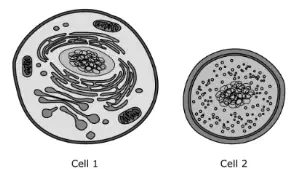
These images show two different cells. How are these cells classified?
Cell 1 is prokaryotic, cell 2 is eukaryotic
Cell 1 is eukaryotic, cell 2 is prokaryotic
Cell 1 and 2 are both prokaryotic
Cell 1 and 2 are both eukaryotic
Some microorganisms are able to consume and detoxify hazardous substances, so they are often used to clean up industrial waste and oil spills. However, these bacteria cannot survive in just any environment. What is the MOST likely method scientists use to increase the effectiveness of detoxifying microorganisms in harsh environments?
Release larger than normal concentrations of commonly used strains of detoxifying bacteria into the spill area.
Use bacterial transformation to insert genes for detoxifying enzymes into bacteria from that environment.
Rely on local populations of microorganisms to adapt to the toxic substances through natural adaptation processes.
Add chemical agents that increase the surface area of hazardous substances exposed to detoxifying microorganisms.
Which cellular organelle is thought to have evolved from a prokaryote that was able to use oxygen?
Chloroplast
Golgi apparatus
Mitochondrion
Ribosome
Which of the following lists correctly identifies two abiotic factors and two biotic factors in an ecosystem?
Sunlight, water; plants, animals
Soil, temperature; rocks, water
Plants, animals; bacteria, fungi
Air, sunlight; soil, water
Which example best demonstrates an organism’s interaction with the environment affecting gene expression?
a monkey learning to use a twig to capture termites for food
a fox producing more offspring when prey are readily available
a fish entering saltier waters and producing glands to remove excess salt
a person with high blood pressure maintaining normal pressure levels through diet and exercise
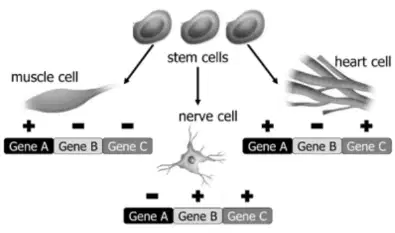
The model shows differentiation of stem cells with activated genes (+) and repressed genes (-) for three different cell types. Which statement best explains the model?
All cells with the same active gene are identical to one another.
The cells with the same repressed gene will be identical to one another.
As the stem cell is differentiating, the genes will activate one at a time to produce a new cell.
As different genes are activated or repressed, a cell will form with different characteristics.

