wayground logo

Free Printable Worksheets

Font size

S
M
L
XL
Worksheets

2nd Semester Anatomy Final (Muscle, skeletal, heart)

Total questions: 98

Worksheet time: 52mins

Name
Class
Date
1.

given the following events:

1.acetycholine broken down

2.acetylcholine moves across the synaptic cleft

3.action potential reaches the terminal branch (presynaptic terminal)

4.acetylcholine combines with a receptor molecule on a skeletal muscle (postsynaptic membrane)

5.action potential produced in skeletal muscle cell


Choose the arrangement that lists the events in the order the occur at a neuromuscular injunction

a)

2,3,4,1,5

b)

3,2,4,5,1

c)

3,4,2,1,3

d)

4,5,2,1,3

2.

How many types of muscles are there?

a)

2

b)

4

c)

3

d)

1

3.

Muscles that oppose one another are

a)

synergist

b)

hateful

c)

prime movers

d)

antagonists

4.
Which of the following is defined as the ability of an object to quickly return to the original shape and size?
a)
Elasticity
b)
Excitibility
c)
Flexibility
d)
Extensibility
5.
Which of the following is defined as the ability to change or be changed according to circumstances?
a)
Elasticity
b)
Excitability
c)
Flexibility
d)
Extensibility
6.
Which of the following is NOT a type of muscle?
a)
Rough
b)
Smooth
c)
Cardiac
d)
Skeletal
7.
Skeletal muscles are responsible for which of the following?
a)
Movement of the body
b)
Movement of the heart
c)
Movement of the ligaments 
d)
Movement of the extremities
8.
Which of the following describes the sarcomere? 
a)
The basic unit of muscle’s cross-striated myofibril
b)
. A protein band which defines the boundary between one sarcomere 
c)
 Various muscle proteins 
d)
Contains the protein, actin
9.
Skeletal muscles are attached to which of the following? 
a)
Bones and ligaments 
b)
Ligaments and tendons
c)
Tendons and bones
d)
Bones and fat 
10.

The nerve releases a chemical called a

a)

neurotransmitter

b)

neuron

c)

myofibril

d)

cell

11.
The thick filament is composed of: 
a)
Myosin
b)
Actin
12.
The thin filament is composed of: 
a)
Myosin
b)
Actin
13.

Name the highlighted muscle

a)

tricep

b)

bicep

c)

bicep femoris

d)

extensor longus

14.

Name the highlighted muscle

a)

pectoralis major

b)

biceps

c)

triceps

d)

deltoid

15.

Name the highlighted muscle

a)

quadraceps

b)

hamsting

c)

rectus abdominals

d)

deltoid

16.

Name the highlighted muscle

a)

transvers abdominals

b)

rectus abdominals

c)

external obliques

d)

internal obliques

17.

Name the highlighted muscle

a)

pectorals

b)

deltoid

c)

trapezius

d)

latissimus dorsi

18.

Name the highlighted muscle

a)

latissimus dorsi

b)

obliques

c)

rhomboids

d)

deltoid

19.

Name the highlighted muscle

a)

pectorals

b)

deltoid

c)

trapezius

d)

latissimus dorsi

20.

Name the highlighted muscle

a)

rectus abdominals

b)

transverse abdominals

c)

external obliques

d)

internal obliques

21.

Name the highlighted mucles

a)

hamstring

b)

quadricep

c)

soleus

d)

gastrocnemius

22.

Name the highlighted muscle

a)

tricpes

b)

biceps

c)

rectus femoris

d)

trapezius

23.
a)
Quadriceps
b)
Satorius
c)
Hamstring
d)
Gastronecmius
24.
a)
Buccinator
b)
Occuli
c)
Satorius
d)
Gastronecmius
25.
a)
Buccinator
b)
Occuli
c)
Pectorals
d)
Soulius
26.
The human skeleton can be subdivided into two parts, what part is made up of the skull, sternum, vertebral column and rib cage?
a)
appendicular
b)
axial
27.
What type of bone is the scapula?
a)
long bone
b)
short bone
c)
flat bone
d)
sesamoid bone
28.
What type of bone is the femur?
a)
Long bone
b)
Short bone
c)
Flat bone
d)
Irregular bone
29.
Which one of the following is an irregular bone?
a)
humerus
b)
tibia
c)
temporal
d)
vertebrae
30.
What is the name of the collar bone?
a)
Clavicle
b)
Scapular
c)
Sternum
d)
Xiphoid
31.
What is the name of the long bone in the top part of the leg?
a)
Patella
b)
Femur
c)
Fibula
d)
Tibia
32.
Name the bone located at number  8.
a)
Humerus
b)
Radius
c)
Fibula
d)
Tibia
33.
Name the bone located at number 12.
a)
Patella
b)
Clavicle
c)
Sternum
d)
Scapula
34.
Name the bone located at number 16.
a)
Clavicle
b)
Humerus
c)
Radius
d)
Ulna
35.
Name the bone located at number 14.
a)
Femur
b)
Fibula
c)
Tibia
d)
Radius
36.
Name the bone located at number 3.
a)
Scapula
b)
Humerus
c)
Sternum
d)
Clavicle
37.
The ______________ is made up of arms, wrists, hands, fingers, legs, ankles, feet, and toes.
a)
Axial
b)
Appendicular
38.
One function of the skeletal system is _______ especially in regards to the vital organs, such as the brain, heart, and lungs.
a)
Protection
b)
Storage
c)
Synthesis
d)
Movement
39.
A mature bone cell is called a _________.
a)
osteon
b)
osteocyte
c)
osteoclast
d)
osteoblast
40.
An osteocyte "lives" in __.
a)
lacunae
b)
lamellae
c)
Haversian canals
d)
Volkmann's canals
41.

bone building cells; deposit calcium

a)

osteoclasts

b)

osteoblasts

c)

hematoma

d)

fibrocartilage callus

42.

Bone destroying cells

a)

osteoblasts

b)

hematoma

c)

bony callus

d)

osteoclasts

43.

Disease of the bone caused by lack of exposure to the sun and lack of vitamin D; results in bending of the femur

a)

osteoporosis

b)

hematoma

c)

rickets

d)

reduction

44.

Name the bone

a)

maxilla

b)

palatine

c)

lacrimal

d)

temporal

45.

Name the bone

a)

lacrimal

b)

maxilla

c)

palatine

d)

nasal

46.

Name the bone

a)

zygomatic

b)

palatine

c)

frontal

d)

lacrimal

47.

Name the bone

a)

maxilla

b)

nasal

c)

frontal

d)

sphenoid

48.

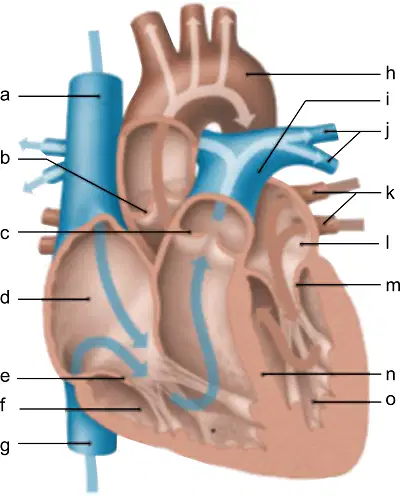
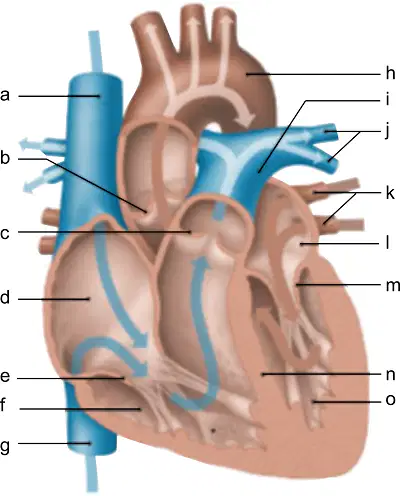
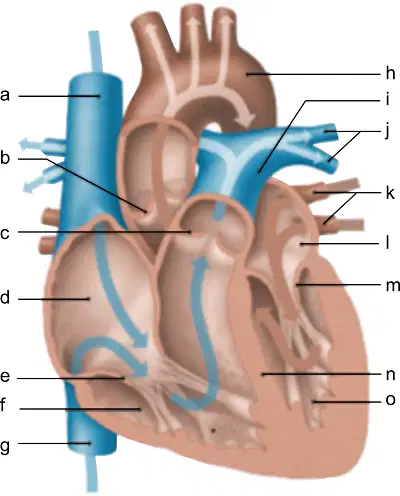
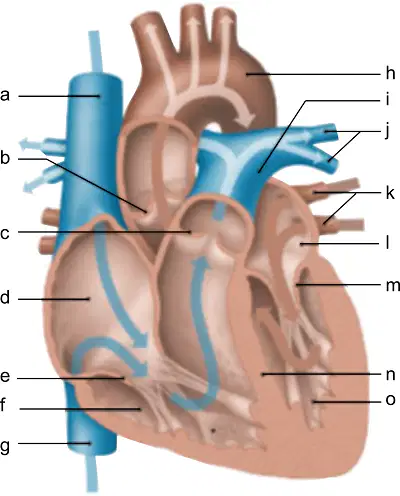
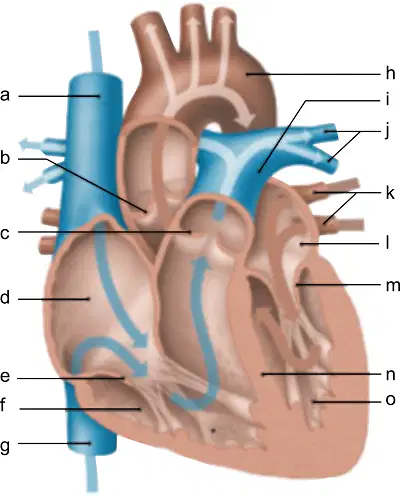
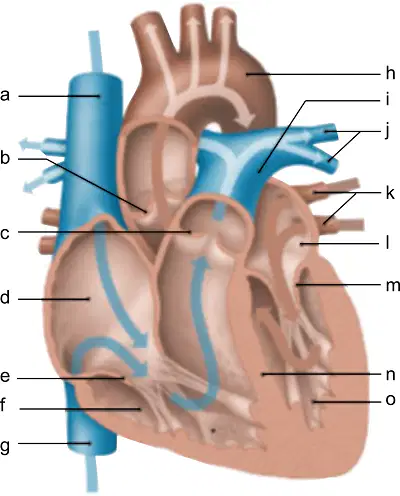
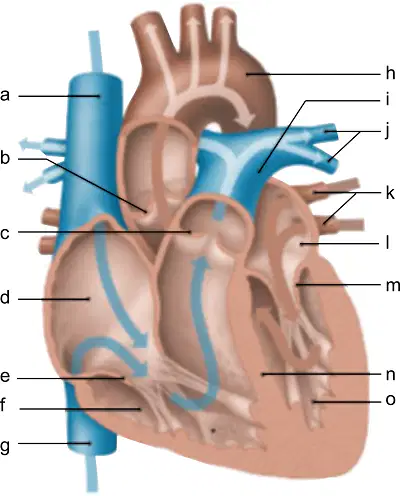
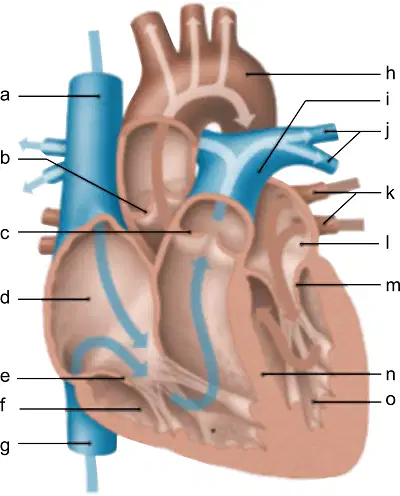
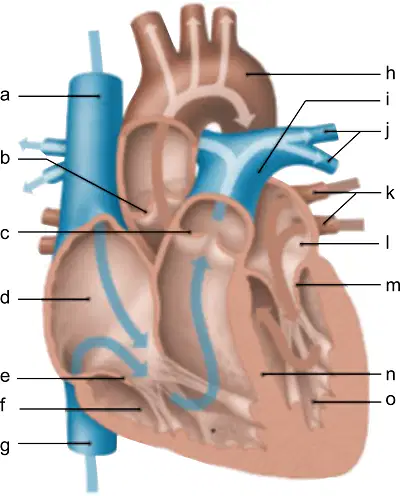
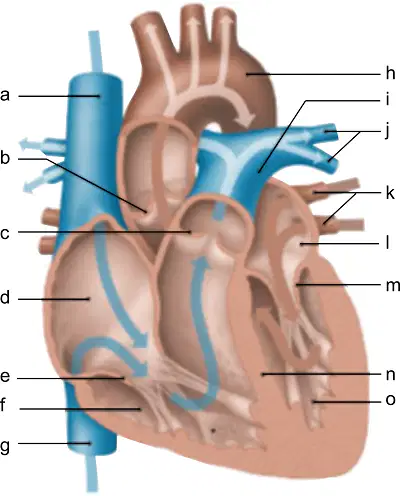
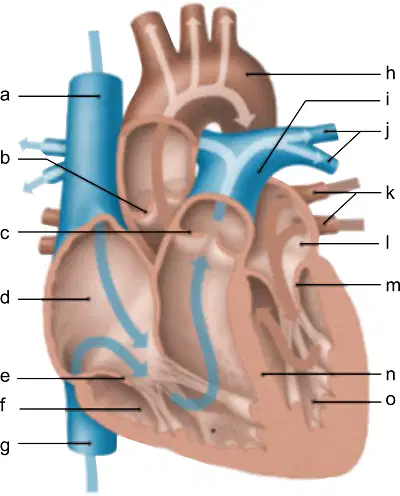
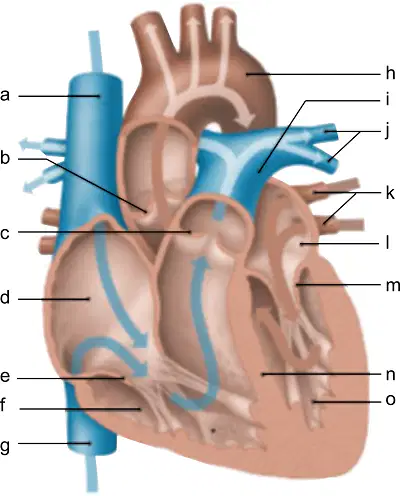
WHAT PART OF THE HEART IS LABELED (i)?

a)

Aorta

b)

Pulmonary Artery

c)

Inferior vera cava

d)

Right Ventricle

49.

WHAT PART OF THE HEART IS LABELED (C)?

a)

Aortic Valve

b)

Tricuspid Valve

c)

Bicuspid Valve

d)

Pulmonary Valve

50.

WHAT PART OF THE HEART IS LABELED (A)?

a)

Inferior vera cava

b)

Aorta

c)

Superior vera cava

d)

Left Atrium

51.

WHAT PART OF THE HEART IS LABELED (E)?

a)

Aortic Valve

b)

Tricuspid Valve

c)

Mitral Valve

d)

Pulmonary Valve

52.
What is the name of the circulation between the heart and the body?
a)
Diastolic
b)
Systemic
c)
Pulmonary
d)
Coronary
53.

WHAT PART OF THE HEART IS LABELED (F)?

a)

Right Atrium

b)

Right Ventricle

c)

Left Atrium

d)

Left Ventricle

54.

WHAT PART OF THE HEART IS LABELED (D)?

a)

Right Atrium

b)

Right Ventricle

c)

Left Atrium

d)

Left Ventricle

55.

WHAT PART OF THE HEART IS LABELED (B)?

a)

Aortic Valve

b)

Tricuspid Valve

c)

Mitral Valve

d)

Pulmonary Valve

56.
How many chambers does the heart have ? 
a)
4
b)
6
c)
3
d)
1
57.

WHAT PART OF THE HEART IS LABELED (H)?

a)

Aorta

b)

Pulmonary Trunk

c)

Superior vera cava

d)

Pulmonary vein

58.
What is the name of the circulation between the heart and lungs?
a)
Diastolic
b)
Systemic
c)
Pulmonary
d)
Coronary
59.

WHAT PART OF THE HEART IS LABELED (K)?

a)

Pulmonary Artery

b)

Inferior vera cava

c)

Pulmonary vein

d)

Tricuspid Valve

60.
How many valves does  the heart have ? 
a)
7
b)
4
c)
d)
61.

WHAT PART OF THE HEART IS LABELED (M)?

a)

Aortic Valve

b)

Tricuspid Valve

c)

Pulmonary Valve

d)

Bicuspid(Mitral) Valve

62.

WHAT PART OF THE HEART IS LABELED (G)?

a)

Superior vera cave

b)

Septum

c)

Pulmonary vein

d)

Inferior vera cava

63.
What is the function of a valve?
a)
Helps blood to clot
b)
Keeps blood flowing in all directions
c)
Keeps blood flowing in one direction
d)
Stops blood from flowing
64.

WHAT PART OF THE HEART IS LABELED (N)?

a)

Pulmonary vein

b)

Septum

c)

Tricuspid Valve

d)

Aorta

65.

WHAT PART OF THE HEART IS LABELED (L)?

a)

Right Atrium

b)

Right Ventricle

c)

Left Atrium

d)

Left Ventricle

66.
Which vessels carry blood away from the heart?
a)
arteries
b)
veins
c)
capillaries
67.

WHAT PART OF THE HEART IS LABELED (O)?

a)

Right Atrium

b)

Right Ventricle

c)

Left Atrium

d)

Left Ventricle

68.
A blood vessel that carries blood back to the heart.
a)
Cardiovascular System
b)
Heart
c)
Vein
d)
Artery
69.

Found in the heart

a)

smooth

b)

cardiac

c)

skeletal

d)

all

70.

Found attached to bones throughout the body

a)

smooth

b)

cardiac

c)

skeletal

d)

all

71.

Found in the walls of hollow organs; also called visceral

a)

smooth

b)

cardiac

c)

skeletal

d)

all

72.
What are the 3 types of muscles?
a)
Skeletal, muscular, ligament
b)
Skeletal, smooth, cardiac
c)
Smooth, Cellular, Cerebrum
d)
Cardiac, smooth, brain stem
73.

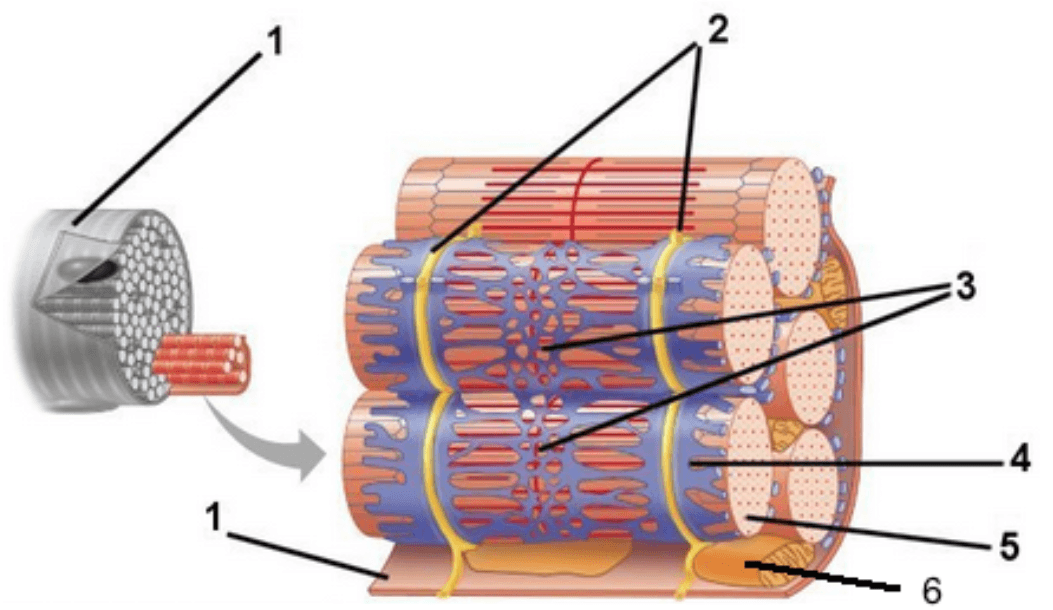
What is labeled "4" (the blue/purple part) in the diagram?

a)

sarcolemma

b)

sarcoplasmic reticulum

c)

transverse tubules

d)

myofibril

74.

What is the length between Z-lines of an actin molecule called?

a)

fascicle

b)

sarcomere

c)

myosin binding site

d)

sarcoplasmic length

75.
What is the name of the thick myofilaments?
a)
Actin
b)
Myosin
c)
Myoglobin
d)
Titan
76.
What is the name of the thin myofilaments in the muscle cell?
a)
Actin
b)
Myosin
c)
Myoglobin
d)
Titan
77.

What is another name #2? (Hint: It is a muscle layer)

a)

Skeletal muscle

b)

Epimysium

c)

Perimysium

d)

Endomysium

78.

What is another name #5? (Hint: It is a muscle layer)

a)

Skeletal muscle

b)

Epimysium

c)

Perimysium

d)

Endomysium

79.

What is another name #6? (Hint: It is a muscle layer)

a)

Skeletal muscle

b)

Epimysium

c)

Perimysium

d)

Endomysium

80.

What is the name of #3?

a)

Skeletal muscle

b)

Myofibril

c)

Myofiber

d)

Tendon

81.

What is another name for #9 (cell membrane)?

a)

Sarcomere

b)

Sarcolemma

c)

Myofibril

d)

Myofiber

82.

What is another name for a muscle cell?

a)

Sarcomere

b)

Sarcolemma

c)

Myofibril

d)

Myofiber

83.

Actions of Muscle...lets see what we can figure out before we learn them officially (add to your notes when the question is over)

a)

Flexion

1.

Decrease the angle between bones

b)

Extension

2.

Increase the angle between bones

c)

Rotation

3.

Spinning a bone on an axis.

d)

Abduction

4.

Taking a bone away from the midline

e)

Adduction

5.

Moving a bone toward the midline

84.

What movement is shown at the shoulder?

a)

abduction

b)

flexion

c)

extension

d)

adduction

85.

What motion is being show?

a)

Flexion

b)

Extension

c)

Adduction

d)

Abduction

86.

What motion is being show?

a)

Extension

b)

Flexsion

c)

Adduction

d)

Abduction

87.

What motion is being shown?

a)

Adduction

b)

Abduction

c)

Flexion

d)

Extension

88.
Turning the hand so that the palm is upward or facing anteriorly (in anatomical position).
a)
supination
b)
pronation
c)
flexion
d)
dorsiflexion
89.
What are the 3 types of muscle tissue?
a)
Thigh, Calf, & Shoulder
b)
Traps, Forearm, & Abs
c)
Hamstring, Biceps, & Triceps
d)
Smooth Muscle, Cardiac Muscle, & Skeletal Muscle
90.

Skeletal muscles are attached to the _________.

a)

Stomach

b)

Heart

c)

Bones

d)

Involuntary Muscles

91.
Which muscle type is found in your stomach, bladder, and intestines?
a)
Skeletal
b)
Smooth
c)
Cardiac
d)
Straight
92.
Which type of muscle is found in your heart?
a)
Skeletal
b)
Smooth
c)
Cardiac
d)
Straight
93.
Voluntary muscle is
a)
muscle that has to be told when to move
b)
muscle that moves automatically
c)
muscle that needs to be stretched regularly
d)
muscle that makes up the heart and stomach
94.
Which types of muscle tissue are voluntary?
a)
Cardiac
b)
Skeletal
c)
Smooth
d)
Cardiac and Smooth
95.
Which muscles are involuntary?
a)
skeletal
b)
cardiac
c)
smooth
d)
smooth and cardiac
96.
What is an example of an involuntary muscle? 
a)
Heart
b)
Arms 
c)
Legs
d)
Shoulders
97.
Skeletal muscles are responsible for which of the following?
a)
Movement of the body
b)
Movement of the heart
c)
Movement of the ligaments 
d)
Movement of the extremities
98.
Which system enables the body to move, moves food through the digestive system, and keeps the heart beating?
a)
skeletal 
b)
muscular
c)
digestive
d)
nervous