
 Worksheets
Physics 1
Total questions: 68
Worksheet time: 34mins
A ballistic pendulum consists of a large block of wood of mass M = 9.99 kg. One bullet of mass m = 10 g, travelling horizontally with speed v hits the pendulum and remains stuck in it. After the collision the pendulum starts to oscillate reaching a maximum height h = 5 cm. What is the velocity v ofthe bullet?
v = 5*10^4 m/s
v = 10^2 m/s
v = 10^3 m/s
v = 10^4 m/s
A gas is compressed at constant temperature. Which is correct?
It will give off heat
It will recieve heat
Its internal energy will increase
Its internal energy will decrease
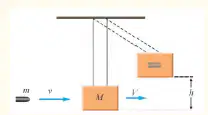
A ballistic pendulum is a device used to calculate the muzzle velocities of bullets. It is a pendulum constructed by hanging a wooden block with a very high mass at the end of a rope with length L. When a bullet with mass m traveling at speed v embeds itself into the wooden block with mass M, the (bullet + block) system rises by height h. Calculate the speed of the bullet when: m = 50 g, M = 5 kg, L = 2 m, h = 80 cm
40
400
4
4000
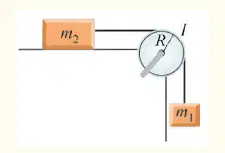
A block of mass m1 = 1 kg is attached to one end of a rope going around a pulley. Another block of mass m2 = 2 kg at rest on a frictionless horizontal plane is tied to the other end of the rope. The pulley has mass M = 2 kg, radius R = 20 cm, and moment of inertia I = 3 kg · m2 . Calculate the linear acceleration a and angular acceleration α.
a = 0.33 m s 2 ; α = 1.64 s −2
a = 0.53 m s 2 ; α = 2.64 s −2
a = 1.13 m s 2 ; α = 0.64 s −2
a = 0.13 m s 2 ; α = 0.64 s −2
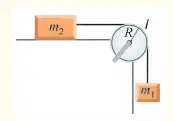
A block of mass m1 = 1 kg is attached to one end of a rope going around a pulley. Another block of mass m2 = 2 kg, at rest on a frictionless horizontal plane, is tied to the other end of the rope. The pulley has a mass M = 2 kg, a radius R = 20 cm, and a moment of inertia I = 3 kg · m2 . Calculate the tensions T1 and T2 in the ropes.
T1=0.9N, T2=0.3N
T1=9.9N, T2=0.3N
T1=9.9N, T2=0.13N
T1=9.9N, T2=9.3N
A block of 0.1 kg of ice at T = 0 ◦C is completely melted always at temperature T = 0 ◦C. What is its variation of entropy ∆S? (The latent heat of fusion of water is L = 3.335 × 10⁵ J/kg)
1220 J/K
0 J/K
122 J/K
-122 J/K
A body of mass m and specific heat c, initially at temperature Ti , exchanges heat from a single hot reservoir (at constant temperature Th). The body is not a reservoir, so it has a finite heat capacity, and its temperature will increase up to Th. What is the entropy variation of the Universe (system + environment)?
∆SU = mc(Th-Ti)/Th+mcln(Ti/Th)
∆SU = mc(Ti-Th)/Th+mcln(Th/Ti)
∆SU = mc(Th-Ti)/Th+mcln(Th/Ti)
∆SU = 0
A body of mass M = 10 kg falls from a height h = 10 m and stops. Initially the body and the environment are at the same temperature T = 293 K. What is the entropy variation ∆S of the universe?
0 J/k
33.3 J/k
-3.3 J/k
3.3 J/k
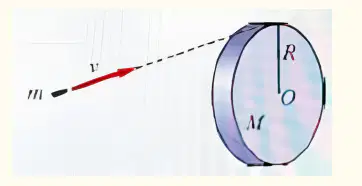
A bullet with mass m = 50 g travels at a speed of v = 200 m/s and embeds itself into the rim of a disk at rest that can rotate freely, at a distance of R = 60 cm from the center. The disk mass is M = 0.9 kg. What is the angular speed ω of the system (M + m) after the collision?
w=3.3 s^-1
w=6 s^-1
w=33 s^-1
w=0.3 s^-1
A carnot cycle is a cycle of special interest because:
It provides the maximum efficiency for any cycle
It operates between two constant temperature thermal reservois
It establishes a lower limit on cycle efficiency
When it is carefully constructed inside a labaratory it provides an upper limit on cycle efficiency
A Carnot engine, operating between reservoirs at 20◦C and 200◦C, produces 10 kW of power. The rejected heat per unit time is nearest to:
12.0 kj/s
20.2 kj/s
16.3 kj/s
26.3 kj/s
A Carnot refrigerator requires 10 kW to remove 20 kJ/s from a 20◦C reservoir. The temperature of the high-temperature reservoir is nearest:
400 K
320 K
440 K
360 K
A conservative system goes from state A to state B and the change in the potential energy is equal to 200 J. Which of the following statements is correct?
The variation of kinetic energy is 400 J
The variation of kinetic energy is 200 J
The work of the forces is equal to −200 J
The work of the forces is equal to 200 J
A copper block of mass M = 0.5 kg falls from a height h = 100 m into a lake at temperature TL = 283 K. The initial temperature of the copper block is Tcu = 423 K. Calculate the change in entropy of the universe ∆SU in this process. The specific heat of copper is c = 387 J/kg · K.
∆SU = −9.71 J/ K
∆SU = 140.00 J /K
∆SU = 9.71 J /K
∆SU = 19.7 J/ K
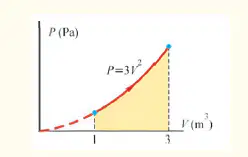
A gas expands from volume V1 = 1 m3 to volume V2 = 3 m3 along the parabolic curve P = 3V 2 (in Pascals), as shown in the figure. Calculate the work W performed by the gas.
W = 2.6 J
W = 26 J
W = 0.26 J
W = 260 J
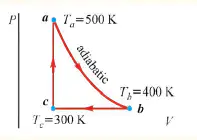
A gas with γ = cP cV = 1.4 undergoes a 3-step cycle, as shown in the figure. It expands adiabatically along the path ab, is compressed under constant pressure along the path bc, and is heated at constant volume along the path ca. Temperatures: Ta = 500 K, Tb = 400 K, Tc = 300 K Calculate the efficiency η of the cycle.
η = 30%
η = 3%
η = 0.3%
η = 15%
A helium-filled rubber balloon is left in a car on a cold winter night. Compared to its size when it was in the warm car the afternoon before, the size the next morning is:
not enough information to say
smaller
larger
unchanged
A homogeneous solid cylinder of length l = 40 cm, radius r = 2 cm, and mass m = 2 kg rotates in a horizontal plane around a vertical axis perpendicular to its axis through its midpoint O, as a result of an impulse J = 5 · 10−2 N·s received perpendicularly at the edge. As a result of friction, the cylinder stops after traveling one lap. The initial angular speed ω0 is 3.7 s−1 . Calculate the moment M of the friction forces.
M = 2.93 · 10^-3 Nm
M = 2.93 · 10^−2 Nm
M = 2.93 Nm
M = 2.93 · 10^−4 Nm
A homogeneous solid cylinder of length l = 40 cm, radius r = 2 cm, and mass m = 2 kg rotates in a horizontal plane around a vertical axis perpendicular to its axis through the middle point O, as a result of an impulse J = 5 · 10−2 N·s received perpendicularly at an extreme (the rim). As a result of the friction, the cylinder stops after traveling a lap. Calculate the initial angular speed ω0 of the cylinder.
ω0 = 0.37 s−1
ω0 = 37.00 s−1
ω0 = 3.70 s−1
ω0 = 0.07 s−1
A homogeneous spherical mass M of radius R, when r < R, produces a gravitational field G⃗ (r) equal to: (here r is the distance from the center of the sphere)
G(r) = − γMur/r^3
G(r) = − γM r ur/R^3
G(r) = − γMur/R^2
G(r) = − γMur/r^2
A
B
C
D
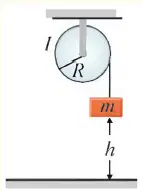
A mass m = 1 kg is attached to the end of a rope that is wrapped around a pulley with radius R = 0.2 m and moment of inertia I = 0.5 kg·m 2 . The mass is released from a height h = 2.7 m. With what velocity v will it hit the ground?
v = 12 m/s
v = 2 m/s
v = 0.2 m/s
v = 20 m/s
A mass M = 0.25 kg of copper at an initial temperature Ti is immersed into a container holding 0.1 kg of water initially at 320 K. When the system reaches thermal equilibrium, 0.09 kg of water remains in the container. Determine the initial temperature Ti of the copper, ignoring heat exchange with the environment. Given: cCu = 387 J kg · K , cH2O = 4187 J kg · K , λH2O = 2.26 · 106 J kg
Ti = 441.11 K
Ti = 541.11 K
Ti = 640.00 K
Ti = 841.11 K
A
B
C
D

always
just if it is solid mass
just if it is a point mass or a homogenous sphericala mass
just if a macroscopic mass
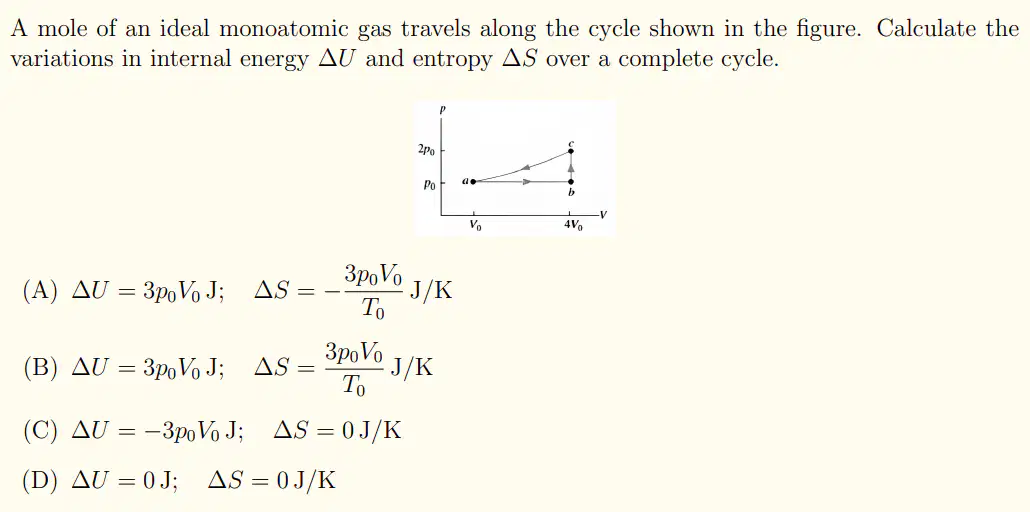
A mole of an ideal gas is initially in the state P0, V0, T0. The gas undergoes the following threestep process: heated at constant volume to a temperature 2T0, expanded isothermally to volume 2V0 and cooled at constant pressure back to temperature T0. What is the total change in entropy ∆S of the gas?
∆S = 0 J/K
∆S = 3 · 8.31 /2 ln 2 J/K
∆S = 5 · 8.31 /2 ln 2 J/K
∆S = 5 · 8.31 /2 J/K
A 1.0 mole sample of an ideal gas is kept at 0.0 ◦C during an expansion from 3.0 L to 10.0 L.
• How much work W is done by the gas during the expansion?
• How much energy Q is transferred as heat with the surroundings during the process?
W = 2.7 · 10^3 J; Q = 2.7 · 10^3 J
W = 2.7 · 10^3 J; Q = 0 J
W = 2.7 · 10^3 J; Q = −2.7 · 10^3 J
W = 5.4 · 10^3 J; Q = 2.7 · 10^3 J
A motorcycle showman with mass m drives through a vertical circular track with radius r = 40 m. What should his minimum speed v be at the top point so that the motorcycle does not lose contact with the track?
v = 40 m/s
v = 20 m/s
v = 30 m/s
v = 10 m/s
A pencil of length L = 15 cm and mass m is placed vertically on a rough plane and initially held at rest. It falls by rotating about the point of contact with the ground (acting as a pivot). What is the angular speed ω of the pencil at the instant it hits the ground?
ω = 1.40 s−1
ω = 14 s−1
ω = 0.14 s−1
I cannot answer because I don’t know the pencil mass
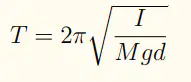
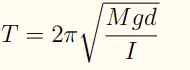
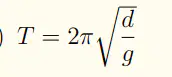
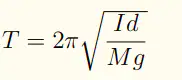
A physical pendulum swings around axis passing through the point P which is at distance d from the center of mass and has a moment of inertia I relative to the axis of rotattion and mass M. Its period of oscillation T in the approximation of the small oscillation is
A piece of ice is floating in a glass of water. What will happen to the level of water when the ice fully melts?
it is impossible to say
it will increase
it will decrease
It will remain the same
A piston allows air to expand from 6*10^6Pa to 2*10^5Pa. The initial volume and temperature are 500cm^3 and 800 C. If the temperature is held constant, calculate the heat transfer Q and the entropy change delta S (air molucular weight 28.96 g/mole)
Q=1.02*10^4J
S= 95.1 J/K
Q=1.02*10^4J
S= 9.51 J/K
Q=1.02*10^3J
S= 9.51 J/K
Q=1.02*10^5J
S= 9.51 J/K
A planet describes an elliptical orbit around a star. Let w= d0/dt its angular velocity and r its distance from that center of the star in a given instant is the following reletionship correct?
w/r=constant
w*r=constant
w*r^2=constant
w/r^2=constant
A plastic cube floats in a basin full of water. It is observed that the cube protrudes above the water surface by 20% of its edge length. What is the ratio between the density of the plastic and that of the water Pp/Pw ?
0.6
0.8
0.4
0.2
A point like particle, moving at speed v is subject to a force F=b x v where b is a constant vector. The work done by the force F
depends from the value of b
is always different from zero
is zero just when the point particle moves with circular motion
is always zero
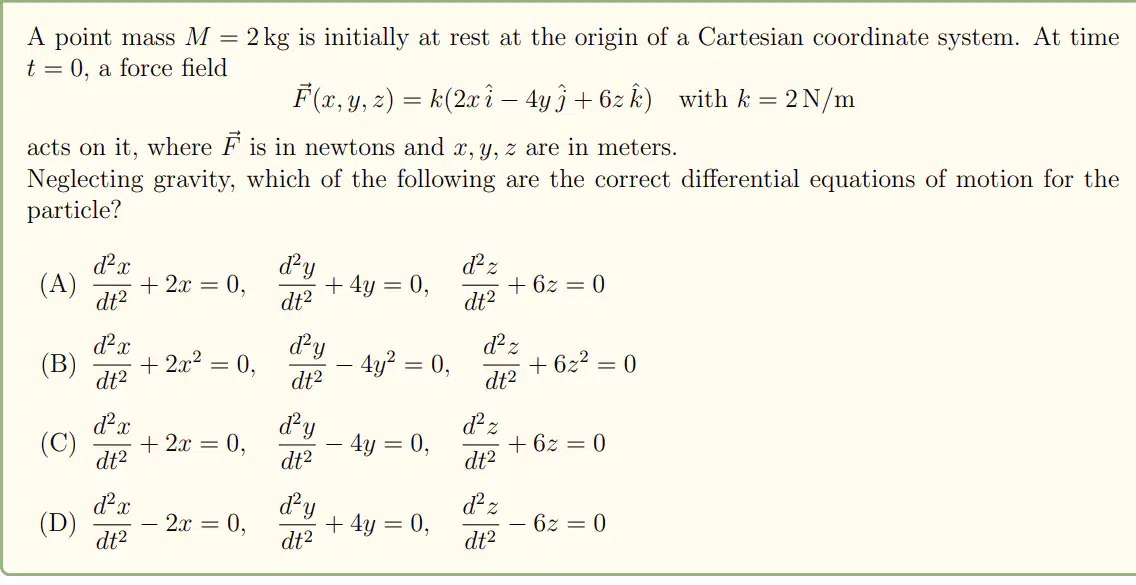
a
b
c
d
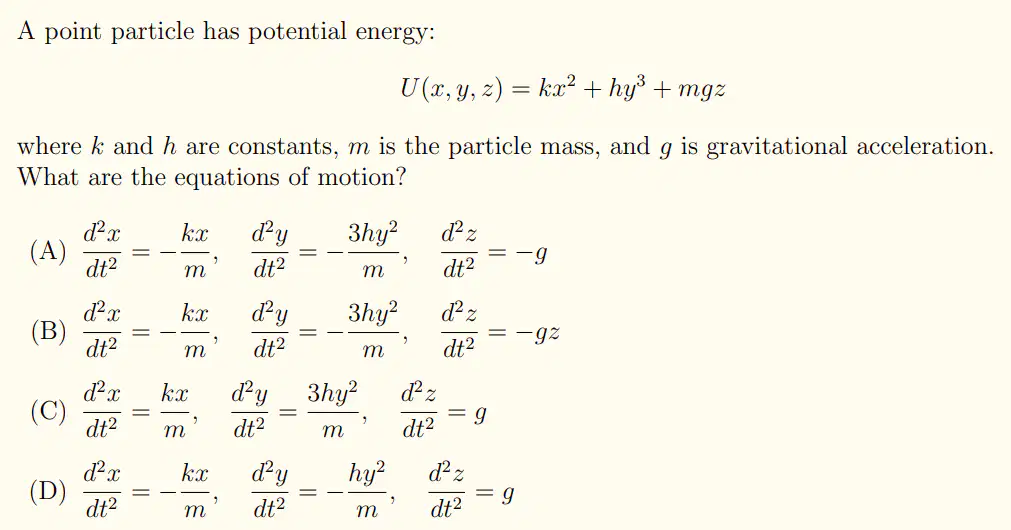
a
b
c
d
A point particle moves along a curvilinear path. Is it possible that ots acceleration is zero?
yes but only if its scalar speed constant
No because there is always at least centripetal force
yes but only if its vector speed constant
no because there is always at least tangetial acceleration
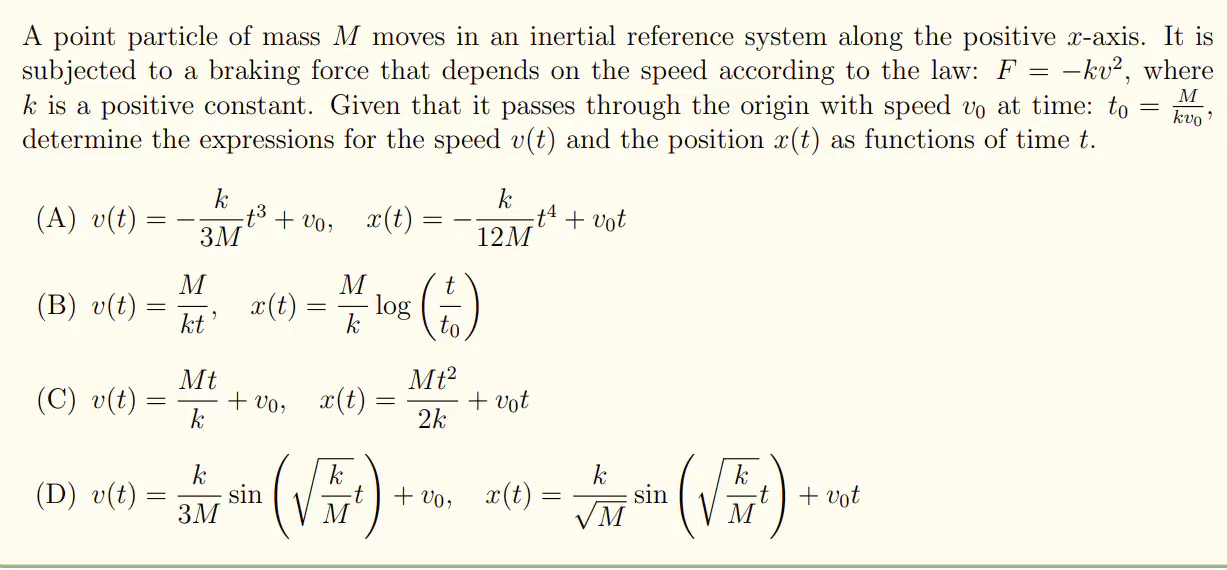
a
b
c
d
A reversible thermal machine works with four heat sources. From the first source at temperature T1 = 500 K, the machine absorbs heat Q1 = 5000 J. At the fourth source, at temperature T4 = 280 K, the machine transfers heat Q4 = −1400 J. With the second and third sources, respectively at T2 = 400 K and T3 = 300 K, the machine exchanges heat Q2 and Q3 = −Q2. Calculate the efficiency of the thermal machine
0.327
0.127
0.427
0.227
A root of negligible section and length Li is heated. With temperature variation ∆T, the final length of the rod is Lf = Li + ∆L. Which of the following stataments is correct
If ∆T doubles, also the Li /Lf ratio doubles
If ∆T doubles, also the Lf /Li ratio doubles
If ∆T doubles, also the ∆L/Lf ratio doubles
If ∆T doubles, also the ∆L/Li ratio doubles
A rod with mass m and length L=1.2 m is hinged from one end to a wall. The rod is reales in horizontal position. What will its angular velocity w be once it reaches vertical position?
5 s^-1
15 s^-1
0.5 s^-1
0.25 s^-1
A simple pendulum used to measure time is made of mass attached to the end of a stell wire. The period of the pendulum correctly sows 1s when temperature is 0 C. Calculate how much time the clock will lose or gain in day in a hot country where the average temperature is 40 C?
The pendulum lags by 1.0s per day
The pendulum lags by 20s per day
The pendulum lags by 2.0s per day
The pendulum lags by 10s per day
A small object dropped to earth from great distance (for example of the order of the earth-moon distance)
does not describe a uniformly accelerated motion given the large distance from the earth
nothing can be said unless the mass of the object known
describes a uniformly accelerated motion like a any other body that falls to earth from much shorter distance
describes a uniformrectilinear motion
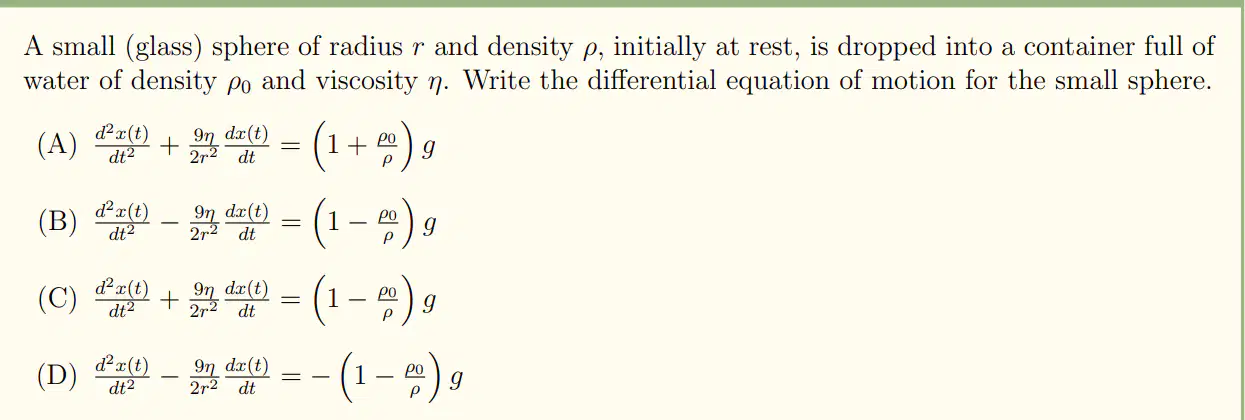
a
b
c
d
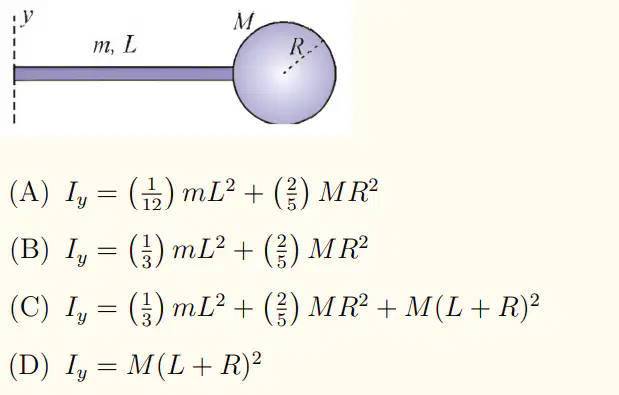
A solid sphere with mass M and radius R is welded to the end of rod with mass m and length L. Calculate the moment of inertia of this system with respect to the y-axis on the other end.
a
b
c
d
A sphere with radius R=0.25 m and mass M=1 kg released on an inclined planed at height h=10.5 m from the groung rolls down without slipping. What will the velocity of the center of mass be once it reaches the ground?
4.0 m/s
12 m/s
1.2 m/s
24.0 m/s
n 54 A sphere of 10 g hits centrally and elastically, at a speed of 5 m/s, another stationary sphere of unknown mass. After the impact, it goes back with a speed of 2 m/s. Is it possible, neglecting frictions, to calculate the mass of the impacted s
No, a collision without friction is no
No, because in this type of impact the total energy of the system composed of the two systems is not con
Yes
No, because the speed of the second sphere after the impact is u
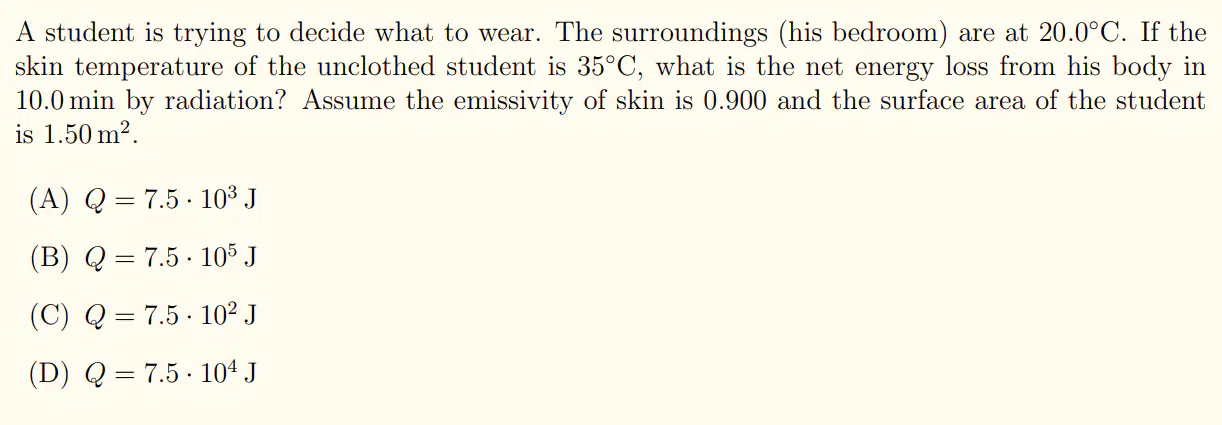
a
b
c
d
A system performs a thermodynamic cycle. Its entropy variation?
depends on the thermodynamic cycle it is positive or negative
is null
is always positive
is null if the cycle is reverible
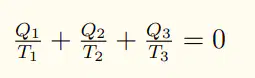
A thermal machine operates with three heat sources. T1, T2, and T3 are the temperatures of the sources, and Q1, Q2, Q3 are the amounts of heat that the thermal machine exchanges with each of the sources. If the cycle of the thermal machine is irreversible, then it is always true that:
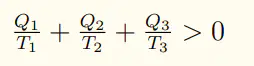
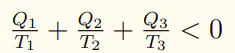
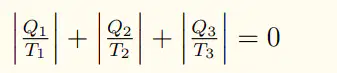
A tire, which is initially at the temperature T0 = 300 K, is inflated to a pressure equal to three times that of the initial pressure. Assuming that this process is adiabatic and almost static, determine the final temperature TF of the air considered as a perfect diatomic gas.
TF = 900 K
TF = 300 K
TF = 100 K
TF = 411 K
A vessel contains 4 moles of a monatomic gas at T1 = 0◦C. The temperature of the gas is increased to T2 = 50◦C at constant volume. Calculate the given heat Q, the work performed W by the gas, and the increase in internal energy U.
Q=2500 J,
W=2500,
U=0 J
Q=2600 J,
W=0,
U=2500 J
Q=2500 J,
W=0 J,
U=0 J
Q=2500 J,
W=2500,
U=2500 J
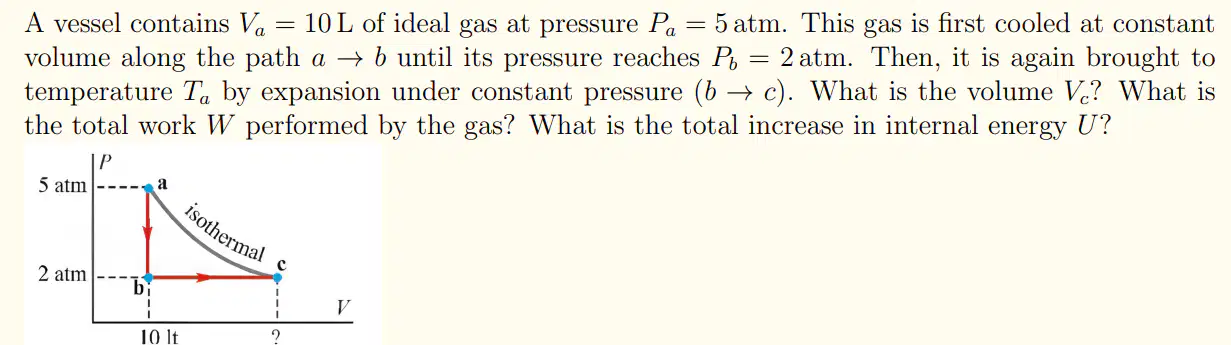
Vc = 2.5 L; W = 300 J; U = 0 J
Vc = 25 L; W = 0 J; U = 0 J
Vc = 25 L; W = 3000 J; U = 0 J
Vc = 25 L; W = 3000 J; U = 3000 J
A wheel of radius R rotates around the fixed xis. When a point at a distance R from the center, moves an angular speed of w second point, located at a distance R/2 from the center, moves with an angular velocity
4w
w
2w
w/2
Air density is 1.3 kg/m^3 at sea level. What would the thickness of the Earth's atmosphere be if the density of air did not decrease with height, remaining constant?
not enough information to say
78 km
7.8 km
100 km
Air undergoes a three-process cycle with a P = const process, a T = const process, and a V = const process. Select the correct statement for a piston-cylinder arrangement.
W = 0 for the P = const process
Q = 0 for the V = const process
Q = 0 for the T = const process
W = 0 for the V = const process
An aerodynamic tunnel must be used with a model car of size 20 cm to roughly reproduce the situation in which a car of size 550 cm travels at 15 m/s. What should be the wind speed in the tunnel? (Reynolds number has to be the same.)
410 m/s
4.10 m/s
0.41 m/s
41.0 m/s
An aluminum block of mass m1 = 0.1 kg at temperature T1 = 580 K is immersed in a glass vessel of mass m2 = 0.2 kg and having temperature T2 = 300 K. The glass vessel contains m3 = 0.5 kg of water at T2 = 300 K. Disregarding heat exchange with the surroundings, determine the equilibrium temperature TF of the system. The specific heats are: c1 = 896.0 J/kg·K (aluminum), c2 = 630.4 J/kg·K (glass), c3 = 4187.0 J/kg·K (water)
Tf=410.86 K
Tf=440.00 K
Tf=310.86 K
Tf = 390.66 K
An ice cube (density ρice = 920.0 kg/m3 ) with edge a = 4.0 cm floats in a cylindrical glass with section area S = 25.00 cm2 , filled with water up to a height h = 10.0 cm. Calculate the new height h ′ of the water when the cube is completely melted.
h ′ = 9.0 cm
h ′ = 11.0 cm
h ′ = 10.0 cm
h ′ = 9.5 cm
An inventor claims that a thermal engine, operating between ocean layers at 27◦C and 10◦C, produces 10 kW of power while discharging 9900 kJ/min. This engine is:
Impossible
reversible
possible
probable

A=4.0; f=0.25 Hz; T=4.0
A=4.0; f=0.5 Hz; T=2.0
A=4.0; f=1.5 Hz; T=0.7
A=40; f=0.5 Hz; T=2.0
An oscillator has an elastic constant k, mass m, and is subjected to a braking force proportional to the speed (F = −λv). It performs damped oscillations just when:
λ^2 > mk
λ^2 < mk
λ^2 < 4mk
λ^2 > 4mk
Bernoulli’s theorem:
deals with the relationship between the flow rate of a conduct and the viscous friction coefficient of the fluid
claims that in the points of a duct where the section is smaller, vortices are produced that increase the pressure locally
deals with the relationship between speed and pressure in a fluid at different points in the same conduct provided that the latter is not horizontal
deals with the relationship between speed and pressure in a fluid at different points in the same conduct
By introducing in a calorimeter at room temperature 300 g of water at 353 K, it is observed that at equilibrium the temperature is 323 K. Is it possible to deduce from this the thermal capacity of the calorimeter?
No, you need to know the nature of the various parts that make up the calorimeter, their specific heats, etc.
No, other data are required
Yes
No, is not an exact differential

A
B
C
D
Calculate the total entropy change if 10 kg of ice at 0◦C is mixed in an insulated container with 20 kg of water at 20◦C. (The heat of fusion for ice is 340 kJ/kg, and the process is thermally isolated.
0.21 kJ/K
3.9 kJ/K
1.2 kJ/K
6.1 kJ/K
Clapeyron’s formula, for phase transitions, states that the derivative of pressure versus temperature, dP/dT :
is inversely proportional to the latent heat of the substance.
is directly proportional to the temperature of the substance
is inversely proportional to the temperature of the substance.
does not depend on the density of the substance

