
 Worksheets
Hydraulics Final
Total questions: 85
Worksheet time: 3hrs 20mins

What is this ANSI symbol?
Working or Main Line
Pilot Line
Enclosure Line
Underline

What is this ANSI symbol?
Working Line
Pilot Line
Enclosure Line
Captain Line

What is this ANSI symbol?
Working Line
Pilot Line
Enclosure Line
Captain Line

What is this ANSI symbol?
Line, Flexible
Sturdy Line
Crossed Lines
Joined Lines

What is this ANSI symbol?
Direction of flow - Hydraulics
Direction of flow - Pneumatics
Needle Valve
Enclosure Line
What is this ANSI symbol?
Direction of flow - Hydraulics
Direction of flow - Pneumatics
Needle Valve
Enclosure Line

What is this ANSI symbol?
Direction of Flow - Hydraulics
Direction of flow - Pneumatics
Lines Crossing
Direction of flow - Water

What is this ANSI symbol?
Lines Joining
Lines Crossing
Flexible Lines
Swerve Lines

What is this ANSI symbol?
Lines Joining
Lines Crossing
Flexible Lines
T-Fitting

What is this ANSI symbol?
Single Acting Cylinder
Double Acting Cylinder
Push Button Actuator
Push Pop

What is this ANSI symbol?
Single Acting Cylinder
Double Acting Cylinder
Push Button Actuator
Push Pop

What is this ANSI symbol?
Fixed Displacement Hydraulic Pump
Variable Displacement Hydraulic Pump
Hydraulic Motor Fixed Displacement
Hydraulic Motor Variable Displacement

What is this ANSI symbol?
Fixed Displacement Hydraulic Pump
Variable Displacement Hydraulic Pump
Hydraulic Motor Fixed Displacement
Hydraulic Motor Variable Displacement

What is this ANSI symbol?
Fixed Displacement Hydraulic Pump
Variable Displacement Hydraulic Pump
Hydraulic Motor Fixed Displacement
Hydraulic Motor Variable Displacement

What is this ANSI symbol?
Fixed Displacement Hydraulic Pump
Variable Displacement Hydraulic Pump
Hydraulic Motor Fixed Displacement
Hydraulic Motor Variable Displacement

What is this ANSI symbol?
Electric Motor
Hydraulic Motor
Meter Valve
'Merica

Name this schematic symbol.
3/2 hand lever valve
4/2 hand lever valve
4/3 hand lever valve with shutoff position
2/2 way stem actuated
Which of these is a hydraulic pump unit?


Which one of these is a manual shutoff valve?


Which one of these is a hydraulic filter?


Which of these is a spring loaded, pilot operated check valve?


Which is a spring operated check valve?


Which of these is a hydraulic tank symbol?


Which of these is a diaphragm accumulator with shutoff block?


Which of the following is a 2/2 stem actuated valve?


Name this schematic symbol.
Check valve
Spring operated check valve
Spring loaded, pilot operated check valve
Shuttle valve
Which of these is a single acting actuator?


Which of these is a double acting actuator?


What are the considerations when choosing a replacement hydraulic hose?
Determine dash size and proper length
Ensure compatibility with fluid and proper pressure rating
Consider color and weight rating
Ensure proper weight and color coding

What are the two branches of Fluid Power.
Pneumatics and Hydrogen
Pneumatics and Horsepower
Pneumatics and Hydraulics
Pneumatics and Horoscops

What is a power unit in hydraulics known as?
Pump
Compressor
Filter
Internal Combustion Engine

P =F÷A If we are applying 20 pounds of force over 1 square inch how much pressure is being applied?
20 psi
30 psi
21 psi
20 pounds
What is a Hydraulic Check Valve?
A device that will only allow liquid to flow in one direction
A device that checks the quality of hydraulic fluid
A device that checks itself before it wrecks itself
A device that checks all valves in a hydraulic system
What are flow control valves used for in hydraulic systems?
Regulate flow rate of hydraulic fluid
Monitor temperature of hydraulic fluid
Filter hydraulic fluid
Control pressure of hydraulic fluid
Name two methods for controlling cylinder speed in hydraulic systems.
flow control valves and pressure control valves
volume control valves
temperature control valves
direction control valves
How does pressure-compensated flow control work?
Pressure-compensated flow control works by using a sensor to measure the flow rate and adjust the valve accordingly.
Pressure-compensated flow control works by increasing the pressure drop across the valve to increase the flow rate.
Pressure-compensated flow control works by adjusting the valve opening based on the flow rate.
Pressure-compensated flow control works by maintaining a constant pressure drop across the valve to regulate the flow rate.
What is the purpose of flow restrictors in hydraulic systems?
To increase the flow rate of fluid and regulate pressure.
To prevent the flow of fluid and increase pressure.
To filter the fluid and remove impurities.
The purpose of flow restrictors in hydraulic systems is to control the flow rate of fluid and regulate pressure.
Explain the concept of speed control circuits in hydraulic systems.
Speed control circuits in hydraulic systems are used to regulate the flow rate of hydraulic fluid.
Speed control circuits in hydraulic systems are used to regulate the speed of hydraulic actuators or motors.
Speed control circuits in hydraulic systems are used to adjust the pressure of hydraulic actuators or motors.
Speed control circuits in hydraulic systems are used to control the temperature of hydraulic fluid.
List three factors that can affect cylinder speed in hydraulic systems.
Fluid type, filter condition, pipe diameter
Valve type, hose length, reservoir size
Flow rate, piston size, pressure
Temperature, viscosity, cylinder material
What are the advantages of using pressure-compensated flow control?
Consistent flow rate and precise control of flow rates
Enhanced system reliability and longevity
Improved system stability and performance
Increased energy efficiency and reduced operating costs
How do flow restrictors help in controlling hydraulic flow?
By increasing the flow rate of fluid passing through a system
By reducing the flow rate of fluid passing through a system
By diverting the flow of fluid to different components
By preventing the flow of fluid through the system
Describe the working principle of a speed control circuit in a hydraulic system.
A speed control circuit in a hydraulic system works by adjusting the temperature of the hydraulic fluid to control the speed of a hydraulic actuator.
A speed control circuit in a hydraulic system works by changing the pressure of the hydraulic fluid to control the speed of a hydraulic actuator.
A speed control circuit in a hydraulic system works by altering the viscosity of the hydraulic fluid to control the speed of a hydraulic actuator.
A speed control circuit in a hydraulic system works by regulating the flow of hydraulic fluid to control the speed of a hydraulic actuator.
Name this schematic symbol.
Check valve
Spring operated check valve
Spring loaded, pilot operated check valve
Shuttle valve

What is this?
spring accumulator
weighted accumulator
gas accumulator
accumulator

What is this?
spring accumulator
gas accumulator
accumulator
weighted accumulator

What is this?
sharp-edge orifice
fixed orifice
variable orifice
shuttle valve

What is this?
fixed orifice
spring-loaded check valve
shuttle valve
one-way check valve

What is this?
fixed orifice
variable orifice
sharp edge orfice
shuttle valve

What is this?
enclosed component
pressurized reservoir
open component
accumulator
What is the approx pressure range that Hydraulic systems operate in ?
20 - 40 psi
50-70 psi
700 - 9000
80 - 100 psi
What must you NEVER do with respect to a hydraulic hose leak ?
Turn off the hydraulic pump before you start working on it
Clean up oil spills immediately
Lock and Tag the electrical switch and put the keys in your pocket.
Place your finger over the leak in an attempt to stop this
Which of the following is a disadvantage of a hydraulic system?
High power density
Precise control
Low maintenance
Potential for leaks
What are the five elements of a hydraulic system?
Driver, pushbotton, motor, control valves, sensors.
Reservoir, gear pump, relief valve, directional control valve and actuator cylinder.
Driver, gear pump, motor, control valves, sensors.
Driver, pump, motor, relief valve, directional control valve
Pressure in a liquid is transmitted equally throughout the liquid.
Pascal's Law
Multiplication of force
Law of Conservation of Energy
Cycle time
Energy may be changed from one form to another, but it cannot either be created or destroyed
Law of OHM
Law of conservation of energy
Multiplication of force
Pascal's law
Converts fluid energy into mechanical energy
Rotary actuator
Hydraulic actuator
Linear actuator
Straight line actuator
Delivers the same volume of oil per cycle regardless of the pressure at the pump outlet
Pump
Positive displacement pump
Gear pump
Pressure relief valve
Graphic symbols show flow paths, connections, and functions of components.
True
False
Hydraulic fluids lubricate moving parts of a circuit.
True
False
Strainer screens are rated in microns and filters are rated in mesh.
True
False
A flared fitting is a fitting that is connected to tubing with an end that is spread outward.
True
False
The higher the mesh number of a strainer, the smaller the opening.
True
False
Tubing may be connected by welding or compression.
True
False
Positive displacement is the movement of a fixed volume of fluid with each revolution of a hydraulic pump.
True
False
A spur gear has straight teeth that are parallel to the shaft axes in a gear pump.
True
False
A pressure-relief valve is a valve that sets a maximum operating pressure level for a circuit to protect the circuit from overpressure.
True
False
Vane pumps are the most widely used hydraulic pumps because of their simple design and ease of repair.
True
False
A double-acting cylinder will extend when oil flows into the ____.
Rod end
Piston
Cap end
Pump
Pressure is equal to force divided by ____.
Weight
Liquid
Gas
Area
A(n) ____ fitting is used when you want to connect two circuits to a single supply.
Reducer
Tee
Elbow
Four-way
Fluid power deals with the transmission and control of energy by a pressurized ____.
Vessel
Directional Control Valve
Electric motor
Fluid
Quick-connect fittings have a ____ valve built in.
Directional Control
Relief
Check
Sequence
Another name for a cylinder would be a(n) ____.
Power input device
Valve
Control device
Actuator
Pressure is created by the ____.
Pump
Reservoir
Resistance to flow
Flow meter
Pascal's law states that pressure in a confined fluid is equal and acts ____.
On flat surfaces
Perpendicular to all surfaces
Only at the bottom of the vessel
Only against the external load
The hydraulic lever provides ____.
Flow multiplication
A pressure drop
Power multiplication
Force multiplication
Check valves are used in hydraulics to ____.
Control flow
Control speed
Block flow
Control system pressure
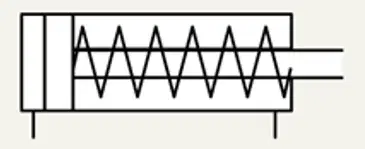
What does this symbol represent?
How to cross out a mistake on a circuit
Spring actuated pilot
Single acting cylinder
Spring loaded flow control valve
A 3/2 valve has
1.5 ports
3 ports and 2 directions
3 directions and 2 ports
5 ports and 2 directions
Pneumatic and other power systems can support three kinds of motion; they are
Linear, reciprocating, and random motion
Linear, flowing, and rotary motion
Linear, reciprocating, and rotary motion
Linear, zigzag, and spiral motion
What is Pascal's law?
A scientific principle related to fluid mechanics.
A principle of chemistry related to atomic structure
A mathematical theorem about prime numbers
A law of physics related to electricity
State the formula for calculating pressure using Pascal's principle.
P = F/A
P = F*d
P = F/m
P = F/V

If a downward force is applied to piston A, it will be transmitted through the system to piston B.
According to Pascal’s law,the pressure at piston A (P1) equals the pressure at piston B (P2).
True
False

