
Font size
 Worksheets
Lab ES Final Practice Test
Total questions: 82
Worksheet time: 45mins
What are the four major layers of the Earth?
Crust, Mantle, Core, Atmosphere
Lithosphere, Mantle, Inner Core, Outer Core
Hydrosphere, Biosphere, Mantle, Core
Troposphere, Stratosphere, Mantle, Core
Saltwater biomes have around (a) % salinity, while freshwater biomes have around .1%.
3
13
30
50
The amount of saltwater on the earth’s surface is vastly larger than the amount of freshwater.
True
False
The location in which freshwater and saltwater mix at the mouth of a river is known as a(n)
intertidal zone
productivity zone
euphotic zone
estuary
In terrestrial biomes, the factor limiting photosynthesis is __________, whereas in marine biomes, it is ___________.
light, oxygen
carbon dioxide, light
light, nutrients
nutrients, carbon dioxide
Which of the following is NOT a characteristic of an organism living in the intertidal zone?
the ability to be submerged under water
the ability to photosynthesize with little sunlight
the ability to securely attach to a substrate
the ability to tolerate desiccation (drying out)
The portion of the ocean where sunlight can penetrate the water is known as _______________.
intertidal zone
productivity zone
euphotic zone
estuary
Which of the following is NOT a condition that would be found in an area of high marine productivity?
Strong thermoclines
High levels of nutrients
Upwelling
High amounts of phytoplankton
What type of relationship exists between stony marine corals and zooxanthellae?
commensalistic
parasitic
mutualistic
predatory
Of the following ocean zones, which makes up the greatest percentage of the open ocean?
euphotic zone
aphotic zone
disphotic zone
photic zone
Which wavelengths of light are able to penetrate deepest into the ocean?
red
purple
blue
yellow
Which of the following is NOT a benefit that can be gained from aquaculture?
Stable income for fishermen
Fewer diseases for fish
Reduced fuel consumption for commercial fishing vessels
Requires less aquatic area to yield the same catch
(a) are used to redistribute oil after an oil spill, but they often cause oil to sink to the bottom, affecting aquatic habitats.
Sorbents
Booms
Dispersants
Skimmers
A large farm near your house is contaminating the local stream with fertilizer runoff. This pollution could be categorized as (a) .
point-source chemical pollution
nonpoint-source nutrient pollution
point-source sediment pollution
nonpoint-source thermal pollution
A nuclear power plant discharges thermal pollution into a nearby water supply. How will this affect the water quality in this area?
the dissolved oxygen in the water will increase
the dissolved oxygen in the water will decrease
the pH of the water will increase
the pH of the water will decrease
What type of pollution includes POPs?
biological pollution
nutrient pollution
chemical pollution
sediment pollution
Which trophic level would be most susceptible to biomagnification of POPs?
producers
primary consumers
secondary consumers
tertiary consumers
Which of the following is NOT a possible result of microplastic pollution in an aquatic ecosystem?
The organisms get less nutrition
The organisms get caught in the plastic pollution
The organisms get endocrine disorders
The organisms may have offspring with birth defects
The anoxic soils in wetlands allow them to be __________ sinks.
carbon
nitrogen
photosynthetic
mitigation
Which type of pollution could cause higher murkiness in a stream?
chemical
biological
thermal
sediment
Which of the following would concern water quality in a local waterway?
high dissolved oxygen
cold temperature
low pH
low hardness
The source of most irrigation and drinking water is
flowing surface water such as streams and rivers
surface water reservoirs such as lakes and ponds
the ocean
underground
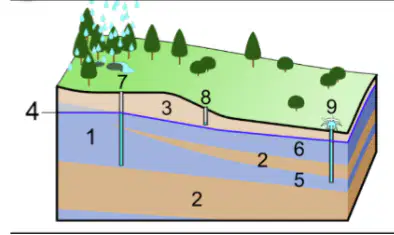
In the image, which number is an example of a confined aquifer?
2
5
6
9
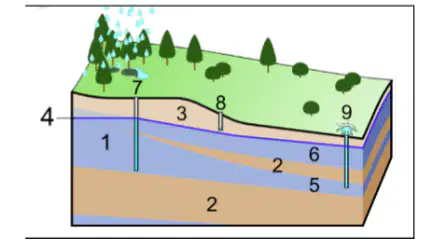
In the image, which number is an example of an aquitard?
2
3
8
9
Which of these was NOT a primary cause of the Dust Bowl?
prolonged drought
poor farming techniques
weather
surface water quickly draining into cracks in the soil
Which of these is NOT true about water?
water expands as a solid
water is a nonpolar molecule
water has a neutral pH
water has a high specific heat
The reason water striders can sit on the top of a body of water is due to which property?
cohesion
evaporation
adhesion
inversion
Which process brings water into the ground?
transpiration
condensation
infiltration
evaporation
Which is not true about aquifers?
confined aquifers recharge slowly.
an aquifer consists of a layer of permeable rock and the water in its pores.
artesian wells cannot be drilled directly into an aquifer due to tremendous water pressure.
water in an unconfined aquifer cannot be recharged.
Which of the following is NOT true of acid rain?
It is caused by a mixing of air pollutants with water vapor.
It raises the pH of rain water.
It can strip trees of leaves and needles.
It can damage statues and buildings.
How does deforestation affect the local climate?
A. A lack of trees reduces the humidity in the air.
B. Groundwater infiltration will decrease.
C. Precipitation will increase.
D. Both A & B are correct.
E. Both B & C are correct.
Which of the following is NOT true of headwaters?
The water is usually cold.
The water usually flows quickly.
The water contains a wide variety of organisms.
The water usually has little sediment.
The area in which freshwater meets saltwater is called
an estuary.
a watershed.
a headwater.
a waterfall.
When groundwater is pumped from aquifers, it can leave dissolved salts behind on the surface of the soil. This process is known as ______________.
evapotranspiration
salinization
artesian welling
recharging
The lithosphere is also known as the Earth’s...
Mantle
Core
Crust
Atmosphere
What is the outermost layer of the Earth called?
mantle
inner core
outer core
lithosphere
The boundary between the Earth’s crust and the mantle is known as…
Asthenosphere
Lithosphere
Mohorovicic discontinuity
Tectonic boundary
Which type of rock is NOT a major type found in the lithosphere?
Sedimentary
Igneous
Metamorphic
Basaltic
What causes the movement of tectonic plates?
Gravity
Convection currents in the asthenosphere
Solar radiation
Magnetic fields
What causes earthquakes?
Sudden movement of the moon
Stress at a fault causing plates to slip
Volcanic eruptions
Heavy rainfall
What forms at a convergent plate boundary?
Volcanoes
Deserts
Canyons
Islands
Urbanization is defined as:
The migration of people from urban to rural areas
The concentration of population in cities
The decrease of land used for agriculture
The increase in global temperatures
What is the primary purpose of Euclidean zoning?
To promote industrial development
To separate residential areas from industrial pollution
To increase traffic congestion
To reduce the efficiency of land use
A major effect of urbanization on the environment is:
Increased biodiversity
Creation of heat islands
Reduction in pollution
Expansion of wildlife habitats
Sustainability aims to:
Use resources faster than they are replenished
Meet the needs of the present without compromising future needs.
Focus solely on economic growth
Prioritize short-term gains over long-term stability
The main cause of deforestation is:
Urban expansion
Agriculture
Natural disasters
Renewable energy projects
The Green Revolution was characterized by:
A. A return to traditional farming methods
B. The development of disease-resistant wheat varieties
C. An increase in the use of chemical pesticides
D. A decrease in global food production
Sustainable agriculture practices include:
Using high levels of chemical fertilizers
Monoculture cropping
Cover crops to prevent erosion
Clear cutting forests for farmland
Organic farming avoids the use of:
Crop rotation
Synthetic fertilizers
Manure
GMOs
What is the downside of organic farming?
It leads to higher yields than conventional farming
It is more productive per hectare
It requires more land for the same yields
It uses more chemical pesticides
A city is planning to expand its urban area to accommodate the growing population. To minimize environmental impact, they should consider:
Increasing impervious surfaces to reduce water absorption
Developing green spaces and vertical forests
Expanding industrial zones into nearby forests
Decreasing public transportation options
After an earthquake, a region is focusing on rebuilding. What practice would best ensure the safety and sustainability of the rebuilt area?
Rebuilding using the same urban planning principles as before
Implementing strict zoning codes to prevent residential areas from being too close to fault lines
Increasing the density of buildings to accommodate more people
Focusing solely on rapid reconstruction without considering future earthquake risks
A community near a deforested area is experiencing decreased air quality and higher temperatures. A sustainable solution to address these issues would be to:
Increase industrial activities to boost the economy
Implement a large-scale reforestation project
Build more residential areas to accommodate displaced wildlife
Encourage the use of air conditioning units to combat heat
To combat the effects of climate change, a city decides to revamp its urban planning. Which of the following would be the most effective strategy?
Increasing the number of factories to boost job creation
Developing more highways to reduce traffic congestion
Integrating renewable energy sources and green spaces into city planning
Expanding residential zones into nearby natural habitats
A farming community is facing soil degradation due to overuse of chemical fertilizers. To improve soil health sustainably, they should:
Continue current practices but increase the amount of fertilizers
Switch to organic farming practices, including the use of manure and crop rotation
Abandon agriculture in favor of urban development
Introduce genetically modified organisms to increase yields without addressing soil health
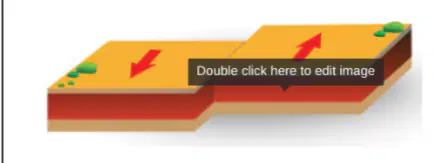
Which boundary type is represented in the picture?
Convergent
Transform
Divergent
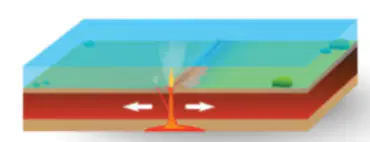
Which boundary type is represented in the picture?
Convergent
Transform
Divergent
Sources like coal and oil, not easily replenished.
soil
natural gas
fossil fuels
nonrenewable energy
A fossil fuel extensively used for electricity.
renewable energy
natural gas
coal
petroleum
Produces low greenhouse gases.
pros of renewable energy
cons of renewable energy
natural gas
fossil fuels
Formed from ancient decomposed plants and animals.
renewable energy
coal
natural gas
fossil fuel
Sources easily replenished, like wind and solar.
renewable energy
coal
natural gas
fossil fuel
A fossil fuel used for energy production such as transportation.
petroleum
coal
natural gas
fossil fuel
Inconsistent electricity production, requires large land parcels.
pros of renewable energy
cons of renewable energy
natural gas
fossil fuels
The ability to do work.
fossil fuel depletion issues
power
technology
energy
Takes millions of years to form, and depleting quickly, contributes to climate change.
fossil fuel depletion issues
fossil fuel
renewable energy
energy
Burns coal or oil to generate electricity.
fossil fuel depletion issues
fossil fuel plant electricity
coal mines
nuclear plant
Generates power using aerodynamic force; can be built on land and offshore
concentrated solar thermal
hydroelectric power
solar panels
wind turbines
Are there more clouds in the sky when air pressure is high or low?
High
Low
The number of clouds is unrelated to air pressure
If Earth’s axis is tipping away from the sun, that means the Northern Hemisphere is in which season?
Spring
Summer
Autumn
Winter
Label the layers of the atmosphere.
Thermosphere
Troposphere
Exosphere
Mesosphere
Stratosphere
The main layer of the atmosphere responsible for weather is (a)
Which layer of the atmosphere contains the Ozone Layer? (a)

Match the following descriptions to the correct term.
plant eater
herbivore
meat eater
carnivore
break down dead organic matter
decomposer
consumes both plants & animals
omnivore
consumes dead organisms
scavanger
What would be a good example of a primary consumer?
carnivore
detrivore
decomposer
herbivore
A chimpanzee eats fruits, nuts, leaves, and small mammals. What kind of organism is a chimpanzee?
carnivore
decomposer
producer
omnivore


The biome shown in the climatogram above would best be described as a:
temperate deciduous forest
desert
tundra
tropical rain forest

According to the diagram, which of the following both have large amounts of precipitation?
desert & tropical rain forest
seasonal forest & tundra
tundra & desert
tropical rain forest & temperate rain forest

