
 Worksheets
WWII Final Review
Total questions: 59
Worksheet time: 44mins
The Soviet Union signed a non-aggression pact in 1939 with
Italy
Poland
Germany
Great Britain
With which country did the Soviet Union sign the Molotov-Ribbentrop Pact in 1939?
France
Japan
Germany
United States
Which event occurring in Hawaii brought America into World War II?
Battle of Guadalcanal
Bombing of Hiroshima
Hitler’s invasion of Poland
Attack on Pearl Harbor
What significant event in Hawaii led the United States to enter World War II?
Battle of Midway
Attack on Pearl Harbor
Signing of the Treaty of Versailles
Battle of Iwo Jima
Where were atomic bombs dropped?
Dresden and Berlin
Tokyo and Hong Kong
Hiroshima and Nagasaki
Leyte Island and Midway Island
Which two Japanese cities were targeted with atomic bombs during World War II?
Osaka and Kyoto
Hiroshima and Nagasaki
Sapporo and Yokohama
Kobe and Fukuoka
Hitler’s idea of the master race was based on the idea that:
Germans were superior to others
Racial background didn’t matter
The races were all equal
The Aryans were not German
According to Nazi ideology, which group was considered the most superior?
Aryans
Slavs
Jews
Romans
Fascism could be defined as:
Extreme nationalism combined with totalitarianism
Religious extremism bordering on violence
Dictatorship of the proletariat
Capitalism and socialism combined
Which of the following best describes the main feature of fascist ideology?
Authoritarian control and suppression of opposition
Promotion of global democracy
Emphasis on individual freedoms
Support for a classless society
Why did U.S. President Truman agree to use the atomic bomb?
To punish Japan for Pearl Harbor
To avenge the lives of civilians killed in the Pacific Islands
To destroy weapons plants in Japan
To bring the way to the quickest possible end.
What was President Truman's main reason for authorizing the use of the atomic bomb during World War II?
To demonstrate U.S. military power to the world
To force Japan to surrender quickly and end the war
To retaliate for attacks on American soldiers
To destroy Japanese cultural sites
Which person was the Soviet dictator during World War II?
Joseph Stalin
Adolf Hitler
Vladimir Lenin
Benito Mussolini
Who led the Soviet Union during the Second World War?
Joseph Stalin
Leon Trotsky
Nikita Khrushchev
Winston Churchill
Which national leader of World War II is NOT correctly matched with his country?
Benito Mussolini - Italy
Adolf Hitler - Germany
Tojo Hideki - Japan
Joseph Stalin – France
Which of the following World War II leaders is incorrectly paired with his nation?
Winston Churchill - United Kingdom
Franklin D. Roosevelt - United States
Charles de Gaulle - Soviet Union
Emperor Hirohito - Japan
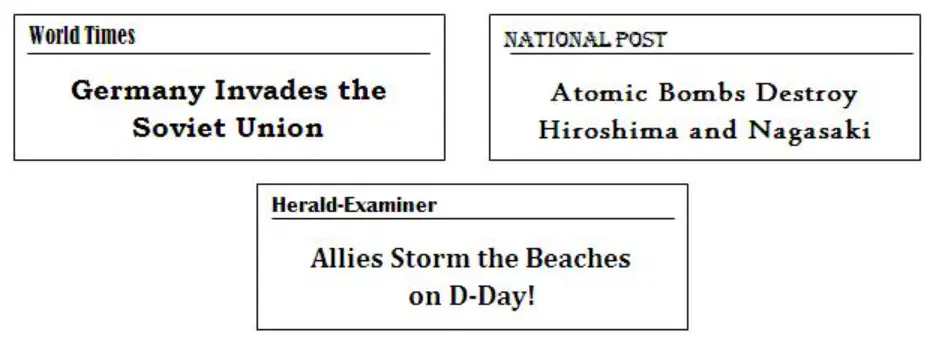
Which war would BEST be associated with these headlines above?
Cold War
World War I
World War II
Korean War
Which two countries became military superpowers after World War II?
Poland and France
Germany and Italy
Soviet Union and the United States
Japan and China
After World War II, which two nations emerged as the dominant global military powers?
United Kingdom and France
Italy and Japan
United States and Soviet Union
Germany and China
Which person was the Soviet dictator during WWII?
Joseph Stalin
Adolf Hitler
Vladimir Lenin
Benito Mussolini
Which is the BEST example of attempted genocide during World War II?
The American effort to detain Japanese-Americans in relocation camps
The German effort to topple Soviet government officials
The American effort to infiltrate the German high command
The German effort to kill all people of Jewish heritage
Which event during World War II is considered a clear example of genocide?
The internment of Japanese-Americans by the United States
The German campaign against Soviet military leaders
The Allied bombing of German cities
The systematic extermination of Jews by Nazi Germany
Who was the British prime minister during World War II?
Harry Truman
Franklin D. Roosevelt
Winston Churchill
David Lloyd George
Who was the British prime minister during World War II?
Harry Truman
Franklin D. Roosevelt
Winston Churchill
David Lloyd George
Following World War II, Germany and Berlin were NOT occupied by -
France
the United States
the Soviet Union
China
Which of the following countries did NOT have a zone of occupation in Germany after World War II?
the United States
the Soviet Union
France
Japan
Which document was created by the United Nations to establish a code of conduct for the treatment of people under the protection of their government?
Universal Declaration of Human Rights
Charter of Rights and Freedoms
Monroe Doctrine
Treaty of Versailles
Which United Nations document outlines fundamental rights and freedoms that should be protected for all individuals?
Universal Declaration of Human Rights
Geneva Convention
Magna Carta
Emancipation Proclamation
Which of the following best describes a communist system?
Businesses are owned by private individuals.
The government controls the economy and most property
Citizens have many freedoms and choices.
In a communist system, who typically owns and manages most resources and industries?
Private corporations
The government
Individual citizens
The U.S. policy of containment was aimed at preventing the spread of what?
Democracy
Capitalism
Communism
During the Cold War, what ideology did the United States seek to limit through its foreign policy?
Socialism
Communism
Fascism
What did the term "Iron Curtain" symbolize?
The physical border between the US and the USSR
The division between democratic and communist countries in Europe
A trade agreement between Eastern and Western Europe
Which phrase best describes the meaning of the "Iron Curtain" during the Cold War?
The military alliance between the US and Western Europe
The symbolic separation of Eastern and Western Europe
The construction of the Berlin Wall
Which side did China support when it entered the Korean War?
South Korea
The United States
North Korea
During the Korean War, which country did China provide military assistance to?
Japan
North Korea
South Korea
What was the status of Vietnam after Ho Chi Minh's fight for independence?
It became a unified democratic nation.
It became a unified communist nation.
It was divided into North Vietnam and South Vietnam.
What happened to Vietnam following the end of French colonial rule?
It was immediately united under one government.
It was split into two separate countries.
It became a colony of another European power.
The U.S. involvement in the Vietnam War was primarily motivated by the desire to:
Support Vietnamese independence from France
Promote democratic elections in Vietnam
Prevent the spread of communism in Southeast Asia
What was the main reason for the United States' intervention in the conflict in Vietnam?
To assist France in regaining control over its former colony
To stop the influence of communism from expanding in the region
To establish a monarchy in Vietnam
What was the Cuban Missile Crisis?
A trade dispute between Cuba and the United States
A nuclear standoff between the US and the Soviet Union
A revolution in Cuba
Which event brought the United States and the Soviet Union to the brink of nuclear war in 1962?
The Bay of Pigs Invasion
The Cuban Missile Crisis
The Berlin Blockade
The fall of the Berlin Wall was significant because it symbolized:
A minor shift in East German border policy.
The end of World War II.
The collapse of communist regimes in Eastern Europe and the end of the Cold War's division.
What did the fall of the Berlin Wall in 1989 come to represent in world history?
The beginning of the Cold War.
The reunification of Germany and the decline of Soviet influence in Eastern Europe.
A change in West German immigration policy.
What was the outcome of the Korean War?
North Korea conquered South Korea.
Korea remained divided.
South Korea conquered North Korea.
How did the Korean War affect the division of Korea?
It led to the unification of Korea.
The division between North and South Korea continued.
North Korea became part of South Korea.
Who proposed the Strategic Defense Initiative, aka Star Wars?
Margaret Thatcher
Ronald Reagan
Mikhail Gorbachev
Which U.S. president announced the Strategic Defense Initiative in 1983?
Ronald Reagan
George H. W. Bush
Jimmy Carter
The idea of nuclear deterrence suggested that:
Only one side should have nuclear weapons.
The use of nuclear weapons was the best way to win a war.
Neither side would attack because both had nuclear weapons.
What was the main purpose of the policy of nuclear deterrence during the Cold War?
To encourage the use of nuclear weapons in conflicts.
To prevent both sides from launching a nuclear attack.
To ensure only one country had nuclear capabilities.
What did the policies of "Glasnost" and "Perestoika," introduced by Gorbachev, mean?
political repression, political liberalization
openness, restructuring
increased censorship, military expansion
Which of the following best describes the main goals of Gorbachev's reforms of "Glasnost" and "Perestroika"?
increasing government secrecy and economic isolation
promoting transparency and economic restructuring
strengthening authoritarian rule and limiting free speech
What type of economic policy did Reagan generally believe in?
Socialist policies with nationalized industries
Conservative economic policy, including tax cuts and deregulation
Keynesian economics with significant government intervention
Which of the following best describes Ronald Reagan's approach to economic policy during his presidency?
Government ownership of major industries
Reducing government regulation and lowering taxes
Increasing government spending on social programs
What type of government does Vietnam have today?
Democratic
Reunited Communist
Republic
Which political system is currently in place in Vietnam?
Monarchy
Communist State
Federal Republic
What is the primary purpose of NATO?
To promote economic cooperation among Asian countries
To provide collective defense for its member countries
To regulate international trade laws
Which of the following best describes NATO?
A military alliance between the Soviet Union and its allies
A trade agreement between the US and Western Europe
A military alliance between the US and its allies
U.S. Naval base attacked by the Japanese that brought the U.S. into WW II.
Pearl Harbor, Hawaii
San Diego, California
Corpus Christi, Texas
San Juan Puerto Rico

