
Font size
 Worksheets
Weather and Climate Regents Review
Total questions: 96
Worksheet time: 48mins
What is the meaning of the term 'Gravity'?
Gravity is the force that attracts objects toward the center of the Earth or toward any other physical body having mass.
Gravity is the process of water turning into vapor.
Gravity is the energy produced by the sun.
Gravity is the movement of air from high pressure to low pressure.
What is the 'Atmosphere'?
The atmosphere is the layer of gases surrounding the Earth or another planet.
The atmosphere is the solid crust of the Earth.
The atmosphere is the core of the Earth.
The atmosphere is the collection of all water bodies on Earth.
What does 'Hydrosphere' refer to?
The hydrosphere refers to all the waters on the Earth's surface, such as lakes and seas, and sometimes including water over the Earth's surface, such as clouds.
The hydrosphere refers to the solid outer layer of the Earth, including rocks and soil.
The hydrosphere refers to the layer of gases surrounding the Earth.
The hydrosphere refers to all living organisms on Earth.
What is the 'Universe'?
The universe is all of space and everything in it, including stars, planets, galaxies, and all forms of matter and energy.
The universe is only the Earth and its atmosphere.
The universe is just the Sun and the Moon.
The universe is a single galaxy in space.
What are 'Seasons'?
Seasons are the four divisions of the year (spring, summer, autumn, and winter) marked by particular weather patterns and daylight hours, resulting from the Earth's changing position with regard to the sun.
Seasons are the phases of the moon that occur every month.
Seasons are the names given to different types of storms.
Seasons are the periods when animals migrate from one place to another.
Fill in the blank: Earth's climate is driven by the balance of energy coming from the ______ and the energy Earth radiates back into space.
sun
moon
ocean
atmosphere
Fill in the blank: Human activities, especially the burning of ______, are increasing greenhouse gases, causing global temperatures to rise.
fossil fuels
plastic waste
nuclear materials
solar panels
Fill in the blank: Weather patterns result from the movement and interaction of different ______ and fronts.
air masses
water currents
mountain ranges
solar flares
Fill in the blank: The equilibrium between incoming solar radiation and outgoing terrestrial radiation is called _________.
Energy balance
Greenhouse effect
Albedo
Photosynthesis
Fill in the blank: _________ is the energy emitted from the sun that reaches Earth.
Solar radiation
Geothermal energy
Wind energy
Nuclear energy
Fill in the blank: _________ is heat energy re-emitted from Earth’s surface.
Infrared Radiation
Ultraviolet Radiation
Visible Light
Gamma Rays
Fill in the blank: _________ are atmospheric gases (e.g., CO₂, methane, water vapor) that trap heat in the atmosphere.
Greenhouse gases
Noble gases
Trace elements
Mineral particles
Fill in the blank: The reflectivity of Earth’s surface is called the _________; higher values mean more solar energy reflected back to space.
Albedo effect
Greenhouse effect
Coriolis force
Ozone layer
Fill in the blank: _________ refers to natural fluctuations in climate patterns over short or long time periods.
Climate variability
Climate change
Global warming
Greenhouse effect
Fill in the blank: _________ are particles released by volcanic eruptions that can reflect sunlight and cool the atmosphere temporarily.
Volcanic aerosols
Lava flows
Igneous rocks
Magma chambers
Fill in the blank: _________ means human-caused, often referring to sources of greenhouse gas emissions.
Anthropogenic
Photosynthetic
Geological
Astronomical
What is latitude?
The distance east or west of the prime meridian
How north or south you are of the equator
The height above sea level
The amount of rainfall in a region
Throughout the world there are different wind belts, known as global winds. What effect do these wind belts have?
They bring warm or cold air to different regions
They increase rainfall everywhere
They cause earthquakes
They have no effect on climate
Fill in the blank: Water takes a really long time to heat up and a long time to cool down. If you live close to the ocean it acts like a ________, keeping temperatures more mild.
regulator
barrier
conductor
insulator
How do landscapes like mountains, hills, and valleys affect a region's climate?
They have no effect
They can block clouds and cause different conditions on each side
They increase the temperature everywhere
They only affect deserts
Earth’s climate is driven by the balance between energy received from the sun and energy lost to space.
True
False
What are Milankovitch cycles?
Changes in ocean currents
Changes in solar radiation, Earth’s orbit, and volcanic activity
Changes in wind direction
Changes in rainfall patterns
Which feedback amplifies cooling by increasing reflection from ice?
CO₂ Feedback
Ice-Albedo Feedback
Greenhouse Gas Feedback
Ocean Feedback
Fill in the blank: Greenhouse gases trap ______, maintaining Earth’s temperature; increases in these gases lead to warming.
heat
light
sound
water
Human activities such as burning fossil fuels increase greenhouse gases and alter the natural energy balance.
True
False
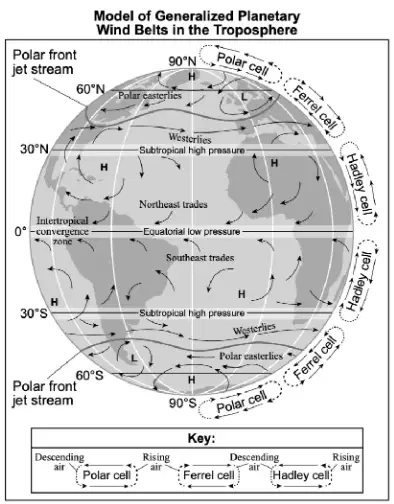
Which wind belt is found between 30°N and 60°N?
Northeast trades
Southeast trades
Westerlies
Polar easterlies
According to the Earth and Space Science Reference Table, which wind belt is found near the equator?
Trade winds
Prevailing westerlies
Polar easterlies
Subtropical jet stream
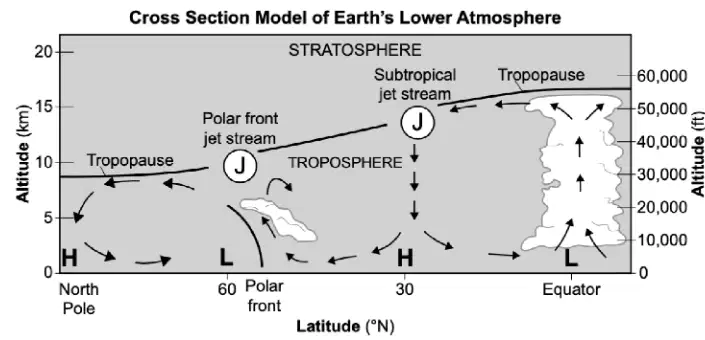
Based on the Cross Section Model of Earth's Lower Atmosphere, what is the name of the atmospheric layer where weather happens?
Troposphere
Stratosphere
Mesosphere
Thermosphere
According to the Earth and Space Science Reference Table, the stratosphere contains the ________ layer.
ozone
troposphere
ionosphere
mesosphere
Which of the following statements is true according to the Earth and Space Science Reference Table?
The troposphere is above the stratosphere.
The stratosphere contains the ozone layer.
Weather happens in the stratosphere.
The polar easterlies are found near the equator.
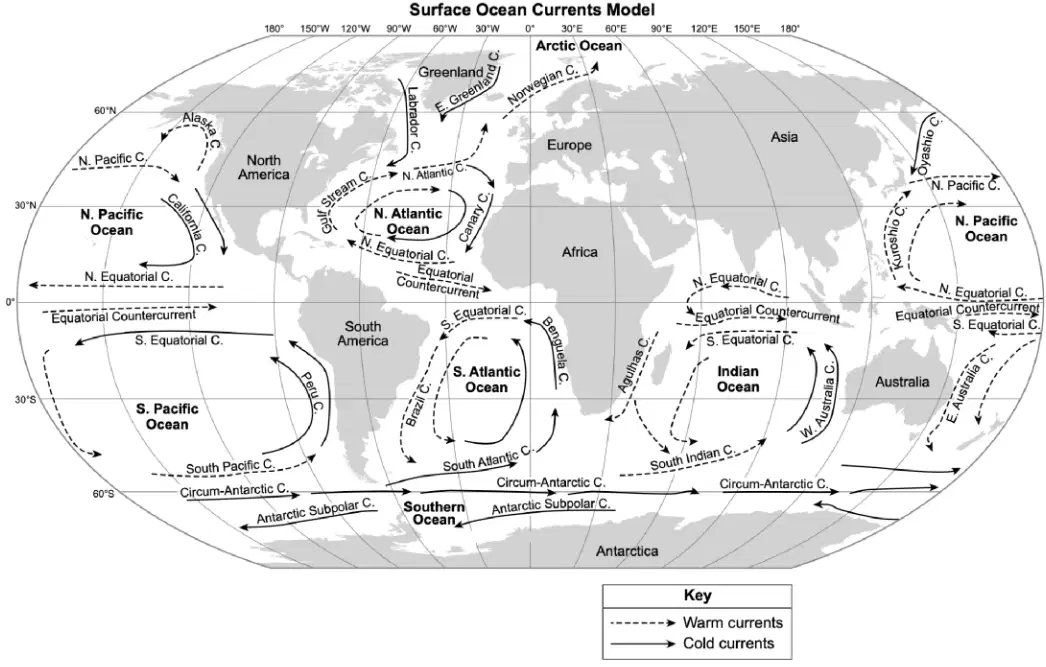
According to the key, what type of current is represented by a dashed line on the map?
Warm current
Cold current
Both warm and cold currents
None of the above
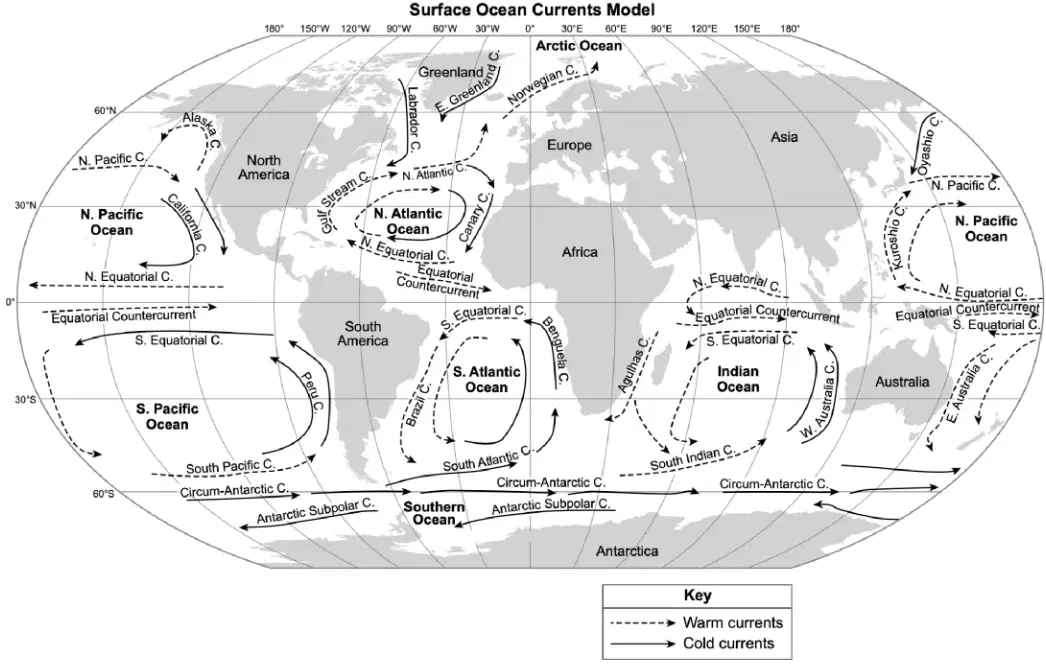
The North Atlantic Current is an example of which type of current?
Warm current
Cold current
Tidal current
Upwelling current
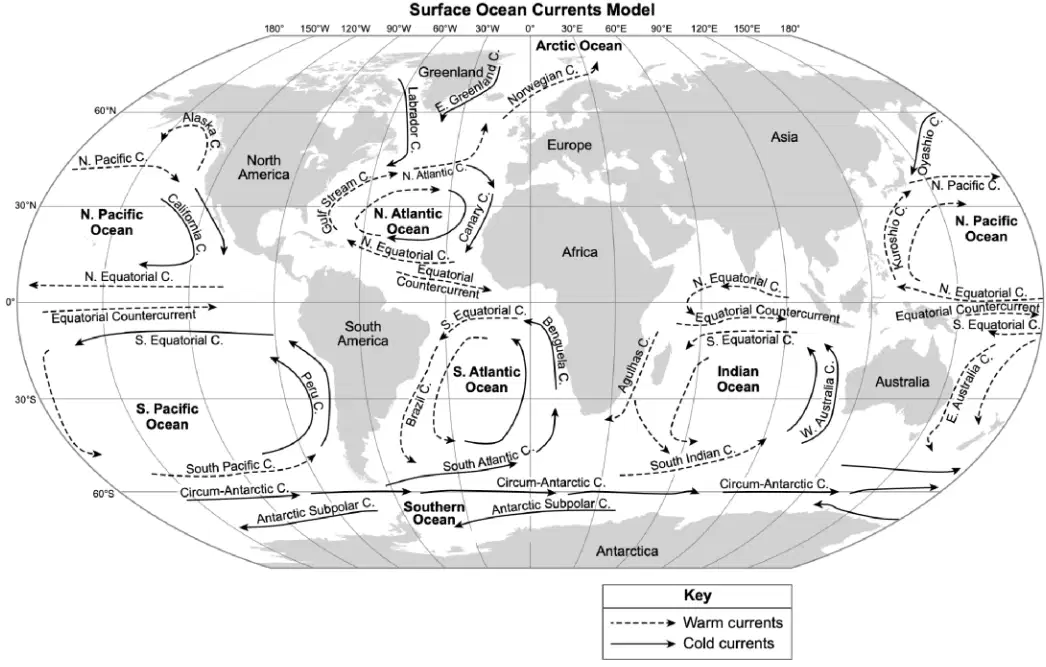
Name one way that surface ocean currents help regulate climate across the planet.
Surface ocean currents help regulate climate by redistributing heat across the planet.
Surface ocean currents increase the salinity of all ocean water.
Surface ocean currents cause the Earth's rotation to speed up.
Surface ocean currents create new land masses.
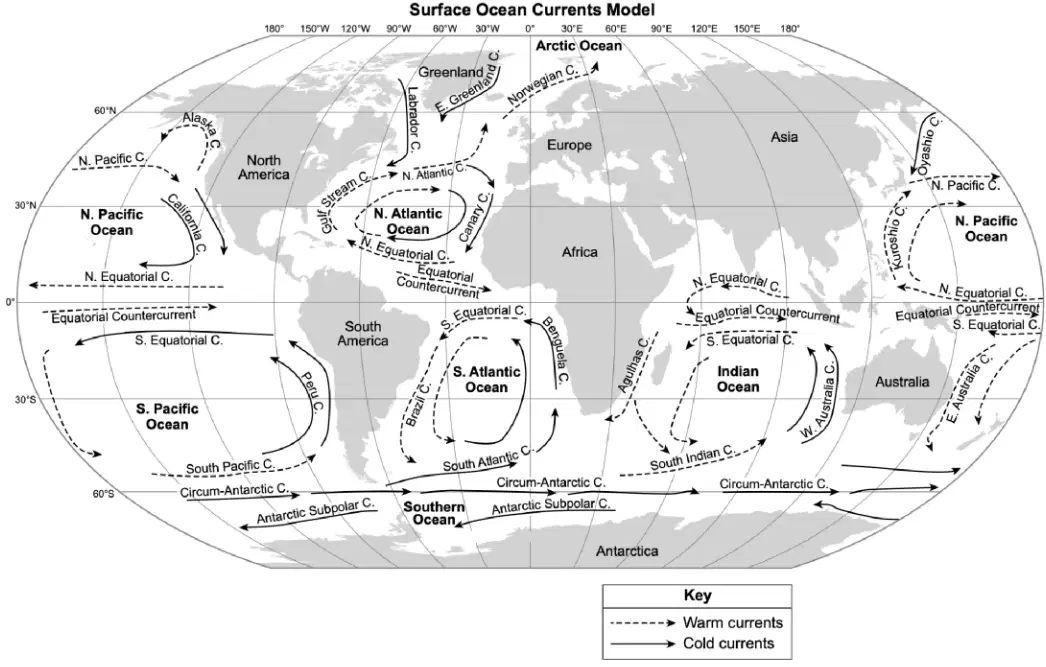
Based on the 'Surface Ocean Currents Model' map and the provided information, the movement of surface ocean currents can impact regional climates by:
Transferring heat between the equator and the poles
Increasing the salinity of the ocean
Causing earthquakes along coastlines
Raising sea levels globally
Fill in the blank: ________ is data related to Earth sciences like temperature records, ice cores, sea levels, etc.
Geoscience Data
Financial Data
Literary Data
Medical Data
Fill in the blank: The warming of Earth’s surface due to trapped heat by greenhouse gases is called the ________.
Greenhouse effect
Ozone depletion
Acid rain
Photosynthesis
Fill in the blank: The total greenhouse gas emissions caused by an individual, organization, or activity is known as the ________.
Carbon footprint
Greenhouse effect
Ozone layer
Global warming potential
Fill in the blank: ________ is a major greenhouse gas driving climate change.
Carbon Dioxide (CO₂)
Oxygen (O₂)
Nitrogen (N₂)
Helium (He)
Fill in the blank: ________ is a potent greenhouse gas with a stronger but shorter-lived effect than CO₂.
Methane (CH₄)
Oxygen (O₂)
Nitrogen (N₂)
Argon (Ar)
Fill in the blank: ________ is the increase in global average sea level caused by melting ice and thermal expansion of seawater.
Sea-level rise
Ocean acidification
Coral bleaching
Ozone depletion
Fill in the blank: Severe weather events such as hurricanes, droughts, and floods influenced by climate change are called ________.
Extreme weather
Mild breezes
Gentle showers
Normal patterns
Fill in the blank: Actions taken to reduce or prevent greenhouse gas emissions are called ________.
Mitigation
Deforestation
Urbanization
Desertification
Fill in the blank: Adjusting to actual or expected climate changes to reduce harm is called ________.
Adaptation
Mitigation
Deforestation
Desertification
Fill in the blank: Meeting present needs without compromising the ability of future generations to meet theirs is called ________.
Sustainability
Deforestation
Industrialization
Overconsumption
Fill in the blank: A diagram that summarizes ten pieces of weather information is called a ________.
Station Model
Weather Chart
Climate Graph
Barometer
Fill in the blank: The amount of water vapor in the air for a given temperature is called ________.
Relative humidity
Dew point
Barometric pressure
Wind speed
Fill in the blank: The temperature at which air becomes saturated with water vapor and condensation begins is called the ________.
Dewpoint
Frostpoint
Boiling point
Melting point
What is barometric pressure?
The pressure exerted by the atmosphere; changes often indicate weather shifts.
The speed of wind at sea level.
The amount of rainfall in a given area.
The temperature difference between day and night.
What is an air mass?
A large body of air with uniform temperature and humidity characteristics.
A small pocket of air found only in mountains.
A type of cloud formation in the sky.
A current of water in the ocean.
What is a front in meteorology?
The boundary between two different air masses.
A type of cloud formation.
A measurement of wind speed.
A type of precipitation.
What is a cold front?
A front where a cold air mass moves under a warmer air mass, often causing storms.
A front where a warm air mass moves under a colder air mass, usually bringing clear skies.
A boundary where two air masses mix evenly, causing no weather changes.
A front that only occurs in tropical regions, bringing hot and dry weather.
What is a warm front?
A front where warm air moves over cold air, usually causing gradual precipitation.
A front where cold air moves under warm air, causing thunderstorms.
A boundary where two air masses do not move, leading to prolonged rain.
A front that brings only clear skies and no precipitation.
What is a stationary front?
A boundary between two air masses that don’t move significantly, causing prolonged cloudy weather.
A fast-moving cold air mass overtaking a warm air mass, causing thunderstorms.
A warm air mass replacing a cold air mass, leading to clear skies.
A zone where two air masses mix rapidly, causing tornadoes.
What is an occluded front?
When a cold front overtakes a warm front, leading to complex weather patterns.
When a warm front overtakes a cold front, causing clear skies.
A boundary where two cold fronts meet, resulting in heat waves.
A stationary front that never moves, causing no weather changes.
What do station models do in meteorology?
Summarize and condense weather data onto a small diagram.
Predict earthquakes and volcanic eruptions.
Measure the depth of ocean currents.
Track the migration patterns of birds.
How is pressure abbreviated on station models in 3-digit form if the value is greater than 500?
Add 9 and a decimal (e.g., 998 → 999.8 mb).
Add 10 and a decimal (e.g., 998 → 1008.8 mb).
Add 5 and a decimal (e.g., 998 → 1003.8 mb).
Add 1 and a decimal (e.g., 998 → 999.8 mb).
How is pressure abbreviated on station models in 3-digit form if the value is less than 500?
Add 10 and a decimal (e.g., 084 → 1008.4 mb).
Add 9 and a decimal (e.g., 084 → 908.4 mb).
Add 5 and a decimal (e.g., 084 → 508.4 mb).
Add 1 and a decimal (e.g., 084 → 108.4 mb).
Temperature is measured by a ________ and changes with altitude.
thermometer
barometer
anemometer
hygrometer
What happens to temperature as altitude increases in the troposphere and mesosphere?
Temperature decreases.
Temperature increases.
Temperature remains constant.
Temperature fluctuates randomly.
What happens to temperature as altitude increases in the stratosphere and thermosphere?
Temperature increases.
Temperature decreases.
Temperature remains constant.
Temperature fluctuates randomly.
Warm air _______; cool air _______.
expands; contracts
contracts; expands
rises; falls
falls; rises
Pressure is measured by a ________ and decreases with altitude.
barometer
thermometer
anemometer
hygrometer
Where is the greatest atmospheric pressure found?
At sea level.
On top of a mountain.
In the upper atmosphere.
At the bottom of a valley.
Winds blow from ________ pressure to ________ pressure due to pressure differences.
high; low
low; high
equal; equal
low; high and high; low
Wind direction is measured by a ________; speed by a ________.
wind vane; anemometer
barometer; thermometer
hygrometer; rain gauge
thermometer; barometer
Wind is named from where it comes from.
True
False
Land heats faster than water.
True
False
During the day, a sea breeze blows from ________ to ________.
ocean to land
land to ocean
north to south
east to west
At night, a land breeze blows from ________ to ________.
land to ocean
ocean to land
mountain to valley
valley to mountain
In the Northern Hemisphere, the Coriolis effect causes winds to deflect to the:
Right
Left
Low pressure is associated with which of the following?
Warm, humid, rising air, cloudy or stormy
Cool, dry, sinking air, clear and calm
High pressure is associated with which of the following?
Warm, humid, rising air, cloudy or stormy
Cool, dry, sinking air, clear and calm
Relative humidity and dew point are measured with a ________.
sling psychrometer
barometer
anemometer
thermometer
Dew point is the temperature where air becomes ________ (100% RH).
saturated
frozen
humidified
condensed
As temperature increases, relative humidity ________ if vapor stays the same.
decreases
increases
remains constant
doubles
Clouds form as rising air expands, cools, and condenses; it needs ________ nuclei.
condensation
evaporation
precipitation
sublimation
Mountains cause rising air: windward = ________ and ________, leeward = ________ and ________.
cool and moist; warm and dry
warm and dry; cool and moist
dry and cool; moist and warm
moist and warm; dry and cool
Precipitation depends on air temp and vapor; measured by ________.
rain gauge
thermometer
barometer
anemometer
Air masses develop over source regions with distinct ________ and ________ conditions (e.g., ocean, desert).
temperature, moisture
pressure, wind
altitude, latitude
cloud, rain
Which of the following is a cold, dry air mass?
cP
mT
mP
cT
When air masses meet, what forms, causing changes in weather such as precipitation, temperature shifts, and storms?
fronts
clouds
winds
currents
Cold fronts cause quick storms with precipitation at the front and cold air behind it.
True
False
Warm fronts cause long, gentle precipitation ahead of the front and warm air behind it.
True
False
Stationary fronts cause ________ cloudy, wet weather, while occluded fronts combine characteristics of cold and warm fronts.
prolonged
brief
sporadic
dry
Weather maps show current weather using which of the following?
Isobars
Isotherms
Fronts
Station models
All of the above
U.S. weather moves NE due to ________ wind belt.
SW
SE
NW
NE
Precipitation occurs at which of the following locations?
At cold fronts
Ahead of warm fronts
Near low pressure centers
All of the above
Radar and satellite maps show clouds and precipitation.
True
False
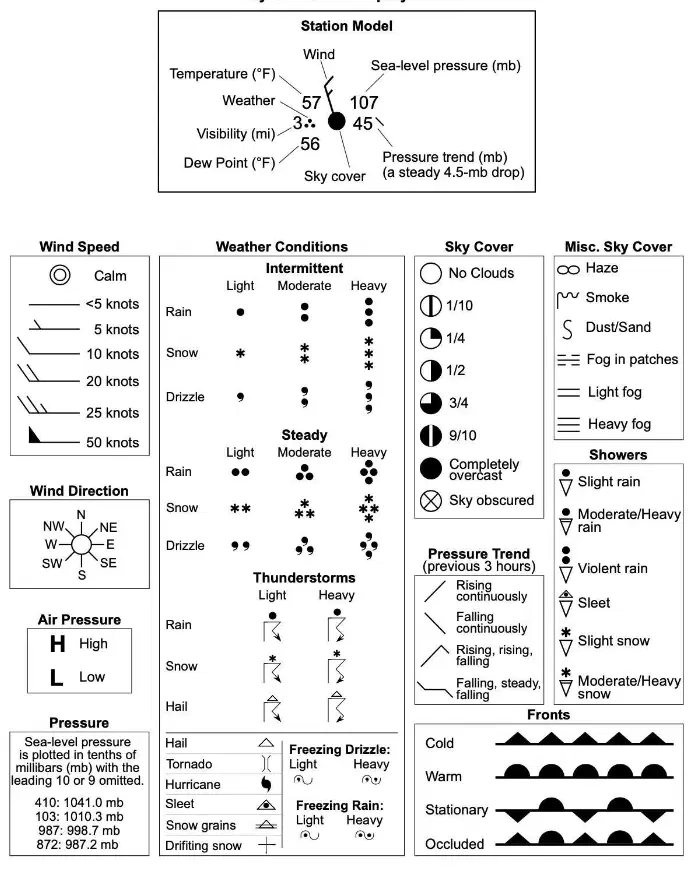
What does the symbol '○' represent in the Sky Cover section?
No Clouds
1/10
1/4
1/2
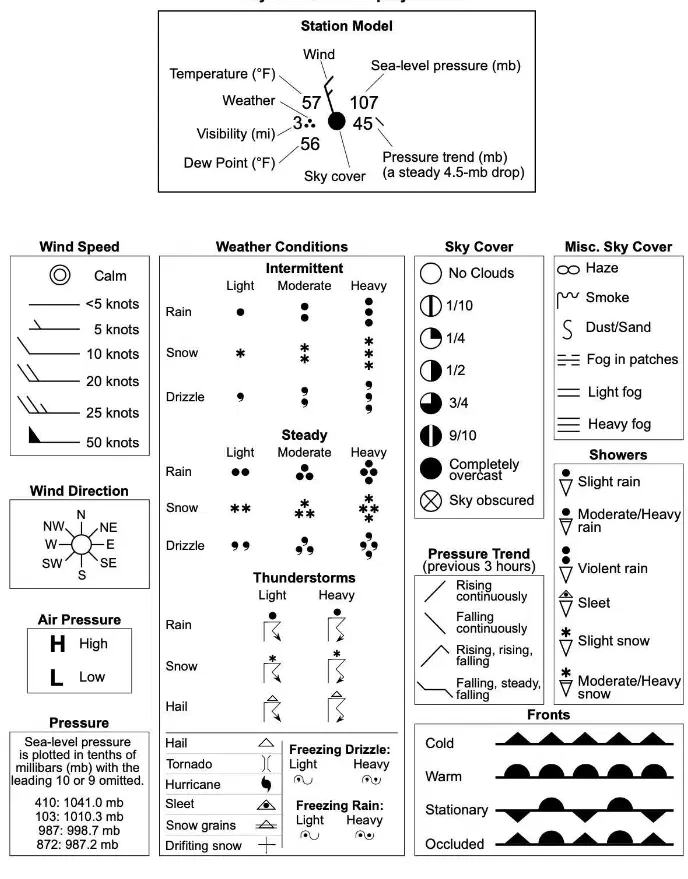
Which symbol represents a Cold Front on a weather map?
Line with triangles
Line with semicircles
Line with both triangles and semicircles
Line with alternating triangles and semicircles on the same side
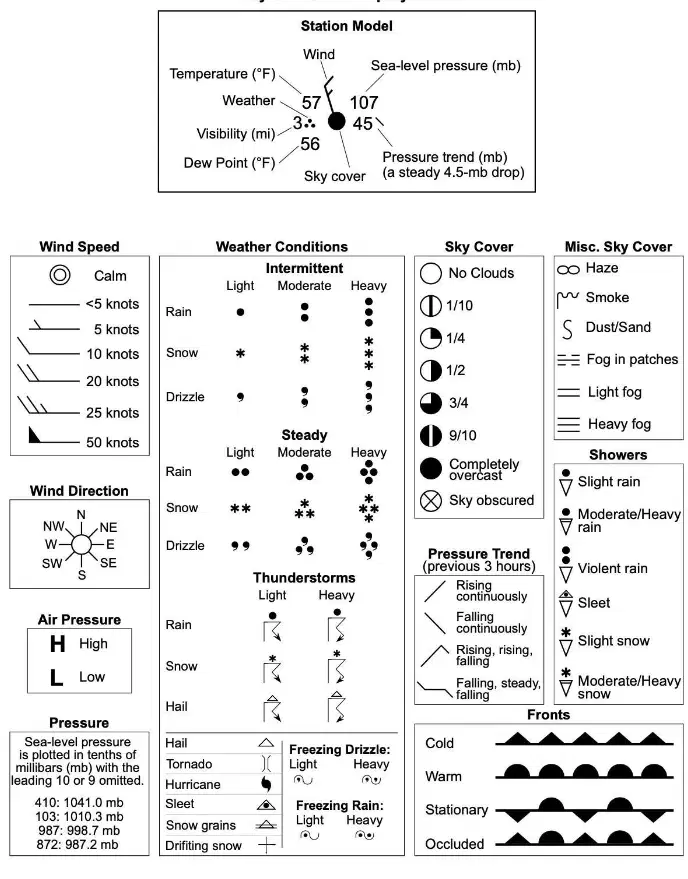
Fill in the blank: The symbol '●' in the Wind Speed section represents ________ wind.
Calm
Strong
Gusty
Variable
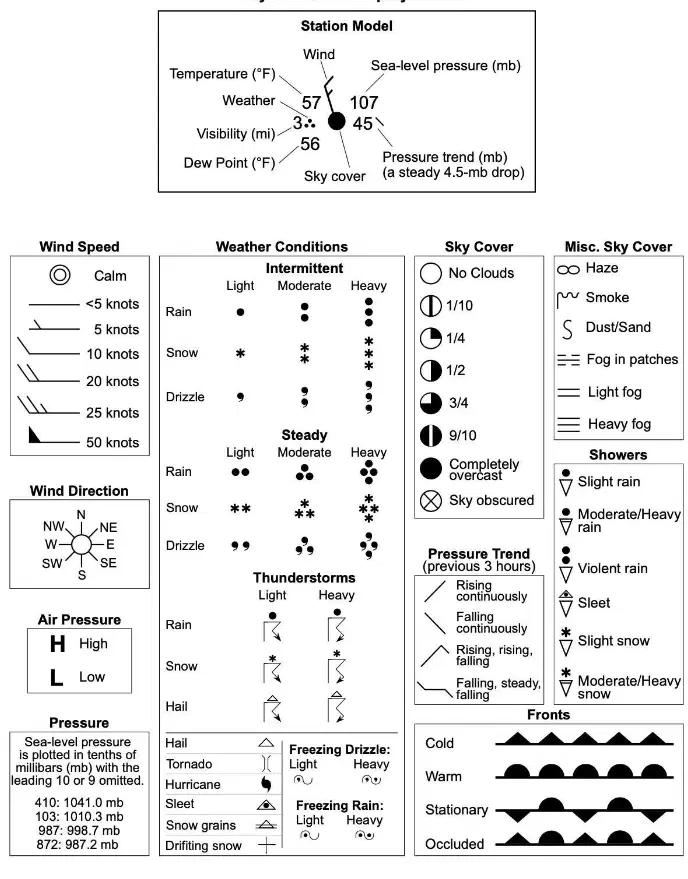
What does the symbol '≈' indicate in the Misc. Sky Cover section?
Haze
Smoke
Fog in patches
Light fog
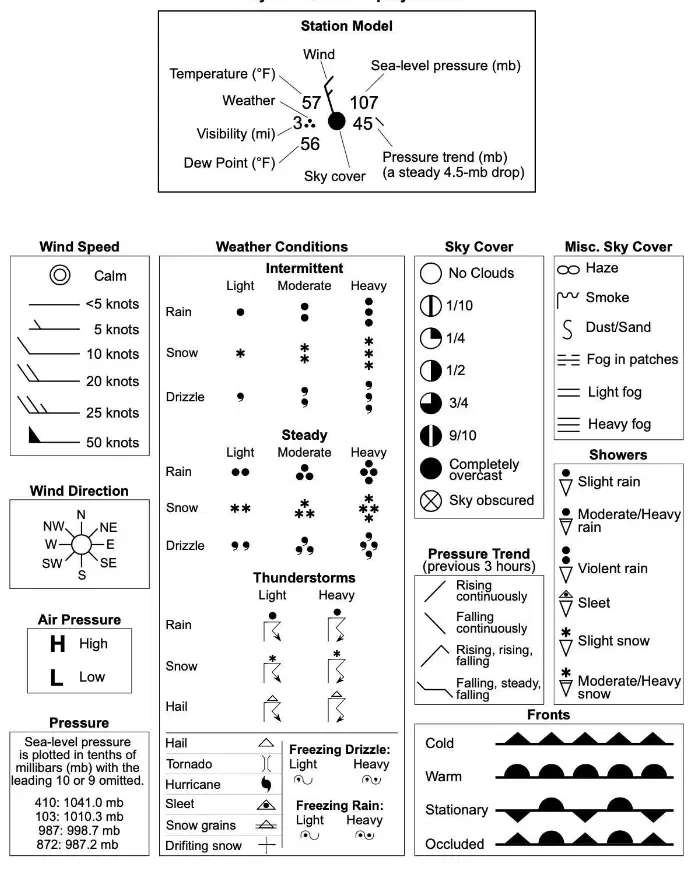
Which weather condition is represented by the symbol '*' under Steady conditions?
Light Snow
Moderate Snow
Heavy Snow
Drizzle
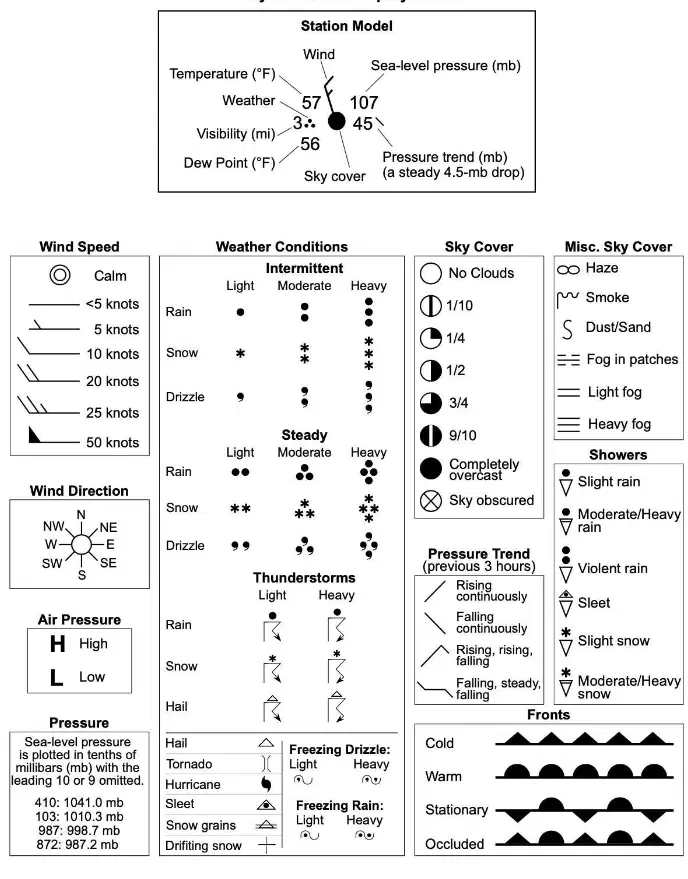
What does the symbol '↗' represent in the Wind Direction section?
NE (Northeast)
SW (Southwest)
SE (Southeast)
NW (Northwest)
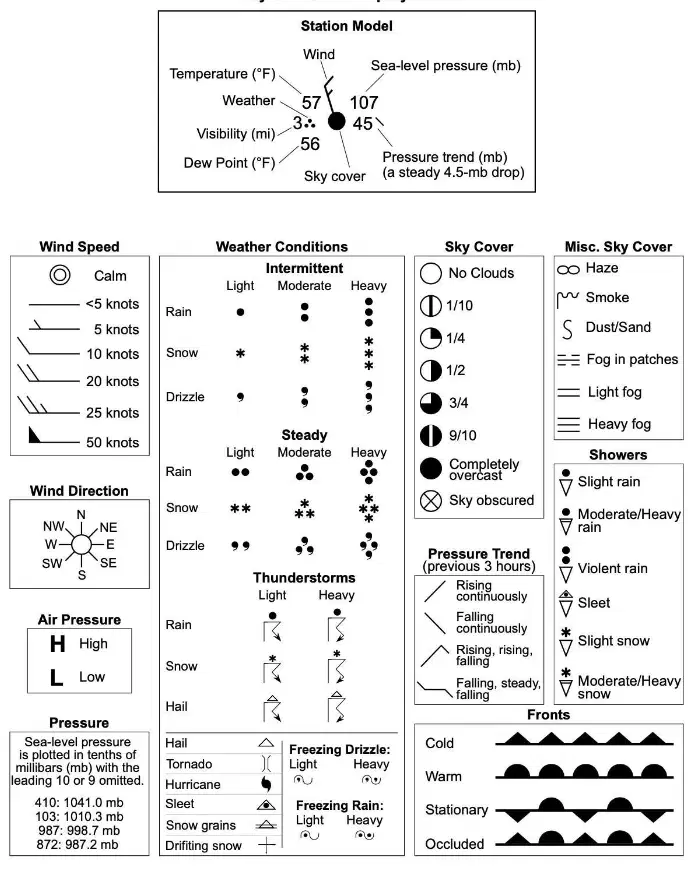
Fill in the blank: The symbol 'L' in the Air Pressure section stands for ________ pressure.
Low
High
Medium
Normal
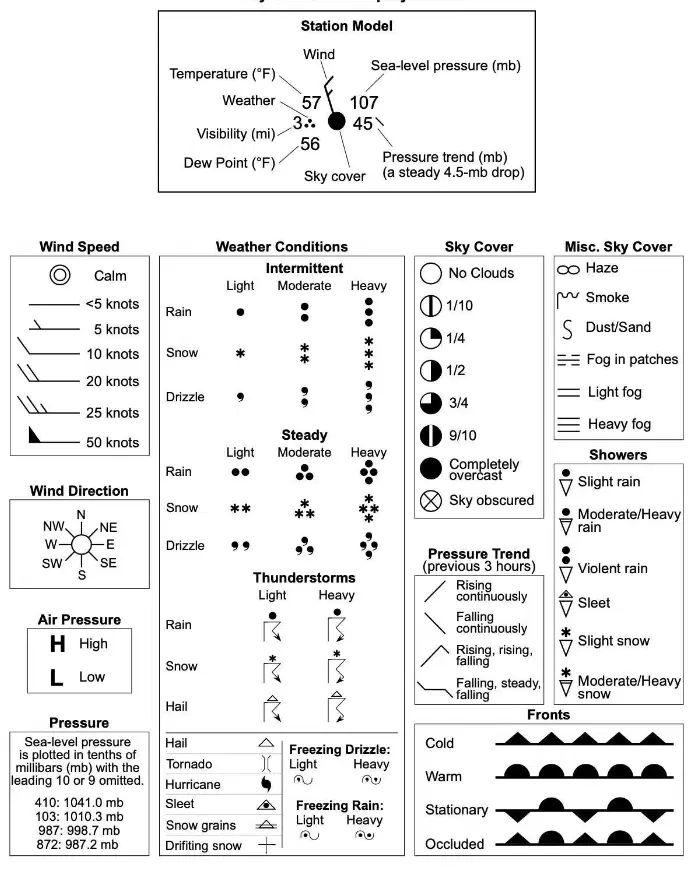
Which symbol indicates a Hurricane in the Pressure section?
Spiral
Triangle
Star
Circle with dot

