
 Worksheets
FA 2025 Forestry Final Part A
Total questions: 83
Worksheet time: 1hrs 21mins
Which of the following helps you in the process of tree identification? Select all that apply.
Observe the bark
Observe the surrounding environment
Observe the leaves
Observe the aspect

Which of the following describes the way tree branches in the picture above?
Compound
Alternate
Opposite
All of the above

How do you describe the branching in the above picture?
Alternate
Opposite
whorled
None of the above

Conifer needles that are flat and overlapping, like fish scales.
Bundle
Scaly
Broadleaf
Compound Leaf

The outer edge of a leaf.
Leaf Base
Petiole
Lobe
Margin

A type of leaf margin that has small points along it (teeth).
Lobed
Toothed
Entire

A type of leaf that has many smaller leaflets that attach to its petiole, which is attached to a twig.
Compound Leaf
Simple Leaf
Multiple Leaf
Single Leaf

A type of leaf that has one blade attached to a twig by a petiole.
Compound Leaf
Simple Leaf

Blue Spruce
Balsam Fir
Red Pine
White Pine

What tree?
ocean spray
snowberry
sycamore
western larch
When using a dichotomous key to identify trees, what do we look at?
physical features of the tree
physical features of the animal
physical features of the environment
physical features of its diet

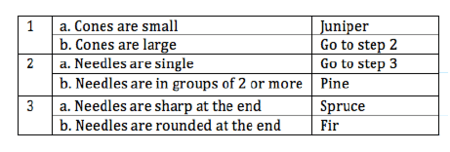
A dichotomous key for trees is provided. Hikers found a tree that has large brown cones and needles are in groups of 2 or more. What species of tree have the hikers found?
What do the roots of a tree absorb? select all that apply
Soil
Water
Insects
All of the above
Nutrients

NAME THE FORESTRY EQUIPMENT
FELLING WEDGE
MAUL
CANTHOOK
FIRE RAKE
What does Biodiversity refer to?
All of the organisms that look alike
All of the different races of humans
All of the different species in an area
All of the different carnivores in an area
What are the long ribbons that are pealed off of logs to create plywood called?
bark
pulp
paper
veneer
The value of a tree is determined by the
base
diameter
basal area
leaves
The maximum amount of organisms which may inhabit the area without compromising the ability to support the same species in that region in the future
carrying capacity
total habitation
forest capacity
total organisms
Diseased area on a plant part, particularly on ;the trunk, branch or twig of a woody plant, usually caused by fungi or bacteria
canker
insect
blister
lethal
The science concerning the description, identification, naming and classification of living things
inheritance
dichotomous
genes
taxonomy
comprised of all woody plants that grow low to the ground
forest layer
herbaceous layer
canopy layer
shrub layer
What is "water loss" in leaves called?
perspiration
photosynthesis
transpiration
sweat
What are the 3 circles in Idaho's forest sustainability model?
social, economical, ecological
health, fit, sound
healthy, profitable, manageable
industry, work, grow
Define sustainable Forests
What is the most important thing that you learned from this class? Why is it important?
How can you apply what you have learned from this class to your future?
What skills did you learn in this class? Are they useful? Explain why or why not.
If you went on the Wilderness Trip, do you feel it was a valuable part of the class and should be antegraded every year? Explain why or why not. If you did not go on the trip, do you wish that you had? Explain why or why not.
Name 1 insect that infects Idaho's forests
What methods do they use at the U of I to propagate their trees?
Name 5 forestry related careers.
In order to assess a tract of timber, foresters conduct a survey, or _____, to estimate its quantity by species, products, size, quality, or other characteristics.
cruise
transect
tally
traverse
Which tool is used to get a more accurate measurement of tree diameter?
Diameter tape
Biltmore stick
Hypsometer
Vernier caliper
When measuring a tree, what does the abbreviation dbh stand for?
Diameter at breast height
Diameter at base height
Distance at branch height
Diameter at bark hardness
At what height above the ground is dbh measured?
(a)
Which instrument is commonly used to measure tree height?
Clinometer
Increment borer
Biltmore stick
Compass
Typically, a forester stands one “chain” from the tree when measuring height. How long is one chain?
33 feet
44 feet
66 feet
100 feet
How long is one “log” section of a tree for volume estimation?
8 feet
12 feet
16 feet
20 feet
What term is used to denote the volume of wood in a tree?
Board foot
Cord
Cubic yard
Stumpage
Which set of dimensions represents one board foot of lumber?
12 inches by 12 inches by 1 inch
12 inches by 6 inches by 2 inches
10 inches by 10 inches by 1 inch
24 inches by 6 inches by 1 inch
Which tool removes a small cylindrical core from a tree so foresters can determine age by counting growth rings?
Increment borer
Clinometer
Diameter tape
Biltmore stick
The study of tree classification is called ______.
dendrology
taxonomy
arboriculture
silviculture
A tree that has no leaves at least some time during the year is called ______.
deciduous
evergreen
coniferous
broadleaf
A tree that usually has cones and needle-shaped leaves is a ______.
conifer
broadleaf
hardwood
monocot
Conifers produce wood known commercially as ______.
softwood
hardwood
heartwood
sapwood
Broad leaved trees produce wood known commercially as ______.
hardwood
softwood
heartwood
adult wood
Broad leaved trees whose seedlings have one leaf are called ______.
monocots
dicots
cotyledons
gymnosperms
Broad leaved trees whose seedlings have two leaves are called ______.
dicots
monocots
angiosperms
cotyledons
A ______ is generally large with a well defined main stem.
tree
shrub
vine
grass
A ______ is generally smaller and has no well defined stem.
shrub
tree
vine
grass
A “baby” tree is called a ______.
seedling
sapling
sprout
sucker
A young tree becomes a ______ when the dbh is 2 to 4 inches.
sapling
seedling
pole
snag
The part of the tree that carries water and nutrients up from the roots is the ______.
xylem
phloem
cambium
bark
The part of the tree that transports food downward is the ______.
phloem
xylem
cambium
bark
The tree would then die, leaving a ______.
snag
stump
log
burl
The ______ of a tree is where most of the branches and leaves are.
crown
trunk
roots
bark
One of the most common insect pests is the ______ which bore usually into the cambium layer of the tree, although some species damage roots, twigs, cones, and solid wood. What term correctly completes the statement?
bark beetle
weevil
sawfly
leaf miner
A person educated and trained as a forest professional is called what?
Forester
Arborist
Park ranger
Ecologist
The application of business methods and technical forestry principles to the operation of a forest property is called what?
Forest management
Silviculture
Conservation biology
Wildlife husbandry
Seedlings grown in a small tube and transported to the forest for planting intact are called what?
Container-grown seedlings
Bare-rooted seedlings
Broadcast seed
Nursery stock
By knowing site classes of land and using a volume table as well as other tools, the ____ ____ or price that a stand of timber could be sold for as it stands can be determined.
Market value
Replacement cost
Stumpage fee
Opportunity cost
The three elements required for a fire to exist make up the fire triangle. Select all that apply.
Fuel
Heat
Oxygen
Water
Carbon dioxide
An unplanned and uncontrolled fire that can be started by natural or human means is called what?
Wildfire
Controlled burn
Backfire
Spot burn
Assigning a person to detect and report forest fires from a vantage point, such as the top of a mountain, uses what role?
Fire lookout
Control engineer
Fuel scout
Index observer

What is this piece of equipment?
Clinometer
Compass
Planting Bar
Wedge Prism

Name this Piece of Forestry Equipment
Bark Gauge
Wedge Prism
Increment Borer
Fusee

Name this Piece of Forestry Equipment
Tree Marker/Disc
Fiberglass Measuring Tape
Diameter Tape
Tally Meter

What’s this tree?
White oak
Yellow poplar
Chestnut oak
Northern red oak

What tree species has this leaf?
White Pine
White Oak
White Spruce
Red Oak

Red pine
Jack pine
White pine
Spruce

What tree is shown?
red pine
white pine
blue spruce
balsam fir

An evergreen that has 10 to 15 needles in a bundle. It is also soft and the needles turn gold and fall off in the fall. Choose all answers that are correct.
douglas fir
tamarack
larch
red fir
sub alpine fir

This evergreen has a large cone with prickles, and the needles are 6 to 8 inches long.
ponderosa pine
western white pine
jack pine
lodge pole pine
Describe the process of making paper.

What part of the tree is B closest too?
Heart wood
Pith
Sapwood
Bark

What part of the tree is C closest too?
Sap wood
Cambium
Heart wood
Pith

What part of the tree is D closest too?
Cambium
Bark
Sap Wood
Heart Wood

What part of the tree is E closest too?
Bark
Cambium
Sap wood
Pith

