
 Worksheets
Reference Tables for Earth & Space Sciences Review
Total questions: 99
Worksheet time: 50mins
Which of the following topics is included in the Reference Tables for Earth & Space Sciences?
Solar System Objects Data Table
Photosynthesis in Plants
Human Anatomy
Chemical Bonding
According to the Table of Contents, which page contains information about the Life Cycles of Stars Model?
5
2
10
15
What is the primary focus of the section found on pages 6-7 in the Reference Tables for Earth & Space Sciences?
Geologic History of New York State
Surface Ocean Currents Model
Energy and Mineral Resources of New York State
Model of Bowen’s Reaction Series
Which section would you refer to for information about the Electromagnetic Spectrum related to Earth and Space Sciences?
Page 3
Page 8
Page 12
Page 18
If a student wants to learn about the Model of Generalized Planetary Wind Belts in the Troposphere, which page should they consult?
19
11
6
2
Which of the following is NOT listed as a topic in the Table of Contents for the Reference Tables for Earth & Space Sciences?
Photosynthesis in a Massive Star
Generalized Nucleosynthesis in a Massive Star
Mineral Identification Flowchart
Key to Weather Map Symbols
Which page would you look at to find the Cross Section Model of Earth’s Lower Atmosphere?
19
11
14
20
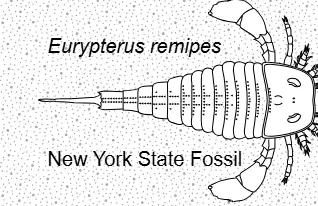
What is the name of the New York State Fossil shown in the image?
Eurypterus remipes
Trilobite
Tyrannosaurus rex
Ammonite
Which planet in the Solar System has the largest equatorial diameter?
Earth
Jupiter
Saturn
Neptune
What is the period of revolution of Mercury around the Sun?
365.26 days
88 days
224.7 days
11.9 years
Which celestial object listed has the greatest axial tilt?
Venus
Uranus
Mars
Pluto
What is the mean distance from the Sun to Neptune?
778.5 million km
149.6 million km
4515.0 million km
5906.4 million km
Which stage of nucleosynthesis in a massive star lasts the shortest amount of time?
H → He
He → C
Si → Fe
Core Collapse
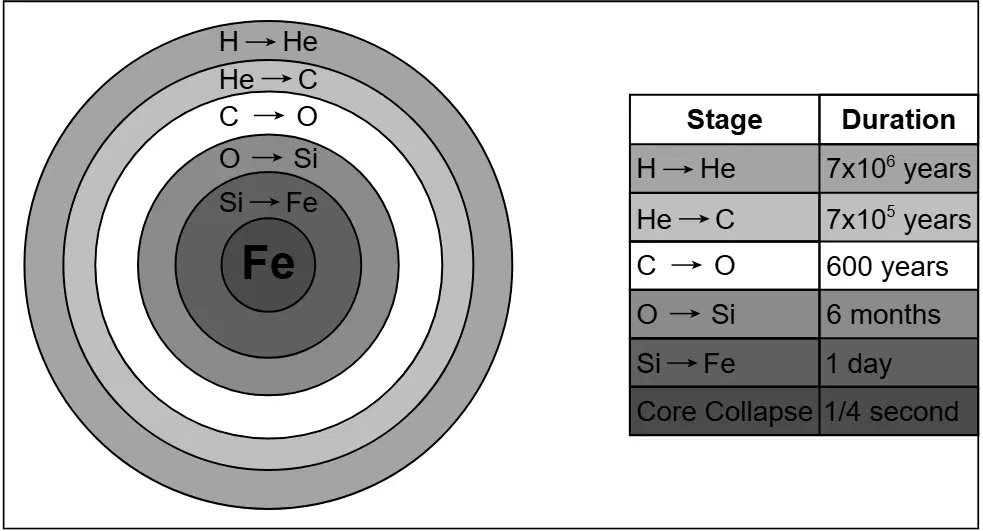
Based on the diagram of nucleosynthesis in a massive star, which element is found at the core after all fusion stages are complete?
Silicon (Si)
Carbon (C)
Iron (Fe)
Oxygen (O)
Which planet has a period of rotation at the equator closest to 24 hours?
Mars
Earth
Jupiter
Venus
If a planet has a high eccentricity of orbit, what does this indicate about its path around the Sun?
The orbit is nearly circular
The orbit is highly elongated
The planet rotates faster
The planet is closer to the Sun
During which stage of nucleosynthesis in a massive star does the fusion process last for 600 years?
H → He
He → C
C → O
O → Si
Which object in the Solar System Objects Data Table has the smallest equatorial diameter?
Pluto
Eris
Ceres
Pallas

Which region of the electromagnetic spectrum has the shortest wavelength?
Ultraviolet
Infrared
Microwave
Visible

What is the approximate wavelength range (in nanometers) of the visible spectrum?
400 nm to 700 nm
100 nm to 400 nm
700 nm to 1000 nm
10 nm to 100 nm

According to the diagram, as the wavelength increases, what happens to the energy (frequency)?
Energy decreases
Energy increases
Energy stays the same
Energy first increases, then decreases

Which element's emission spectrum shows a single prominent line in the visible range around 656 nm?
Hydrogen
Helium
Oxygen
Silicon

If a star's emission spectrum shows strong lines at wavelengths matching those of oxygen, what can you infer about the star's composition?
The star contains oxygen
The star contains only hydrogen
The star contains only silicon
The star does not contain any elements

Which of the following best describes the relationship between frequency and wavelength in the electromagnetic spectrum?
As frequency increases, wavelength decreases
As frequency increases, wavelength increases
Frequency and wavelength are unrelated
As frequency decreases, energy increases

Which region of the H-R Diagram contains stars like the Sun during most of their lifetime?
Main Sequence
Giants
Supergiants
White Dwarfs

What does the x-axis of the H-R Diagram represent?
Luminosity
Surface Temperature
Mass
Lifetime

According to the H-R Diagram, which type of stars have the shortest lifetimes?
White Dwarfs
Main Sequence stars
Supergiants
Giants

If a star is classified as a "White Dwarf," what can you infer about its luminosity and temperature compared to Main Sequence stars?
Lower luminosity, higher temperature
Higher luminosity, lower temperature
Higher luminosity, higher temperature
Lower luminosity, lower temperature

A star with a surface temperature of about 3,000 K would most likely appear which color?
Blue
White
Yellow
Red

Based on the H-R Diagram, explain why stars in the Supergiant region have much shorter lifetimes than those in the Main Sequence.
Supergiants burn their fuel much faster due to higher mass and luminosity
Supergiants are farther from Earth
Supergiants are cooler than Main Sequence stars
Supergiants are smaller in size

Which stage comes immediately after the "Protostar" stage in the life cycle of a massive star?
Red Giant
Red Supergiant
Massive Stars
White Dwarf

What is the final possible stage for a massive star (more than 8 to 10 times the mass of the Sun) after a supernova?
Red Dwarf
White Dwarf
Black Hole
Red Giant

Which of the following is an intermediate stage in the life cycle of a sun-like star?
Red Giant
Neutron Star
Black Hole
Supernova

Explain the difference in the final stages of life between a sun-like star and a massive star, based on the life cycle diagram.
Sun-like stars end as White Dwarfs, while massive stars can end as Neutron Stars or Black Holes.
Both sun-like and massive stars end as Black Holes.
Sun-like stars end as Neutron Stars, while massive stars end as White Dwarfs.
Both sun-like and massive stars end as Red Giants.

How long does it typically take for a sun-like star to evolve from the main sequence to the red giant stage?
Millions of years
Billions of years
Hundreds of years
Thousands of years
Which eon is characterized by the appearance of the first known rocks on Earth?
Phanerozoic Eon
Proterozoic Eon
Archean Eon
Hadean Eon
During which period did the first land plants appear according to the geologic history chart?
Cambrian
Ordovician
Silurian
Devonian
What major event marks the end of the Cretaceous period?
First appearance of mammals
Mass extinction of all non-avian dinosaurs
First land plants
Appearance of trilobites
Which of the following periods is part of the Mesozoic Era?
Cambrian
Devonian
Jurassic
Silurian
What significant evolutionary event occurred during the Devonian period?
First appearance of trilobites
First land plants
First amphibians and seed plants
Mass extinction of dinosaurs

According to the chart, which fossil is labeled as "F"?
Cryptomon
Halysites
Dinorthis
Lingula
Explain how the oxygen revolution during the Proterozoic Eon impacted life on Earth. (DoK Level 3)
It caused the extinction of all life forms.
It led to the development of multicellular organisms and increased atmospheric oxygen.
It resulted in the formation of the first land plants.
It triggered the mass extinction of dinosaurs.
Which epoch is known for the appearance of modern humans?
Pleistocene
Holocene
Eocene
Oligocene
During which period did the largest extinction event in Earth's history occur?
Permian
Jurassic
Cambrian
Silurian
What is the estimated time of origin for the Earth and Solar System according to the chart?
1.3 billion years ago
2.1 billion years ago
3.7 billion years ago
4.6 billion years ago

Which event marks the initial opening of the Atlantic Ocean according to the geologic history of New York State?
Advance and retreat of last continental ice
Initial opening of the Atlantic Ocean; North America and Africa separate
Dome-like uplift of Adirondack region begins
Catskill delta forms

What major geologic event is associated with the collision of North America and Africa, forming Pangaea?
Taconic orogeny
Alleghenian orogeny
Acadian orogeny
Salinic orogeny

Which fossil is represented by the letter "P" in the reference table?
Eurypterus
Isotelus
Zulloeceras
Asaphiscus
According to the table, what significant event happened during the Grenville orogeny?
Formation of the Catskill delta
Metamorphism of exposed bedrock in the Adirondacks and Hudson Highlands
Initial opening of the Atlantic Ocean
Deposition of sands and clays on Long Island
Which of the following best describes the process of the Taconic orogeny?
Caused by closing of western part of Iapetus Ocean and collision between North America and volcanic island arc
Caused by collision of North America and Africa
Caused by new subduction to the east of Proto-North America
Caused by closing of remaining part of Iapetus Ocean and collision of North America and Avalonia
Which time period is associated with the widespread deposition over most of New York along the edge of the Iapetus Ocean?
50 million years ago
125 million years ago
359 million years ago
458 million years ago

Which of the following geologic periods is represented by the symbol "O" on the Generalized Surface Bedrock Geology map of New York State?
Ordovician
Cambrian
Devonian
Silurian

According to the legend on the map, which type of rock is most commonly associated with the Cambrian and Ordovician periods in New York State?
Sedimentary rocks
Metamorphic rocks
Igneous rocks
Volcanic rocks

Based on the map, which of the following statements best describes the distribution of Precambrian rocks in New York State?
They are mostly found in the Adirondack region.
They cover the entire state.
They are only found along the coast.
They are found exclusively in the Finger Lakes region.

If a geologist is studying Devonian rocks in New York State, which region should they focus on according to the map?
The southern and western parts of the state
The Adirondack Mountains
Long Island
The Hudson Valley

Using the map, which of the following best explains why the bedrock geology of New York State is important for understanding its natural resources?
Different rock types and ages can indicate the presence of minerals, fossil fuels, and groundwater resources.
The map only shows political boundaries, not natural resources.
Bedrock geology has no impact on natural resources.
Only Precambrian rocks contain natural resources.

Which of the following is represented by the symbol "S" on the Energy and Mineral Resources map of New York State?
Salt
Shale
Silver
Sand

According to the map key, what does the shaded area with diagonal lines represent?
Area underlain by salt
Area underlain by gypsum
Oil and gas fields
Carbonate rock

Which locality is listed as number 10 in the Localities section of the map?
Elmira
Binghamton
Syracuse
Utica

Based on the map, which resource is associated with the symbol "Wo"?
Wollastonite
Gypsum
Garnet
Cement

If a company is interested in mining for rare earth elements (REE), which symbol should they look for on the map?
REE
Zn
Fe
Ni

Using the map, explain how the distribution of oil and gas fields might influence economic development in New York State.
Oil and gas fields are concentrated in certain areas, which could lead to regional economic growth and job creation in those areas, while other regions may not benefit as much.
Oil and gas fields are evenly distributed, so all regions benefit equally.
Oil and gas fields are only found in urban areas, so rural areas do not benefit.
Oil and gas fields have no impact on economic development.

Which geographic province contains the Adirondack Mountains in New York State?
Grenville Province
Central Lowland Province
Appalachian Plateau Province
Atlantic Coastal Plain
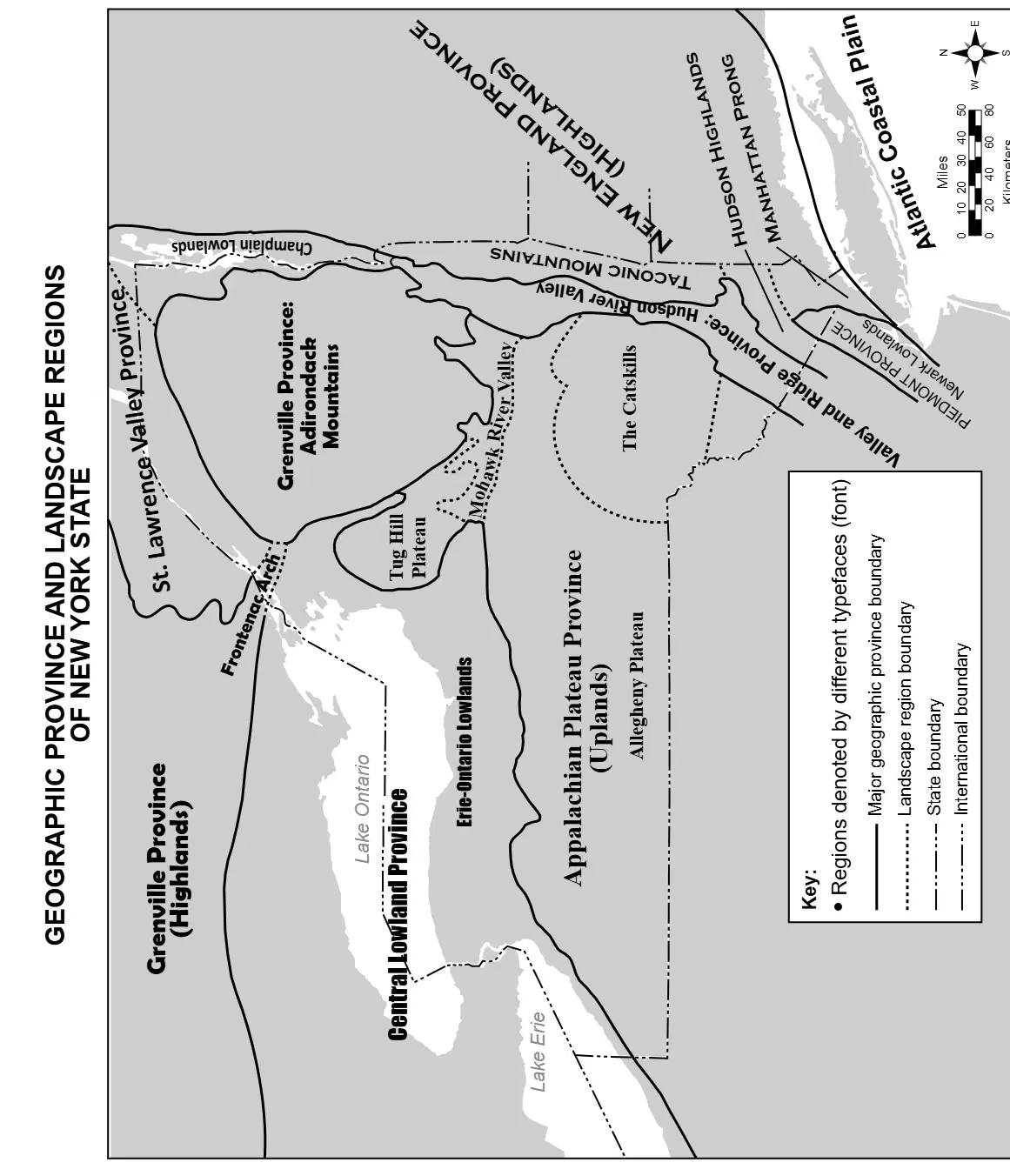
What is the name of the lowland region located between Lake Ontario and Lake Erie in New York State?
Erie-Ontario Lowlands
Champlain Lowlands
Hudson River Valley
Tug Hill Plateau

According to the map, which region is located to the east of the Hudson River Valley?
Taconic Mountains
Tug Hill Plateau
St. Lawrence Valley
Allegheny Plateau

Using the map, which of the following regions is NOT part of the Appalachian Plateau Province (Uplands)?
Allegheny Plateau
Tug Hill Plateau
The Catskills
Champlain Lowlands

Based on the map, if you travel from the Atlantic Coastal Plain to the Central Lowland Province, which major geographic province do you pass through?
New England Province (Highlands)
Grenville Province
Appalachian Plateau Province (Uplands)
St. Lawrence Valley Province

Which layer of the Earth is described as having a density between 9.9 and 12.2 g/cm³ and is in a fluid state?
Upper mantle
Fluid outer core
Solid inner core
Oceanic crust
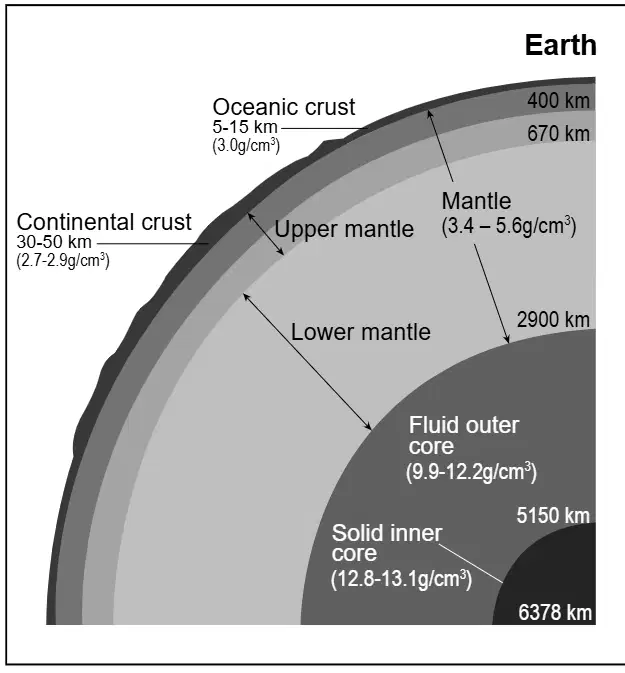
What is the approximate thickness range of the continental crust?
5-15 km
30-50 km
400-670 km
2900-5150 km
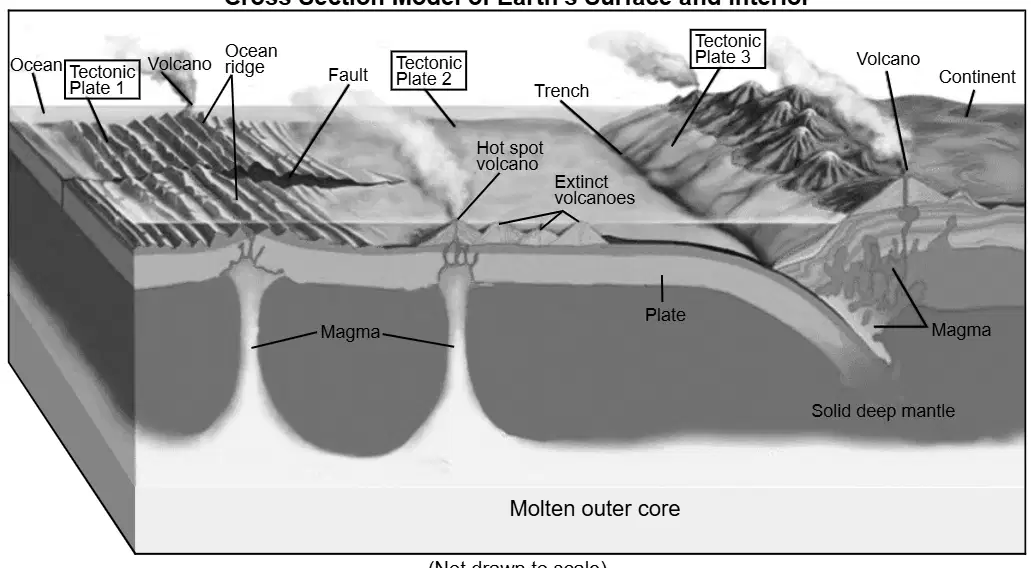
Which of the following best describes the location of tectonic plates in relation to Earth's structure?
They are found in the fluid outer core.
They are located in the solid inner core.
They are part of the Earth's crust and uppermost mantle.
They are only found in the mantle.
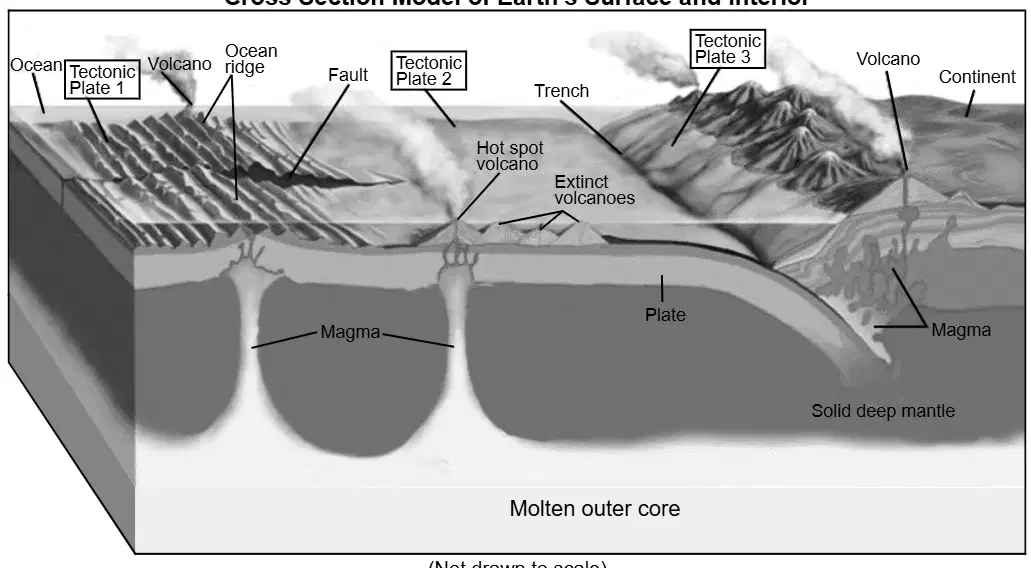
Based on the cross section model, what geological feature is most likely to form at the boundary between two tectonic plates where magma rises to the surface?
Ocean ridge
Solid inner core
Continental crust
Lower mantle
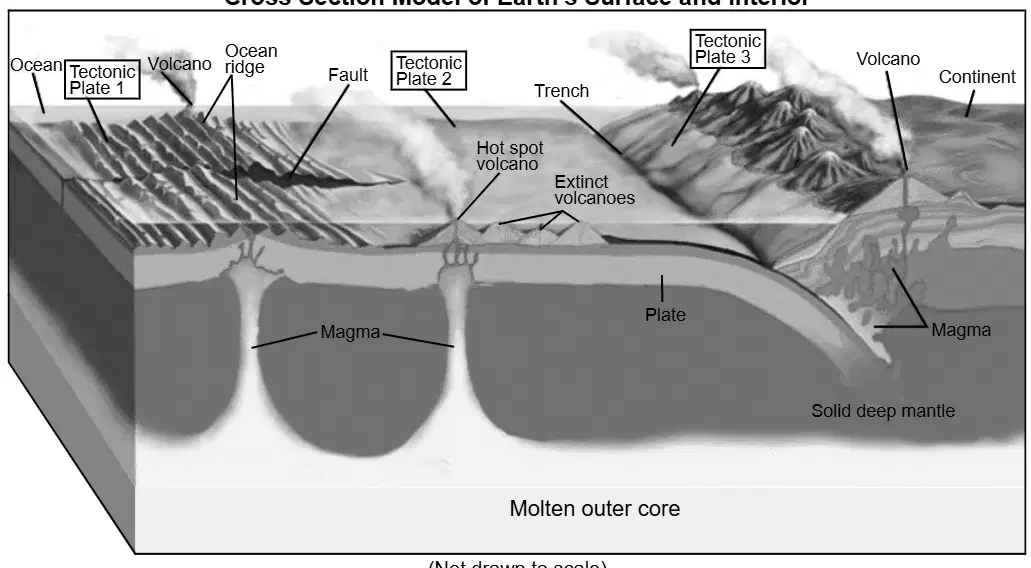
If a scientist is studying extinct volcanoes, which layer of the Earth would they most likely be interested in, according to the cross section model?
Molten outer core
Plate (crust and upper mantle)
Solid deep mantle
Fluid outer core

Which type of plate boundary is represented by a line with triangles on one side, according to the key in the map?
Divergent plate boundary
Convergent plate boundary
Transform plate boundary
Uncertain plate boundary

What does a dashed line represent on the map’s key?
Divergent plate boundary
Convergent plate boundary
Transform plate boundary
Uncertain plate boundary

According to the map, which of the following plates is located between the Pacific Plate and the North American Plate?
Eurasian Plate
Philippine Plate
Juan de Fuca Plate
Antarctic Plate

If a tectonic plate boundary is marked with a double line with arrows pointing away from each other, what type of boundary is it?
Convergent plate boundary
Divergent plate boundary
Transform plate boundary
Major strike-slip fault

Using the map, which ocean contains the Mid-Atlantic Ridge?
Pacific Ocean
Indian Ocean
Atlantic Ocean
Arctic Ocean

Based on the map, explain why the region around the Pacific Plate is often referred to as the "Ring of Fire."
It is surrounded by divergent boundaries.
It is surrounded by transform boundaries.
It is surrounded by convergent boundaries, leading to frequent volcanic and earthquake activity.
It is located at the equator.
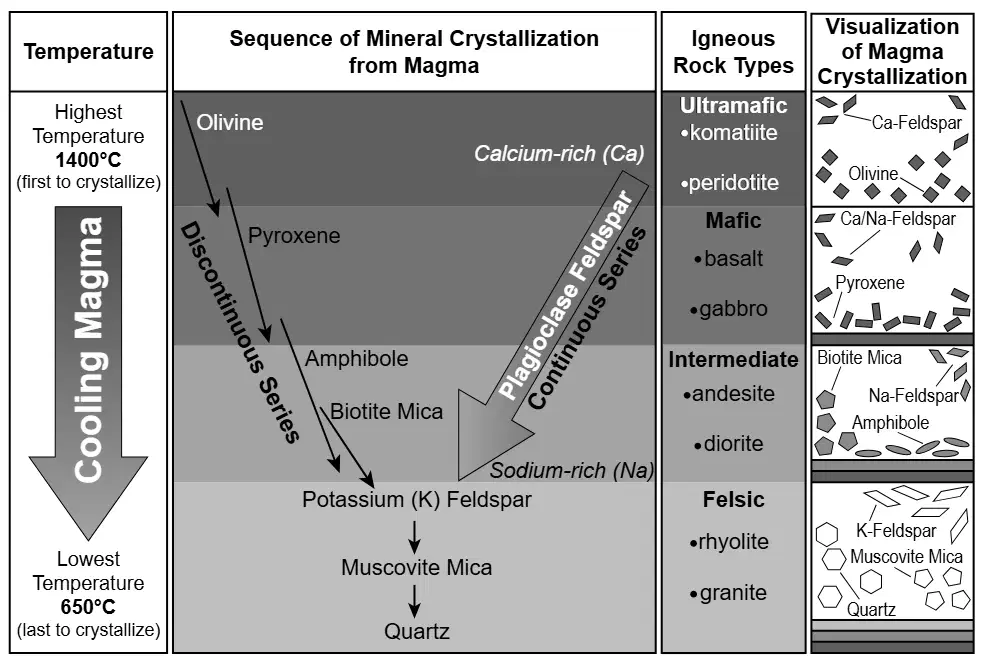
Which mineral is the first to crystallize from magma according to Bowen’s Reaction Series?
Quartz
Olivine
Biotite Mica
Potassium Feldspar
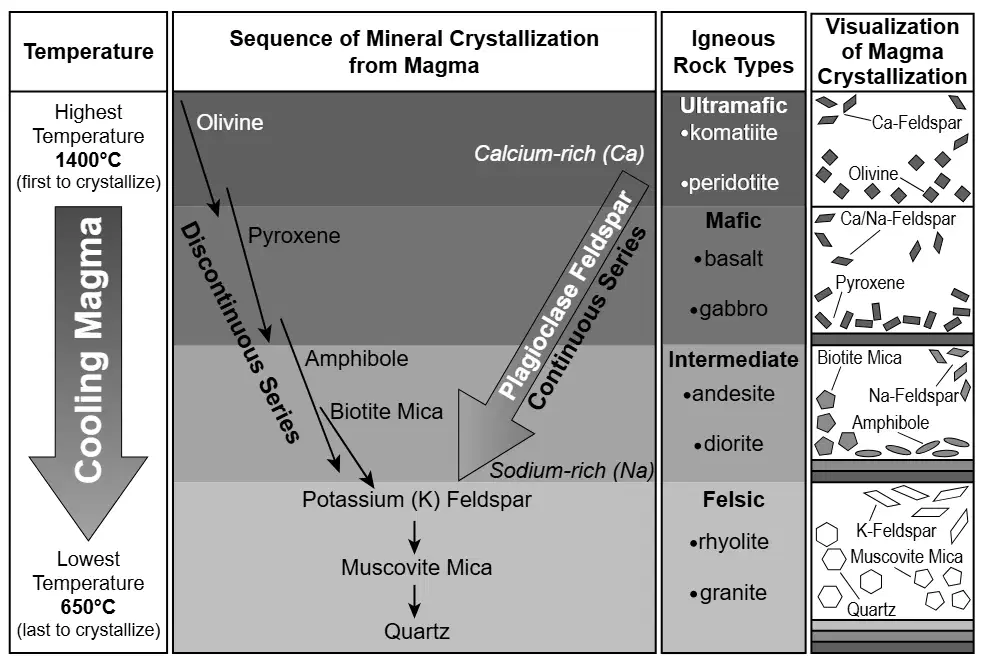
At what temperature does the crystallization of minerals from magma begin, according to the provided model?
700°C
650°C
1200°C
1400°C
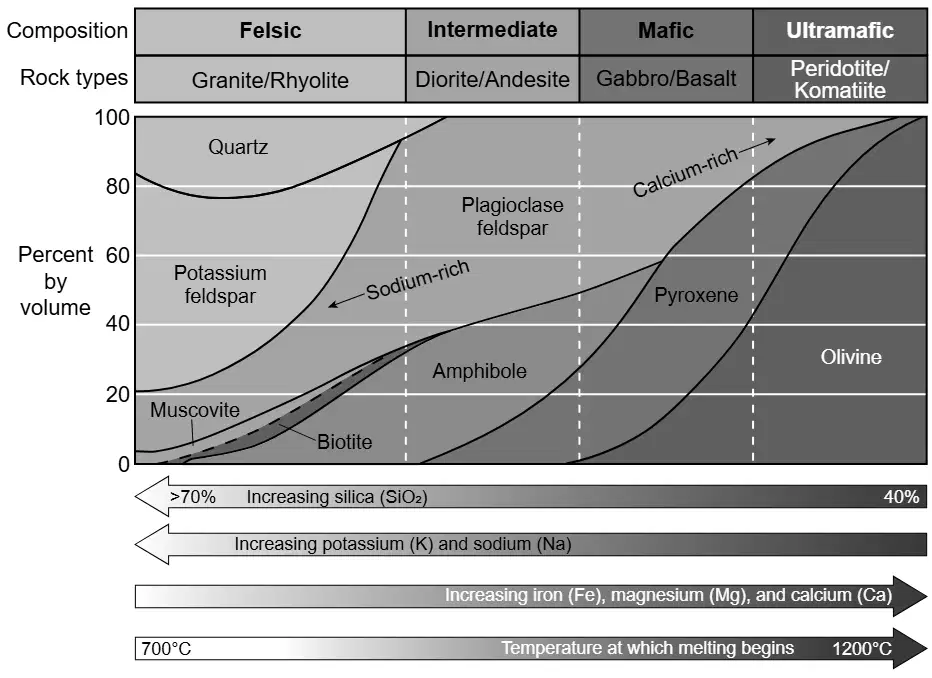
Which igneous rock type is associated with the highest silica (SiO₂) content?
Basalt
Granite
Gabbro
Peridotite

According to the Bowen’s Reaction Series, which mineral is the last to crystallize from magma?
Olivine
Pyroxene
Quartz
Amphibole

If a rock contains mostly olivine and pyroxene, which igneous rock type is it most likely to be?
Granite
Diorite
Basalt
Peridotite
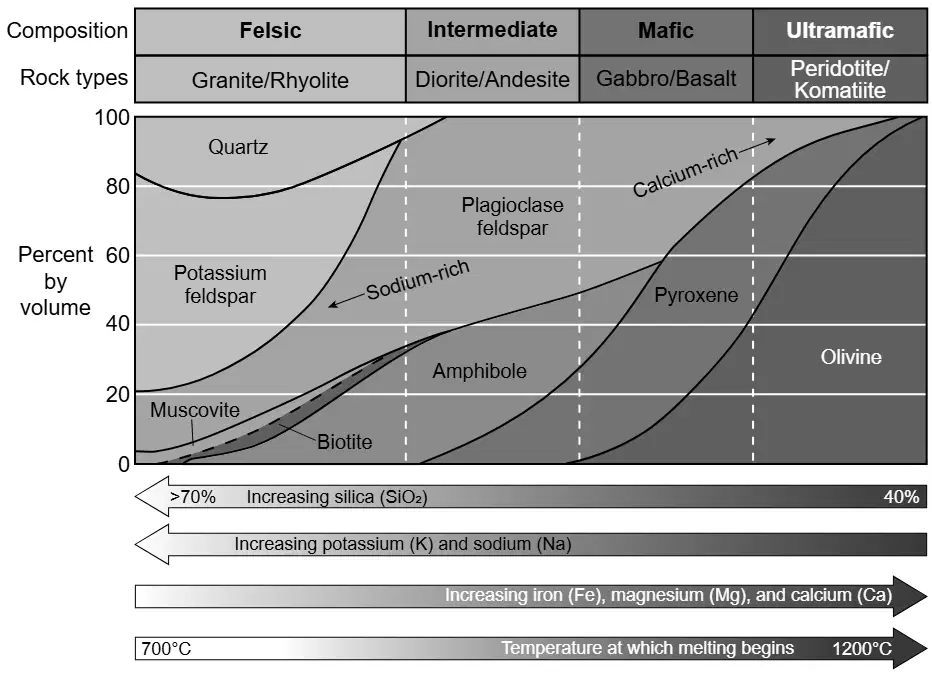
Explain how the composition of igneous rocks changes from ultramafic to felsic in terms of silica and metal content.
Silica decreases, metals increase
Silica increases, metals decrease
Both silica and metals increase
Both silica and metals decrease

Which of the following processes is responsible for the transformation of sediment into sedimentary rock?
Melting
Crystallization
Compaction and cementation
Folding

What type of rock is formed when magma cools and solidifies?
Sedimentary rock
Metamorphic rock
Igneous rock
Limestone

Which process leads to the formation of metamorphic rocks from pre-existing rocks?
Erosion
Melting
Heat and pressure (metamorphism)
Deposition

If a sedimentary rock is subjected to intense heat and pressure, what is the most likely result?
It will melt into magma
It will become an igneous rock
It will become a metamorphic rock
It will erode into sediments

Which of the following best describes the process of weathering in the rock cycle?
The breakdown of rocks into smaller pieces by mechanical and chemical means
The cooling and solidification of magma
The compaction of sediments
The folding of rock layers

Explain how igneous rocks can become sedimentary rocks through the rock cycle.
By melting and cooling
By weathering, erosion, deposition, burial, and lithification
By folding and faulting
By direct crystallization from magma
Which parent isotope is used in radiometric dating to produce Neodymium-143 as its daughter decay product?
Samarium-147
Rubidium-87
Uranium-238
Potassium-40
What is the half-life of Uranium-238?
4.5 billion years
713 million years
48.8 billion years
106 billion years
Which datable material is associated with the use of Carbon-14 in radiometric dating?
Organic materials, glacial ice containing carbon dioxide, groundwater, and ocean water
Potassium-bearing minerals (mica, feldspar, hornblende)
Uranium-bearing minerals (zircon, apatite, uraninite)
Garnets, micas
If a scientist wants to date a rock that is approximately 1 billion years old, which radioactive element would be most appropriate to use?
Potassium-40
Carbon-14
Uranium-235
Neodymium-143
Explain why Carbon-14 is not suitable for dating rocks that are billions of years old.
Its half-life is too short to date such old materials.
It is only found in igneous rocks.
It only decays into Argon-40.
It is not radioactive.
Which radioactive element would be best for dating volcanic tuff or lava flows?
Potassium-40
Uranium-238
Rubidium-87
Samarium-147
What is the useful dating range for Rubidium-87?
10 million - 4.6 billion years
100 - 70,000 years
713 million years
1.3 billion years
Which of the following pairs is correctly matched for parent isotope and its daughter decay product?
Uranium-235 and Lead-207
Potassium-40 and Lead-206
Rubidium-87 and Argon-40
Samarium-147 and Nitrogen-14
Which mineral is the hardest according to the Mohs Hardness Scale?
Diamond
Quartz
Gypsum
Talc

