
 Worksheets
Locally Employed Laboratory Staff CME 2025 Quiz
Total questions: 60
Worksheet time: 42mins
There is no universally compatible ABO Fresh Whole Blood (FWB) type. FWB must be an ABO match.
True
False
Fill in the blank: In MASCAL situations, particularly when more than one blood type is being collected, there is an increased risk of clerical error leading to a ____ transfusion reaction.
Temporary
Mild
Delayed
Aside from ABO group antigens, females of less than 50 years old must also be matched for which antigen?
Kell
HLA
Rh
Duffy
Which blood type is considered the universal donor for plasma?
AB Pos
A Pos
O Neg
B Neg
For blood type B, what ABO group antibody is present in the plasma?
Anti-A antibodies
Anti-A,B antibodies
Anti-B antibodies
Anti-O antibodies
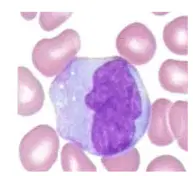
Identify the cell in this picture.
Monocyte
Neutrophil
Eosinophil
Lymphocyte
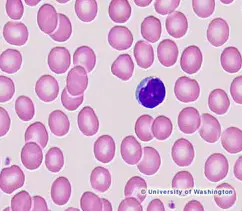
The red cells in this film are best described as:
MCV and RDW within reference range
MCV low, RDW high
MCV low, RDW within reference range
MCV within reference range, RDW high
Which statement regarding absolute and relative WBC counts is true?
The absolute count measures the total number of WBC per unit volume, while the relative count measures the percentage of each type of WBC.
The absolute count measures the percentage of each type of WBC, while the relative count measures the total number of WBC per unit volume.
Both the absolute and relative counts measure only the total number of WBC.
Both the absolute and relative counts measure only the percentage of each type of WBC.
How do the MCV, MCH, and MCHC correlate to the appearance of a peripheral blood smear?
They determine the size and color of RBC seen on the smear.
They indicate the number of white blood cells present.
They reflect platelet function.
They measure blood glucose levels.
Which of the following is a potential consequence of platelet clumping in a blood sample?
False increase in platelet count
False decrease in platelet count
Normal platelet count
No effect on platelet count

What of the following would not be associated with this platelet histogram?
Thrombotic thrombocytopenic purpura (TTP)
Pre-analytical errors such as improper sample handling or traumatic collection
Cold agglutinins
EDTA antibodies
Platelets are derived from which of the following?
Lymphoblasts
Monoblasts
Pronormoblasts
Megakaryocytes
Which of the following is a common cause of cold agglutinin syndrome?
A genetic predisposition
Due to infection (e.g., Mycoplasma pneumonia)
A direct injury to the red blood cells
A high level of vitamin K
What is the most common cause of platelet clumping on a peripheral blood smear?
Platelet activation due to traumatic venipuncture
EDTA-dependent antibodies reacting with platelet glycoprotein IIb/IIIa
Decreased platelet count
Increased platelet count
What is the most appropriate way to resolve EDTA-induced platelet clumping and obtain a more accurate platelet count?
Ignore the clumping and estimate the platelet count manually.
Use a blood collection tube with sodium citrate as the anticoagulant.
Centrifuge the blood sample.
Repeat the blood draw with a different EDTA tube.
What is the significance of platelet clumping on a blood smear?
It always indicates an enhanced risk for patient bleeding.
It is a normal finding and has no clinical significance.
It can interfere with automated blood cell counts and may invalidate the results.
It only occurs in patients with ITP.
Which of the following is a false statement regarding pseudothrombocytopenia?
It is characterized by a falsely low platelet count due to clumping.
It can be caused by EDTA-dependent antibodies.
It is always caused by a serious underlying medical condition.
It can be corrected by using a sodium citrate tube for blood collection.
What is the normal reference range for fasting blood glucose levels in adults?
70-99 mg/dL
100-125 mg/dL
126-140 mg/dL
140-199 mg/dL
ALP (alkaline phosphatase) is increased in all of the following conditions except:
During normal child development
Liver diseases
Vitamin D deficiency
Hypothyroidism
Which of the following Piccolo panels would be most effective in helping a clinician diagnose gout or investigate kidney stones?
General Chemistry 13
Comprehensive Metabolic Panel
MetLyte Plus CRP
Lipid Panel
How many grams of glucose should be in the glucola for the One Step Gestational Diabetes Diagnostic Test? Type a number only.
(a)
How many samples are necessary when conducting the Diabetes Mellitus Diagnostic Test?
3 samples: At 0 hour (fasting), 1, and 2 hour(s)
1 sample: At 2 hours
2 samples: At 0 hour (fasting) and 2 hours
2 samples: At 1 and 2 hour(s)
How many grams of glucose should be in the glucola for the Two Step Gestational Diabetes Screen? Type a number only.
(a)
Which statement regarding a lipid panel is true?
Results cannot be reported if the patient is not fasting.
A lipemic sample indicates a patient was not fasting.
Since lipemia is caused by lipoprotein particles, results for non-lipid analytes are not affected.
Centrifugation can be used to remove lipemia from a sample.
A quality control Gram stain smear was prepared using an 18-hour old culture of Escherichia coli (a Gram negative bacillus). On microscopic examination of the Gram stained smear, the organisms appear blue. These organisms were:
Stained appropriately
Over decolorized
Under decolorized
Too young to properly Gram stain
Which body site does not contain normal flora?
Upper respiratory tract
Skin
Colon
Cerebral spinal fluid
The first test to be performed after evaluating colony morphology usually is:
Catalase
Acid fast stain
Oxidase
Gram stain
Why should laboratorians engage in basic quality control or quality assurance practices and utilize proper documentation?
It eliminates the need to double check patient results.
It is part of an external quality assessment program.
It reduces the cost of laboratory testing.
It ensures accuracy and reliability of results.
What is quality control in a medical laboratory?
Quality control is testing multiple samples, in order to identify the most common values and create an acceptable range.
Quality control is following the rules of clinical laboratory testing, in order to satisfy inspection requirements.
Quality control is a statistical process used to monitor and evaluate the processes that produce patient results.
Quality control is following SOP to ensure patient results are accurate and reproducible.
Which of the following is not an example of a best practice requirement by in vitro diagnostics manufacturers?
Instruments should have internal quality controls like background checks or optical calibration.
Periodic preventative maintenance should occur on a set schedule.
Deviations from the manual should be validated with documentation by the performing laboratory.
Peer-to-peer comparisons or some other external quality assessment program needs to occur.
Which of the following is not a disease carried by a mosquito vector?
Chikungunya
Leishmaniasis
Dengue
Yellow Fever
What is the name of the most dangerous species of malaria parasite?
Plasmodium vivax
Plasmodium falciparum
Plasmodium ovale
Plasmodium malariae
Which of the following statements is true?
Schistosoma spp. will be difficult to observe so I need to use high power magnification.
If Taenia spp. cysts are identified and the patient ate beef yesterday, I can result out Tania saginata.
Sputum can be an acceptable sample for parasitology.
Pinworm infections can only be identified using the tape test.
Malaria is not important to a clinical laboratory practice if it is not endemic to a region/post.
True
False
Proper nomenclature for laboratory professionals in the Foreign Service include:
Select all that apply.
Laboratory Officer
Lab Specialist
Medical Laboratory Technician
Medical Laboratory Scientist
Where do you find the reference ranges for urinalysis controls and how often do you run quality controls?
MED Laboratory Services SharePoint, QC is performed daily.
By referring to the package insert; QC is performed on the day of patient testing.
By referring to the package insert; QC is performed weekly on the same day of calibration.
Packaged with the urine dipsticks, QC is performed on the day of patient testing.
Why is it important to follow the SOP, especially in areas that are more subjective such as cell identification and visual evaluation?
To ensure consistency and accuracy in subjective assessments.
To save time during analysis.
Because the SOP will guarantee that my interpretation is correct.
Because benchtop reference guides are not good resources.
The cafeteria should be inspected only once per year.
True
False
If I did not perform QC before reporting out a patient’s urinalysis result, but performed QC later, it is okay and I do not need to report this using the QM event reporting tool.
True
False
I can lose the ability to perform laboratory testing within my Health Unit Laboratory if I do not follow CLIA standards.
True
False
I can face legal action for negligence if I report inaccurate results and it leads to patient harm.
True
False
Where are SOP for every clinical laboratory test found?
MED Laboratory Services SharePoint
From my RMLS
In the SOP binder in my Health Unit Laboratory
On manufacturer websites
Which cannot be detected by out of range internal and external quality controls?
Reagent degradation
Calibration drift
Use of a new lot
Mechanical dysfunction
If whole blood is left for over an hour in a serum separator tube before being spun down, what effect will this have on the glucose level?
The level of glucose will be lower than the actual amount due to red cell consumption.
The level of glucose will be higher than the actual amount from red cells release.
The level of glucose will not be affected due to glycolytic inhibitors in the gel.
The level of glucose will not be affected after the whole blood is spun due to the equalizing of glucose concentration.
Which situation would require a sample to be recollected?
Sample collected without a tourniquet
An extra tube is collected by mistake
Serum collected in a red top instead of a yellow top
Plasma collected in a purple top instead of a green top
Which sample is unacceptable for hematology testing and should be rejected?
A sample after it has had a clot removed.
A sample showing some separation between red cells and plasma after sitting for 30 minutes.
A sample that is well-mixed but stored at room temperature for three hours.
A sample collected via capillary collection.
What is the longest amount of time one can leave the tourniquet on the arm when drawing blood for a potassium level? What will be the result for prolonged tourniquet application?
3 minutes, K+ will decrease if tourniquet is left on longer.
3 minutes, K+ will increase if tourniquet is left on longer.
1 minute, K+ will decrease if tourniquet is left on longer.
1 minute, K+ will increase if tourniquet is left on longer.
Which collection tube additive is correctly described?
EDTA chelates iron and prevents coagulation.
Heparin inhibits Factor II action and fibrinogen formation.
Sodium fluoride disables the glucose transporter in RBC.
Sodium citrate replaces Ca++ ions with Na+ ions to stop blood from clotting.
What is the correct order of draw?
Blood cultures, blue, green, purple, red, yellow
Blue, blood cultures, red, yellow, green, purple
Blood cultures, blue, red, yellow, green, purple
Blue, red, yellow, green, purple, blood cultures
Which pair of microscopic/dipstick urinalysis analytes is the most specific indicator of urinary tract infection?
Urinary leukocytes + Nitrites
Urinary leukocytes + Red cells
Urinary red cells + Nitrites
Urinary leukocytes + Protein
Which statement correctly describes proper urinalysis (macroscopic and microscopic) procedures?
Dipstick results performed by an instrument can be manually confirmed.
Green urine is contaminated, should not be tested, and disposed for recollection.
Cells should be counted with a low power field.
Microscopic urinalysis should be performed on every sample that receives dipstick testing.
Which pair of dipstick/microscopic urinalysis results are discordant and require follow up for potential quality assurance issues?
Blood/hemoglobin 3+/250 erythrocytes/μL – 0 RBC/HPF
Protein 2+/100mg/dL – 20 renal tubular cell/HPF
pH 8.0 – Many calcium oxalate crystals
Nitrites NEG – 23 WBC/HPF

The image represents a patient's blood type. What blood types of packed red blood cells can the patient receive?
O-, AB-, A-, B-
O+, AB-, A-, B-
Only O-
All Types
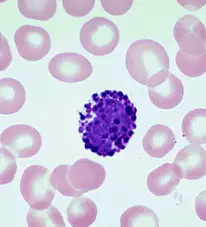
Identify the cell in this picture.
Neutrophil
Eosinophil
Basophil
Lymphocyte
Monocyte

Identify the cell in this picture.
Neutrophil
Eosinophil
Basophil
Lymphocyte
Monocyte
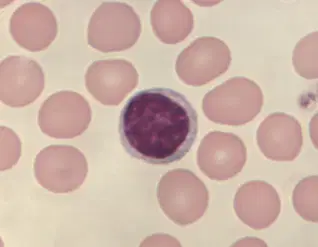
Identify the cell in this picture.
Neutrophil
Eosinophil
Basophil
Lymphocyte
Monocyte

What might cause this "left shift" slide?
Clefted monocytes migrating to tissues
Hypersegmentation occurring due to a B12 or folate deficiency
Leukocytosis engaging in iron capture as a response to anemia
Immature neutrophils being mobilized for infection

Identify the cell in this picture.
Atypical Lymphocyte
Blast
Promyelocyte
Lymphocyte
Monocyte
What is the primary role of eosinophils in the blood?
To produce IgE when encountering an antigen
To fight bacterial infections by degranulating
To combat parasitic infections and play a role in allergic reactions
To cause targeted inflammation in the respiratory tract
You have purchased only 75g glucola for your Health Unit, the bottles are 300mL. How much of the bottle should a patient consume to conduct a Two Step Gestational Diabetes Screen?
50mL
150mL
200mL
300mL

