
 Worksheets
Ethics in Healthcare
Total questions: 44
Worksheet time: 22mins
What does ethics deal with in the context of health professionals?
Laws and regulations
Values and morals
Scientific research
Financial management
Which of the following best defines "values" ?
Rules set by society
Principles you hold dear, such as honesty
Actions taken in emergencies
Skills learned through training
How are morals described in the context of ethics for health professionals?
The laws that govern healthcare
What a person believes to be right or wrong
The financial responsibilities of a professional
The technical skills required for a job
Why is the code of ethics considered especially important in healthcare professions?
Because healthcare professionals work with advanced technology
Because few professions hold a higher code of ethics than those in healthcare
Because healthcare professionals earn higher salaries
Because healthcare professionals work longer hours
A healthcare professional is faced with a situation where honesty conflicts with a patient’s wishes. Using your understanding of values and morals, how should the professional approach this situation?
Ignore both values and morals
Only follow the patient’s wishes
Consider both their own values (such as honesty) and their morals (what they believe is right or wrong) to make an ethical decision
Only follow hospital rules

Which of the following best describes the role of ethical principles for health professionals?
They provide guidance for moral action and ethical decision making.
They are only relevant to legal professionals.
They are used only in academic research.
They are not necessary for professional conduct.

Ethical principles are applicable to which of the following?
Only the medical profession
Any profession
Only business professions
Only government jobs

Why do many professions adopt a code of ethics?
To provide a foundation based on ethical principles
To increase profits
To reduce the number of employees
To avoid training staff

A health professional is faced with a difficult decision. What should guide their actions?
Ethical principles
Personal interests only
Random choice
Peer pressure
Which of the following is NOT listed as an ethical principle in the provided material?
Autonomy
Nonmaleficence
Creativity
Justice
What does the ethical principle of "confidentiality" primarily require a professional to do?
Always tell the truth
Protect private information
Make independent decisions
Treat everyone equally
Which ethical principle emphasizes the importance of doing good and promoting the well-being of others?
Beneficence
Fidelity
Accountability
Veracity
A healthcare professional is faced with a situation where they must choose between telling the truth and protecting a patient's privacy. Which two ethical principles are most likely in conflict in this scenario?
Justice and Autonomy
Veracity and Confidentiality
Fidelity and Accountability
Nonmaleficence and Beneficence
Which of the following best defines "autonomy" in the context of healthcare?
A person's right to self-determination and to make their own healthcare decisions without coercion.
A healthcare provider's right to make decisions for the patient.
A patient's obligation to follow the doctor's advice without question.
A family's right to decide treatment for the patient.
Why must healthcare providers respect a patient's autonomy, even if they disagree with the patient's decision?
Because patients have the right to make choices about their own healthcare.
Because healthcare providers are not allowed to give advice.
Because only patients know about medical treatments.
Because it is required by law in every country.
Olivia is a patient who is fully informed of all treatment options for her condition. She chooses a treatment that her healthcare provider disagrees with. According to the principle of autonomy, what should the healthcare provider do?
Respect the patient's decision and support their choice.
Refuse to provide any treatment.
Convince the patient to change their mind.
Ignore the patient's wishes and choose the best treatment.
Which ethical principle requires that we benefit others and act in the person's best interests?
Justice
Autonomy
Beneficence
Confidentiality
According to the principle of nonmaleficence, what should health professionals do when harm is being inflicted?
Ignore the harm
Remove the harm and act to prevent further harm
Report the harm to authorities only
Allow the harm to continue if it benefits others
Which of the following best describes the principle of justice in health care?
Acting in the patient's best interests
Ensuring fair treatment and equitable allocation of resources
Maintaining patient confidentiality
Avoiding harm to patients
A hospital administrator is deciding how to allocate limited resources among patients. Which ethical principle is most relevant to this decision?
Beneficence
Nonmaleficence
Justice
Autonomy
Why is the principle of justice in health care considered complicated?
It only involves legal elements
It encompasses legal, moral, and ethical elements
It is only about patient confidentiality
It focuses solely on preventing harm
Which ethical principle is defined as honesty and truthfulness in health care?
Fidelity
Autonomy
Veracity
Justice
In the context of health care, what does the principle of fidelity primarily refer to?
Telling the truth to patients
Meeting the reasonable expectations of others by carrying out obligations and duties
Respecting patient privacy
Making fair decisions
Why is veracity considered important in the relationship between health professionals and patients?
It ensures that health professionals are always punctual
It helps patients expect honesty regarding their personal and valued health matters
It allows health professionals to avoid difficult conversations
It focuses on financial management in health care
Ellie, a health professional, is faced with a situation where she must choose between telling a patient the full truth about their diagnosis or withholding some information to avoid distress. Using the ethical principle of veracity, what should Ellie do?
Withhold information to protect the patient
Tell the full truth to uphold honesty and truthfulness
Refer the patient to another professional
Focus only on the employer’s expectations
Which of the following best describes the principle of confidentiality in health care?
Sharing patient information with anyone who asks
Keeping anything stated to health-care providers by patients confidential
Only sharing information with family members
Posting patient information online
Under which circumstance can the principle of confidentiality be violated?
If the patient is late for an appointment
If the patient gives permission for the information to be shared
If the health-care provider is curious
If the patient is healthy
What is an example of accountability for health-care professionals?
Ignoring mistakes made at work
Being responsible for their own actions
Blaming others for errors
Avoiding teamwork
Why is accountability important among health-care professionals and their colleagues?
It allows them to avoid responsibility
It ensures they are only accountable to patients
It promotes responsibility and trust within the team
It encourages secrecy among staff
A patient tells their health-care provider something personal. Under what condition can this information be shared without violating confidentiality?
If the patient may harm themselves or others
If the provider wants to tell a friend
If the information is not important
If the patient is a minor
What usually happens when you decide in favor of one ethical principle in an ethical dilemma?
It usually violates another ethical principle
It solves all ethical problems
It makes both sides happy
It avoids any negative consequences
Why are ethical dilemmas challenging to resolve?
Both sides have “goodness” and “badness” associated with them
There is always a clear right and wrong answer
Only one side has any value
They are based solely on personal preferences
A hospital administrator faces a situation where respecting patient confidentiality conflicts with the need to inform public health authorities about a contagious disease. Which concept does this scenario best illustrate?
Ethical dilemma
Legal compliance
Personal preference
Financial decision-making
Which of the following is the first step in the ethical decision-making process?
Gather information
Identify the problem
Make a decision
Take action
Which principle of health care ethics is best described as "Do no harm"?
Autonomy
Beneficence
Non-maleficence
Justice
What should you do after determining the ethical approach in the decision-making process?
Take action
Gather information
Make a decision
Identify the problem
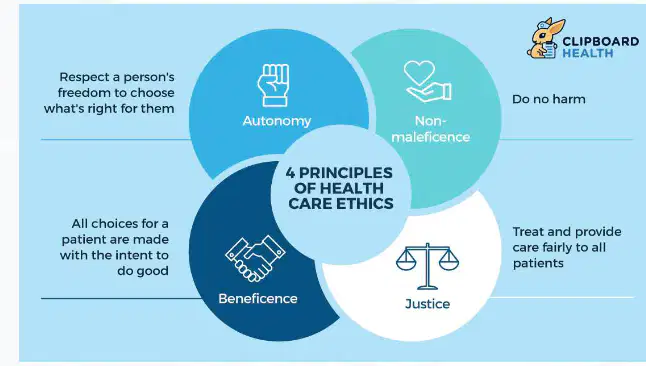
Which principle of health care ethics emphasizes treating and providing care fairly to all patients?
Autonomy
Justice
Beneficence
Non-maleficence
Why is it important to stay calm, focused, and open-minded when making an ethical decision?
It helps to avoid making any decision at all
It ensures decisions are made quickly without considering consequences
It allows for informed and fair decision-making
It guarantees everyone will agree with your decision
Which of the following is NOT one of the four pillars of medical ethics?
Autonomy
Beneficence
Confidentiality
Justice
Which pillar of medical ethics emphasizes the obligation to do good and act in the best interest of the patient?
Non-maleficence
Beneficence
Justice
Autonomy
A doctor respects a patient’s right to make their own decisions about their treatment. Which pillar of medical ethics does this represent?
Justice
Non-maleficence
Autonomy
Beneficence
Which pillar of medical ethics is most directly concerned with avoiding harm to patients?
Non-maleficence
Justice
Autonomy
Beneficence
How does the principle of justice apply in medical ethics?
By ensuring patients are not harmed
By ensuring fair and equal treatment for all patients
By allowing patients to make their own choices
By acting in the best interest of the patient

What is an ethical dilemma?
A situation where a problem exists between ethical principles
A situation where there is only one correct answer
A problem that can be solved without any consequences
A scenario where laws are always followed

