
 Worksheets
Sound beams + Study guide
Total questions: 69
Worksheet time: 53mins
(a) is the width of a pulse as it travels away from the transducer
__ __ ultrasound beam is filled with sound waves all the time, just like a flashlight
(a)
Are pulsed ultrasound sound beams different from continuous wave sound beams?
Yes
No
In pulsed ultrasound, the (a) of the scan plane is NOT the same as the width of the perpendicular to the scan plane
In pulsed ultrasound, the width of the scan plane is (a) the same as the width of the perpendicular to the scan plane
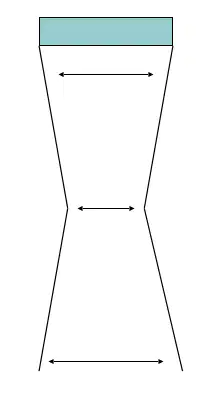
Does this image show a frontal or side view of the scan plane?
Frontal
Side
The width of the scan plane (frontal view) determines the (a)
The width perpendicular to the scan plane (thickness of the “slice”) determines the (a)
Front view (scan plane) = (a)
Side view (perpendicular) =
(a)
Single-element disc under continuous wave mode:
Sound beam with same width depending on the diameter from the transducer
Sound beam with variable width depending on the distance from the transducer
The near zone is also called the (a)
The far zone is also called the (a)
From the transducer to the focus.
(a)
In this area the width of the beam decreases progressively until it reaches half the length of the element size.
(a)
In the near zone, the width of the beam decreases progressively
until it reaches (a) the length of the element size.
The near zone goes until it equals (a) diameter of the crystal
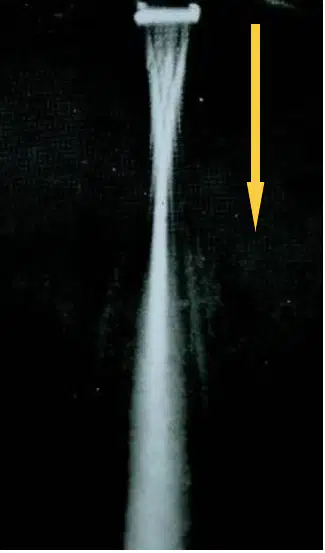
What is the yellow arrow in this image highlighting?
Near zone
Fresnel zone
Near field
Far field
From the focus down to the deeper planes
(a)
At the beginning it is half the length of the element size.
(a)
In this zone, the beam diverges.
(a)
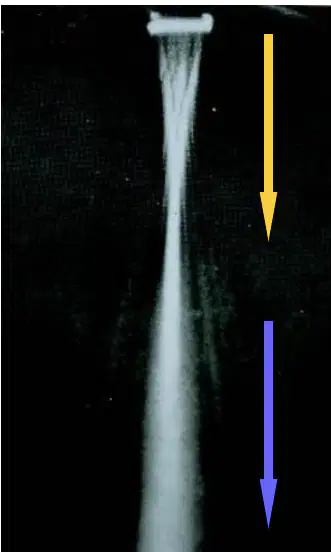
In this image, what is the blue arrow highlighting?
Near zone
Far zone
Fraunhofer zone
Far field
The narrowest point of the beam.
(a)
For a single disc element the (a) is equal to one-half the width of the element or transducer.
The element is 5cm diameter, what is the width of the beam at the focus?
1.5cm
2cm
2.5cm
3cm
The beam is 5cm, what is the width of the beam where the near zone ends?
1.5cm
2.5cm
4.5cm
5cm
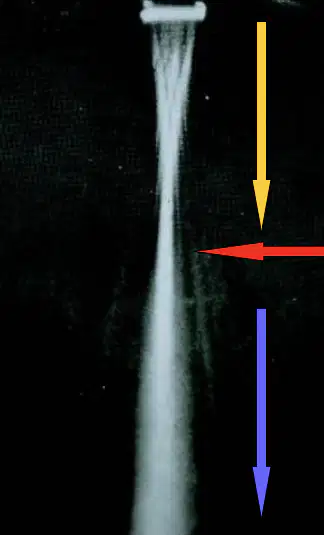
In this image, what is the red arrow pointing to?
(a)
In ultrasound imaging, where should the focus be?
In the middle of the imaging field
In the posterior imaging field
Wherever the structure is
Where the surrounding structures are
It is the distance from the transducer to the focus.
(a)
The focus is also called the (a)
It is the region around the focus where the beam is narrow
(a)

What is the best estimate of the diameter or width of the sound beam as it exits the transducer?
6mm
9mm
12mm
8mm

What is the diameter of the sound beam at a depth of 8cm?
6mm
9mm
12mm
8mm

At what depth is the focus?
6mm
8mm
1cm
12mm

What depth marks the beginning of the focal zone?
6mm
8mm
12mm
8mm
In a 25 mm diameter transducer, what is the beam width as it initially exits the transducer?
25mm
12.5mm
10mm
5mm
If the active element has a diameter of 12 mm, what is the beam width at the focal point?
6mm
12mm
10mm
4mm
Which synthetic material is most commonly used in diagnostic ultrasound transducers?
Barium titnate
Lead zirconate titanate (PZT)
Lithium niobite
Quartz
What is a drawback of using damping material in a transducer?
Increases sensitivity
Produces longer pulses
Reduces Bandwidth
Decreases sensitivity
Which of the following is not a characteristic of damping material?
Enhances axial resolution
Reduces pulse duration
Has low sound absorption
Matches impedance with the crystal
Which transducer component is typically one-quarter wavelength thick?
Matching layer
Crystal
Damping block
Housing
How does Q-factor relate to bandwidth?
Directly proportional
Inversely proportional
No relationship
Equal
What term describes the range of frequencies emitted by a transducer?
Frequency spectrum
Bandwidth
Resonance range
Q-factor
Which of the following is not true about the matching layer?
It improves sound transmission
It is 1/4 wavelength thick
It has higher impedance than the crystal
It is located at the front of the transducer
The impedance of PZT is approximately ______ times ______ than that of soft tissue.
15, greater
20, greater
10, lesser
5, greater
What is the term for the point where the ultrasound beam is narrowest?
Focal point
Near field
Far field
Focal zone
What is the name of the region from the transducer face to the focal point?
Fraunhofer Zone
Focal zone
Fresnel zone
Divergence zone
What is the distance from the transducer to the focal point called?
Focal length
Beam width
Axial depth
Near zone
Half of the focal zone lies in the near field, and the other half lies in the far field.
True
False
Which transducer frequency will result in the deepest focus?
10 MHz
7.5 MHz
5 MHz
2.5 MHz
Which transducer diameter will result in greater beam divergence?
15mm
10mm
8mm
5mm
What characteristics of a fixed focus transducer determine the focal depth?
Transducer diameter
Transducer length
Frequency of sound
PRP
A larger diameter results in a (a) focus
Transducer diameter and focal depth are (a) related
High frequency results in a (a) focus
Frequency and focal depth are (a) related
(a) describes the gradual spread of the ultrasound beam in the far field
What characteristics of a transducer determine the spread of the beam in the far field?
Transducer length
Transducer diameter
Frequency of sound
Period of sound
True or false: Smaller diameter crystals produce beams that spread out or diverge more in the deep far zone
True
False
Crystal diameter and beam divergence are (a) related
Larger diameter crystals (a) lateral resolution in the far field
Larger diameter, (a) divergence
How does frequency alter beam divergence in the far field?
Higher frequency sound beams spread out or diverge more in the far zone
Lower frequency sound beams diverge less in the far zone
Higher frequency sound beams spread out or diverge less in the deep far zone
Lower frequency sound beams spread out or diverge ore in the deep far zone
Frequency and sound beam divergence are (a) related
Higher frequency sound (a) lateral resolution in the far field
Larger diameter, higher frequency
(a)
Smaller diameter, lower frequency
(a)
With a transducer diameter of 10 mm and a focal depth of 5 cm, what is the beam width
at 10 cm from the transducer
10mm
12mm
5mm
8mm
What is the term for the ability of a material to generate an electric charge in response
to mechanical stress?
Piezoelectric effect
Acoustic impedance
Thermal expansion
Reverse piezoelectric effect

