
Font size
 Worksheets
Forces & Motion
Total questions: 95
Worksheet time: 48mins
What is a force? Fill in the blank: A force is ___ .
Any influence that causes an object to undergo a change in speed, direction, or shape.
A type of energy that cannot be measured.
A property that only exists in liquids.
A measurement of temperature change.
A force is:
Only a push
Only a pull
A push or a pull
Neither a push nor a pull
What is Displacement?
Displacement is the change in position of an object from its starting point to its ending point, measured in a straight line and in a specific direction.
Displacement is the total distance traveled by an object, regardless of direction.
Displacement is the speed at which an object moves from one place to another.
Displacement is the amount of time taken by an object to return to its starting point.
What is Speed?
Speed is the distance traveled per unit of time.
Speed is the amount of force applied to an object.
Speed is the total mass of an object.
Speed is the energy stored in an object.
What is Velocity?
Velocity is the speed of an object in a specific direction.
Velocity is the amount of matter in an object.
Velocity is the force applied to an object.
Velocity is the distance covered by an object.
What is Acceleration?
Acceleration is the rate at which an object's velocity changes over time.
Acceleration is the amount of distance covered in a given time.
Acceleration is the total distance traveled by an object.
Acceleration is the force applied to an object.
What is Linear & Angular Momentum?
Linear momentum is the product of an object's mass and velocity. Angular momentum is the rotational equivalent, depending on the object's moment of inertia and angular velocity.
Linear momentum is the force applied to an object, and angular momentum is the speed of rotation.
Linear momentum is the energy stored in a moving object, and angular momentum is the energy stored in a rotating object.
Linear momentum is the distance traveled by an object, and angular momentum is the distance rotated by an object.
What is the definition of displacement? Displacement is an object's ________ position.
overall
average
initial
final
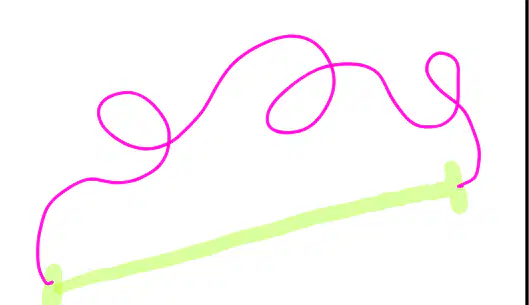
In the diagram, the pink line shows the path taken by an object, and the green line shows the straight line from start to finish. What does the green line represent?
The total distance traveled
The displacement
The speed of the object
The time taken
What is the rate of change of an object's position called?
Speed
Mass
Force
Temperature
Speed depends on which two factors?
Distance and time
Mass and volume
Force and acceleration
Temperature and pressure
Is speed a scalar or vector quantity?
Scalar quantity
Vector quantity
What is the formula for speed?
s = d/t
s = t/d
s = d*t
s = t-d
What is the common unit for speed shown in the image?
mph
kg
cm
L
Velocity is defined as ______ in a certain direction.
speed
distance
acceleration
force
Velocity involves a change in either ______ or speed.
direction
mass
temperature
volume
Is velocity a scalar or vector quantity?
Scalar
Vector
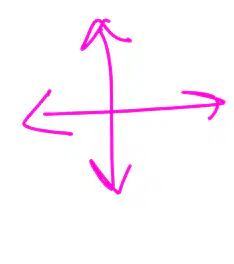
The diagram shows arrows pointing in different directions. What does this represent in the context of velocity?
Different speeds
Different directions
Different objects
Different times
What is the definition of acceleration?
Rate of change of an object's velocity with time.
The amount of force applied to an object.
The distance traveled by an object.
The mass of an object.
Which of the following describes acceleration?
Only speeding up
Only slowing down
Speeding up or slowing down
Remaining at constant speed
Acceleration can occur due to which of the following?
Only when speed increases
Only when speed decreases
Directional change even when speed remains the same
Only when speed is constant
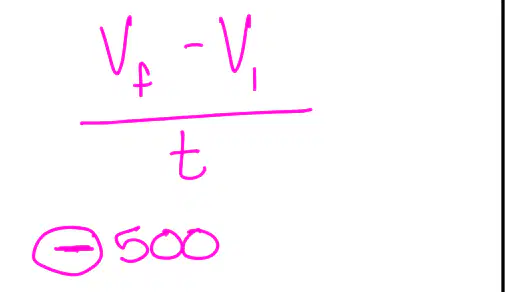
Fill in the blank: The formula for acceleration is _________. (Use the variables shown in the image)
(Vf - Vi) / t
(Vi - Vf) * t
Vf * Vi / t
(Vf + Vi) * t
Newton's 3rd Law of Motion states: For every action, there is an ______ and ______ reaction.
equal and opposite
strong and weak
fast and slow
direct and indirect
According to Newton's 3rd Law of Motion, forces act in pairs. What are these pairs called?
Balanced pairs
Action/reaction pairs
Friction pairs
Gravity pairs
The diagram shows two arrows pointing in opposite directions. What does this represent according to Newton's 3rd Law of Motion?
Forces acting in the same direction
Forces acting in pairs, equal and opposite
Only one force acting
No forces acting
What is matter?
Anything that has mass and occupies space
Anything that has color
Anything that can move
Anything that is liquid
Matter can be classified based on:
Physical Properties
Chemical Properties
Electrical Properties
Magnetic Properties
Fill in the blank: Matter is anything that has ______ and occupies space.
mass
color
temperature
energy
Fill in the blank: Matter can be classified based on Physical Properties and ______ Properties.
Chemical
Thermal
Optical
Electrical
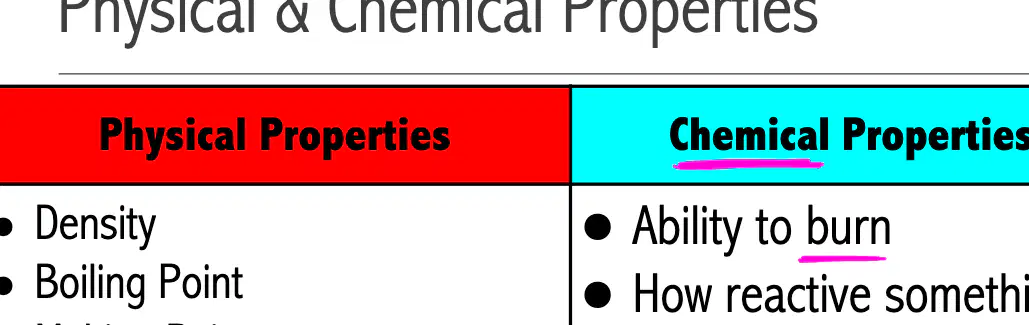
Is density a physical property or a chemical property?
Physical Property
Chemical Property
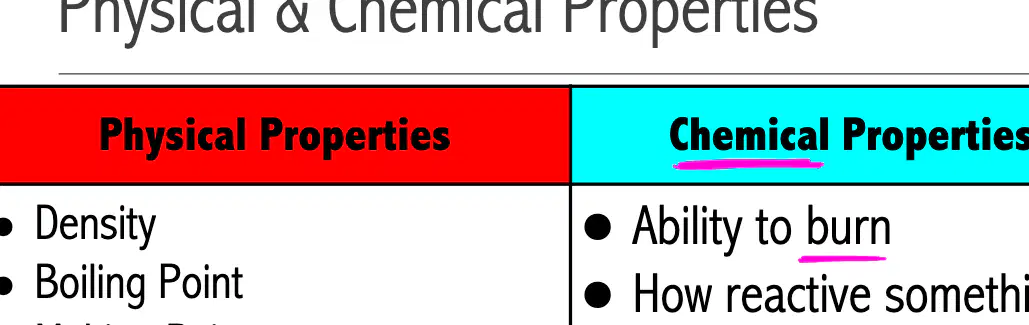
Is boiling point a physical property or a chemical property?
Physical Property
Chemical Property
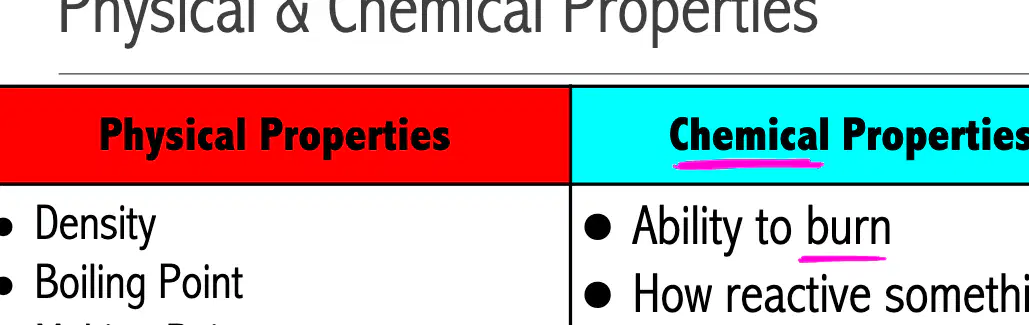
Is melting point a physical property or a chemical property?
Physical Property
Chemical Property
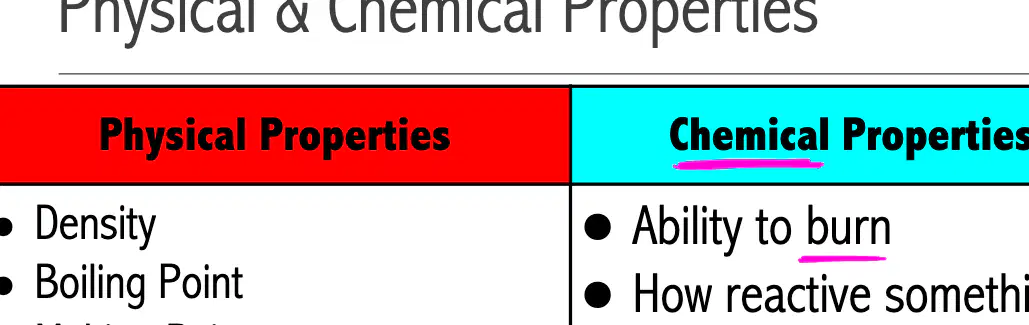
Is luster a physical property or a chemical property?
Physical Property
Chemical Property
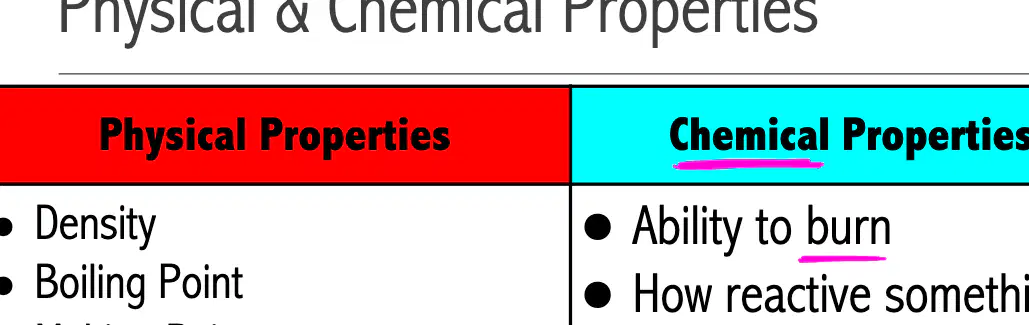
Is malleability a physical property or a chemical property?
Physical Property
Chemical Property
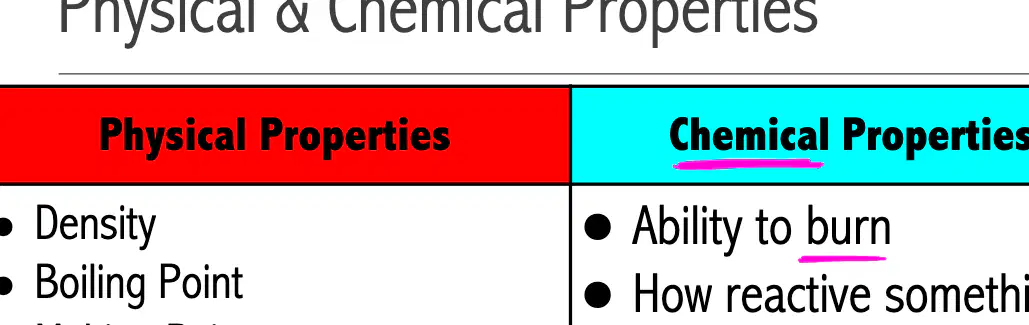
Is the ability to burn a physical property or a chemical property?
Physical Property
Chemical Property
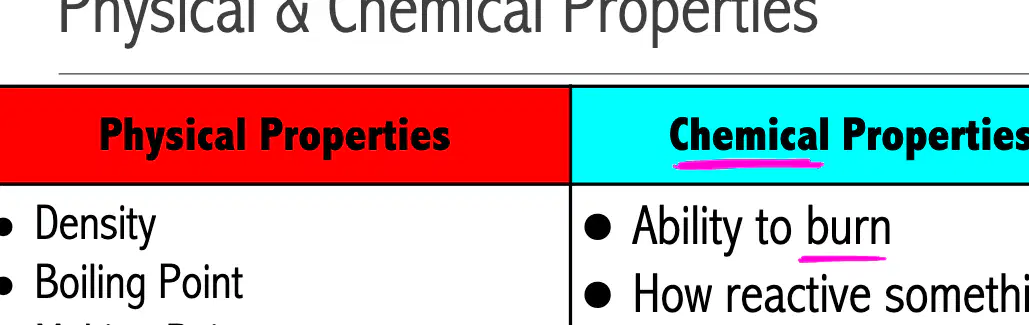
Is how reactive something is a physical property or a chemical property?
Physical Property
Chemical Property
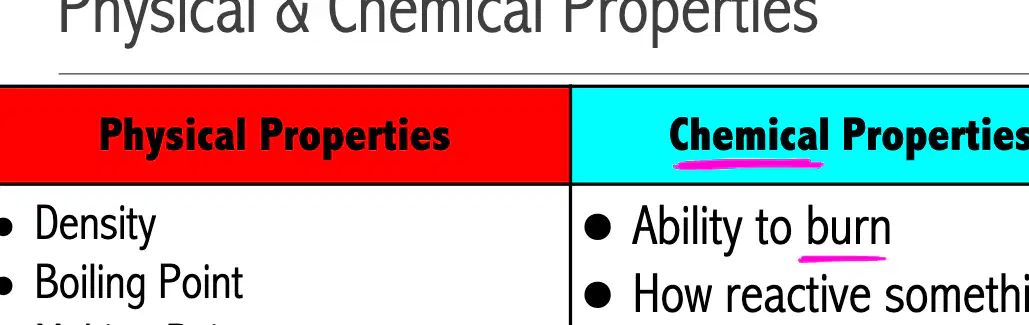
Is rusting a physical property or a chemical property?
Physical Property
Chemical Property
What is the definition of density? Fill in the blank: Density is ______ per unit volume.
mass
weight
length
temperature
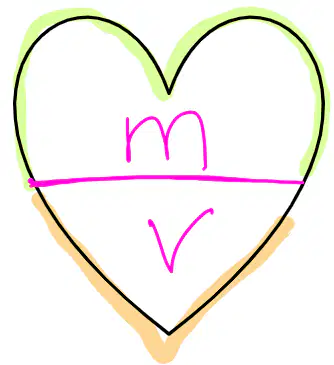
What is the formula for density as shown in the diagram? Fill in the blank: Density = m / ___?
v
m
d
g
How does the density of gases and liquids change with temperature?
It stays the same
It varies with temperature
It increases with temperature
It decreases with temperature
Which of the following are the three main states of matter shown in the diagram?
Solid, Liquid, Gas
Water, Ice, Steam
Metal, Plastic, Wood
Earth, Wind, Fire
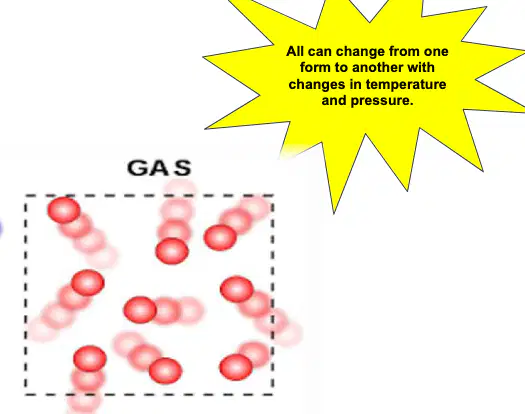
Fill in the blank: All states of matter can change from one form to another with changes in _______ and pressure.
temperature
volume
mass
density
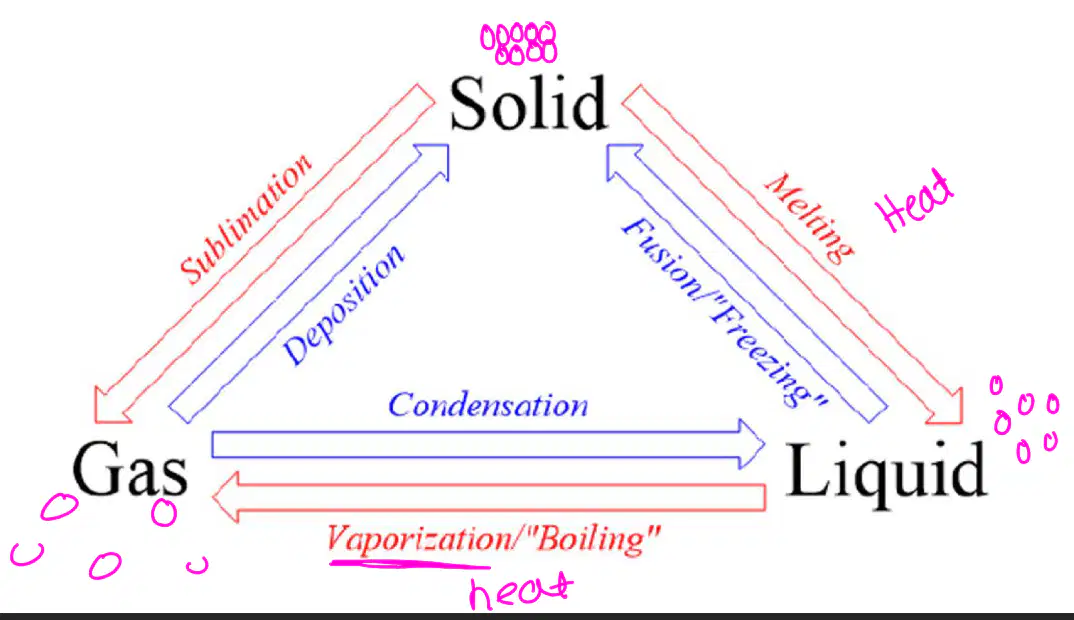
Refer to the diagram showing the changes of state of matter. What is the process called when a solid changes directly into a gas?
Melting
Sublimation
Condensation
Deposition
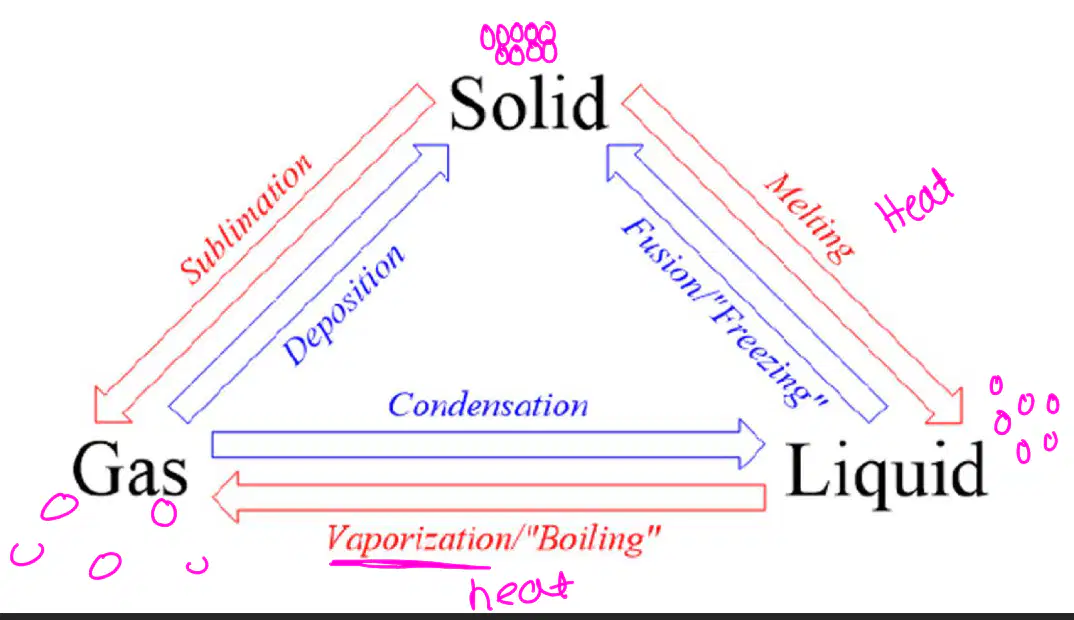
What is the process called when a gas changes directly into a solid?
Deposition
Fusion
Condensation
Melting
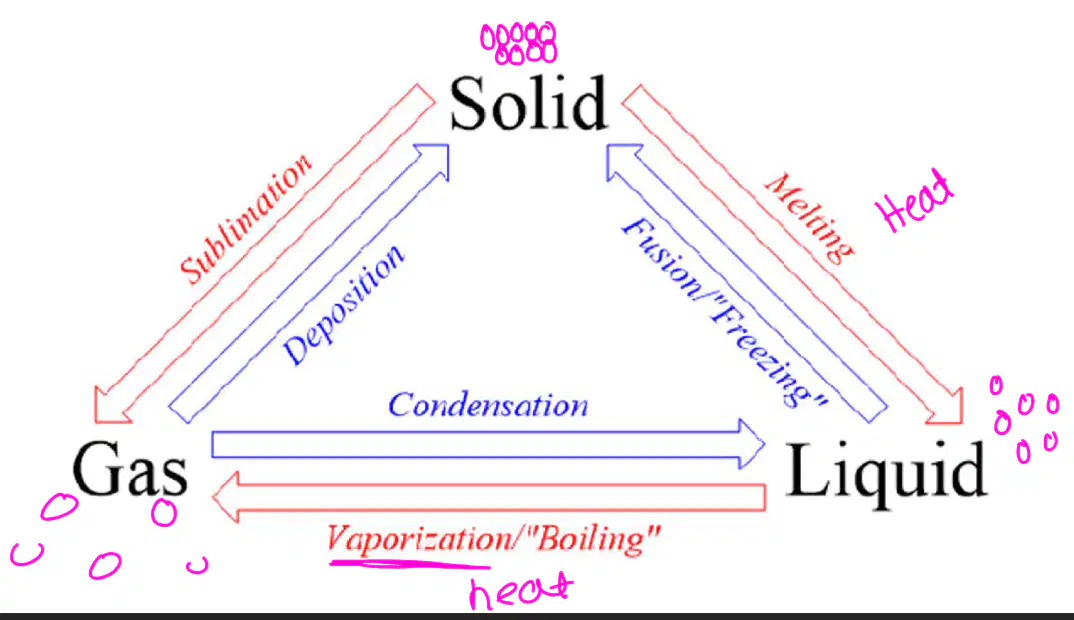
Refer to the diagram showing the changes of state of matter. The process of changing from a liquid to a gas is called ________.
Vaporization/Boiling
Condensation
Melting
Freezing
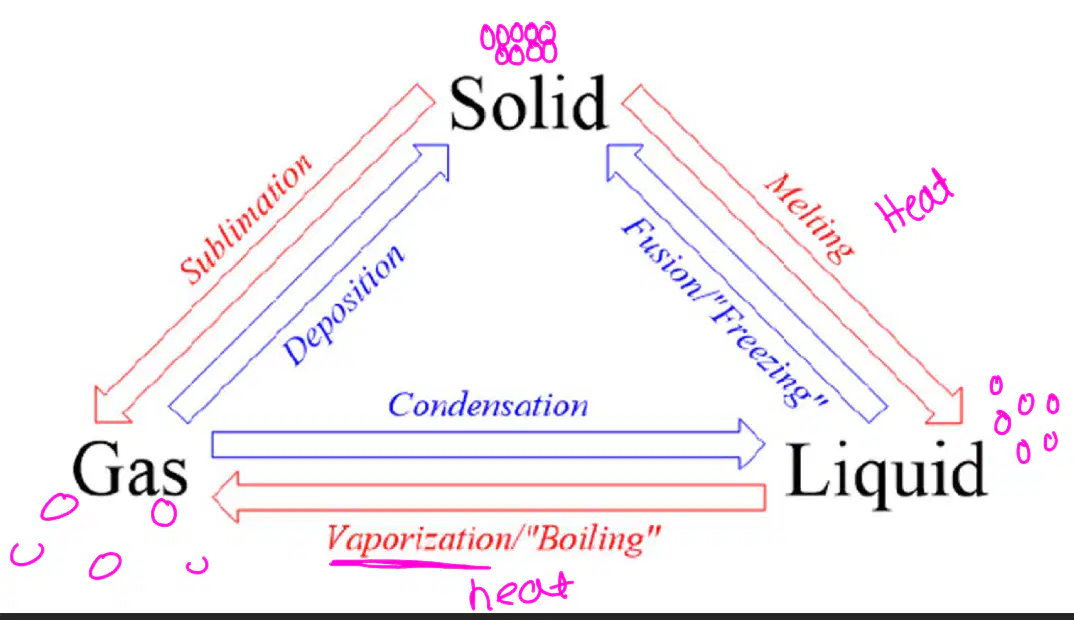
Refer to the diagram showing the changes of state of matter. The process of changing from a gas to a liquid is called ________.
Condensation
Evaporation
Sublimation
Melting
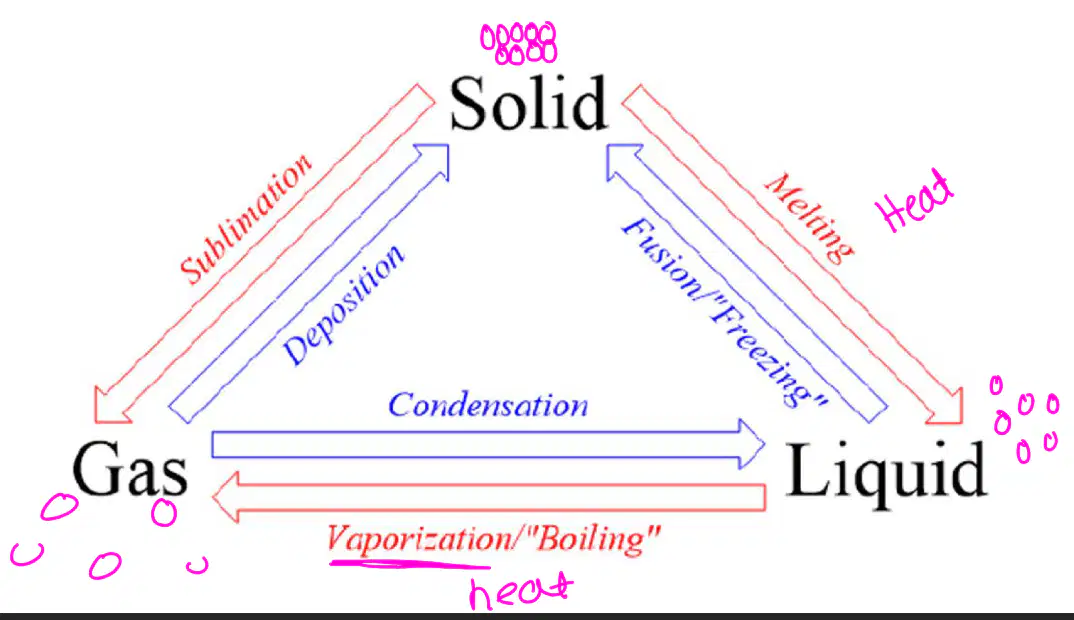
Refer to the diagram showing the changes of state of matter. Which process requires the addition of heat?
Melting
Vaporization/Boiling
Sublimation
All of the above
According to Newton's 2nd Law of Motion, the acceleration of an object is equal to the net force on an object divided by the _______ of the object.
mass
speed
volume
temperature
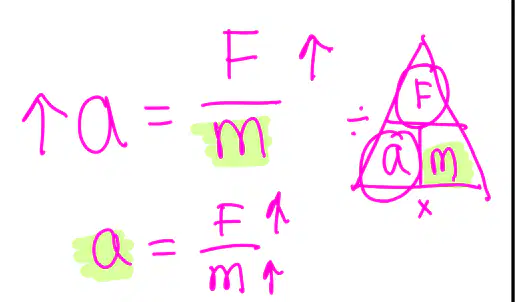
Which of the following is the correct formula for acceleration according to Newton's 2nd Law of Motion?
A) a = F + m
B) a = F / m
C) a = m / F
D) a = F - m
The more force applied to an object, the faster it will accelerate.
True
False
True or False: The more mass an object has, the less force you need to accelerate it.
True
False
According to Newton's First Law of Motion, what happens to an object at rest?
It starts moving on its own
It stays at rest unless acted upon by an outside force
It changes direction
It speeds up automatically
Newton's First Law of Motion is also known as the _________.
Law of Inertia
Law of Acceleration
Law of Gravitation
Law of Action-Reaction
The diagram shows a person pushing a ball. According to Newton's First Law of Motion, what will happen to the ball after it is pushed?
It will keep moving in the same direction at the same speed unless acted upon by another force
It will stop immediately
It will move in circles
It will bounce up and down
Newton's First Law of Motion states that an object in motion will stay in motion with the same speed and direction unless acted upon by an outside force.
True
False
What is one of the features of metals? Fill in the blank: Metals can conduct ______ & electricity.
heat
wood
plastic
paper
Which of the following is a feature of metals?
They are dull
They have luster
They have low densities
They make up a minority of the periodic table
Fill in the blank: Metals have ______ densities.
high
low
average
variable
Fill in the blank: Metals make up the majority of the ______ ______.
periodic table
solar system
human body
atmosphere
What happens to the atoms of metals in terms of their electrons? Fill in the blank: Atoms of metals lose electrons from their ______ shells.
outer
inner
core
valence
What is an alloy?
A pure metal
A mixture of two or more metals
A type of nonmetal
A type of gas
What type of materials are crystals?
Polycrystalline materials
Amorphous materials
Liquid materials
Gaseous materials
What do atoms in crystals form?
A crystal lattice, also known as a repeating pattern.
A random arrangement of atoms.
A liquid structure.
A single large atom.
Which of the following is NOT an example of a polymer?
Rubber
Nylon
PVC
Glass
Polymers include naturally occurring synthetic materials.
True
False
Polymers are large molecules connected by ______ chemical bonds.
covalent
ionic
hydrogen
metallic
Thermoplastic polymers can be:
Melted and reformed to be used again
Changed chemically and cannot be melted or reformed
Thermoset polymers:
Can be melted and reformed
Change chemically and cannot be melted or reformed
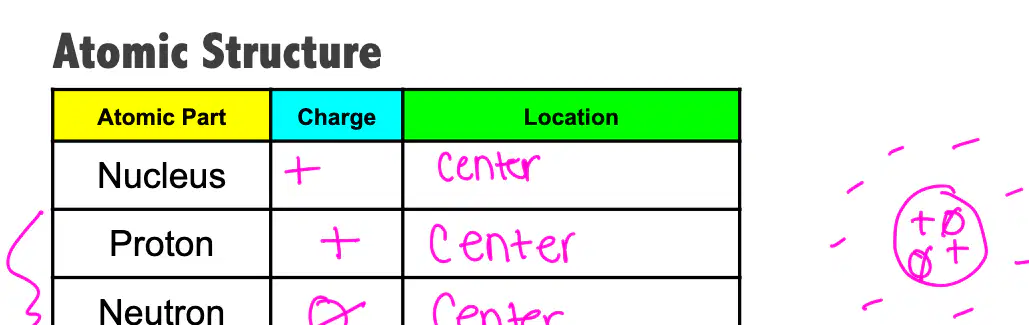
What is the charge of the nucleus in an atom?
Positive (+)
Negative (-)
Neutral (0)
Depends on the atom
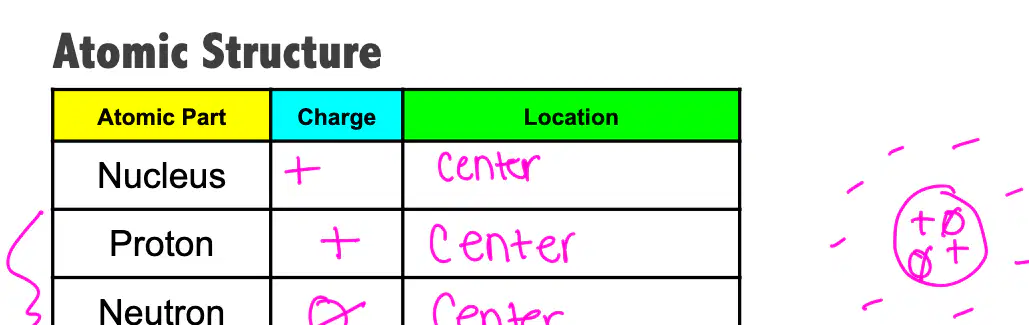
Where is the proton located in an atom?
Center
Outer shell
Electron cloud
Outside the atom
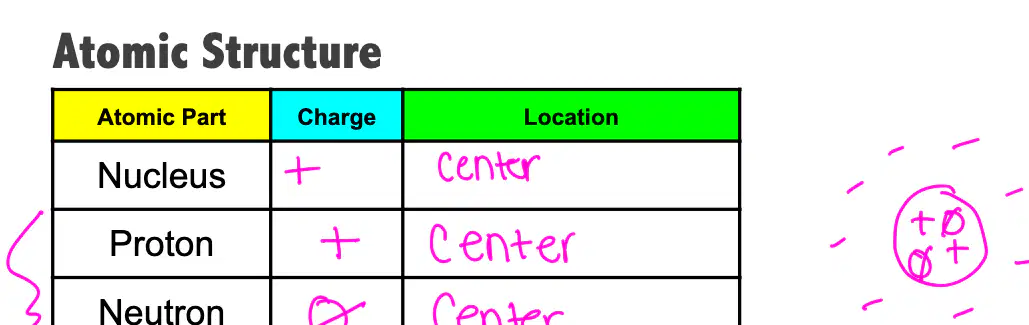
What is the charge of a neutron?
Neutral (0)
Positive (+1)
Negative (-1)
Positive (+2)
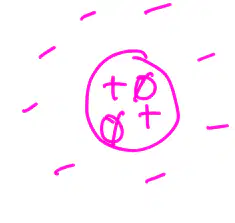
Where is the electron located in an atom?
Outside
Inside the nucleus
In the proton
In the neutron

Which direction do periods run on the periodic table?
Vertically
Horizontally
Diagonally
In a circle
What do the numbers at the top of each column in the periodic table represent?
Periods
Groups/Families
Atomic Mass
Atomic Size
The atomic number of Sodium (Na) is ___
11
12
10
15
Which of the following is true about atomic size as you move down a group/family in the periodic table?
It increases
It decreases
It stays the same
It fluctuates randomly
What is the atomic mass of Carbon (C)?
12.01
14.01
16.00
10.81
Which side of the Periodic Table are metals located on?
Left side
Right side
Middle
Bottom
Metals tend to ______ electrons.
Lose
Gain
Share
Attract
Which group of metals is the most reactive?
Group 1
Group 2
Group 17
Group 18
Metalloids have properties of both ______ and ______.
metals, nonmetals
solids, liquids
gases, liquids
metals, gases
What is the main function of metalloids on the Periodic Table?
A) Separate the metals and non-metals
B) Gain electrons
C) Lose electrons
D) Are the most reactive
On which side of the Periodic Table are non-metals found?
Left side
Right side
Middle
Bottom
Non-metals tend to ______ electrons.
Gain
Lose
Share
Donate
What are valence electrons? Fill in the blank: Valence electrons are the electrons in the ________ that are involved in bonding.
outermost orbital
innermost shell
nucleus
core region
Valence electrons are involved in which of the following?
A) Bonding
B) Melting
C) Freezing
D) Evaporation
How do you determine the number of valence electrons an element has using the periodic table? Fill in the blank: The number of valence electrons is equal to the ________ number (e.g., 1A, 7A).
group
period
atomic
mass
Chemical properties are influenced by which of the following?
Atomic mass
Valence electrons
Number of protons
Number of neutrons
Elements that have the same valence electrons are in the same group on the periodic table and have similar ________ properties.
chemical
physical
atomic
magnetic
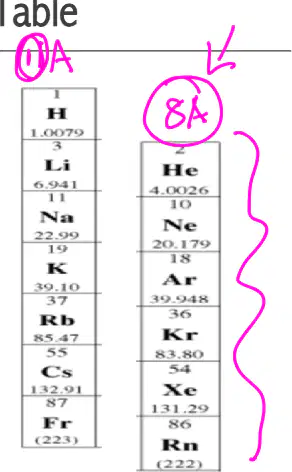
According to the periodic table diagram, which group is labeled as 1A?
A) H, Li, Na, K, Rb, Cs, Fr
B) He, Ne, Ar, Kr, Xe, Rn
C) O, S, Se, Te, Po
D) B, Al, Ga, In, Tl
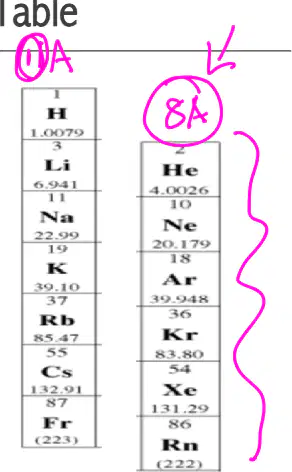
According to the periodic table diagram, which group is labeled as 8A?
A) H, Li, Na, K, Rb, Cs, Fr
B) He, Ne, Ar, Kr, Xe, Rn
C) O, S, Se, Te, Po
D) B, Al, Ga, In, Tl
Fill in the blank: Any change to the ________ properties of matter (size, shape, state of matter) is a physical change.
physical
chemical
atomic
magnetic
Fill in the blank: In a physical change, no ________ chemical substance is formed.
new
old
visible
large
Which of the following is an example of a physical change?
A) Boiling Water
B) Burning Wood
C) Rusting Iron
D) Baking a Cake
Which of the following is an example of a physical change?
Dissolving sugar in water
Cooking an Egg
Digesting Food
Lighting a Match

