
 Worksheets
Science 8 Final Exam
Total questions: 50
Worksheet time: 40mins
What is the measure of how far something moved divided by the time it took to travel that distance?
Velocity
Speed
Acceleration
Force
What is speed in a specific direction called?
Acceleration
Force
Velocity
Distance
How fast would a spacecraft need to travel to reach the moon in 24 hours if the moon is 238,900 miles away?
9954.2 mph
2389 mph
10000 mph
5000 mph
What type of energy is stored energy based on the position of an object?
Kinetic Energy
Potential Energy
Thermal Energy
Mechanical Energy
Which type of energy is energy of motion?
Potential Energy
Kinetic Energy
Chemical Energy
Nuclear Energy

Which letter represents the least potential energy?
A
B
C
None
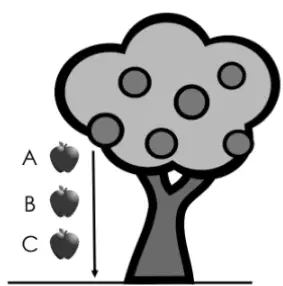
Which letter represents the greatest kinetic energy?
A
B
C
None
What happens to potential energy when the mass of an object increases?
It decreases.
It remains the same.
It increases.
It disappears.

Select the point that has the greatest kinetic energy.
W
X
Y
Z

A softball is hit high in the air, as it rises, the softball _____________.
gains kinetic energy and loses potential energy
loses kinetic energy and gains potential energy
loses kinetic energy and loses potential energy
gains kinetic energy and gains potential energy
The continents continue to move slightly each year, therefore as the continents shift due to the plate movement, the natural resources are deposited in new places.
true
false
What is the difference between weathering and erosion?
Weathering moves rocks, erosion breaks them down
Weathering breaks down rocks, erosion moves them
Weathering and erosion are the same process
Erosion only happens in water
Which sphere includes all of Earth's water?
Geosphere
Atmosphere
Hydrosphere
Biosphere
The geosphere includes
Includes all of Earth’s water - oceans, lakes, and rivers.
Rocky parts of Earth that are solid - crust, mantle, core.
Made up of all living things - plants, animals, bacteria, fungi.
Made up of the gases that surround Earth - air we breathe, ozone, CO2
The biosphere includes
Includes all of Earth’s water - oceans, lakes, and rivers.
Rocky parts of Earth that are solid - crust, mantle, core.
Made up of all living things - plants, animals, bacteria, fungi.
Made up of the gases that surround Earth - air we breathe, ozone, CO2
The carbon cycle is the biogeochemical cycle by which _____.
the carbon is exchanged among the biosphere, geosphere, hydrosphere, and atmosphere of the Earth.
the carbon is locked in rocks without any exchange with the atmosphere.
the carbon circulates only within the Earth's atmosphere and oceans.
the carbon is confined solely to terrestrial plants and animals.
Carbon is exchanged among Earth's spheres (biosphere, geosphere, hydrosphere, and atmosphere) through various processes including
It is exchanged only through photosynthesis and respiration.
It is exchanged through photosynthesis, respiration, decomposition, and sedimentation.
It is exchanged only through geological processes.
It is exchanged solely in the atmosphere.
Combustion is a chemical process that burns fuel and excessively releases which substance into the atmosphere?
Carbon dioxide
Oxygen
Nitrogen
Water vapor
Living organisms depend on the atmosphere because it provides:
It provides oxygen, regulates temperature, and offers protection.
It only provides oxygen.
It only regulates temperature.
It only offers protection.
The greenhouse effect is defined as the process by which certain gases trap heat in the Earth's atmosphere. Select the statement that correctly describes the greenhouse effect and its causes.
It is a process where greenhouse gases in the atmosphere trap heat, with causes including both natural phenomena and human activities such as burning fossil fuels.
It is a process where the Earth loses heat to space due to the absence of greenhouse gases.
It describes the reflection of sunlight off the atmospheric layers with no role for human activities.
It refers to the trapping of heat exclusively by water vapor with no contribution from other gases or human activities.
Which of the following best summarizes the definition and causes of global warming, along with its effects on climate change?
Global warming is the gradual increase in Earth's temperature due to human-induced greenhouse gas emissions, leading to climate change.
Global warming is a sudden climatic event unrelated to human activities, with no significant impact on climate change.
Global warming is a myth that has no scientific basis and does not affect the climate.
Global warming refers to the Earth's cyclical temperature variations that occur without any human influence.
Which two are likely to result from climate change?
increase in surface temperatures
reduction in greenhouse gases
rise in ocean levels
decrease in air pollution

Why are forests important in reducing climate change? Trees ____
use Carbon Dioxide to make food & release oxygen into the atmoshpere
provide building materials
are an important food source
reflect all sunlight away from the Earth

Which best explains how livestock farming contributes to global warming ? Animals __________
waste pollutes the soil
are consuming too much grass
decayed matter emits too much carbon dioxide
produce methane when they are digesting food

The graph shows changes in carbon dioxide
(CO2) concentrations and surface temperatures
on Earth from the years 1880 to 2000.
Why do carbon dioxide concentrations and
surface temperatures show the relationship seen
in the graph?
because lower carbon dioxide levels mean more
heat is retained in Earth's atmosphere
because higher carbon dioxide levels mean
more heat is retained in Earth's atmosphere
because lower carbon dioxide levels mean less
heat is retained in Earth's atmosphere
because higher carbon dioxide levels mean less
heat is retained in Earth's atmosphere


The EM spectrum increases from left to right in________________.
Wavelength
Frequency
Amplitude
Height

In the EM spectrum, ________ is shorter on the right than on the left.
Frequency
Hertz
Amplitude
Wavelength


EM waves ________ a medium.
require
don't require
can have
sometimes have
Select the correct order of waves on the EMS from longest wavelength to shortest wavelength.
______ is the distance between one point of a wave to the same point in
the next wave.
Amplitude
Frequency
Wavelength
Crest
______ is the height of a wave from its point of rest to a crest or a trough.
Amplitude
Frequency
Wavelength
Crest
What do waves carry?
Water
Energy
Matter
Particles
What is the material waves travel through called?
Matter
Medium
Material
Amplitude
The type of wave sound is. Energy moves parallel to the wave.
Transverse wave
Longitudinal wave
Oblique wave
Acute wave
The type of wave that light is. Energy causes the wave to move up and down.
Transverse wave
Longitudinal wave
Oblique wave
Acute wave
_______ is the number of waves per unit of time
Amplitude
Frequency
Wavelength
Crest
What happens if we increase frequency?
Wavelength gets smaller
Wavelength gets bigger
Amplitude gets bigger
Amplitude gets smaller
The lowest part/bottom of a wave is called what?
Amplitude
Frequency
Crest
Trough
The highest part/top of a wave is called what?
Amplitude
Frequency
Crest
Trough
Which type of resource can be replaced or never run out. Examples include solar energy, wind power, geothermal energy, hydroelectric energy (water), and biomass (material made from plants and animals)?
nonrenewable resources
renewable resources
Which type of resources cannot be replaced at the same rate it is being used? It takes a long time to be replaced. Most Non-renewable energy sources are fossil fuels: coal, natural gas, and oil.
nonrenewable resources
renewable resources
Which of Earth's cycles is continuously recycled between the Earth’s surface and atmosphere, driven by solar energy.
rock cycle
water cycle
nitrogen cycle
Catastrophic events caused by nature that change the Earth's surface are classified as ____________________.
storms
natural disasters
climate
An intense storm that forms in the ocean with swirling winds up to 150 miles per hour is known as a __________.
tornado
tsunami
hurricane
tropical storm
Which of the following describes the most common locations where earthquakes typically occur? Select TWO correct answers.
Along the boundaries where tectonic plates meet.
Right in the middle of thick, solid tectonic plates where the ground never moves.
Only in places that have very hot, sunny weather all year long.
In regions known as "fault zones" where the Earth's crust has cracked and shifted.
18. Which of the following describes the most common locations where hurricanes typically occur? Select THREE that apply.
Over warm ocean waters near the equator.
Over very cold, icy waters near the North and South Poles.
In tropical regions during the late summer and fall months.
In areas where moist air rises and creates low-pressure systems.

