
 Worksheets
MNGT 250_M4
Total questions: 100
Worksheet time: 50mins
Fill in the blank: One of the learning outcomes is to ______ how to communicate, cooperate, and collaborate effectively with others.
Learn
Forget
Ignore
Disrupt
Fill in the blank: One of the learning outcomes is to develop skills such as conflict resolution, ______, and leadership.
problem-solving
dancing
singing
painting
Fill in the blank: One of the learning outcomes is to build stronger professional relationships, improve productivity and achieve better results in your ______.
work
hobby
vacation
garden
Fill in the blank: One of the learning outcomes is to examine strategies for creating effective ______ teams.
workplace
sports
family
study
Differentiate between groups and teams.
Groups and teams are the same.
Groups focus on individual goals, while teams focus on collective goals.
Teams have no shared responsibility, unlike groups.
Groups always have fewer members than teams.
The formation and development of teams involves which of the following stages?
Forming, Storming, Norming, Performing
Planning, Organizing, Leading, Controlling
Initiating, Executing, Closing, Monitoring
Recruiting, Training, Evaluating, Promoting
Team effectiveness is influenced by which of the following factors?
Clear goals, good communication, and trust among members
High salaries only
Strict hierarchy
Individual work only
Different types of teams are:
Functional, Cross-functional, Self-managed, Virtual
Only Functional and Virtual
Only Cross-functional and Self-managed
Only Virtual
Which of the following best summarizes the advantages and disadvantages of teams?
Teams promote collaboration and diverse ideas, but may face conflicts and slower decision-making.
Teams always work faster and have no disadvantages.
Teams eliminate the need for leadership and structure.
Teams are only beneficial in sports settings.
Which of the following is a characteristic of a group?
Share common goals and objectives
Collection of individuals
Formed with a specific purpose in mind
Requires collaboration for complex tasks
Which of the following is NOT necessarily true for a group?
May not share common goals or objectives
Share common goals and objectives
Formed with a specific purpose in mind
Increase productivity and creativity
Groups can be ______ or informal.
formal
casual
temporary
random
Groups can provide networking, brainstorming, and opportunities to ______.
share
compete
isolate
ignore
Which of the following is a characteristic of a team?
May not share common goals
Formed with a specific purpose in mind
Can be formal or informal
Only provides networking opportunities
Teams require ______, coordinated efforts for complex tasks.
collaboration
competition
isolation
confusion
In teams, members have ______ roles and responsibilities.
different
same
no
unclear
Teams increase productivity, innovation, and ______.
creativity
confusion
delay
competition
Fill in the blank: A ______ is a cohesive coalition of people working together to achieve mutual goals.
team
individual
machine
tool
What is the purpose of a team?
To accomplish smaller, individual goals
To accomplish larger, more complex goals than would be possible for an individual working alone or even the simple sum of several individuals working independently.
To work independently
To avoid decision making
Fill in the blank: Team Permanence refers to how long the ______ will exist.
team
project
meeting
task
Fill in the blank: Skill Diversity refers to the different ______ and knowledge of the team members.
skills
hobbies
ages
locations
Fill in the blank: Authority dispersion refers to the degree of ______ making throughout the team.
decision
resource
conflict
role
Which type of team is organized around work processes?
Functional
Self-Directed
Cross Functional
Which type of team is brought together to solve a specific problem?
Functional
Self-Directed
Cross Functional
Functional teams are located in the same unit or _________?
functional department
geographical area
project team
customer segment
Which type of team has a high level of autonomy?
Functional
Self-Directed
Cross Functional
Cross Functional teams are brought from different _________
functional departments/disciplines
countries
age groups
project phases
Functional teams have high team permanence and low authority dispersion.
True
False
Which type of team typically has low task interdependence?
Functional
Self-Directed
Cross Functional
Which type of team works together remotely?
Project
Virtual
Management/Executive
None of the above
Which type of team relies on technology to collaborate and communicate?
Project
Virtual
Management/Executive
None of the above
Which type of team provides flexibility and geographic dispersion?
Project
Virtual
Management/Executive
None of the above
High team permanence, skill diversity and authority dispersion in Virtual teams depends on ________.
objective
location
technology
budget
Which type of team is brought together for a specific project to be completed?
Project
Virtual
Management/Executive
None of the above
Which type of team provides opportunity to take on multiple projects?
Project
Virtual
Management/Executive
None of the above
Project teams have ________ team permanence, medium/high skill diversity, and medium/high authority dispersion.
low
high
no
full
Which type of team consists of executives and top-level managers?
Project
Virtual
Management/Executive
None of the above
Management/Executive teams are able to make decisions quickly with high levels of ________.
consensus
conflict
confusion
delay
Management/Executive teams have medium/high level team permanence, high level skill diversity, and ________ authority dispersion.
high
low
none
limited
Which of the following is a model of team development?
Tuckman's Stages of Group Development
Maslow's Hierarchy of Needs
Herzberg's Two-Factor Theory
McGregor's Theory X and Theory Y
Which model describes team development as a process with periods of stability interrupted by rapid change?
Tuckman's Stages of Group Development
The Punctuated-Equilibrium Model
Group Cohesion
Social Identity Theory

What term refers to the strength of the relationships linking the members of a group to one another and to the group itself?
Group Cohesion
Social Loafing
Role Conflict
Groupthink
Which of the following is NOT one of Tuckman's Stages of Group Development?
A) Forming
B) Storming
C) Performing
D) Transforming

Fill in the blank: The stage that comes after 'Forming' in Tuckman's Stages of Group Development is ________.
Storming
Performing
Adjourning
Reforming

Match the following stages of group development to their correct order:
Forming
Forming
Storming
Storming
Norming
Norming
Performing
Performing
Adjourning
Adjourning
Which stage in Tuckman's model is characterized by the group starting to work effectively towards the goal?
A) Forming
B) Storming
C) Norming
D) Performing
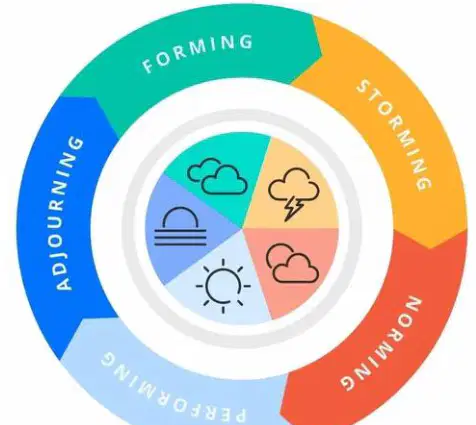
Fill in the blank: The final stage in Tuckman's Stages of Group Development is ________.
Adjourning
Forming
Storming
Norming
In the 'Forming' stage of team development, the group comes together for the ______ time.
first
second
last
third
High levels of uncertainty among team members are common during the 'Forming' stage.
True
False
What is established during the 'Forming' stage of team development?
The rules or acceptable behaviours of the team
The final project outcome
The team leader's salary
The team's vacation schedule
This phase is generally ______.
short
long
difficult
expensive

Fill in the blank: During the Storming phase, members begin to utilize ______ and influence.
power
humor
silence
resources

Fill in the blank: Discussions can become ______ as members seek to differentiate themselves during the Storming phase.
heated
silent
brief
unnoticed
Fill in the blank: During the Storming phase, members become more ______ in their behaviours.
authentic
reserved
indifferent
passive
Fill in the blank: ______ energy is released during the Storming phase.
Creative
Thermal
Mechanical
Electrical

Fill in the blank: One way to avoid getting stuck in the storming phase is to ________ conflict.
Normalize
Ignore
Escalate
Suppress
Fill in the blank: To avoid getting stuck in the storming phase, it is important to be ________.
inclusive
distant
impatient
secretive
Fill in the blank: Make sure ________ is heard to avoid getting stuck in the storming phase.
everyone
no one
the leader
the loudest person
Fill in the blank: Support all ________ members to avoid getting stuck in the storming phase.
group
teamwork
project
committee
Fill in the blank: Remain ________ to avoid getting stuck in the storming phase.
positive
silent
aggressive
indifferent
Fill in the blank: Don’t rush the group’s ________ to avoid getting stuck in the storming phase.
development
meeting
argument
break
Which of the following is established during the norming stage of group development?
Group conflict
Group cohesion
Individualism
Competition
Fill in the blank: During the norming stage, commitment to the ______ is established.
group
leader
project
schedule

Open and respectful behaviours between members are characteristic of the norming stage.
True
False

Fill in the blank: In the 'Performing' stage of group development, greater care and attention is being taken with the _____
work
schedule
location
budget
Fill in the blank: In the 'Performing' stage, the group has matured and is more _____ in their task.
competent
hesitant
disorganized
uncertain
Fill in the blank: In the 'Performing' stage, leaders focus more on _____ roles.
coaching
directive
administrative
monitoring
Fill in the blank: The adjourning stage occurs when the team is _______ or restructured.
disbanded
promoted
expanded
rewarded
During the adjourning stage, there can be insecurity over next steps.
True
False
Fill in the blank: Leaders should _______ with the team during the adjourning stage.
debrief
compete
ignore
punish
According to the Punctuated-Equilibrium Model, what do groups maintain for long periods?
Constant change
Certain equilibrium
Continuous conflict
Rapid innovation
Revolutionary change in the Punctuated-Equilibrium Model occurs in brief, punctuated bursts, generally catalyzed by a ______ or problem that breaks through the systemic inertia.
crisis
celebration
routine
tradition
According to the Punctuated-Equilibrium Model, groups can repeatedly cycle through the storming and performing stages, with revolutionary change taking place during short transitional windows.
True
False
For organizations who understand that disruption, conflict, and chaos are inevitable in the life of a social system, these disruptions represent opportunities for ______ and creativity.
innovation
stagnation
regression
confusion
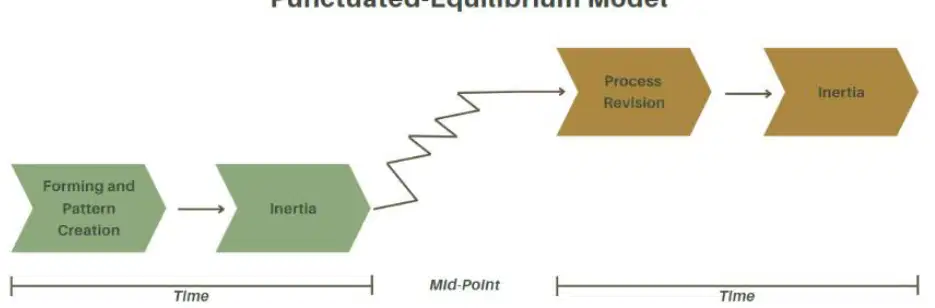
What stage follows 'Forming and Pattern Creation'?
Inertia
Process Revision
Mid-Point
Creativity
The purpose of the 'Pass the Message' classroom activity is:
To encourage teamwork and communication among students.
To test students' memory skills only.
To assess students' writing abilities.
To improve students' mathematical skills.
Which of the following lists the correct steps involved in the 'Pass the Message' classroom activity as described in the instructions?
Students form a line, the first student whispers a message to the next, and the message is passed along the line until the last student says it aloud.
Students write a message on paper, pass it to the teacher, and the teacher reads it to the class.
Students shout a message across the room, and everyone repeats it together.
Students draw a picture, pass it to a friend, and the friend guesses what it is.
The scenarios for the 'Pass the Message' classroom activity can be found in:
The teacher's guide
The student workbook
The school website
The classroom notice board
What is the 'social glue of a group'?
Degree of camaraderie within the group
The number of group members
The group's performance
The group's leader
Cohesive groups are those in which members are attached and act as one unit.
True
False
Which of the following is NOT a factor that impacts group cohesion?
A) Similarity
B) Stability
C) Size
D) Competition
Fill in the blank: More similar group members are, the more likely the group will _____.
bond
argue
separate
compete
What happens to group cohesion as the group stays together longer?
Group becomes more cohesive the longer the group stays together.
Group becomes less cohesive the longer the group stays together.
Group cohesion remains unchanged regardless of time.
Group members become more isolated the longer the group stays together.
Smaller groups tend to have _____ levels of cohesion.
higher
lower
equal
unstable
Group members who receive coaching and are encouraged to support their fellow team members strengthen their _____.
identity
weaknesses
competition
isolation
How does satisfaction impact group cohesion?
How pleased group members are with each other's performance, behavior, and conformity to group norms impacts group cohesion.
Satisfaction has no effect on group cohesion.
Satisfaction only impacts individual performance, not group cohesion.
Group cohesion is only influenced by external rewards, not satisfaction.
Fill in the blank: To create and maintain a cohesive team, you should ______ the group with the greater organization.
Align
Separate
Ignore
Distract
Fill in the blank: To create and maintain a cohesive team, let members have choices in setting their own ______.
goals
uniforms
break times
meeting rooms
Fill in the blank: To create and maintain a cohesive team, define clear ______.
roles
colors
locations
menus
Fill in the blank: To create and maintain a cohesive team, situate group members ______ to each other.
close
far
random
opposite
Fill in the blank: To create and maintain a cohesive team, give frequent ______.
praise
criticism
punishments
orders
Fill in the blank: To create and maintain a cohesive team, treat all members with dignity and ______.
respect
envy
neglect
indifference
Fill in the blank: To create and maintain a cohesive team, ______ differences.
celebrate
ignore
criticize
hide
Fill in the blank: To create and maintain a cohesive team, establish common ______.
rituals
rules
meetings
goals
One of the steps to creating and maintaining a cohesive team is to give frequent praise.
True
False
What is the alert mentioned at the end of the steps to creating and maintaining a cohesive team?
GROUPTHINK
BRAINSTORM
SYNERGY
TEAMWORK
Fill in the blank: Groupthink is a decision-making phenomenon that prevents the group from making good ________.
decisions
friends
predictions
jokes
Fill in the blank: Groupthink is most common in highly ________ groups.
cohesive
divided
competitive
isolated
Which of the following is NOT a possible outcome of groupthink?
Increased insularity as it sees outsiders as inferior or enemies
Easily adopt extreme ideas that will not be challenged
Denial increases as problems are ignored and failures are blamed on external factors
Groups become more open to external opinions and avoid disastrous decisions
Fill in the blank: To address groupthink, it is important to monitor group size, play an impartial role, encourage members to challenge views, and discuss ________ consequences.
negative
positive
financial
personal

