
 Worksheets
Environmental Final Exam Spring
Total questions: 100
Worksheet time: 50mins
Name
Class
Date
1.
Approved eye protection devices (like goggles) are used in the laboratory
a)
to avoid eye strain
b)
to improve your vision
c)
to wear only if you don't have corrective lenses
d)
to wear at all times when so instructed by the science teacher
2.
Injuries and accidents may result from spills. Always clean them up
a)
when you have time
b)
at once
c)
at the end of the class
d)
during clean up time
3.
You have been injured in the lab (cut, burn, etc.). First you should
a)
ask to see the school nurse
b)
see a doctor after school
c)
tell the science teacher at once
d)
tell the principal
4.
You are aware that you have allergies. You should
a)
always wear gloves in the lab
b)
discuss the matter with your science teacher
c)
let another student handle the experiment
d)
say nothing to avoid trouble
5.
Before you touch an electrical outlet, electrical plug or electrical switch
a)
ask the school custodian
b)
your hands must be clean
c)
your hands must be dry
d)
ask a fellow student
6.
All laboratory floors, aisles and passageways should be kept clear of
a)
teachers and students
b)
lab equipment and chemicals
c)
lab equipment only
d)
chemicals only
7.
If a piece of equipment is not working properly, stop, turn it off, and tell
a)
the custodian
b)
your lab partner
c)
your best friend in the class
d)
the science teacher
8.
Long hair in the lab must be
a)
cut short
b)
held away from the experiment with one hand
c)
always neatly groomed
d)
kept entirely out of the way with a hair band, hairpins, a hairnet or other confining device
9.
If you do not understand a direction or part of a lab procedure, you should
a)
figure it out as you do the lab
b)
try several methods until something works
c)
ask the instructor before proceeding
d)
skip it and go on to the next part
10.
In a laboratory, you should be cautious of
a)
loose clothing
b)
dangling jewelry
c)
flammable clothing
d)
all of the above
11.
The following footwear is the best in the laboratory.
a)
sandals
b)
open toed shoes
c)
closed shoes
d)
shoes appropriate for the weather
12.
Playing (as opposed to working) in the lab is
a)
always against the rules
b)
okay
c)
not dangerous
d)
okay if you are working at the same time
13.
Which of the following are considered part of the environment?
a)
forests
b)
people
c)
buildings
d)
all of these
14.
A natural resource that is naturally formed much more slowly than we use it is called
a)
renewable
b)
nonrenewable
c)
ecological
d)
sustainable
15.
Which of the following is an example of a renewable natural resource?
a)
crude oil
b)
coal
c)
wave energy
d)
copper
16.
Which of the following is an example of a nonrenewable natural resource?
a)
wind energy
b)
sunlight
c)
natural gas
d)
geothermal energy
17.
What has happened to resource consumption (usage) in the last several hundred years?
a)
It has remained at the same level
b)
It has decreased only slightly
c)
It has increased dramatically
d)
It has decreased dramatically
18.
Natural resources that are naturally replenished over months, years, or decades are called
a)
nonrenewable resources
b)
fossil fuels
c)
footprints
d)
renewable resources
19.
“Energy Star,” “USDA Organic,” and “Fair Trade Certified” are all examples of
a)
ecosystems
b)
ecolabelling
c)
non-market values
d)
market failure
20.
The basic units of matter, the smallest units that maintain the chemical properties of an element, are called
a)
atoms
b)
lipids
c)
compounds
d)
molecules
21.
Because of their large size, proteins, nucleic acids, carbohydrates, and lipids are together called
a)
solutions
b)
elements
c)
hydrocarbons
d)
macromolecules
22.
Which sphere are humans a part of?
a)
geosphere
b)
hydrosphere
c)
biosphere
d)
atmosphere
23.
All material in the universe that has mass and occupies space is called
a)
covalent
b)
compound
c)
matter
d)
carbon
24.
The central core of every atom, containing particles called protons and neutrons, is called a(n)
a)
electron
b)
bond
c)
nucleus
d)
compound
25.
The thin layer of rock that forms Earth’s outer skin both on dry land and in the ocean is called Earth’s
a)
core
b)
crust
c)
mantle
d)
asthenosphere
26.
Which of Earth’s spheres consists of the layers of gases surrounding our planet?
a)
geosphere
b)
biosphere
c)
atmosphere
d)
hydrosphere
27.
Water which returns from the atmosphere to Earth’s surface as rain or snow is called
a)
evaporation
b)
transpiration
c)
condensation
d)
precipitation
28.
Nutrients circulate endlessly throughout the environment in complex cycles called
a)
eutrophication cycles
b)
respiration cycles
c)
photosynthesis cycles
d)
biogeochemical cycles
29.
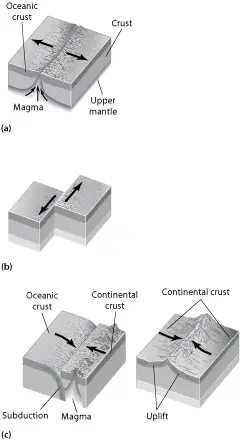
Which diagram shows a divergent plate boundary?
a)
A
b)
B
c)
C
30.
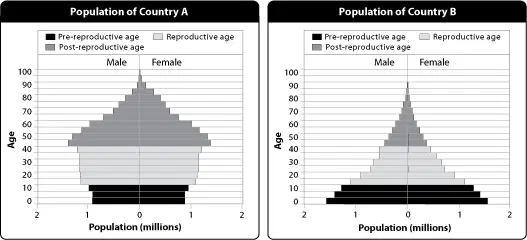
The graphs shown here are called
a)
age structure diagrams/population pyramids
b)
life expectancy diagrams
c)
demographic diagrams
d)
infant mortality diagrams
31.
The average number of years an individual is predicted to live is called
a)
carrying capacity
b)
life expectancy
c)
growth rate
d)
demography
32.
The number of organisms that an environment can support is called the
a)
life expectancy
b)
demography
c)
carrying capacity
d)
growth rate
33.
Every spring, many species of bird travel north to the Arctic to breed, and in the fall travel south again for the winter. This is an example of
a)
immigration
b)
emigration
c)
migration
d)
population growth
34.
You are studying the vegetation (plant) communities of the Mongolian grasslands in a 1000-square-kilometer-area. What is your best strategy for estimating the number of individuals of different plant species growing throughout the grasslands?
a)
direct observation
b)
sampling
c)
indirect observation
d)
simply counting each one
35.
“All the living things AND their physical environment within a given area” best defines
a)
a community
b)
an ecosystem
c)
the biosphere
d)
a population
36.

In the graph shown, as time goes on, populations...
a)
decrease
b)
remain the same
c)
fluctuate rapidly
d)
increase
37.
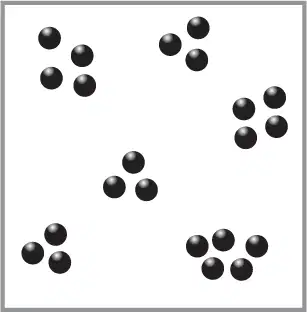
The diagram shown would most likely display the distribution of a population of a plant that
a)
can grow anywhere
b)
clumps around a specific resource
c)
establishes a boundary for itself using a chemical that poisons other plants.
d)
has reached its carrying capacity.
38.
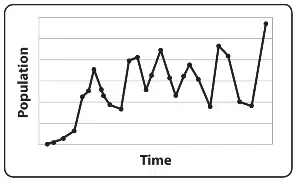
In the graph shown, the population size is
a)
increasing consistently
b)
decreasing consistently
c)
remaining stable
d)
undergoing cyclic change
39.
When the environment changes too quickly for an organism to adapt, what will occur?
a)
evolution
b)
speciation
c)
genetic drift
d)
extinction
40.
Which of the following statements defines the members of a species?
a)
They are temporally isolated from each other
b)
They are geographically isolated from each other
c)
They mate and produce offspring
d)
They have identical genes
41.
The genes carried by all members of a particular population make up the population’s
a)
allele frequency
b)
phenotype
c)
genotype
d)
gene pool
42.
A change in the DNA of an organism is called a
a)
recombination
b)
mix-up
c)
mistake
d)
mutation
43.
When a dairy farmer chooses to breed the cows that give the most milk in the herd, the farmers are following the principle of
a)
acquired characteristics
b)
descent with modification
c)
artificial selection
d)
natural selection
44.
An interaction in which an individual of one species kills and consumes (eats) an individual of another is called
a)
predation
b)
parasitism
c)
herbivory
d)
symbiosis
45.
A producer who performs photosynthesis and is "self-feeding" is called a(n)
a)
heterotroph
b)
homotroph
c)
autotroph
d)
omnivore
46.
When energy is transferred between trophic levels, the energy that moves to the next level is about
a)
90%
b)
50%
c)
25%
d)
10%
47.
Humans are generally
a)
carnivores
b)
herbivores
c)
omnivores
d)
detrivores
48.
The ultimate source of energy in an ecosystem in which deer eat grass and coyotes eat deer is
a)
the grass
b)
the sun
c)
the deer
d)
chemosynthesis
49.
A deer eating a shrub (small bush) is an example of
a)
predation
b)
parasitism
c)
herbivory
d)
symbiosis
50.
The first level of all food pyramids
a)
consists of primary producers
b)
consist of primary consumers
c)
is chemosynthesis
d)
is photosynthesis
51.
A beehive depends on pollen from flowers to survive. Flowers depend on bees to pollinate them. Humans tend bee hives, offering the bees a place to live in exchange for some of their honey. The relationship among these three sets of organisms is
a)
parasitism
b)
mutualism
c)
commensalism
d)
predation
52.
During succession, what would be the first species to populate an area?
a)
pioneer species
b)
deer
c)
invasive species
d)
climax community
53.
A caribou is adapted to live in cold tundra environments. It would not be able to survive in a hot tropical forest because the tropical forest does not provide a suitable
a)
community
b)
population
c)
population structure
d)
habitat
54.
A population’s growth rate is determined by births, deaths,
a)
immigration, and emigration
b)
immigration, and migration
c)
migration, and biotic potential
d)
immigration, and biotic potential
55.
Which of the following would cause population to increase in a region?
a)
increased emigration
b)
decreased survivorship
c)
increased immigration
d)
decreased fertility rates
56.
People living in developed countries have longer life expectancies mainly because they have access to
a)
healthcare
b)
better weather
c)
more diverse food choices
d)
fuelwood
57.
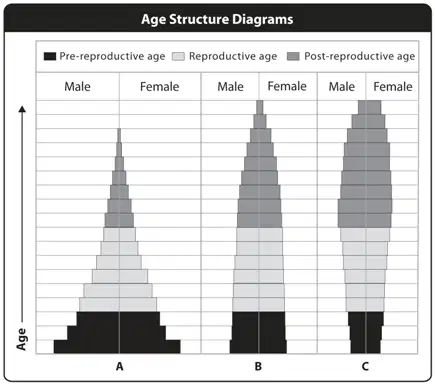
In the age structure diagrams (population pyramids), which diagram represents a population that is likely to grow rapidly in the future?
a)
A
b)
B
c)
C
58.
Day-to-day conditions in Earth’s atmosphere, such as “sunny and humid,” describe
a)
climate
b)
climograph
c)
weather
d)
biome
59.
Which biome would have the lowest net primary production?
a)
tropical rain forest
b)
temperate grassland
c)
coral reef
d)
desert
60.
Which biome is characterized by very low temperatures, little precipitation, and permafrost?
a)
desert
b)
temperate forest
c)
tundra
d)
tropical dry forest
61.
Which two biomes have the LEAST precipitation?
a)
tropical rain forest and temperate grassland
b)
tropical savanna and tropical dry forest
c)
tundra and desert
d)
boreal forest and temperate woodland and shrubland
62.

As shown in the figure, the climate zone that receives the most direct sunlight throughout the year is
a)
Tropical
b)
Temperate
c)
Polar
d)
Marine
63.
Which of the following is NOT part of overall biodiversity?
a)
species diversity
b)
genetic diversity
c)
individual diversity
d)
ecosystem diversity
64.
Species that is likely to become endangered soon
a)
endangered
b)
threatened
c)
ecotourism
d)
all of the above
65.
Which of the following increases species diversity?
a)
extirpation
b)
speciation
c)
extinction
d)
poaching
66.
Biomes are often named for their __________________
a)
animal life
b)
sun values
c)
vegetation (plant life)
d)
soil characteristics
67.
What percentage of Earth’s surface is covered in water?
a)
75%
b)
90%
c)
25%
d)
50%
68.
Marshes, swamps, and bogs are examples of
a)
terrestrial biomes
b)
freshwater wetlands
c)
estuaries
d)
ocean zones
69.

What is the type of graph pictured called?
a)
weather graph
b)
precipatograph
c)
thermograph
d)
climograph
70.

What does the bars in the graph represent?
a)
precipitation
b)
temperature
c)
weather
d)
all of the above
71.
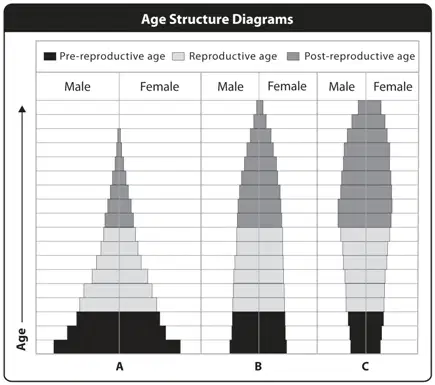
Which population has the highest proportion of reproductive individuals?
a)
A
b)
B
c)
C
72.
The disappearance of a particular population from a given area, but not of the entire species globally, is called
a)
extinction
b)
immigration
c)
extirpation
d)
speciation
73.
A species that is critical to the functioning of the ecosystem in which it lives because it affects the survival and abundance of many other species in its community is called a
a)
keystone species
b)
invasive species
c)
exotic species
d)
primary species
74.
Globally, the leading cause of biodiversity loss is
a)
invasive species
b)
poaching and overharvesting
c)
pollution
d)
habitat change and loss
75.
The illegal capture or killing of an organism, often for money, is called
a)
poaching
b)
harvesting
c)
fragmentation
d)
extinction
76.
Variety of organisms in one area
a)
extinction
b)
biodiversity
c)
ecosystem
d)
habitat
77.
How are species prone to extinction?
a)
species who migrate
b)
need large or special habitats
c)
exploited by humans
d)
all the above
78.
Species at a serious risk of extinction
a)
endangered
b)
threatened
c)
ecotourism
d)
all the above
79.
Greatest cause of biodiversity loss which causes almost 75% of extinctions now
a)
humans
b)
biodiversity
c)
habitat change or loss
d)
all the above
80.
Viruses, bacteria, and other organisms in the environment that harm human health are classified as
a)
biological hazards
b)
social hazards
c)
chemical hazards
d)
physical hazards
81.
Which of the following types of people generally has a greater sensitivity to environmental hazards than the other types of people?
a)
teenagers
b)
adults
c)
infants
d)
senior citizens
82.
Chemicals that cause cancer are called
a)
neurotoxins
b)
hazards
c)
carcinogens
d)
bacterium
83.
What do asbestos, radon, volatile organic compounds (VOCs), carbon monoxide, and lead all have in common?
a)
they are all safe to work with
b)
exposure to them cannot be prevented
c)
they are all highly dangerous carcinogens
d)
they are indoor chemical hazards
84.
Epidemiology deals primarily with what type of hazards?
a)
physical
b)
chemical
c)
biological
d)
social
85.
COVID-19 first appeared in the United States in January of 2020. By March it had rapidly spread to 114 different countries infecting nearly 118,000 cases. COVID-19 is an example of a(n)
a)
localized infectious disease
b)
emerging disease
c)
endemic disease
d)
worldwide disease
86.
Which of the following is always associated with a tornado.
a)
storm surge
b)
funnel of rotating air
c)
earthquake
d)
snow
87.
The best way to stay safe during a thunderstorm when swimming in a lake is to
a)
swim so the water covers your entire body
b)
get out of the lake and stand beneath a tall isolated tree
c)
get out of the lake and try to be the lowest object around you
d)
nothing, just keep swimming
88.
All households should have these types of detectors/alarms
a)
fire and smoke
b)
carbon monoxide
c)
radon
d)
all of the above
89.
Earthquakes are measured using this scale
a)
Saffir-Simpson
b)
Fujita (or F-Scale)
c)
Richter Scale
d)
1-10 scale
90.
A powerful storm that forms over the ocean in the tropics is called a
a)
cyclone
b)
tsunami
c)
avalanche
d)
hurricane
91.
Watering crops by way of human-constructed structures is known as
a)
Precipitation
b)
Irrigation
c)
Salinization
d)
Fertilization
92.
Most of the nutrients in soil come from
a)
Chemical weathering
b)
Mechanical weathering
c)
Erosion
d)
Decomposition
93.
The process by which material, such as topsoil, is moved from one place to another
a)
Terracing
b)
Erosion
c)
Ranching
d)
Degradation
94.
The organic matter in soil includes
a)
Minerals
b)
Living and decomposing organisms
c)
Living organisms
d)
Bedrock
95.
As a farmer, you would be most concerned with the quality of the soil in the
a)
O horizon
b)
A horizon
c)
E horizon
d)
R horizon
96.
Compared to minerals that form on the surface of Earth, minerals that form within Earth's crust are typically formed
a)
under higher temperatures and pressures
b)
under lower temperatures and pressures
c)
the temperature and pressure have no effect
d)
under higher temperatures and lower pressures
97.
What are the benefits of recycling minerals?
a)
Decrease energy use
b)
Save consumers and businesses money
c)
Fewer of these toxic metals will end up in landfills and other places where they would pollute the environment
d)
all of the above
98.
All minerals are
a)
naturally occurring
b)
inorganic
c)
solid
d)
all of the above
99.
What type of rock is formed at very high temperatures within the mantle that forms as magma cools and solidifies?
a)
Igneous rock
b)
Sedimentary rock
c)
Metamorphic rock
d)
Clay
100.
Arid and semiarid lands are prone to desertification because
a)
The Sahara is expanding
b)
Gigantic dust storms blow sand from China to North America
c)
The precipitation cannot meet the growing human demand for water
d)
10% of productivity is lost to erosion
100 %

