
 Worksheets
Holy Cross College Cover Page Comprehension Quiz
Total questions: 100
Worksheet time: 50mins
What is the main theme presented on the cover page of the learning material?
The importance of academic achievement
A journey of transformation in the spirit of the risen Christ
The history of Holy Cross College
The significance of sports in education
Which institution is featured on the cover of the learning material?
St. Peter's University
Holy Cross College
Sacred Heart School
St. Mary's Institute
What phrase is used as the motto on the cover of the document?
Knowledge is Power
Life to the Full
Faith and Wisdom
Learning for Life
According to the introduction, what is the main source of inspiration for a Catholic school like Holy Cross College?
The person of Jesus Christ
The achievements of alumni
Government educational policies
Local community leaders
Which of the following best describes the vision of Holy Cross College as stated in the introduction?
A community of transformation in the spirit of the Risen Christ
A focus on academic excellence only
A commitment to sports and recreation
A dedication to technological advancement
How do Catholic schools typically develop their unique character, according to the text?
By drawing upon spiritual gifts and traditions
By following only government regulations
By focusing solely on sports achievements
By copying other schools’ practices
What does the text suggest is the foundation of the whole educational enterprise in a Catholic or ecumenical school?
Christ
Science
Technology
Economics
According to the passage, what role do charisms play in Catholic schools?
They provide a pathway for the community to interpret and give voice to the centrality of Jesus Christ.
They determine the school’s sports curriculum.
They set the school’s financial policies.
They dictate the school’s dress code.
Which of the following best describes the main purpose of the document discussed in the provided material?
To articulate the vision, values, rituals, symbols, and stories that give Holy Cross College its spiritual energy and ensure its Catholic identity and unique charism continue to flourish.
To provide a detailed history of all Catholic schools in Western Australia.
To outline the academic curriculum of Holy Cross College.
To compare different religious schools in the Swan Valley.
What was the main focus of the masterplan for Holy Cross College?
Creating an integrated concept of parish and school as a symbol of one Catholic community.
Expanding the number of classrooms in the school.
Building a new sports complex for the students.
Introducing a new language program.
Why are Masses at Holy Cross College often combined with the parish daily Mass?
To further enhance the relationship with the parish.
To reduce the number of Masses held each week.
To allow students to leave school early.
To celebrate only special occasions.
What process was used to select the name for Holy Cross College?
A consultation process involving the community, parish, and school, with suggestions and feedback leading to a short-list and final decision by the Archbishop.
A random draw from a list of Catholic saints.
A vote by only the school staff.
A decision made solely by the local government.
Who announced the name "Holy Cross College" for the new school in March 2008?
Archbishop Barry Hickey
Archbishop Timothy Costelloe
The College Principal
The local parish priest
During the development of the College Vision and Mission in 2008, which groups were involved in the process?
College Board, Catholic Education Office staff, College Principal and Business Manager, local parish priest, Ellenbrook community members, Catholic primary school representatives, and Catholic Education Western Australia representatives.
Only the students and their parents.
Only the Archbishop and parish priest.
Only the College Principal and teachers.
What is one way Holy Cross College maintains its family-focused and parish-based identity?
By preparing for and celebrating sacraments for children in collaboration with the parish.
By focusing only on academic achievements.
By limiting community involvement in school activities.
By not holding any religious events.
What historical event marked the beginning of Catholic education in Western Australia, as mentioned in the material?
The establishment of the Swan River Colony in 1843 and the founding of the first convent school in 1846.
The construction of the first public library in Perth.
The opening of the first government school in 1900.
The arrival of the first Catholic bishop in 1850.
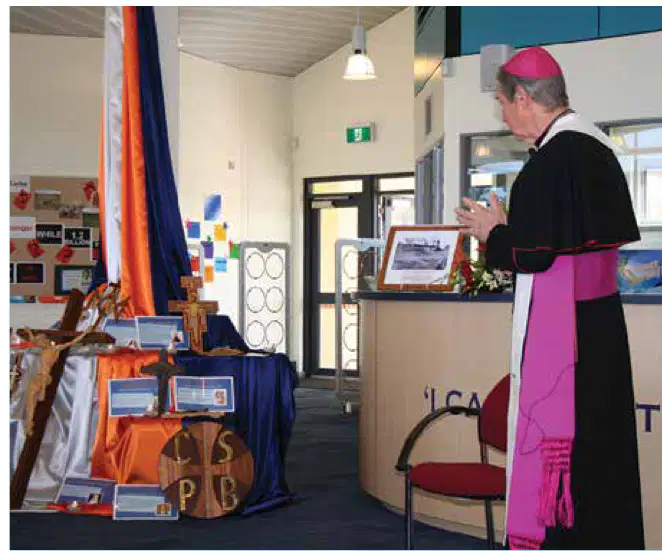
What does the photograph in the document most likely depict?
The announcement of the name "Holy Cross College" by Archbishop Barry Hickey.
A regular classroom lesson at Holy Cross College.
A sports event at the school.
A science fair presentation.
Which of the following best describes the vision of Holy Cross College?
A place of transformation in the spirit of the Risen Christ, inspired by Saint Oscar Romero.
A college focused only on academic excellence.
A school dedicated to sports achievements.
A community center for local events.
According to the mission statement, what is Holy Cross College’s primary goal for its students?
To empower students to have Life to the Full.
To prepare students for sports competitions.
To teach only religious studies.
To focus solely on academic rankings.
Which LIFE Pillar emphasizes nurturing a caring, compassionate, and connected community?
Inter-relationships: Compassion and Connection
Learning: Dignity and Personal Best
Faith: Justice and Service
Enrichment: Gratitude and Stewardship
What is the significance of the four flames in the Holy Cross College logo?
They represent the four central pillars of the College: Learning, Inter-relationships, Faith, and Enrichment.
They symbolize the four seasons.
They are a decorative element with no specific meaning.
They represent four famous alumni.
How does the College logo connect to Aboriginal culture?
The cross-bar takes the shape of a coolamon, a vessel used by Aboriginal women.
It uses traditional Aboriginal colors.
It features Aboriginal artwork.
It is named after an Aboriginal leader.
Which House Patron provides guidance for the pillar of Learning: Dignity and Personal Best?
Ursula Frayne
Frédéric Ozanam
Irene McCormack
Rosendo Salvado
What does the College motto ‘Life to the Full’ express?
Each person should have the opportunity to live life to the full, inspired by Christ’s transformation and redemption.
Students should focus only on academic success.
The importance of winning in sports.
A call to follow only traditional customs.
Which LIFE Pillar is associated with gratitude and stewardship?
Enrichment
Learning
Faith
Inter-relationships
What does the flame in the Holy Cross College logo symbolize?
The transformation in the spirit of the risen Christ.
The start of a new academic year.
A celebration of sports achievements.
A symbol of local wildlife.
Which House Patron is associated with the pillar of Faith: Justice and Service?
Irene McCormack
Ursula Frayne
Frédéric Ozanam
Rosendo Salvado
Which of the following was a key criterion for selecting House patrons at Holy Cross College?
They must have been former students of the College.
They must be linked to the Catholic Faith story.
They must have written a book about education.
They must be local government officials.
What was the main purpose of the Living Library event held on 29 July 2010 at Holy Cross College?
To introduce new textbooks to students.
To assist students in learning about people who showed the face of Jesus through their lives of service.
To organize a sports competition between schools.
To recruit new teachers for the College.
Which of the following best describes the process used to select House patrons at Holy Cross College?
The College principal made the decision alone.
Students and staff were involved in a rich process to shortlist names based on specific criteria.
Only parents were allowed to nominate patrons.
The selection was based on a random draw.
According to the text, what skill did students develop by participating in the Living Library?
Advanced mathematics
Listening and note-taking
Computer programming
Sportsmanship
Why did the College want House patrons to be role models for students?
To help students with their homework.
To represent the College’s Vision and Mission through their lives and values.
To teach students how to play musical instruments.
To organize school trips.
What was one of the outcomes for students after attending the Living Library event?
They learned how to cook traditional meals.
They gained a better understanding of significant people and the historical context in which they lived.
They were given free books.
They participated in a sports tournament.
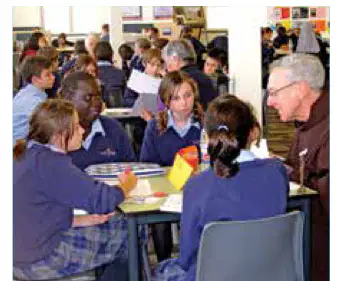
What does the image most likely depict in the context of the Living Library event?
Students engaging in a sports activity.
Students participating in a collaborative learning session about House patrons.
Students performing on stage.
Students taking a written exam.
What role did Archbishop Oscar Romero play in the College's history?
He was the first principal of the College.
He was selected as the College patron.
He founded the College.
He was a student at the College.
Which statement best describes Oscar Romero's approach to justice and faith, as reflected in his life and words?
He avoided conflict and preferred to remain silent.
He believed that death was the final word.
He stood up for the poor and believed in resurrection after death.
He discouraged others from seeking justice.
Why was Oscar Romero known as the 'bishop of the poor'?
He donated all his wealth to the church.
He defended the people of El Salvador and stood up for justice.
He built many churches in poor areas.
He was born into a poor family.
Analyze the significance of Oscar Romero's statement: "If they kill me, I will be resurrected in the Salvadoran people." What does this reveal about his beliefs and leadership?
He believed in literal physical resurrection only.
He thought his death would end his influence.
He saw his mission as continuing through the people, reflecting hope and resilience.
He wanted to discourage others from following him.
When was Oscar Romero canonised, and who decreed his martyrdom for the Catholic faith?
Canonised in 2015 by Pope Benedict XVI.
Canonised in 2017 by Pope Francis.
Canonised in 2018 by Pope Francis, who decreed his martyrdom in 2015.
Canonised in 1980 by Pope John Paul II.
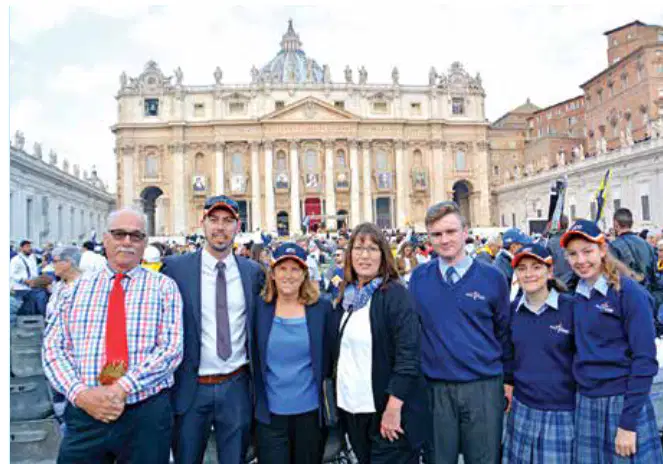
What event is depicted in the image described above?
The opening of Holy Cross College.
The Canonisation Mass of Oscar Romero in Saint Peter’s Square.
A graduation ceremony at the College.
A protest for justice in El Salvador.
Which of the following best describes the main message of the College Prayer?
To ask for material wealth and success
To seek courage and strength to face challenges and act with justice, inspired by Saint Oscar Romero
To request forgiveness for past mistakes
To pray for good health and long life
According to the College Prayer, what is a sign of God's love in the world?
Every act of justice
Every prayer said aloud
Every moment of silence
Every act of charity
What was the primary purpose of the first convent school established by Mother Ursula Frayne in Western Australia?
To provide education for boys only
To cater for girls of any religious creed as a free school
To train teachers for public schools
To serve as a hospital for the sick
What core values are associated with Frayne House?
Justice and Peace
Dignity and Personal Best
Faith and Charity
Wisdom and Knowledge
Why was Mother Ursula Frayne chosen as the patron for the Learning Pillar?
She was the first woman to arrive in Australia
She challenged each person to achieve their personal best in an environment valuing respect and dignity
She was a famous scientist
She wrote many books about education
Which statement best reflects the impact of the Mercy sisters' work, as described in the text?
They focused only on religious education for boys
They served people suffering from injustices related to poverty, sickness, or lack of education
They established hospitals across Australia
They only worked in Ireland
Which value is emphasized as a core value of Ozanam House?
Compassion and connection
Justice and peace
Honesty and integrity
Wisdom and knowledge
What was Frédéric Ozanam’s main hope throughout his life, as described in the text?
To become better and do a little good
To become famous and wealthy
To write many books
To travel the world
According to the Frayne House Prayer, what example does Mother Ursula Frayne provide?
Determination and commitment to learning
Generosity and wealth
Artistic talent and creativity
Physical strength and endurance
How did Frédéric Ozanam address the needs of the poor?
By founding the Society of Saint Vincent De Paul
By building schools
By writing novels
By starting a business
Why is the House named after Ozanam, according to the text?
To acknowledge the link to the parish and the work with the Saint Vincent de Paul Society
Because he was a famous artist
Because he was a local politician
To honor his military achievements
In the Frayne House Prayer, what do students pray for when facing challenges in learning?
Faith and a sense of courage
More free time
Better technology
Easier assignments
Analyze how the legacy of Frédéric Ozanam continues to impact communities today.
His legacy endures through the Society of Saint Vincent de Paul, which supports needy communities worldwide and fosters compassion and connection.
His legacy is only remembered in history books.
His legacy is limited to his family members.
His legacy is not relevant in modern times.
Explain how the example of Mother Ursula Frayne is intended to inspire students, according to the Frayne House Prayer.
By encouraging them to strive for their personal best and face challenges with determination, faith, and courage.
By teaching them to avoid challenges.
By focusing only on academic success.
By discouraging teamwork.
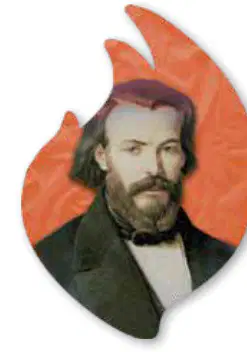
What does the image of Frédéric Ozanam symbolize in the context of Ozanam House?
The values of compassion and connection, and the legacy of supporting the needy.
A focus on sports and competition.
A symbol of artistic achievement.
A representation of technological innovation.
What was the main dream of Blessed Frédéric Ozanam as mentioned in the Ozanam House Prayer?
To establish a school for the poor
To embrace the whole world in a network of love
To become a famous writer
To travel the world
Which core values are associated with McCormack House?
Faith and Hope
Justice and Service
Charity and Peace
Wisdom and Knowledge
According to the text, what significant decision did Irene McCormack make after reflecting on her life?
To become a politician
To go to Peru to work with the very poor
To write a book about her experiences
To start a new school in Australia
What was the reason given for Irene McCormack’s murder in Peru?
She was a political leader
She was handing out Caritas food parcels to impoverished villagers
She was a famous author
She was building a church
How does the McCormack House Prayer encourage individuals to approach life, according to Irene McCormack’s Morning Offering?
By seeking wealth and power
By facing life without fear and living wholeheartedly in every present moment
By avoiding challenges and risks
By focusing only on personal achievements
What legacy does Irene McCormack represent, as mentioned in the text?
The legacy of Mary MacKillop
The legacy of Saint Vincent de Paul
The legacy of Saint Joseph
The legacy of Saint Francis
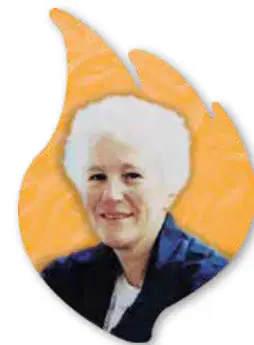
Who is the patron of McCormack House?
Blessed Frédéric Ozanam
Irene McCormack RSJ
Mary MacKillop
Saint Vincent de Paul
What was the primary focus of Dom Rosendo Salvado's work in New Norcia?
Building churches for European settlers
Giving a practical education to Aboriginal children
Establishing trade routes
Writing religious texts
Which core values are associated with Salvado House?
Justice and Peace
Gratitude and Stewardship
Faith and Hope
Charity and Compassion
Why did Dom Salvado perform a piano recital during his walk from New Norcia to Perth?
To entertain the local community
To raise money for the New Norcia mission
To teach music to children
To celebrate a religious festival
How does the Salvado House prayer reflect the values of Dom Salvado and the Benedictine tradition?
By asking for wealth and power
By expressing gratitude, respect for all cultures, and stewardship of land and resources
By focusing only on scientific achievements
By requesting personal success
What does the example of Dom Salvado’s journey to Perth demonstrate about his character?
His reluctance to leave New Norcia
His willingness to use his talents and perseverance to support his mission
His preference for solitude
His focus on agricultural work
In what way did Dom Salvado show a rare quality for his time regarding Indigenous culture?
He ignored Indigenous traditions
He demonstrated sympathy and respect for Indigenous culture
He tried to convert all Indigenous people by force
He avoided contact with Indigenous communities
What is the significance of receiving and developing the gifts of God, according to the Salvado House philosophy?
To use them for personal gain only
To develop them responsibly and share them lovingly with others
To keep them hidden from others
To use them without gratitude
Which symbol in the Frayne House logo represents Irish heritage?
A four-leaf clover
A ship
A book
A cross
What do the hands in the Ozanam House logo symbolize?
Saint Vincent de Paul Society
Aboriginal people
Learning and education
The Mercy cross
Which House logo includes the stars of the Southern Cross to represent Australian heritage?
McCormack House
Frayne House
Salvado House
Ozanam House
Why are olives included in the Salvado House logo?
They represent trees brought from Europe and planted in New Norcia.
They symbolize Irish heritage.
They represent the Mercy cross.
They are a symbol of learning.
How does the Ozanam House logo symbolize being a caring and connected community?
By including a coolamon, used by Aboriginal people to carry food, water, and infants.
By showing the Benedictine cross.
By displaying the stars of the Southern Cross.
By featuring the Andes Mountains.
What is the significance of the Andes Mountains in the McCormack House logo?
They represent where Sister Irene McCormack worked and lost her life.
They symbolize the journey of the Sisters of Mercy.
They are a symbol of learning and education.
They represent the Abbey Church in New Norcia.
Which House logo features dots representing the influence of Aboriginal people?
Salvado House
Frayne House
Ozanam House
McCormack House
What does the book in the Frayne House logo represent?
Learning and Mother Ursula Frayne opening the first school in Western Australia
The symbol of Christ at the centre of the community
The Abbey Church in New Norcia
The stars of the Southern Cross
Which of the following is NOT a symbol found in the Frayne House logo?
The Benedictine cross
A ship
A four-leaf clover
A book
Which element in the Salvado House logo is directly linked to traditional Aboriginal art?
Dots
The cross
The facade of the Abbey Church
Olive trees
What is the main purpose of the College's annual focus on one of its patrons?
To organize sports competitions
To provide an opportunity for staff and students to learn about and reflect on College and House patrons
To increase student enrollment
To raise funds for the College
How are the themes for staff formation days determined each year at the College?
By student vote
Based on the weather
Linked to the patron the College has as its focus for the year
Chosen by the local government
What does the Holy Cross symbolize in Catholic tradition, according to the text?
The beginning of Lent
The cross on which Christ died and a reminder of Jesus' sacrifice and presence
The resurrection of Christ
The creation of the world
Why did the Principal request crosses from various religious orders before the College opened?
To decorate the classrooms
To symbolize the special charism of each order and their vocation of service
To sell them for fundraising
To use them in sports events
How do the crosses placed around the College contribute to the community's experience?
They serve as landmarks for navigation
They add a further pilgrim trail to encounter Christ through the stories of each cross
They are used for art classes
They are only for decoration
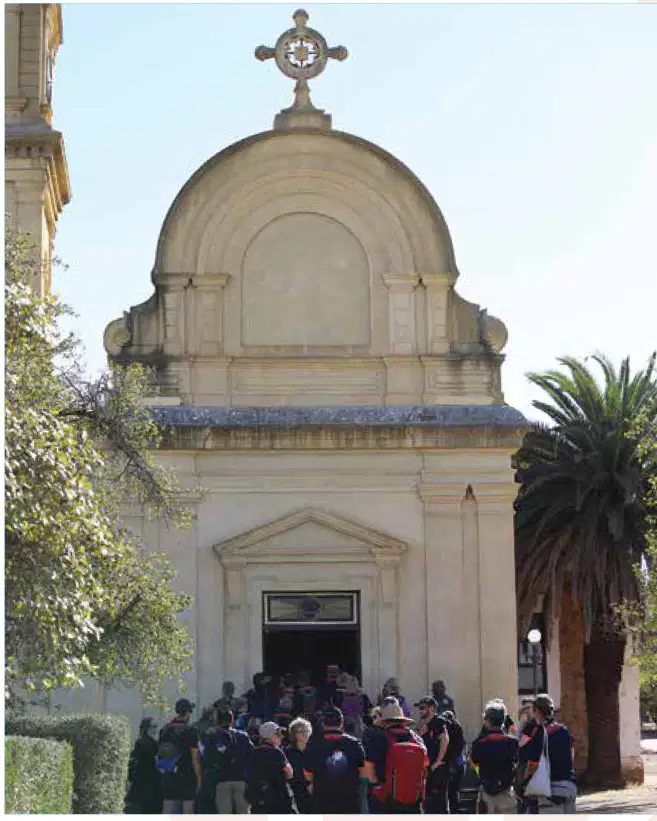
What does the image most likely depict?
A science laboratory
A College chapel or religious building
A sports stadium
A library entrance
Why is the naming of buildings considered important according to the learning material?
It makes a statement about who we are and what we value.
It helps in navigation only.
It is required by law.
It is a tradition with no specific meaning.
Which two buildings are mentioned as being named after places associated with the college patron?
Santiago de Maria and San Salvador
San Salvador and San Jose
Santiago de Maria and Ciudad Barrios
San Jose and Ciudad Barrios
Who is the patron associated with the buildings Santiago de Maria and San Salvador?
Saint Oscar Romero
Saint Francis of Assisi
Saint Teresa of Calcutta
Saint John Paul II
What role did Oscar Romero serve in Santiago de Maria?
Bishop of Santiago de Maria (1974-1977)
President of El Salvador
Mayor of Ciudad Barrios
Governor of San Salvador
How did witnessing the suffering of the landless poor in Santiago de Maria affect Oscar Romero?
It strongly influenced his commitment to social justice.
It made him leave the church.
It led him to become a politician.
It caused him to move to another country.
What positions did Oscar Romero hold in San Salvador?
Auxiliary Bishop (1970-1974) and Archbishop (1977-1980)
President and Vice President
Mayor and Governor
Priest and Deacon
What significant event happened to Oscar Romero on 24 March 1980?
He was assassinated while saying Mass in the Chapel of Divine Providence.
He was elected President of El Salvador.
He moved to Santiago de Maria.
He published a book on social justice.
How did Oscar Romero respond to the killings of the El Salvadoran people by the military?
He spoke out against the killings and offered faith and hope.
He supported the military actions.
He remained silent on the issue.
He left the country.
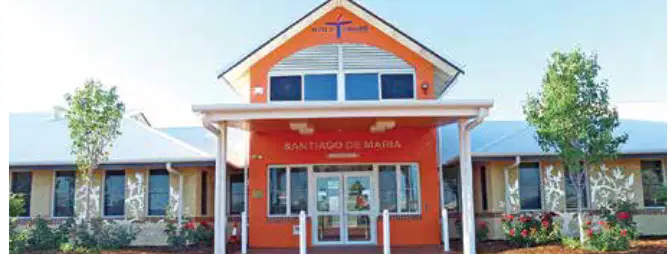
What is the significance of the building shown in the image?
It is named after the Diocese of Santiago de Maria, where Oscar Romero grew up.
It is the main government building in El Salvador.
It is a famous museum in San Salvador.
It is a hospital named after Saint Teresa.
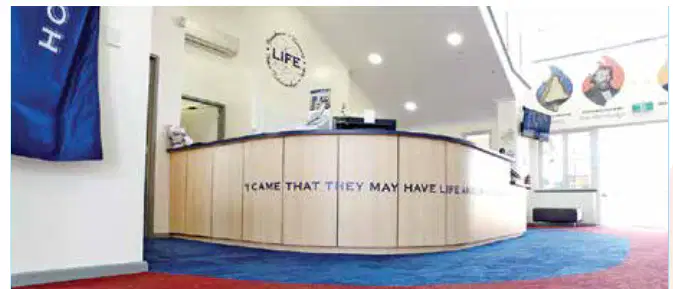
Which city is represented by the building shown in the image, and what is its significance?
San Salvador; it is named after the capital city where Oscar Romero served as Archbishop.
Ciudad Barrios; it is the birthplace of Oscar Romero.
Santiago de Maria; it is a famous tourist destination.
San Jose; it is the largest city in El Salvador.
Which building is named after the cathedral in Santiago de Maria and encompasses the Wellness Centre and the Staff and Community Centre?
Victoria Square
The Saint James Centre
The Cross of Transformation
Dublin Institute
What is the significance of the crosses found in the buildings named for Saint Oscar Romero?
They are made of gold.
They represent different countries in Europe.
They are multicoloured crosses representing El Salvador.
They are only used during Easter.
Why was the Cross of Transformation commissioned?
To celebrate the opening of a new school
To commemorate the one-hundredth anniversary of the birth of Oscar Romero
To honor the foundation of Victoria Square
To mark the canonisation of Mary MacKillop
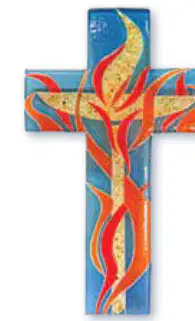
What does the Cross of Transformation symbolize in the context of the Saint James Centre?
The unity of European countries
The importance of education
The connection to health care and the legacy of Oscar Romero
The foundation of Victoria Square
What historical event took place at Victoria Square in 1863?
The canonisation of Mary MacKillop
The opening of the first convent school in Western Australia
The laying of the foundation stone of Saint Mary’s Cathedral by Dom Rosendo Salvado
The birth of Ursula Frayne

