
Font size
 Worksheets
Unit 7 Continuing Credit 24-25
Total questions: 82
Worksheet time: 1hrs 13mins
Match
rapid evolution in short bursts
small and steady evolution over long periods


Select all of the following that can add variation to a population
Gene flow
Sexual Reproduction
Speciation
Equilibrium
Mutation

Which plant species is most likely to go extinct if changes occur in the environment?
A
D
F
C

Which beetle has the more favorable trait after the fire?
Tan
Dark

What is antibiotic resistance?
Bacteria that are resistant to antibiotics survive and reproduce
Bacteria change their genes to be able to survive and reproduce
Bacteria learns how to resist antibiotics through bacterial communication
Bacteria group together to resist antibiotic effects

Through natural selection, tan shelled turtles increased in frequency. What is the relationship between the Bob and the turtle circled in the last image?
That is still Bob.
That is Bob's descendant
That is evolved Bob.
Bob and that turtle have no relationship

Match the answers using the diagram
trilobites
the oldest organism
mammals
youngest organism
amphibians
younger than fishes older than dinosaurs

Which organism is most closely related to the unknown species?
Species I
Species II
Species III
Species IV

The (a) is the most distant to a human.
The (b) shares the most similarities to humans.

Which organism is the most closely related to the common ancestor?
2
3
4

Scientists think that dolphins and whales may have evolved from a common ancestor. What evidence supports this hypothesis?
They swim the same way
They eat the same food
They live in the same parts of the ocean
They have similar anatomies
Which of the following can be inherited?
A mutation in a tongue cell
A mutation in an egg cell
A mutation in a hair cell
A mutation in a leaf cell
Which of the following cannot be passed on?
A mutation in a tongue cell
A mutation in an egg cell
A mutation in a hair cell
A mutation in a sperm cell
Match the following

Geographic Isolation
The creation of 2 separate species
Speciation
when members of the same species can produce offspring
Interbreed

Natural Selection

Which two organisms are most related?
Turtle and Chicken
Human and Salamander
Fish and Sheep
Turtle and Human

When a horse and a zebra mate, the produce a zorse. However, zorses are infertile. Therefore, horses and zebra are 2 different species.
This evolution into 2 separate species is called...
Geographic isolation
Speciation
Asexual Reproduction
Gene Flow
For a species to evolve at a faster rate, the environment they live in must be (a) and the species must be able to reproduce (b) .
Natural selection occurs during the lifetime of a single organism.
True
False

What is most likely to happen to moth populations in the picture shown?
Light moths-hunted easily
Dark moths-population increase
Dark moths-hunted easily
Dark moths-population increase
Light moths-hunted easily
Light moths-population increase
Lights moths will change their color to match dark moths.
Which of the following must occur for natural selection to take place?
The population must have variation (differences)
The population must all be identical
There must be an advantageous trait
Organisms must be able to change themselves to survive

Due to pollution, a pond becomes darker over time. Which trait variation became more common?
light fish
dark fish
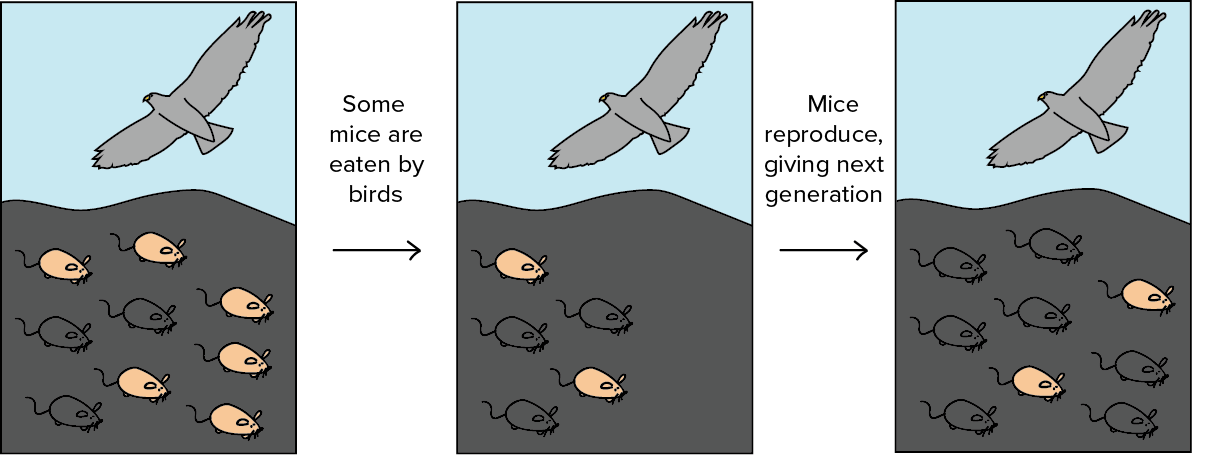
What is the selective pressure in this example?
(why are the mice color frequencies changing?)
The ground color
The predators
The size of the mice
The mice's access to food
If another 100 years pass, how do you expect the mouse color frequency to change?
Tan mice will increase
Dark mice will increase
The population will stay the same
The population will go extinct
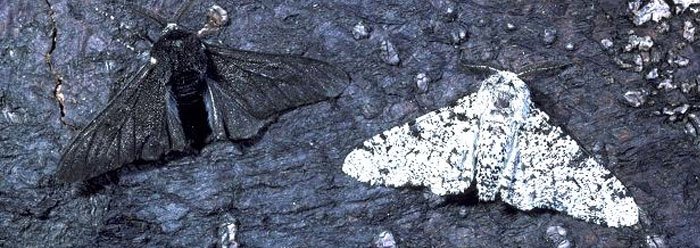
In this image, which moth is the best fit for its environment?
Match the following
Digests other organisms for energy
Heterotroph
Uses the sun to produce food for energy
Photoautotroph
Uses chemicals for energy
Chemoautotrophs

What is the scientific name for a dog?
Canis familiaris
Familiaris canis
Animalia
Chordata animalia
Which organism is the LEAST closely related to the dog?
Fish
Fox
Elephant
Lion
An organism's scientific name is its (a) and (b) .

Organize the following from greatest diversity (1) to least diversity (4)
Kingdom
Class
Genus
Species
At which level can organisms interbreed?
Family
Class
Genus
Species

Which of the following organims is most closely related to the birds?
t.rex
bats
spiders
giraffes
Which organism shares the most amount of traits with the bat?
giraffes
birds
spiders
t.rex

My scientific name is Bos taurus. Which organism is the most closely related to me?
Bison taurus
Bison Bison
Cow taurus
Bos zebu

Which of the following organisms have amniotic eggs?
Turtle
Tuna
Leopard
Lamprey
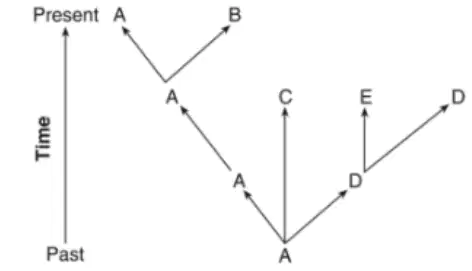
Which organisms most likely share the most similar amino acid sequence?
A + B
B + C
C + E
B + D

Use the diagram to match the following
E
Organism that is extinct
A
Organism that has survived the longest
D
The most closely related organism to E

Which organisms are most closely related?
A + C
B + C
C + D
B + D
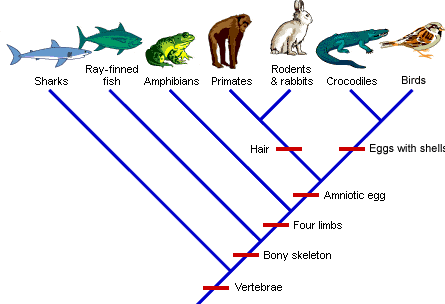
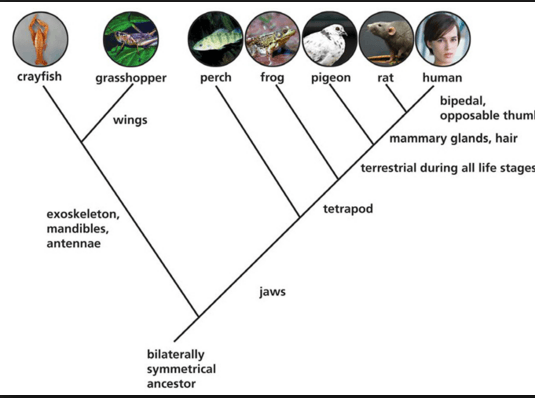

Which species is most closely related to species C?
A
B
D
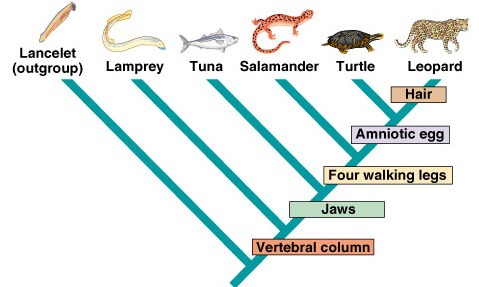
Which is the newest trait?
Amniotic egg
Walking legs
Jaws
Hair

Which trait(s) do conifers have?
vascular tissue only
vascular tissue and seeds
vascular tissue, seeds and flowers
seeds only

Which animals have amniotic eggs?
Turtle and Tuna
Turtle and Leopard
Lancelet and Lamprey

According to the cladogram, which statement is true?
Only angiosperms have seeds
Bryophytes have vascular tissue
Ferns do not have seeds
Algae have an anchoring organ

What is the selective pressure that determines which color moth becomes more common?
The tree color
The predators (The birds)
Sexual Reproduction
The temperature
If there were no predators or selective pressures for the light or dark colored butterflies, what would the population look like over time?
All light colored
All dark colored
A mixture of light and dark colored
Extinct

These shrimp evolved into two separate species because Panama is a geographic barrier that...
keeps the two populations isolated
increases gene flow
encourages interbreeding
increases the number of babies that are born

If scientists determined this is a unicellular eukaryote, which kingdom would it belong to?
Protists
Fungi
Bacteria
Animalia

Bacteria living near hydrothermal vents in the ocean use sulfur as an energy source. They would be considered...
photoautotrophs
decomposers
heterotrophs
chemoautotrophs

This diagram of horse evolution shows that little by little over time the ancestors of horses had leg bones that went form 5, to 4, to , 3, to 2, to 1 foot bone. They also continuously got bigger and taller over time
Punctuated Equilbrium
Gradualism
Speciation
Genetic Variation

When we use antibiotics they kill most of the bacteria, but not all. As a result...
The same kinds of bacteria grow back
The antibiotic resistant bacteria become more common
The normal bacteria become more common
All the resistant bacteria die
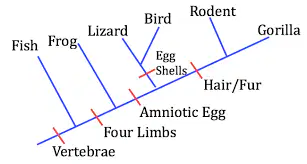
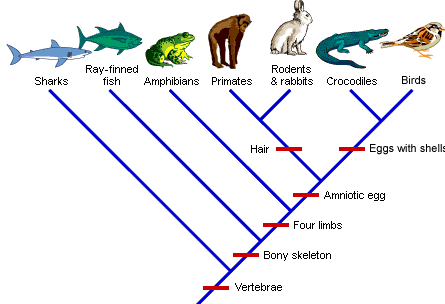
Which statement accurately describes the relationship between the organisms on this diagram?
Frogs and Lizards have amniotic eggs
Fish do not have vertebrae
Lizards and birds have egg shells
Frogs and fish have four limbs
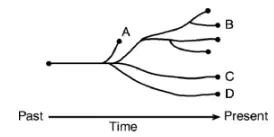
According to the phylogenetic tree organism A is...
still developing
extinct
the species that came into existence most recently
still alive today
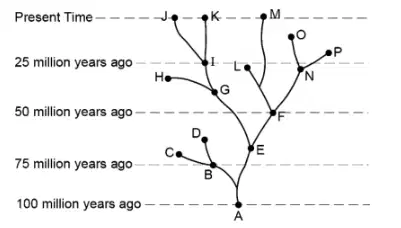
The common ancestor of all of these organisms...
is still alive today
lived 100 million years ago
went extinct 25 million years ago
is still developing
Organism L...
went extinct 25 million years ago
evolved from organism N
came into existence 75 million years ago
is still developing
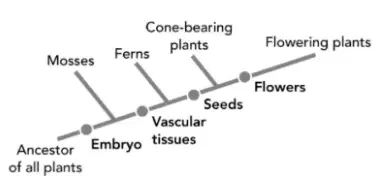
Which statement accurately describes the relationship between the organisms on this diagram?
Ferns and mosses have vascular tissues
Ferns have flowers
Ferns and mosses have seeds
cone-bearing plants and flowering plants have seeds
All of the following kingdoms include autotrophic organisms that can produce their own energy except -
Plantae
Animalia
Protista
Archaebacteria
An organism is eukaryotic, multicellular, heterotrophic, and has a cell wall. To which kingdom does it belong?
Animal
Plant
Fungi
Protist
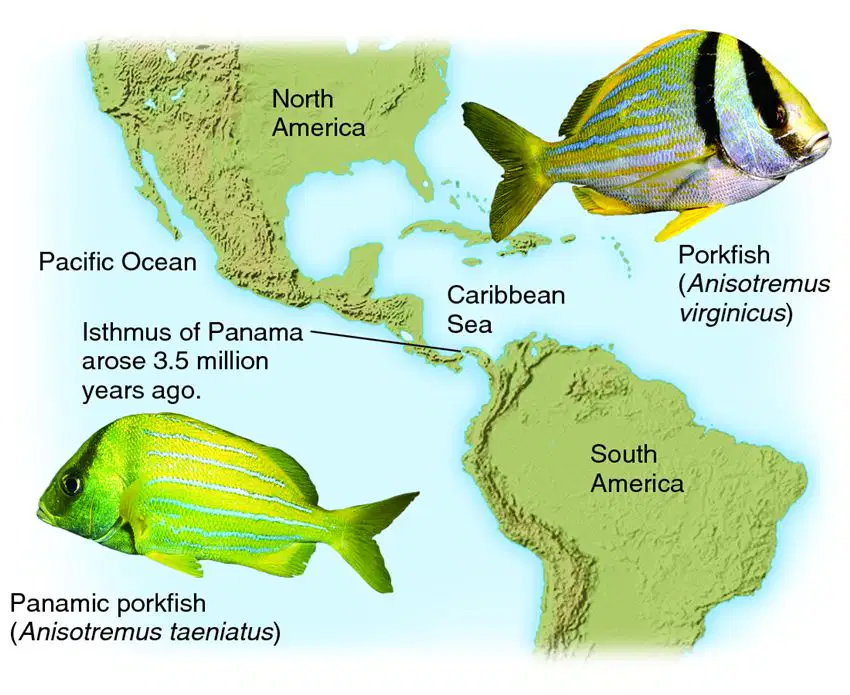
Fish populations were permanently separated when the Isthmus of Panama, a land mass, formed 3.5 million years ago. Over time this geographic isolation resulted in...
the development of two different species of fish
one uniform species
a reduction in the number of mutations in a population
identical evolution between all the fish

A population of squirrels was separated by a river running through the Grand Canyon. What eventually happened to the population of squirrels that was separated?
The number of variations in each population will decrease
Some of the squirrels will become autotrophs
The two populations will follow the same evolution patterns
Two separate squirrel species will be created
Match the following
Chloroplast
where photosynthesis occurs
Mitochondria
where cell respiration occurs --> ATP
Nuclues
where eukaryotes store DNA
Ribosome
where proteins are made
Vacuole
where water and waste are stored
Select all of the kingdoms that are prokaryotes
Protista
Fungi
Animalia
Archaea
Bacteria
Select all of the kingdoms that are eukaryotes.
Protista
Fungi
Animalia
Archaea
Bacteria
Organisms found in the kingdom Animalia are
multicellular, eukaryotic autotrophs
unicellular, prokaryotic heterotrophs
unicellular, prokaryotic autotrophs
multicellular, eukaryotic heterotrophs
Match the following
Digests other organisms for energy
Heterotroph
Uses the sun to produce food for energy
Photoautotroph
Uses chemicals for energy
Chemoautotrophs
No Nucleus
Prokaryote
Has a Nucleus
Eukaryote

I am a heterotrophic multicellular eukaryote. What am I?
Bacteria
Animal
Plant
Protist
I am a photoautotroph. I have a cell wall made of cellulose. What am I?
Plant
Archaea
Protist
Fungi
I am a prokaryote. You can find me EVERYWHERE.
What am I?
Bacteria
Archaea
Protist
Fungi
Some of us are unicellular, but most of us are multicellular. We get our energy through absorption and have cell walls made out of chitin.
What are we?
Animal
Plant
Protist
Fungi
I am a chemoautotroph that is unicellular. I do not have a nucleus. What am I?
Animal
Plant
Protist
Archaea
Which of the following are characteristics of bacteria?
Unicellular
Prokaryote
Has a nucleus
Has a cell wall
Lives in extreme environments
Which of the following are characteristics of archaea?
Multicellular
Prokaryote
Has a nucleus
Has a cell wall
Lives in extreme environments
Which of the following are characteristics of fungi?
Cell wall made of chitin
Eukaryote
Has a chloroplast
Heterotrophic
Multicellular
Which of the following are characteristics of plantae?
Cell wall made of chitin
Eukaryote
Has a chloroplast
Heterotrophic
Multicellular
Identify the type of cell each column represents.
Which of the following are characteristics of animalia?
Has a cell membrane
Eukaryote
Has a chloroplast
Heterotrophic
Multicellular

