
 Worksheets
Microbiology Ch. 12/13
Total questions: 88
Worksheet time: 44mins
A multicellular organism; the digestive tract has one opening.
Ascomycete
Tapeworm
Plasmodial slime mold
Cellular slime mold
Euglenozoa
Which of the following statements about the Oomycote algae is false?
They form hyphae.
They have chlorophyll.
They reproduce sexually.
They produce zoospores in a sporangium.
They cause plant diseases.
Yeast infections are caused by
Aspergillus.
Penicillium.
Saccharomyces cerevisiae.
Histoplasma.
Candida albicans.
What do tapeworms eat?
Intestinal bacteria
Red blood cells
Intestinal contents
Plant matter
Host tissues
Which of the following arthropods does NOT transmit diseases by sucking blood from a human host?
Mosquitoes
Fleas
Kissing bugs
Houseflies
Lice
Assume you have isolated a multicellular heterotrophic organism that produces coenocytic hyphae, motile zoospores, and cellulose cell walls. It is most likely a(n)
Zygomycete fungus.
Green alga.
Tapeworm.
Ascomycete fungus.
Oomycote alga.
In a food chain consisting of the following organisms, which acts as a producer?
Slime molds
Fungi
Protozoa
Lichens
The cells of plasmodial slime molds can grow to several centimeters in diameter because
The large surface can absorb nutrients.
They form spores.
None of these.
They distribute nutrients by cytoplasmic streaming.
They have organelles.
Which stage immediately precedes the adult?
Metacercaria
Miracidium
Cercaria
Proglottid
Redia
Amoebalike vegetative structures that produce sporangia.
Plasmodial slime mold
Cellular slime mold
Tapeworm
Ascomycete
Euglenozoa
Ringworm is caused by a(n)
Cestode.
Protozoan.
Nematode.
Ascomycete.
Trematode.
Which of the following groups of algae does NOT produce compounds that are toxic to humans?
Red algae
Green algae
Diatoms
Dinoflagellates
All of these produce compounds toxic to humans.
Below are several paired items referring to the heartworm Dirofilaria immitis. Which of the pairs is mismatched?
Mosquito - definitive host
Mosquito - vector
Dog - definitive host
Dog - sexual reproduction
All of these are correctly matched.
The encysted larva of the beef tapeworm is called a
Cercaria.
Proglottid.
Cysticercus.
Metacercaria.
Redia.
Helminthic diseases are usually transmitted to humans by
Aerosols.
Respiratory route.
Gastrointestinal route.
Vectors.
Genitourinary route.
The life cycle of the fish tapeworm is similar to that of the beef tapeworm. Which of the following is the most effective preventive measure?
Wearing gloves while handling fish
Refrigerating stored fish
Not swimming in fish-infested waters
Salting fish before eating
Cooking fish before eating
Seventeen patients in ten hospitals had cutaneous infections caused by Rhizopus. In all 17 patients, Elastoplast bandages were placed over sterile gauze pads to cover wounds. Fourteen of the patients had surgical wounds, two had venous line insertion sites, and one had a bite wound. Lesions present when the bandages were removed ranged from vesiculopustular eruptions to ulcerations and skin necrosis requiring debridement. Fungi are more likely than bacteria to contaminate bandages because
They prefer a neutral environment (pH 7).
They are aerobic.
They cannot tolerate high osmotic pressure.
They have a fermentative metabolism.
They can tolerate low-moisture conditions.
Which of the following statements is false?
In a lichen, the fungus provides the holdfast.
In a lichen, the alga produces carbohydrates.
A lichen doesn't exist if the fungal and algal partners are separated.
Lichens are parasites.
Lichens are important soil producers.
Which of the following is NOT a characteristic of parasitic platyhelminths?
They are hermaphroditic.
They are multicellular animals.
They have a complete digestive system.
They can be divided into flukes and tapeworms.
They are dorsoventrally flattened.
If a larva of Echinococcus granulosus is found in humans, humans are the
Definitive host.
Reservoir.
Infected host.
Intermediate host.
None of these.
Which of the following pairs is mismatched?
Red algae - agar
Brown algae - algin
Green algae - prokaryotic
Dinoflagellates - paralytic shellfish poisoning
Diatoms - petroleum
Lysogeny can result in all of the following EXCEPT
Immunity to reinfection by the same phage.
Acquisition of new characteristics by the host cell.
Transduction of specific genes.
Immunity to reinfection by any phage.
None of these.
Bacteriophages derive all of the following from the host cell EXCEPT
Amino acids.
A.T.P.
Nucleotides.
tRNA.
Lysozyme.
Which of the following is most likely a product of an early gene?
Spike proteins
DNA polymerase
Envelope proteins
Capsid proteins
Lysozyme
Assume you have isolated an unknown virus. It is a single-stranded RNA, enveloped virus. To which group does it most likely belong?
Retrovirus
Togavirus
Herpesvirus
Papovavirus
Picornavirus
Some viruses, such as human herpesvirus 1, infect a cell without causing symptoms; these are called
Lytic viruses.
Slow viruses.
Phages.
Unconventional viruses.
Latent viruses.
Continuous cell lines differ from primary cell lines in that
Continuous cell lines always have to be reisolated from animal tissues.
Continuous cell lines are derived from primary cell lines.
Continuous cell lines can be maintained through an indefinite number of generations.
Viruses can be grown in continuous cell lines.
Continuous cell lines are from human embryos.
Which one of the following steps does NOT occur during multiplication of a picornavirus?
Synthesis of + strands of RNA
Synthesis of - strands of RNA
None of these
Synthesis of viral proteins
Synthesis of DNA
Which of the following statements about spikes is false?
They are used for absorption.
They are found only on enveloped viruses.
They may cause hemagglutination.
They are found only on nonenveloped viruses.
They are used for penetration.
A persistent infection is an infection in which
The virus remains in equilibrium with the host without causing a disease.
Host cells are transformed.
Host cells are gradually lysed.
The disease process occurs gradually over a long period.
Viral replication is unusually slow.
Approximately how many virus particles could fit along a 1-millimeter line?
20
2
200
20,000
2,000,000
Generally, in a DNA-containing virus infection, the host animal cell supplies all of the following EXCEPT
All of these are supplied by the host animal cell.
Nucleotides.
RNA polymerase.
DNA polymerase.
tRNA.
Which of the following contributes to the difficulty in establishing the etiology of cancer?
All of these.
Viruses are difficult to observe.
Cancer may not develop until long after infection.
Cancers do not seem to be contagious.
Most viral particles can infect cells without inducing cancer.
Bacteriophages and animal viruses do NOT differ significantly in which one of the following steps?
Adsorption
Penetration
Release
Biosynthesis
Uncoating
The following steps occur during biosynthesis of a + strand RNA virus. What is the third step?
Penetration and uncoating
Synthesis of viral proteins
Attachment
Synthesis of + strand RNA
Synthesis of - strand RNA
The following steps occur during multiplication of herpesviruses. What is the third step?
Biosynthesis
Release
Attachment
Uncoating
Penetration
Which of the following is NOT a method of culturing viruses?
In embryonated eggs
None of these
In cell culture
In culture media
In laboratory animals
A viroid is
A complete, infectious virus particle.
An infectious protein.
A capsid without a nucleic acid.
A nonenveloped, infectious piece of RNA.
A provirus.
The definition of lysogeny is
When the burst time takes an unusually long time.
Phage DNA is incorporated into host cell DNA.
Attachment of a phage to a cell.
The period during replication when virions are not present.
Lysis of the host cell due to a phage.
Viruses that have reverse transcriptase are in the
Bacteriophage families.
Herpesviridae and Retroviridae.
Influenzavirus.
Hepadnaviridae and Retroviridae.
Retroviridae and Picornaviridae.
Most RNA viruses carry which of the following enzymes?
RNA-dependent RNA polymerase
Reverse transcriptase
DNA-dependent DNA polymerase
Lysozyme
ATP synthase
Generalized transduction differs from specialized transduction in that generalized transduction
Kills the host.
Involves lysogeny.
Lyses the host cell.
Transfers specific DNA.
Transfers DNA from one cell to another.
An envelope is acquired during which of the following steps?
Uncoating
Penetration
Adsorption
Biosynthesis
Release
Cercariae, metacercaria, miracidia, and rediae are stages in the life cycle of
Sporozoans.
Trematodes.
Sarcodina.
Cestodes.
Nematodes.
The microspora and archaezoa are unusual eukaryotes because they
Lack mitochondria.
Do produce cysts.
Don't produce cysts.
Lack nuclei.
Are motile.
Which of the following tends to be more complex in a parasitic helminth than in free-living helminths?
Locomotion
Nervous system
Reproductive system
Digestive system
All of these are more complex in a parasitic helminth.
Which of the following statements about helminths is false?
All are parasites.
They are heterotrophic.
Some have male and female reproductive organs in one animal.
They have eukaryotic cells.
They are multicellular animals.
An organism that can grow photoautotrophically in the light and chemoheterotrophically in the dark.
Oomycote
Euglena
Plasmodial slime mold
Cellular slime mold
Phytophthora
Which of the following is the most effective control for malaria?
Eliminate the intermediate host
Eliminate Anopheles
Vaccination
Treating patients
None of these is an effective control.
Which of the following statements is false?
Fungi produce asexual spores.
Fungal spores are resting spores to protect the fungus from adverse environmental conditions.
Fungal spores are for reproduction.
Fungi produce sexual spores.
Fungal spores are used in identification of fungi.
Which of the following pairs is mismatched?
Plasmogamy - union of two haploid cells
Karyogamy - fusion of nucleus
Meiosis - cell division resulting in haploid cells
Deuteromycota - a phylum of fungi
Anamorph - produces asexual spores
Which of the following statements about algae is false?
Some are capable of sexual reproduction.
All are unicellular.
They use light as their energy source.
They use CO2 as their carbon source.
They produce oxygen from hydrolysis of water.
Which of the following would be the first step in biosynthesis of a virus with a - strand of RNA?
Transcription of mRNA from DNA
Synthesis of DNA from an RNA template
Synthesis of double-stranded RNA from an RNA template
Synthesis of DNA from a DNA template
Synthesis of double-stranded RNA from a DNA template
Put the following in the correct order for DNA-virus replication:
1-Maturation; 2-DNA synthesis; 3-Transcription; 4-Translation.
4, 3, 2, 1
3, 4, 1, 2
1, 2, 3, 4
2, 3, 4, 1
4, 1, 2, 3
DNA made from an RNA template will be incorporated into the virus capsid of
Retroviridae.
Hepadnaviridae.
Bacteriophage families.
Herpesviridae.
Influenzavirus.
An example of a latent viral infection is
Subacute sclerosing panencephalitis.
Mumps.
Influenza.
Cold sores.
Smallpox.
A clear area against a confluent "lawn" of bacteria is called a
Pock.
Plaque.
Cell lysis.
Rash.
Phage.
The most common route of accidental AIDS transmission to health care workers is
Environmental surface contact.
Fecal-oral.
Needlestick.
Aerosol.
Mouth to mouth.
What contributes to antigenic shift in influenza viruses?
Different subtypes
Attachment spikes
Worldwide distribution
Ease of transmission
Segmented genome
The following steps occur during multiplication of retroviruses. What is the fourth step?
Synthesis of double-stranded DNA
Attachment
Synthesis of + RNA
Uncoating
Penetration
Which of the following is NOT used as a criterion to classify viruses?
Morphology
Biochemical tests
Nucleic acid
Number of capsomeres
Size
Which of the following statements provides the most significant support for the idea that viruses are nonliving chemicals?
They cannot reproduce themselves outside a host.
They are filterable.
They are not composed of cells.
They cause diseases similar to those caused by chemicals.
They are chemically simple.
Which of the following is necessary for replication of a prion?
DNA
RNA
DNA polymerase
Lysozyme
PSc
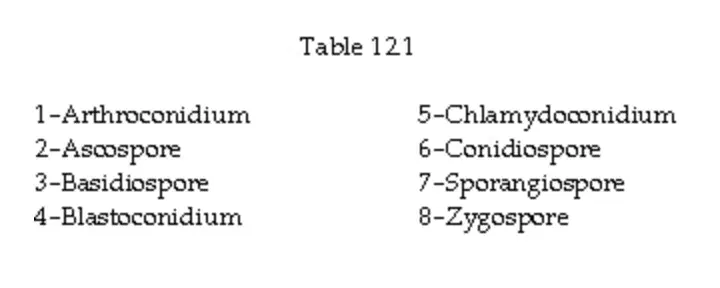
In Table 12.1, which is a thick-walled spore formed as a segment within a hypha?
None
5
7
1
3
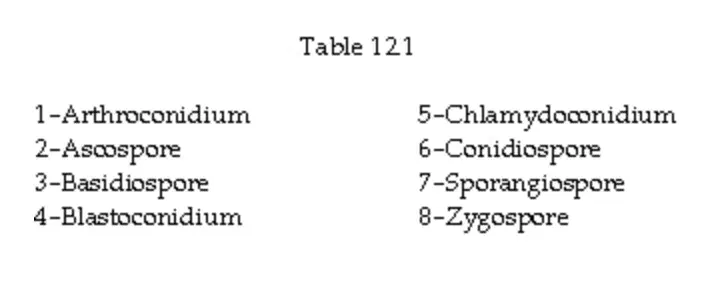
In Table 12.1, which of these spores are asexual spores?
2, 4, 6, 7, 8
1, 4, 5, 6, 7
All
2, 3, 6, 8
1, 3, 5, 8
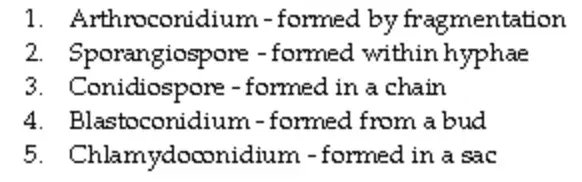
Which of the following pairs are mismatched?
1 and 2
2 and 3
4 and 5
3 and 4
2 and 5
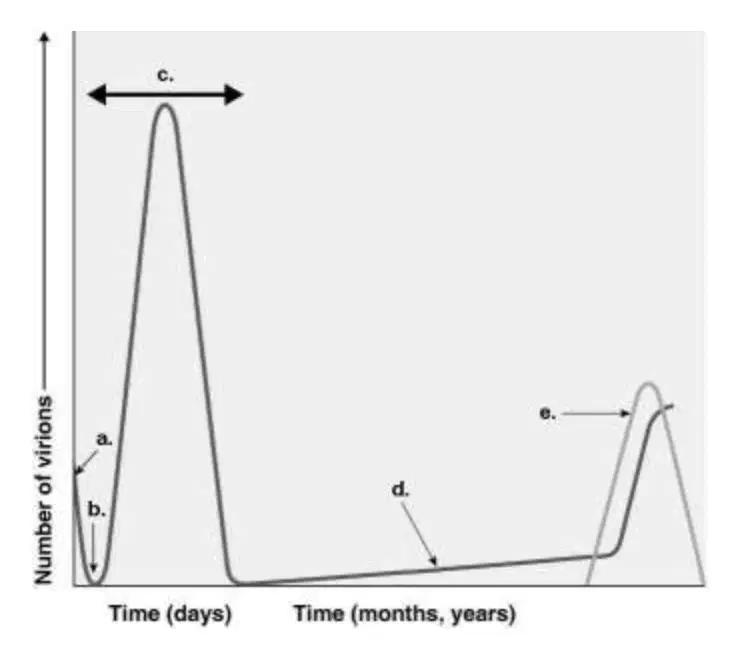
Assume a patient had chickenpox (human herpesvirus 3) as a child. Which line on the graph in Figure 13.2 would show the number of viruses present in this person as a 60-year-old with shingles (human herpesvirus 3)?
a
b
c
d
e
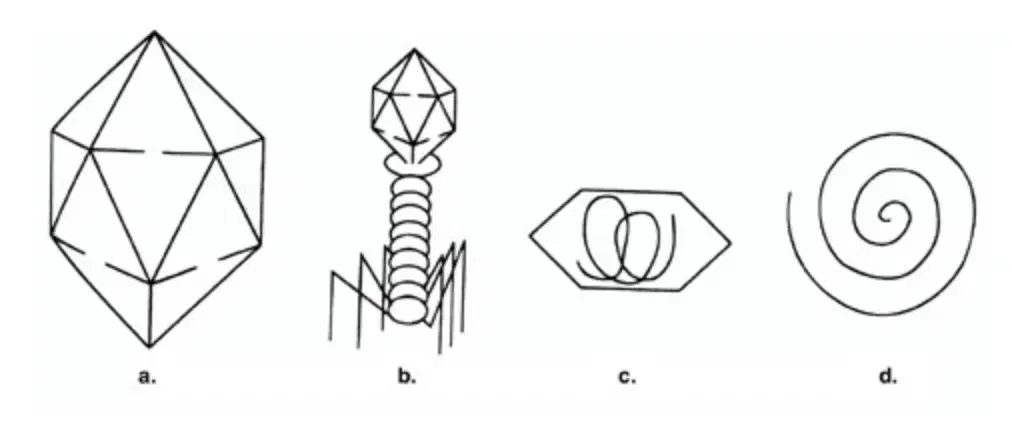
In Figure 13.1, which structure is a complex virus?
All of these
a
b
c
d
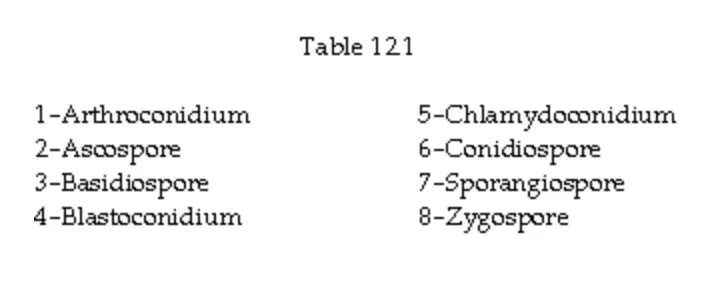
In Table 12.1, which spore is in a sac and results from the fusion of two nuclei from different strains of the same fungi?
4
2
8
1
6
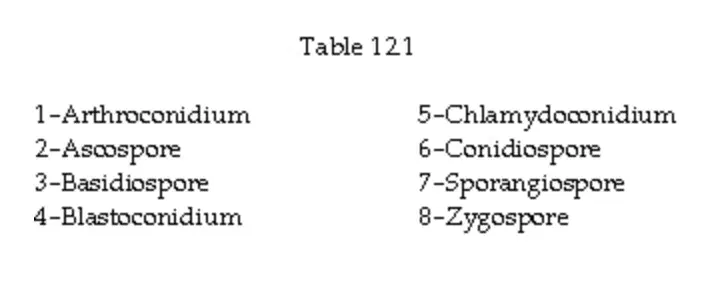
In Table 12.1, which of these spores are characteristic of Penicillium?
1 and 4
4 and 6
1 and 2
2 and 6
3 and 4
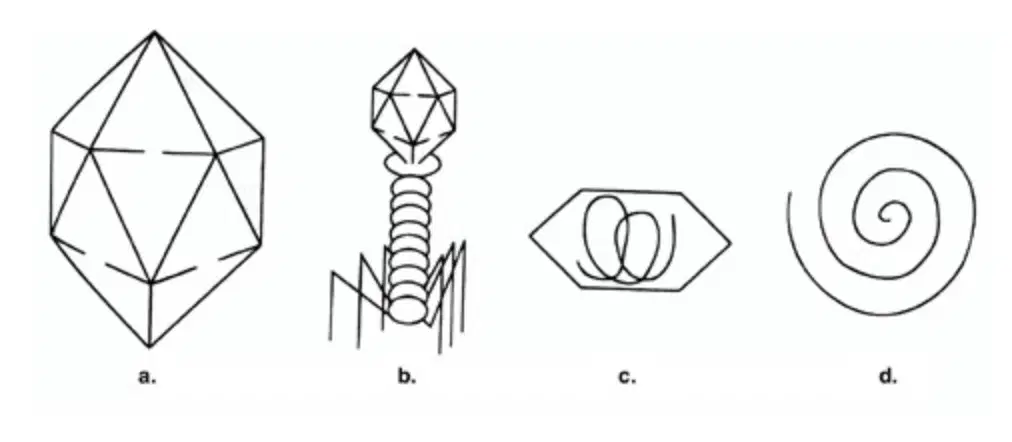
In Figure 13.1, the structures illustrated are composed of
RNA.
DNA or RNA.
Capsomeres.
DNA.
Capsids.
In mid-December, a woman with insulin-dependent diabetes who had been on prednisone fell and received an abrasion on the dorsal side of her right hand. She was placed on penicillin. By the end of January, the ulcer had not healed, and she was referred to a plastic surgeon. On January 30, a swab of the wound was cultured at 35°C on blood agar. On the same day, a smear was made for Gram staining. The Gram stain showed large (10 µm) cells. Brownish, waxy colonies grew on the blood agar. Slide cultures set up on February 1 and incubated at 25°C showed septate hyphae and single conidia. The most likely cause of the infection is a
Parasitic alga.
Dimorphic fungus.
Protozoan.
Yeast.
Gram-negative bacterium.
You see acid-fast oocysts in a fecal sample from a patient who has diarrhea. What is the most likely cause?
Taenia
Entamoeba
Giardia
Cryptosporidium
Diatoms
Multinucleated amoebalike cells that produce funguslike spores.
Tapeworm
Cellular slime mold
Plasmodial slime mold
Ascomycete
Euglenozoa
A nucleated, unicellular organism; when you change the incubation temperature, it forms filaments with conidiospores.
Tapeworm
Euglenozoa
Ascomycete
Plasmodial slime mold
Cellular slime mold
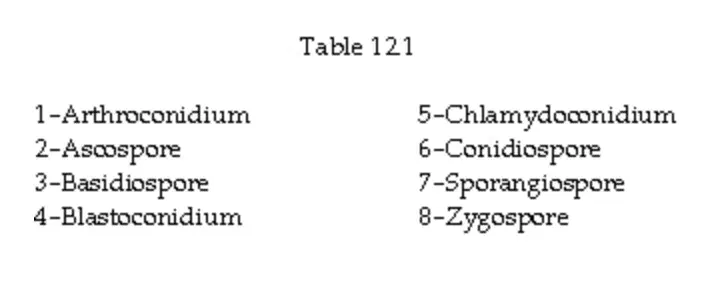
In Table 12.1, which spore is found externally on a pedestal?
5
None
1
3
7
All algae are
Plants.
Unicellular.
Toxic.
Photoautotrophs.
None of these.
In which of the following ways do viruses differ from bacteria?
Viruses don't reproduce.
Viruses are not composed of cells.
Viruses don't have any nucleic acid.
Viruses are obligate intracellular parasites.
Viruses are filterable.
An infectious protein is a
Retrovirus
Prion
Papovavirus
Bacteriophage
Viroid
A viral species is a group of viruses that
Have the same morphology and nucleic acid.
Have the same genetic information and ecological niche.
Infect the same cells and cause the same disease.
Can't be defined.
Which of the following statements is false?
A prophage is phage DNA inserted into a bacterial chromosome.
Prophage genes are represented by a repressor protein coded for by the prophage.
A prophage may result in new properties of the host cell.
A prophage can pop out of the chromosome.
The prophage makes the host cell immune to infection by other phages.
Nontoxic strains of Vibrio cholerae can become toxic when they are in the human intestine with toxic strains of bacteria. This suggests that the toxin genes are acquired by
Transduction.
Host enzymes.
Reverse transcriptase.
Prions.
None of these.

In Table 12.1, which of these spores are characteristic of Rhizopus?
7 and 8
2 and 8
1 and 4
1 and 2
6 and 7
Which of the following statements about fungi is false?
All fungi are unicellular.
All fungi have eukaryotic cells.
Few fungi are pathogenic to humans.
Fungi are heterotrophic.
Most fungi are aerobic.
To which group does a small, nonenveloped single-stranded RNA virus most likely belong?
Herpesvirus
Togavirus
Retrovirus
Papovavirus
Picornavirus
Which of the following statements about viruses is false?
Viruses use the anabolic machinery of the cell.
Viruses have genes.
Viruses contain a protein coat.
Viruses use their own catabolic enzymes.
Viruses contain DNA or RNA but never both.
The most conclusive evidence that viruses cause cancers is provided by
Some liver cancer patients having had hepatitis.
Treating cancer with antibodies.
Finding oncogenes in viruses.
Cancer following injection of cell-free filtrates.
The presence of antibodies against viruses in cancer patients.
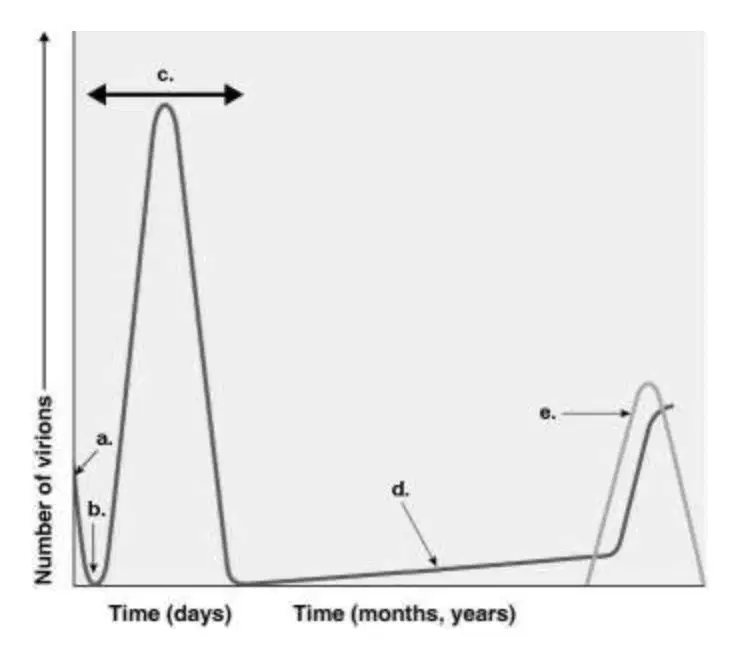
Assume a patient has influenza. During which time (on the graph in Figure 13.2) would the patient show the symptoms of the illness?
a
b
c
d
e

