
 Worksheets
ATL 2 Treaty of Union between England and Scotland in 1707
Total questions: 100
Worksheet time: 50mins
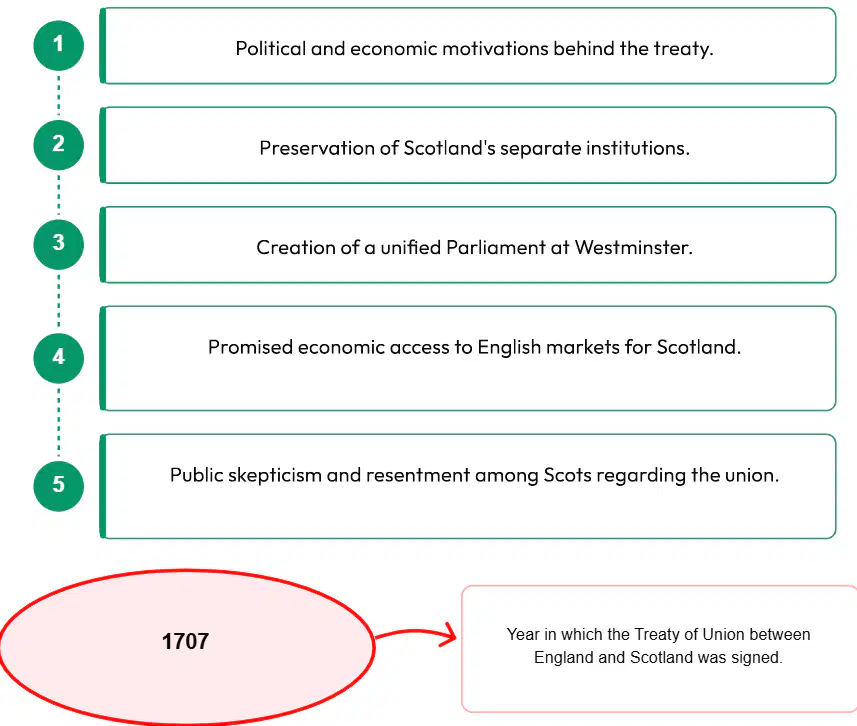
Fill in the blank: The Treaty of Union between England and Scotland was signed in the year _____
1707
1603
1801
1688
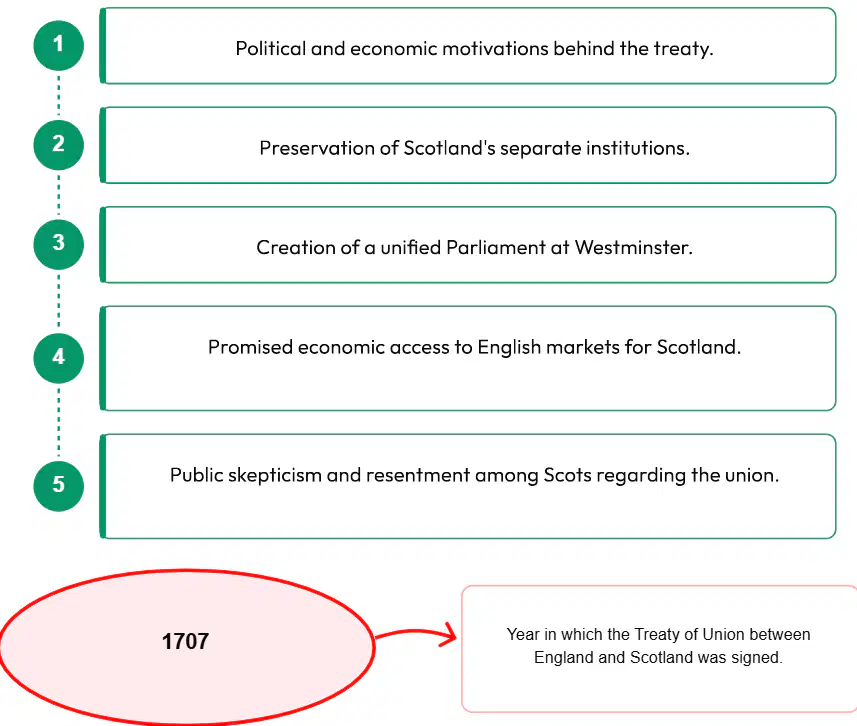
Which of the following was a key motivation behind the Treaty of Union between England and Scotland?
Religious motivations
Political and economic motivations
Military motivations
Cultural motivations
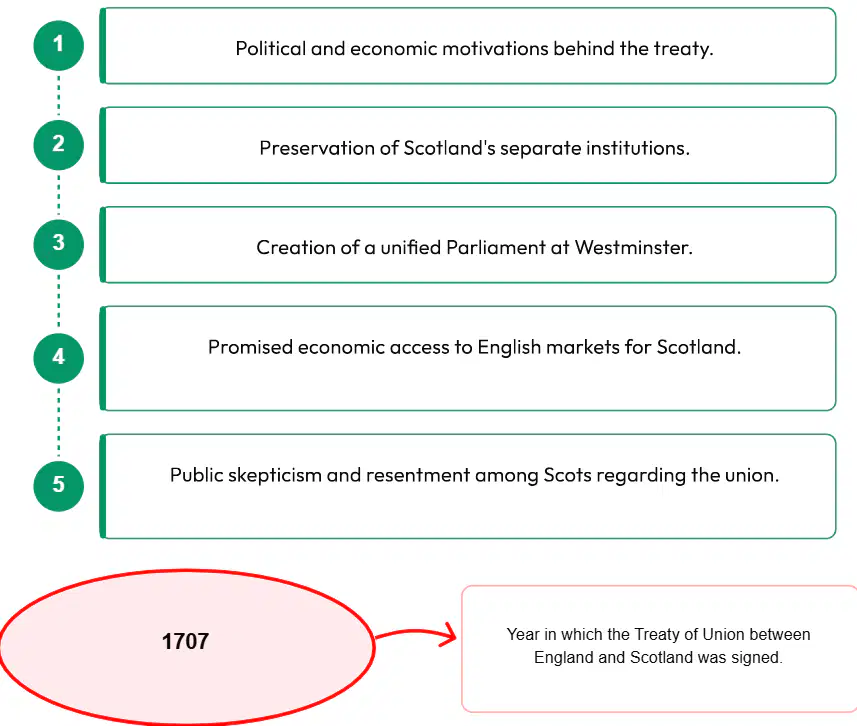
Which key element of the Treaty of Union focused on maintaining Scotland's unique systems?
Creation of a unified Parliament
Preservation of Scotland's separate institutions
Economic access to English markets
Public skepticism
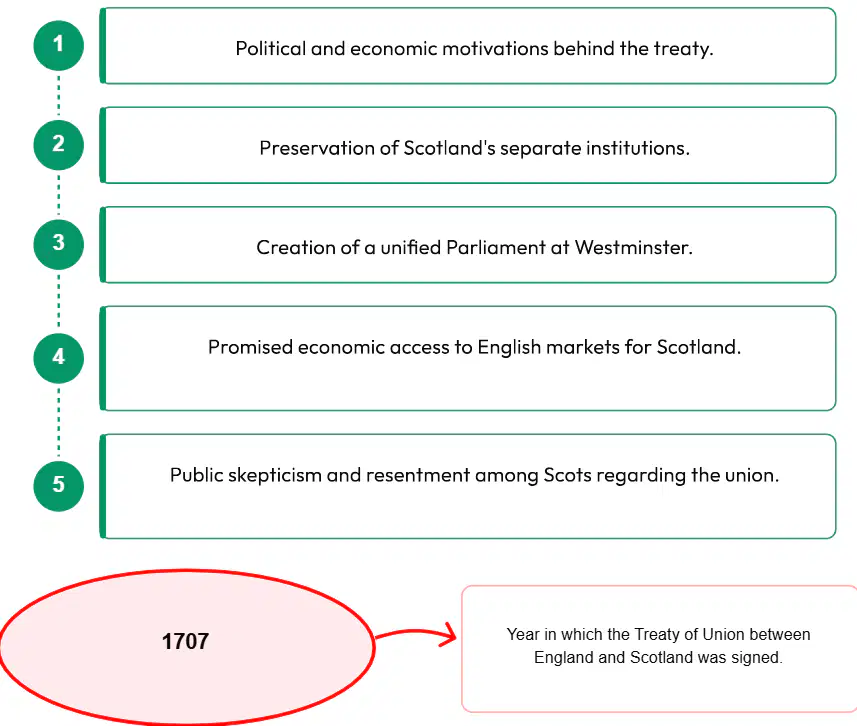
What did the Treaty of Union create at Westminster?
A new monarchy
A unified Parliament
A trade agreement
A military alliance
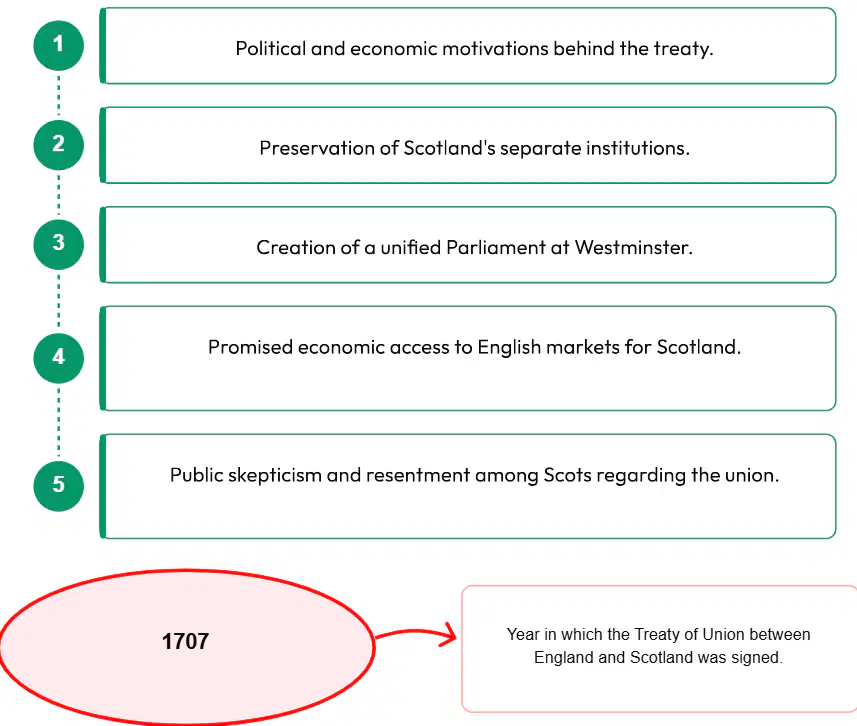
What economic benefit was promised to Scotland in the Treaty of Union?
Free education
Economic access to English markets
Tax exemptions
Land grants
What was the public reaction among Scots regarding the union?
Enthusiasm and support
Skepticism and resentment
Indifference
Celebration
In which year did the Second Act of Union further solidify Welsh incorporation as an administrative province?
1542
1536
1603
1707
What marked the formal integration of Wales into England?
The Acts of Union in 1536 and 1542
The Magna Carta
The English Civil War
The Glorious Revolution
What were the legal implications of the Acts of Union for Wales?
The Acts established English laws as applicable in Wales, significantly transforming the local judicial system and administration.
The Acts granted Wales complete independence from English law and established a separate Welsh parliament.
The Acts abolished all forms of local governance in Wales and replaced them with direct rule from Scotland.
The Acts introduced French civil law into Wales, replacing the existing legal system.
How did the Acts of Union affect Welsh national identity?
The Acts of Union contributed to the erosion of Welsh national identity and cultural autonomy through forced assimilation into English governance.
The Acts of Union led to the complete independence of Wales from England and the restoration of its monarchy.
The Acts of Union resulted in the official recognition of the Welsh language as the primary language of governance.
The Acts of Union promoted the establishment of a separate Welsh parliament with full legislative powers.
Which of the following was a consequence of the Act of Union 1801?
Closure of the Dublin Parliament ended Irish parliamentary autonomy.
Wales gained independence.
The English Civil War began.
Scotland left the United Kingdom.
What was one effect of integrating Irish lawmakers into the Westminster system after the Act of Union 1801?
Irish lawmakers were integrated into the Westminster system, centralizing legislative power.
Ireland gained complete independence from Britain.
Irish lawmakers were excluded from all British political processes.
The Irish Parliament was given more autonomy than before.
What increased tensions between the Catholic Irish population and Protestant Britain after the Act of Union 1801?
Unresolved issues regarding Catholic emancipation increased tensions between the Catholic Irish population and Protestant Britain.
The immediate granting of full independence to Ireland increased tensions.
The abolition of the Irish language in schools increased tensions.
The establishment of a joint monarchy increased tensions.
What was the primary motive behind the Act of Union 1801?
To ensure full political control over Ireland during a time of heightened concern due to potential invasions amid the Napoleonic Wars.
To promote economic prosperity in Ireland through free trade agreements.
To grant Ireland complete independence from British rule.
To establish a joint monarchy between England and France.
What is the significance of Catholic Emancipation rejection in the context of the Act of Union 1801?
The refusal to grant Catholic emancipation set a precedent for future political movements advocating for Irish rights and independence.
It resulted in immediate independence for Ireland from Britain.
It led to the dissolution of the British Parliament.
It caused the Catholic Church to become the official state religion in Britain.
What was the impact of the Act of Union 1801 on the Irish political landscape?
The Act of Union further entrenched English dominance in Ireland and stifled the Irish self-governance movement throughout the 19th century.
It granted Ireland complete independence from Britain and established a separate Irish parliament.
It led to immediate economic prosperity and widespread support for British rule in Ireland.
It resulted in the abolition of all religious restrictions and full equality for Irish Catholics.
Fill in the blank: One factor leading to the 1798 Rebellion was the influence of revolutionary ideals from the ________ Revolution on Irish nationalists.
French
American
Russian
Chinese
Fill in the blank: Discontent with British domination and lack of representation for various ________ was a factor leading to the 1798 Rebellion.
social classes
religious texts
military leaders
colonial governors
Fill in the blank: Heightened tensions in Ireland were due to England's ongoing war with ________.
France
Spain
Germany
Italy
Fill in the blank: A consequence of the 1798 Rebellion was significant loss of life during the bloody suppression by ________ forces.
British
French
Spanish
Dutch
Fill in the blank: The 1798 Rebellion led to strengthened ________ governmental control over Ireland post-rebellion.
British
French
Spanish
Dutch
Fill in the blank: The 1798 Rebellion resulted in an emerging association between Irish nationalism and ________ identity in political discourse.
Catholic
Protestant
Anglican
Presbyterian
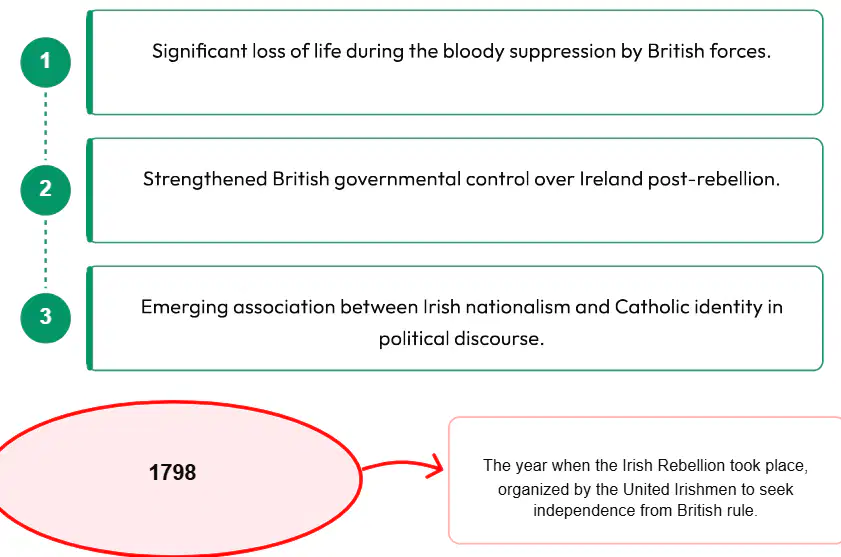
What year did the Irish Rebellion, organized by the United Irishmen to seek independence from British rule, take place?
1776
1798
1848
1916
What were the underlying causes of the 1798 Irish Rebellion?
Desire for Irish independence, social representation, and influence by external revolutionary movements
Economic prosperity and peace
British support for Irish autonomy
None of the above
What were the consequences of the British suppression of the 1798 Irish Rebellion?
Drastic loss of life and reinforced British control, prompting further resistance movements in Ireland
Immediate Irish independence
Economic boom in Ireland
Peaceful resolution
What role did religious identity play in the 1798 Irish Rebellion?
The rebellion marked a shift where Catholic identity became increasingly linked with the struggle for Irish nationalism and self-governance.
Religion was not involved at all.
Protestant identity became dominant.
Religious identity was ignored.
Who were the United Irishmen? Fill in the blank: The United Irishmen were a group formed in the late 18th century aiming to achieve an independent Irish Republic through both _______ and rebellion.
political activism
religious conversion
economic reforms
scientific research
What was the purpose of the Catholic Association formed by Daniel O'Connell in 1821?
To advocate for Catholic rights
To support British rule
To promote Protestantism
To encourage emigration
What was a key result of agitation and political mobilization by Irish Catholics under the Penal Laws? Fill in the blank: Agitation and political mobilization resulted from the repression experienced by Irish Catholics under the _______.
Penal Laws
Act of Union
Great Famine
Home Rule Act
What was the failure of King George III and William Pitt the Younger regarding Catholic rights? Fill in the blank: They failed to grant _______ rights to Catholics prior to O'Connell's efforts.
voting
property
education
military
What was one consequence of Catholic Emancipation in Ireland?
Decreased political participation for Catholics
Increased political participation and representation for Catholics in the Irish Parliament.
Strengthened Protestant political structures
None of the above
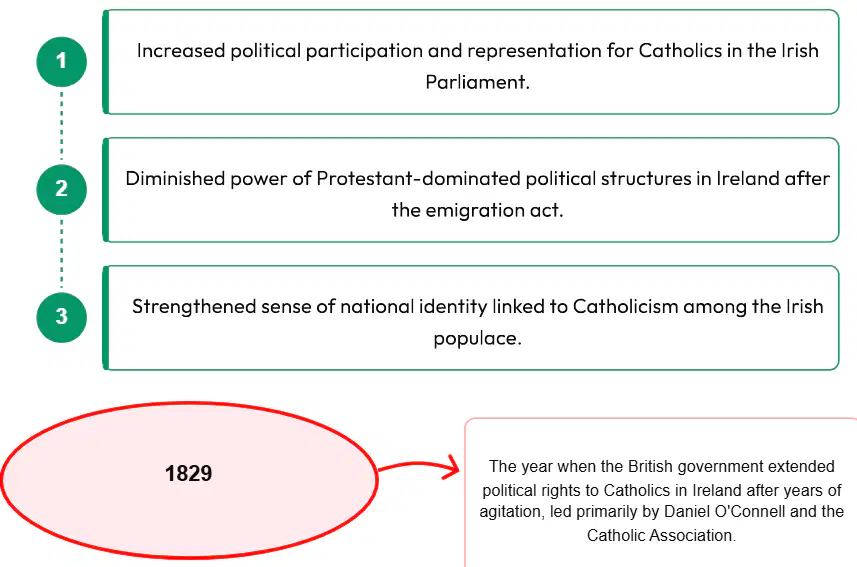
In which year did the British government extend political rights to Catholics in Ireland after years of agitation?
1829
1801
1845
1870
Catholic Emancipation was significant for Ireland because:
it allowed Catholics to sit in Parliament and hold public office
it led to the immediate independence of Ireland
it abolished all religious practices in Ireland
it resulted in the unification of Ireland and Britain
The push for Catholic Emancipation was led by:
Daniel O'Connell
Charles Stewart Parnell
Eamon de Valera
Michael Collins
The impact of Catholic identity on Irish nationalism was:
It strengthened the sense of unity and distinctiveness among Irish nationalists.
It led to the decline of Irish nationalism.
It had no significant effect on Irish nationalism.
It caused Irish nationalists to adopt Protestant beliefs.
The Catholic Association was founded by which individual?
Daniel O'Connell
John Henry Newman
Charles Stewart Parnell
Michael Collins
Fill in the blank: The Irish Parliamentary Party was formed in ____ , marking a shift towards organized political representation for Irish nationalists.
1874
1886
1891
1867
Fill in the blank: The Home Rule Bills proposed by William Ewart Gladstone in ____ and ____ failed, igniting further nationalist sentiments in Ireland.
1886 and 1893
1872 and 1880
1901 and 1910
1850 and 1865
Fill in the blank: The adoption of a Home Rule Bill before World War I was postponed due to ____.
the war
economic crisis
lack of support
political reforms
Fill in the blank: Increased political activism among Irish nationalists occurred despite repeated failures in ____.
Parliament
Education
Industry
Agriculture
Fill in the blank: The Home Rule debate intensified tensions between ____ and ____.
Unionists and Nationalists
Liberals and Conservatives
Catholics and Protestants
Monarchists and Republicans
Fill in the blank: The Home Rule Movement was a catalyst for the ____ in 1916, significantly influencing the push for Irish independence.
Easter Rising
Indian Mutiny
Russian Revolution
Boston Tea Party
What was the Irish Parliamentary Party?
A political party established to represent Irish interests in the British Parliament and advocate for Home Rule.
A secret society aiming to overthrow the British monarchy.
A cultural organization promoting Irish music and dance.
A military group fighting for Irish independence through armed rebellion.
Why did the Home Rule Bills fail in Parliament?
Factors included strong opposition from Unionists, political divisions in Britain, and the complexities of Irish politics at the time.
They were rejected due to lack of interest from Irish nationalists.
The bills failed because they were never introduced in Parliament.
The failure was due to economic reasons unrelated to politics.
How did the Home Rule Movement influence Irish nationalism?
It became a central theme in nationalist rhetoric, unifying various groups in the pursuit of self-governance.
It led to the immediate independence of Ireland from British rule.
It caused Irish nationalism to decline significantly.
It resulted in the dissolution of all nationalist organizations in Ireland.
What is 'Home Rule'? Fill in the blank: Home Rule is a political movement aimed at gaining self-governance for Ireland within the United Kingdom, seeking to establish an _________
Irish Parliament.
English Monarchy.
Scottish Assembly.
Welsh Council.
Fill in the blank: The introduction of ________ and power looms revolutionized fabric production during the early mechanization in textile industries in the late 18th century.
spinning jennies
cotton gins
sewing machines
jacquard cards
Fill in the blank: ________ powered many new machines, allowing for increased efficiency in manufacturing during the early mechanization of textile industries.
Water wheels
Steam engines
Wind turbines
Solar panels
Fill in the blank: Factory work created job opportunities in urban centers, increasing urban population from 15% in 1750 to over _______ by 1851.
50%
25%
35%
60%
Fill in the blank: There was a shift in labor dynamics with workers performing ________ tasks rather than overseeing entire production processes in factories.
specific
random
creative
managerial
Fill in the blank: The Factory Act of 1833 sought to regulate working hours and reduce ________.
child labor
adult wages
factory profits
machine usage
Fill in the blank: Legislation emerged in response to poor working conditions and high ________ rates in factories.
injury
promotion
salary
attendance
What marked the transition to mechanized textile manufacturing?
The transition was marked by the establishment of manufactories and the introduction of machinery that replaced manual labor.
The discovery of new textile dyes in the 18th century.
The widespread use of hand-spun thread in rural areas.
The decline of the wool trade in favor of silk production.
How did mechanization affect labor demographics?
It led to a significant increase in the urban labor force, as many rural workers migrated to cities for factory jobs.
It caused a decrease in urban populations as people moved back to rural areas for agricultural work.
It resulted in a decline in factory jobs and an increase in home-based crafts.
It had no noticeable impact on the movement of workers between rural and urban areas.
What were the consequences for skilled laborers?
Skilled laborers, especially weavers, protested against mechanization, fearing loss of status and income due to factory production.
Skilled laborers were immediately promoted to factory managers as a result of mechanization.
Skilled laborers received higher wages and more job security after mechanization.
Skilled laborers were unaffected by the changes brought by factory production.
Define mechanization in the context of textile production.
The process of transitioning from manual textile production to machine-based manufacturing, greatly increasing production capacity and efficiency.
The use of only natural dyes in textile production to improve fabric quality.
The manual spinning of fibers to create textiles without any tools or machines.
The process of hand-weaving textiles using traditional looms only.
What was one key factor in the development of the factory system at the end of the 18th century?
The end of the 18th century saw a shift from home-based production to factory-based manufacturing in textile regions.
The widespread use of steamships for overseas trade.
The discovery of electricity as a power source for factories.
The implementation of universal free education for factory workers.
What role did industrialists and technological innovations play in the development of the factory system?
Investment from industrialists and the introduction of technological innovations were central to this transition.
They had little to no impact on the development of the factory system.
Industrialists and technological innovations slowed down the transition to factories.
Technological innovations were only used in agriculture, not in factories.
Why did cities like Manchester and Liverpool become major urban centers during the Industrial Revolution?
Cities like Manchester and Liverpool became major urban centers due to the influx of factory workers seeking employment.
They were the only cities with access to clean water.
They were the capitals of England.
They were known for their agricultural production.
How did the population of Britain change between 1750 and 1850?
Population growth was significant, with the British population rising from 5.9 million in 1750 to 16.8 million by 1850.
The population of Britain decreased from 16.8 million in 1750 to 5.9 million by 1850.
There was little to no change in the population, remaining around 6 million throughout the period.
The population fluctuated greatly, dropping to below 3 million by 1850.
The key innovations in textile production in the late 18th century included:
The spinning jenny, water frame, and power loom
The steam engine, telegraph, and cotton gin
The assembly line, sewing machine, and steamship
The printing press, electric motor, and telephone
Industrialization affected family structures in which of the following ways?
It led to smaller, nuclear families as people moved to cities for work.
It caused families to become larger and more rural.
It resulted in families spending more time together at home.
It had no significant impact on family structures.
Urbanization played what role in factory labor?
It provided a large workforce for factories.
It reduced the need for factory workers.
It led to the decline of factory production.
It made factories less efficient.
Fill in the blank: The Factory System is a method of manufacturing that emerged in the late 18th century, characterized by centralized production in factories using ________, leading to increased efficiency and output.
machinery
manual labor
animal power
hand tools
Fill in the blank: Demographic growth and urbanization led to population increases in ________, Scotland, and Wales.
England
France
Ireland
Germany
Urbanization Trends: By 1851, over ___% of the British population resided in towns, up from 15% in 1750.
50%
30%
40%
60%
Urbanization Trends: ___ became increasingly important due to its iron and coal industries post-1850.
Wales
Scotland
Ireland
Cornwall
The population of England surged from 5.9 million in 1750 to ___ million by 1850, reflecting an 81% increase.
16.8
10.2
22.5
13.4
Demographic Growth: ___ and Wales followed similar patterns of population growth during this period.
Scotland
Ireland
England
France
Migration Patterns: Rural populations migrated to urban areas for ___ jobs, significantly increasing urban labor forces.
factory
farming
teaching
medical
Migration Patterns: Irish immigrants contributed notably to the workforce in key industrial cities like ___, Liverpool, and Glasgow.
Manchester
Bristol
Leeds
Birmingham
The rapid population increase in Britain during the 19th century was contributed by which of the following factors?
Improvements in healthcare and sanitation
Decline in agricultural production
Frequent wars and conflicts
Decrease in birth rates
Urbanization in the 19th century was closely related to which demographic change?
A significant increase in population in cities
A decline in rural population only
A decrease in overall population
No change in population distribution
The population of Britain by 1914 was:
About 42 million
About 30 million
About 55 million
About 25 million
Fill in the blank: Urbanization is the process by which an increasing percentage of a population begins to live in ______ areas, often associated with economic development and industrialization.
urban
rural
mountainous
coastal
Which of the following was a driving factor of immigration to industrial cities?
The search for economic opportunities
The desire for rural living
The decline of urban industries
The rise of agriculture
Which of the following pushed many individuals towards urban centers in search of work?
High wages in rural areas
Poor living conditions in rural areas
Abundant farmland
Urban overcrowding
How did the increasing number of immigrants impact urban areas culturally?
It decreased cultural diversity
It contributed to cultural diversity, influencing local customs and traditions
It led to the decline of local traditions
It had no impact
What was one result of women and children joining the workforce in urban settings?
Traditional family roles remained unchanged
Family roles shifted, leading to new cultural dynamics
Fewer women worked outside the home
Urbanization decreased
A significant portion of the workforce in urban industries during the 19th century was comprised of immigrants, particularly from which country?
France
Germany
Ireland
Italy
Between 1815 and 1914, how many people emigrated from Britain, with many seeking a better life in cities overseas?
5 million
10 million
22.6 million
50 million
Irish immigrants played which role in urban centers during the Industrial Revolution?
They provided a large labor force for factories and construction.
They primarily owned large businesses and factories.
They were mostly political leaders and city officials.
They avoided urban areas and worked only in rural farming.
Urban conditions influenced migration patterns in which of the following ways?
Poor living conditions in cities pushed people to migrate elsewhere.
Excellent urban infrastructure attracted people to cities.
Stable urban environments reduced migration.
Urban conditions had no impact on migration patterns.
The general immigration trends from Britain between 1815 and 1914 were:
A significant number of people emigrated to colonies and the United States.
Most people remained in Britain with little emigration.
Immigration to Britain from other countries increased dramatically.
There was a complete ban on emigration from Britain.
Factory work involved specific tasks in textile production, unlike the all-encompassing roles in ______ industries.
home-based artisan
large-scale factory
automated
mechanized
Workers faced long hours, often ranging from ______ to ______ hours per day, dictated by factory owners.
12, 14
6, 8
8, 10
10, 12
The typical working hours in factories during the Industrial Revolution were:
12-16 hours a day
4-6 hours a day
8-10 hours a day
18-20 hours a day
The significance of the Mines and Collieries Act of 1842 was:
It prohibited women and children under ten from working underground in mines.
It established a minimum wage for miners.
It required all mines to be nationalized.
It introduced safety helmets for all miners.
The Factory Act of 1833 influenced child labor in which of the following ways?
It limited the working hours of children and required schooling.
It abolished all forms of child labor immediately.
It allowed children to work unlimited hours in factories.
It increased the minimum working age to 21.
Fill in the blank: The Factory Act of 1833 was an act of legislation aimed at improving labor conditions for children in factories by regulating the ______ they could work.
hours
wages
age
education
Fill in the blank: The Mines and Collieries Act of 1842 prohibited the employment of women and children below the age of ______ in mines, addressing labor abuses.
ten
twelve
eight
fifteen
Fill in the blank: Child labor refers to the employment of children in commercial industries, which often involved long hours and ______ conditions.
dangerous
comfortable
luxurious
pleasant
Which of the following best describes the impact of industrialization on skilled craftsmen?
They gained more autonomy in their work
They saw a shift from home-based weaving and manufacturing to factory settings, losing individual autonomy
They became factory owners
They stopped working altogether
What was one consequence of the mechanization of textile production for skilled workers?
Increased job security
Replacement of traditional artisan roles, leading to job insecurity
Higher wages for all workers
More home-based work opportunities
Fill in the blank: Working women faced increased economic ______ due to factory demands, contrasting with the independence of earlier domestic work.
dependency
freedom
security
mobility
Fill in the blank: Married women were often forced to leave their children at home, adding to their ______ vulnerabilities.
socio-economic
physical
technological
linguistic
How did industrialization change the roles of skilled craftsmen?
Industrialization diminished the independent role of skilled craftsmen, forcing many into factory work with rigid hierarchies and mechanization dominating production.
Industrialization increased the demand for skilled craftsmen, allowing them to open more independent workshops.
Industrialization had little effect on skilled craftsmen, who continued to work as they had before.
Industrialization led to skilled craftsmen becoming the primary owners of large factories.
What was the nature of protests by skilled artisans in the 19th century?
Protests often stemmed from skilled artisans' frustrations with the employment of women and children in factories, reflecting fears about job security and economic survival.
Protests were mainly about demanding higher wages for factory owners.
Protests focused on supporting the expansion of mechanized production.
Protests were organized to promote the use of child labor in rural areas.
What challenges did women face in factory settings?
Women's roles in factories often led to economic dependency and challenges in managing family responsibilities, sharply contrasting their previous domestic roles.
Women in factories were always paid more than men and had no workplace issues.
Factory work allowed women to avoid all family responsibilities and focus solely on leisure.
Women in factories were given leadership roles without any training or experience.
Define Mechanization.
The use of machinery to perform labor tasks that were previously done by hand, significantly impacting skilled labor markets.
The process of increasing manual labor in industries to reduce costs.
The replacement of machines with human workers in factories.
The use of animals instead of machines for agricultural work.

