
 Worksheets
Year 11 Physics Term 3 Physics Quiz
Total questions: 50
Worksheet time: 59mins
Which of the following best describes the image formed by a concave mirror when the object is placed between the focus and the mirror?
inverted and smaller
inverted and bigger
upright and bigger
upright and smaller

A person views his image in front of a mirror. His image is virtual, upright, and smaller than him. What kind of mirror is he using?
plane
concave
convex
Which of these mirrors will ALWAYS form a virtual image?
plane and concave mirror
plane mirror only
convex mirror only
convex and plane mirror
The image of an object as formed by a plane mirror is located ____.
in front of the mirror surface
on the mirror surface
behind the mirror surface
any of the above, depending on the object's locaiton
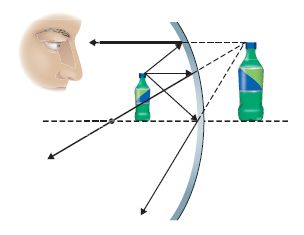

Two polarizing filters are set up so the transmitted light is at a maximum intensity.
Through which angle should polariser 2 be rotated so that no light is transmitted?
45º
60º
90º
180º
You see the reflection of the clock without numbers in your plane mirror. The image formed by the hands of the clock shows the time of 3:30. What is the real time?
3:30
8:30
9:30
10:30
What is the distance of your image from you if you stand 1.5 m in front of a plane mirror?
1.5 m
2.0 m
3.0 m
4.5 m

What shall be the position of image , if an object is place in-front of a concave mirror as shown ?
At C
between F & C
between F & P
at F
An object is kept 30cm away from the pole of a mirror. Its inverted image at the same position as that of object then it is
a concave mirror of focal length 15 cm
a convex mirror of focal length 15 cm
a plane mirror
a concave mirror of focal length 30 cm
An object of size 5 cm is kept 20cm away from a concave mirror of focal length 15 cm . Size of its image shall be
+ 5 cm
- 10 cm
- 15 cm
- 5 cm
At what distance an object is kept in front of a concave mirror of focal length 10 cm so as to obtain a real image twice as magnified as the object ?
5 cm
10 cm
15 cm
20 cm
What is an eclipse?
A collision between astronomical objects.
An astronomical event involving objects casting shadows on one another.
A rare alignment of planets.
The disappearance of a celestial body.
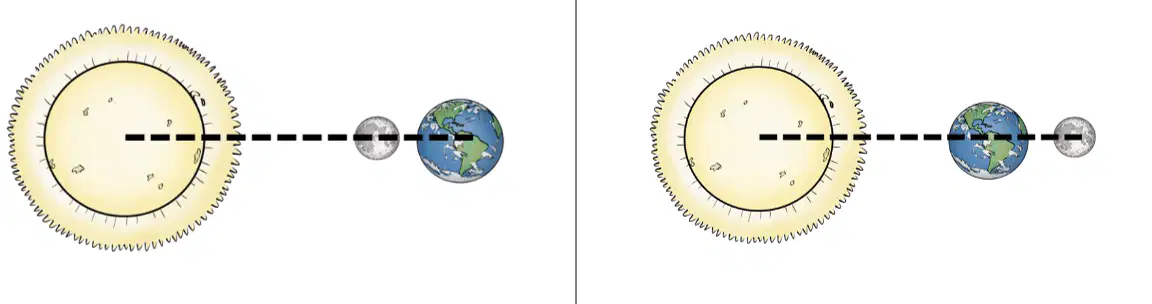
What happens during a solar eclipse?
The Earth casts a shadow on the moon.
The moon is in between the Earth and Sun.
The moon's light is dimmed/changes color.
The Sun's light is dimmed/disappears.
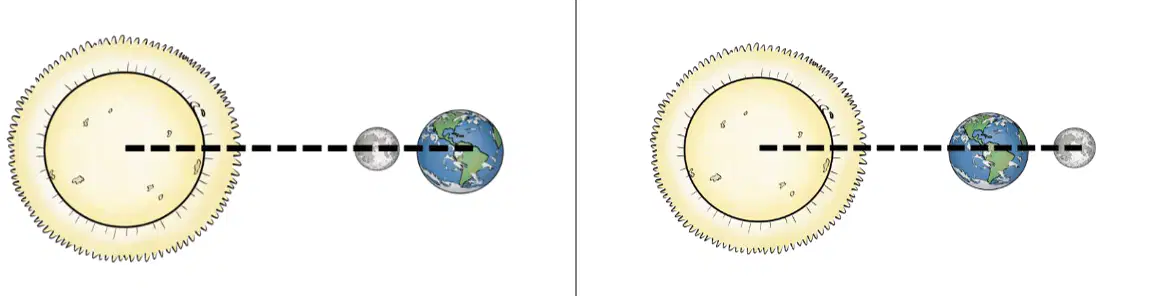
What occurs during a lunar eclipse?
The moon casts a shadow on the Earth.
The Earth is in between the moon and sun.
The Sun's light is dimmed/disappears.
The moon is in between the Earth and Sun.
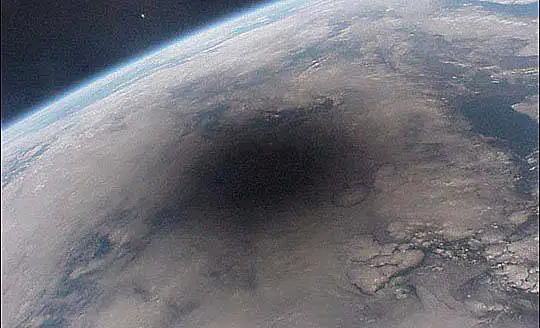
What occurs when the Moon casts a shadow on the Earth?
Lunar eclipse
Solar eclipse
Moon phase change
Earthquake


What is the difference between transverse and longitudinal waves?
Transverse waves move in a circular motion, while longitudinal waves move in a straight line.
Transverse waves move parallel to the direction of the wave, while longitudinal waves move perpendicular to the direction of the wave.
Transverse waves move at a faster speed than longitudinal waves.
Transverse waves move perpendicular to the direction of the wave, while longitudinal waves move parallel to the direction of the wave.
What is the amplitude of a wave?
The speed at which a wave travels through a medium
The number of complete cycles of a wave that pass a given point in a certain amount of time
The measure of the maximum disturbance in the medium from its undisturbed position
The distance between two consecutive crests or troughs of a wave
Explain the concept of wave interference.
Wave interference is the amplification of waves when they meet.
Wave interference is the process of creating a single wave from multiple waves.
Wave interference is the combination of two or more waves to form a new wave.
Wave interference is the cancellation of waves when they meet.
What are the properties of a wave?
Amplitude, wavelength, frequency, and speed
Taste, smell, sound, and texture
Temperature, pressure, density, and volume
Color, shape, size, and weight
How does the medium through which a wave travels affect its speed?
The medium's shape affects the speed of the wave.
The medium's properties such as density and elasticity affect the speed of the wave.
The medium's temperature affects the speed of the wave.
The medium's color affects the speed of the wave.
What is the principle of superposition in relation to waves?
The resulting wave is the average of the individual waves.
The resulting wave is the difference of the individual waves.
The resulting wave is the sum of the individual waves.
The principle of superposition only applies to sound waves.

What is the size of the resultant at C? / ¿Cuál es el tamaño de la resultante en C?
-2
-4
-6
6
What is the size of the resultant at D? / ¿Cuál es el tamaño de la resultante en D?
0
2
4
6
Which diagram best represents the shape and direction of a series of wave fronts after they have passed through a small opening in a barrier?
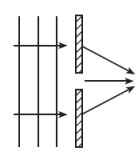
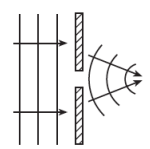
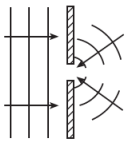
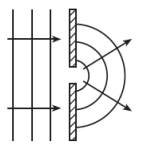

What type of inference is this picture showing
Constructive
Destructive

These waves display
Reflection
Complete destructive interference
Constructive interference

These waves display
Reflection
Constructive interference
Destructive interference

These waves display
Reflection
Constructive interference
Destructive interference
c = λν Calculate the wavelength of light that has a frequency of 5.2 x 10¹²/s. The speed of of light is 3.00 x 10⁸ m/s.
Size of image of an object by a mirror having a focal length of 20 cm is observed to be reduced to 1/3rd of its size. At what distance the object has been placed from the mirror? What is the nature of the image? (Assume that the image is formed behind the mirror.)
+ 40 cm from the mirror, real and inverted
- 40 cm from the mirror, virtual and erect
- 80 cm from the mirror, real and inverted
+ 80 cm from the mirror, virtual and erect
A virtual erect enlarged image is formed by a concave mirror of radius of curvature 30 cm. The object is placed at
13 cm
17 cm
21 cm
27 cm
All the options are correct
An object of size 4cm is place 15 cm in front of a concave mirror of focal length 10 cm. Find the position and magnification of the image
image is formed 30 cm in front of the mirror , m = -2
image is formed 30 cm in front of the mirror , m = -8cm
image is formed 30 cm behind the mirror , m = -2
image is formed 30 cm behind the mirror , m = -8cm
An object of 2cm height is placed 16cm in front of a concave mirror. If the height of the image formed on a screen is 3 cm find the focal length of the mirror
+9.6 cm
- 9.6 cm
- 24 cm
+24 cm
For an object placed 30 cm from the pole of a mirror a virtual image is formed 60 cm from the pole of the mirror. Find the focal length of the mirror
+ 60 cm
- 60 cm
- 30 cm
+30 cm

