
 Worksheets
Exam 3 BIO 124 Review
Total questions: 125
Worksheet time: 10hrs 25mins
The hypothesis of animal origins which states that animals are descended from an ancestor which resembled a hollow, spherical colony of flagellated cells is referred to as
the eucoelomate hypothesis.
the multinucleate hypothesis.
the cephalization hypothesis.
the colonial flagellate hypothesis.
the segmentation hypothesis.
From earliest to latest, which is the correct order of the significant innovations in the evolutionary tree of animals?
multicellular, true tissue germ layers, bilateral symmetry, body cavity, eucoelom, segmentation, jointed limbs
multicellular, body cavity, true tissue germ layers, bilateral symmetry, jointed limbs segmentation, eucoelom
body cavity, bilateral symmetry, true tissue germ layers, multicellular, eucoelom, jointed limbs segmentation
true tissue germ layers, multicellular, bilateral symmetry, eucoelom, body cavity, segmentation, jointed limbs
bilateral symmetry, true tissue germ layers, multicellular, body cavity, eucoelom, segmentation, jointed limbs
Animals which have definite right and left halves are said to have
trilateral symmetry.
bilateral symmetry.
radial symmetry.
asymmetry.
spherical symmetry.
A localization of a brain and specialized sensory organs in the anterior end of the animal's "head" is called
homology.
eucoelomate.
cephalization.
bilateral symmetry.
segmentation.
Which statement is least distinctive of the Cnidarians?
They live in salt and fresh water.
They have two body forms: polyp and medusa.
They capture their prey.
They have radial symmetry.
They have a digestive system.
If you were studying animals which have a body cavity completely lined with mesoderm such as molluscs and arthropods, you would be studying
deuterostomes.
pseudocoelomates.
acoelomates.
coelomates.
radial symmetry.
Organisms in which the mouth appears at or near the blastopore are referred to as
protostomes.
deuterostomes.
acoelomates.
pseudocoelomates.
coelomates.
If you were studying animals which have a mantle, visceral mass, and a foot, you would be studying
annelids.
chordates.
echinoderms.
arthropods.
molluscs.
Which statement is true of at least some arthropods other than arachnids?
They have three body parts.
Spiders and scorpions are examples of arachnids.
They have fours pairs of walking legs.
They have no antennae.
Some are parasitic and some are predators.
The major insect body parts are
head, thorax, and abdomen.
cephalothorax and abdomen.
cephalothorax, midsection, and abdomen.
head, pyothorax, and metathorax.
head, cephalothorax, and abdomen.
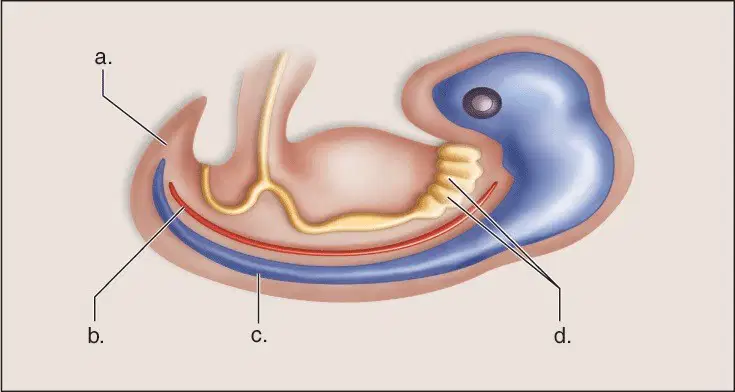
This figure shows the four chordate characteristics. What does "a" represent?
pharyngeal pouches
dorsal tubular nerve cord
vertebral column
notochord
postanal tail
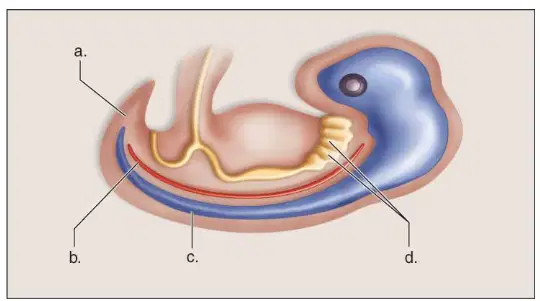
This figure shows the four chordate characteristics. What does "b" represent?
postanal tail
dorsal tubular nerve cord
vertebral column
notochord
pharyngeal pouches

This figure shows the four chordate characteristics. What does "d" represent?
postanal tail
notochord
dorsal tubular nerve cord
vertebral column
pharyngeal pouches
Tetrapods evolved from which of the following groups?
amphibians
ray-finned fishes
jawless fishes
lobe-finned fishes
cartilaginous fishes
Which animal would be excluded from a study of reptiles?
crocodiles
lizards
snakes
frogs
turtles
The amphibians' unique contribution to the evolution of land vertebrates was
the development of the tail for propulsion.
the leathery waterproof egg shell.
the ability to move onto land.
respiration by gills.
respiration through the skin.
Animals which get their heat from the outside environment are referred to as:
Endothermic
Integuthermic
Ectothermic
Adipothermic
Homeothermic
In order for organisms to maintain homeostasis by reversing a change that has occurred they will use:
Neutral feedback
Positive feedback
A control center to detect the change in the environment.
Almost no energy
Negative feedback
Which of the following tissue type forms the external lining of organs?
Cardiovascular
Epithelial
Skeletal
Nervous
Connective
The kidneys are at what level of biological organization?
Organism
Organ system
Organ
Cellular
Tissue
If you were studying several organs working together to perform a particular function, you would be studying:
A cell system
A metabolic system
An organ system
A tissue system
An organism system
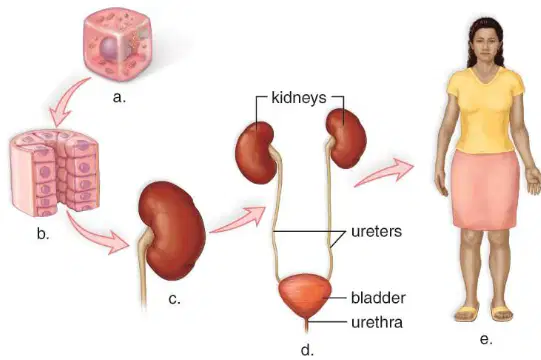
This figure shows the levels of biological organization. What does "b" represent?
An organ system
A cell
An organ
A tissue
An organism
This figure shows the levels of biological organization. What does "e" represent?
An organ system
A cell
An organ
A tissue
An organism
If you were a biologist studying connective tissue, which of the following types of tissue would you not be interested in studying?
Adipose
Cuboidal
Cartilage
Bone
Blood
Muscles are connected to bones by:
Epithelial tissue
A basement membrane
Ligaments
Tendons
Nerve tissue
Which of the following would be considered a type of loose connective tissue?
Cartilage
Adipose
Tendons
Ligaments
Bone
Which type of muscle is unstriated and involuntary?
Skeletal
Cartilage
Intercalated
Cardiac
Smooth
Which is the extension of a neuron that conducts signals toward the cell body?
Myelin
Nucleus
Axon
Dendrite
Intercalated disk
The system which is responsible for collecting extra fluid from the tissues and returning it to the cardiovascular system is the:
Reproductive system
Urinary system
Respiratory system
Lymphatic system
Digestive system
Which of the following is an example of homeostasis?
There is more red blood cells than white blood cells
Muscular tissue that is specialized to contract
An organism is limited in how high it can jump
The human body temperature is always maintained close to 37° C (98.6° F)
Tendons connect muscle to bone
Which of the following is not associated with a bulk feeder?
Biting off chunks of food
Swallowing prey whole
Human feeding strategy
Sifting small particles out of water
Eating discontinuously
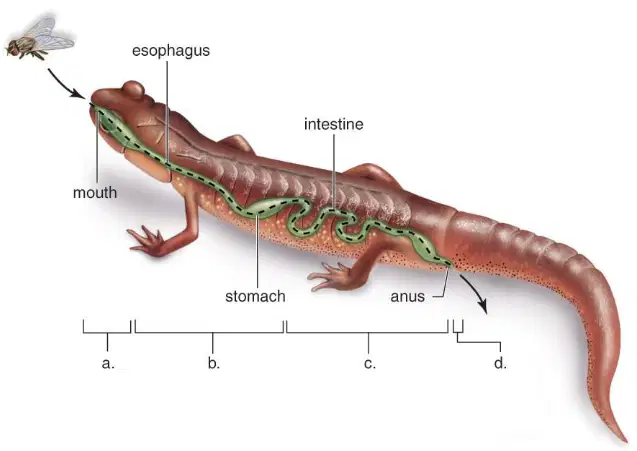
This figure shows the phases of digestion. What does "A" represent?
Elimination
Absorption
Defecation
Ingestion
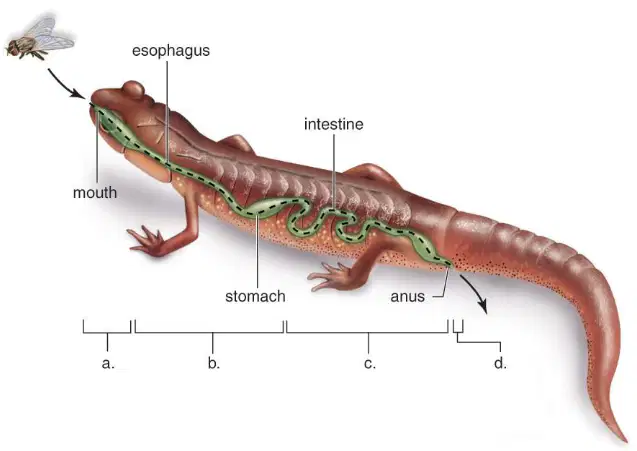
This figure shows the phases of digestion. What does "C" represent?
Absorption
Ingestion
Defecation
Elimination
Digestion
Organisms which are parasites are described as ________ feeders.
Suspension
Bulk
Substrate
Filter
Fluid
If you were examining an organism that has a gizzard which serves as an area for mechanical digestion of food you would be studying which of the following?
A bird
A rabbit
A cow
A flatworm
A fox
The main function of the esophagus is to:
Transport food from the mouth to the stomach
Transport food from the small intestine to the large intestine
Digest carbohydrates
Transport food from the stomach to the small intestine
Muscles that encircle tubes and act as valves are called:
Dilators
Sphincters
Lacteals
Constrictors
Mucosa
What substance protects the stomach lining from the acidic nature of the HCl acid in the stomach?
Antacids
Bacteria
Pepsinogen
Pepsin
Mucus
The main function of bile is:
To kill bacteria
Helps break down starch
Emulsify fats
Neutralize stomach acid
Aids in the absorption of glucose
Name the structure and organ that has microvilli and absorbs nutrients:
Folds, large intestine
Villus, large intestine
Villus, stomach
Folds, stomach
Villus, small intestine
If you were studying the molecules where most of the cells get their energy from, you would be studying which of the following?
Sugars and starches
Fats
Nucleic acids
Minerals and vitamins
Proteins
Water is absorbed primarily by the:
Colon
Stomach
Esophagus
Anal canal
Duodenum
What physical process must take place in order for gas exchange to occur during respiration?
Fermentation
Diffusion
Cellular respiration
Osmosis
None of these are necessary in order for gas exchange to take place.
The gas exchange between air and the blood within the lungs is referred to as:
Pulmonary respiration
External respiration
Ventilation
Cellular respiration
Internal respiration
If you were studying the gas exchange between blood and the tissue fluid you would be studying which of the following?
Internal respiration
Ventilation
External respiration
Cellular respiration
Pulmonary respiration
Which feature is not necessary in order for external respiration to be effective?
A large surface area in relation to the body size.
A moist surface area.
A surface area that is external to the body.
A thin surface area.
A surface area that is vascular.
Ventilation in insects involves _______ that can expand to draw air inside the animal.
Gills
Air sacs
Tracheoles
Lungs
Tracheae
A biologist is counting the small holes on an insect's body which allow air to enter its respiratory system. Based on this information you would conclude that he or she is counting which of the following?
Spiracles
Tracheae
Tracheoles
Alveoli
Air sacs
Trace the path of inhaled air molecules.
Nasal cavity, pharynx, glottis, larynx, trachea, bronchioles, bronchi, alveoli
Nasal cavity, glottis, larynx, trachea, pharynx, bronchi, bronchioles, alveoli
Nasal cavity, pharynx, larynx, glottis, trachea, bronchi, bronchioles, alveoli
Nasal cavity, pharynx, glottis, trachea, larynx, bronchi, bronchioles, alveoli
Nasal cavity, pharynx, glottis, larynx, trachea, bronchi, bronchioles, alveoli
When we eat dinner, what structure prevents food from entering the respiratory system instead of the digestive system?
Epiglottis
Alveoli
Glottis
Larynx
Pharynx
A biologist is studying organisms that have a one-way ventilation mechanism. Based on this information you would conclude that he or she is studying:
Amphibians
Mammals
Reptiles
Birds
Earthworms
Expired air will contain ________ than inspired air.
Less oxygen and less carbon dioxide
More oxygen but less carbon dioxide
More oxygen and more carbon dioxide
The same amount of oxygen and carbon dioxide
Less oxygen but more carbon dioxide
During countercurrent flow which direction does water and the blood flow?
Water flows out of the gills while blood flows in the opposite direction
Water flows across the surface of the lungs while blood flows in the opposite direction
Water flows in through the gills while blood flows in the opposite direction
Water flows inward across the gills while blood flows in the same direction
Water flows out of the gills while blood flows in the same direction
The production of which waste product requires the greatest amount of energy?
Urea
Ammonia
Urea and ammonia are equal
Urea, ammonia, and uric acid all require the same amount of energy.
Uric acid
Which metabolic waste requires the greatest amount of water to excrete?
Uric acid, urea, and ammonia all require the same amount of water to excrete.
Uric acid, urea, and ammonia do not require any water to excrete.
Ammonia
Urea
Uric acid
If you were studying organisms which have flame cells you would be studying which of the following?
Planarians
Insects
Sharks
Earthworms
Fish
The functional unit of excretion found in the kidneys is the:
Alveoli
Glomerulus
Microvilli
Bowman capsule
Nephron
The hormone which is responsible for the reabsorption of water is:
Angiotensin I
Antidiuretic hormone
Angiotensin II
Aldosterone
Renin
Which hormone from the adrenal cortex will cause the distal convoluted tubules to reabsorb more sodium ions?
Aldosterone
Angiotensin II
Renin
Antidiuretic hormone
Angiosinogen
Which body system coordinates activities of body parts by releasing hormones into the blood?
The circulatory system
The nervous system
The respiratory system
The endocrine system
The digestive system
Which of the following is not true about hormones?
Hormones are secreted into the bloodstream
Hormones have a slower effect than that mediated by the nervous system
Hormones bind to receptor sites at a target cell
Hormones are made by glands that have ducts
Hormones may be used at a far distance from where the hormone is made
If you were studying hormones which never enter the cell and are commonly called the first messengers, you would be studying which of the following?
Steroid hormones
Peptide hormones
DNA hormones
RNA hormones
Lipid hormones
A biologist is studying hormones which enter the cell or nucleus where they bind to receptors. Based on this information you would conclude that he or she is studying which of the following?
RNA hormones
DNA hormones
Steroid hormones
Lipid hormones
Peptide hormones
Which two body systems will growth hormone have the biggest influence on?
Skeletal and muscular
Endocrine and digestive
Muscle and reproductive
Skeletal and nervous
Muscular and reproductive
A woman is considered pregnant when:
The developing embryo implants itself in the endometrial lining
The fertilized egg implants in the ovary
The sperm and egg combine
Sperm are in the vagina
Sperm are in the uterus
The ________ develops into the fetal portion of the placenta.
Archenteron
Allantois
Yolk sac
Chorion
Amnion
During development, which of the following describes the correct sequence?
Growth, morphogenesis, differentiation
Morphogenesis, differentiation, growth
Differentiation, growth, morphogenesis
Differentiation, morphogenesis, growth
Growth, differentiation, morphogenesis
Which of the following is the correct order of cellular development?
Blastula - gastrula - zygote - morula
Gastrula - zygote - morula - blastula
Zygote - morula - blastula - gastrula
Morula - blastula - gastrula - zygote
Zygote - morula - gastrula - blastula
Which hormone stimulates and maintains the secondary sexual characteristics in males at puberty?
GnRH
Estrogen
LH
Testosterone
FSH
Which issue do organisms who reproduce on land have to deal with that organisms who reproduce in water do not?
Difficulty in finding a mate
Predators that will eat the young
The egg can dry out
Finding enough food for the offspring to survive
Finding suitable habitat for reproduction
Which structure is not found among animals that reproduce on land?
Penis
Extra embryonic membranes
Egg shell
Yolk
All of theses can be found in animals that reproduce on land
Which of the following consist of a hollow ball of cells
Embryo
Morula
Blastula
Animal with a mouth that does NOT develop from the opening in the gastrula.
deuterostome
protostome
insect
snail
Fertilization that takes place inside the female organism's body is ___________.
internal fertilization
gestation period
external fertilization
asexual reproduction
What is one benefit of having an amniotic egg?
Their egg does not require oxygen
their can have external fertilization
their eggs are protected by jacobson's organs
they do not have to return to the water to reproduce
Which of the following definitions do not match the system next to it?
Endocrine System — The bodily system that consists of the endocrine glands and the hormones that they secrete.
Lymphatic System - Immune Response
Muscular System - The framework of the body.
Nervous System - the system of nerves and nerve centers in an animal or human, including the brain, spinal cord, nerves, and ganglia.
Select all of the organs associated with the Urinary System
Kidneys
Urethra
Uterus
Uterine Tube
Ureter
Which of the following is an example of negative feedback?
After a meal, blood sugar levels in the body rise; insulin is secreted to lower blood sugar levels.
The onset of contractions during childbirth stimulates the release of a hormone that stimulates further contractions.
A person who loses 3 pounds continues to diet to lose an additional 10 pounds
The arrival of platelets at a wound site stimulates the recruitment of more platelets to form a clot.
The giant squid is a large, very active invertebrate. What type of circulatory system do you think it has?
closed circulatory system
no circulatory system
open circulatory system
water vascular system
In a frog, the structure through which digestive wastes, urine, and reproductive cells leave the body is called the
anus
colon
cloaca
coelom
Cardiac muscle is considered a:
Nonstriated involuntary muscle
Striated involuntary muscle
Nonstriated voluntary muscle
Striated voluntary muscle
Smooth muscles can be found in the:
Heart
Stomach
Pelvic limb
Diaphragm
The hormone produced by a developing ovarian follicle is:
Estrogen
Progesterone
Prolactin
Oxytocin
Efferent neurons are part of what system?
Motor
Interneuron
Sensory
Extraneuron
Afferent neurons are part of what system?
Motor
Interneuron
Sensory
Extraneuron
The function of the red blood cell is to:
Provide defense from foreign invaders
Act as a phagocyte
Carry oxygen to the tissues
Respond to the need for clotting
Which structure connects the Brain to the Peripheral Nervous System, while also directing some of the body's reflexes?
Spinal Cord
Esophagus
Pharynx
Larynx
Trachea
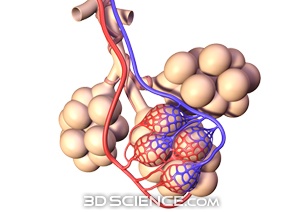
In order to breathe in, pressure must __ in the thoracic cavity.
increase
decrease
stay the same
Which of the following is NOT a function of saliva?
lubrication of food
initial digestion of carbohydrates
lubrication of the mouth
initial digestion of proteins
Gastric juices in the stomach:
kill bacteria.
work together to digest food.
include hydrochloric acid.
All of the above.
What function does the basement membrane serve?
provide blood to the epithelial tissue
hold cartilage to bone
anchor epithelial tissues to underlying connective tissue
secretes the matrix.

What is another name for the hypodermis, which is the deepest layer of the skin?
epidermis
subcutaneous layer
stratum basale
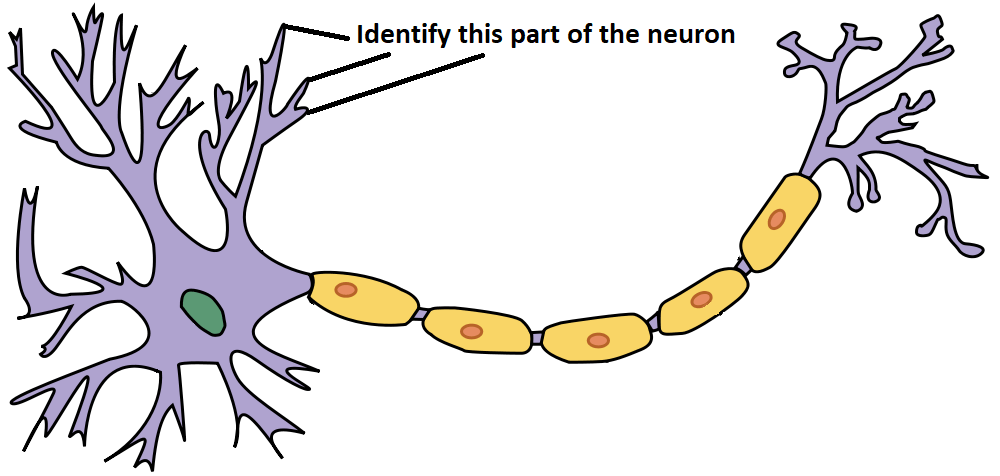
Dendrites
Axon Terminals
Myelin Sheath
Schwann Cells
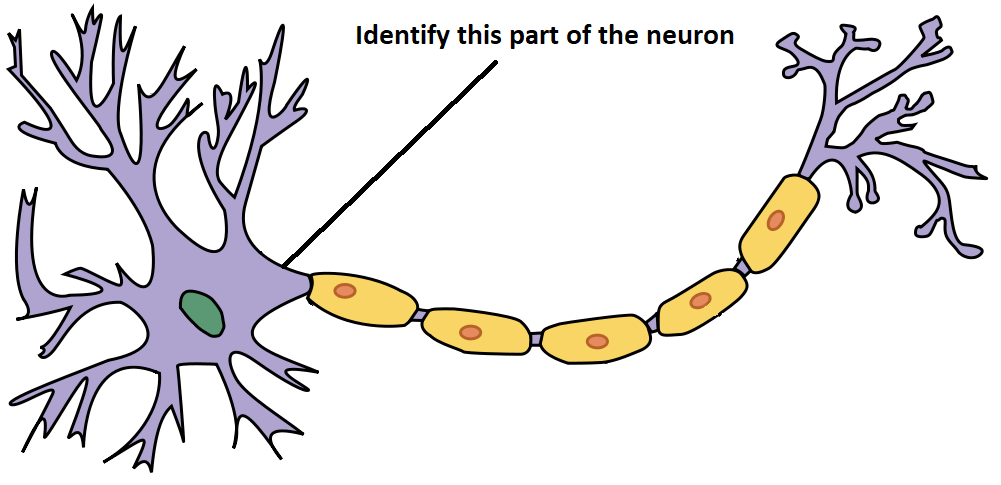
Nucleus
Cell Body
Axon
Node of Ranvier

What is an endothermic animal?
an animal that has the ability to maintain their own body temperature
animals that have the ability to produce milk and give birth to live young
animals that have gills to breathe
animals that exhibit a notochord
Which system can be defined as all forms of tissue in the body that can contract to perform movement or similar functions?
muscular
integumentary
respiratory
skeletal
Which of the following is the liquid in the circulatory system?
blood
water
saliva
sweat
If an individual’s blood analysis reveals a higher number of white cells then what could this indicate?
The liver is overacting
The body is in normal condition
The body is fighting an infection
The body requires an additional amount of iron
How do the circulatory and excretory systems work together?
The circulatory system brings nutrients and oxygen so our cells can produce energy.
The circulatory system brings blood to the kidneys to filter and remove waste.
The circulatory system bring white blood cells around the body to fight infection and disease.
The circulatory system helps the excretory system digest food.

Match the body systems with their functions
Brings oxygen to the body and moves carbon dioxide out of the body
Respiratory system
Produces hormones that help regulate the other systems of the body
Endocrine system
Filters the blood and eliminates waste from the body
Excretory system
Helps the body control and communicate
Nervous system

Match the body systems with their functions
Supports the body, protects the organs
Skeletal system
Responsible for movement
Muscular System
Delivers oxygen and nutrients throughout the body.
Cardiovascular System
Changes food into nutrients and energy for the body
Digestive System
What is the main product of the endocrine system?
Bones
Blood
White blood cells
Hormones

What type of feedback loop is represented here?
Positive
Negative
Give an example of an animal with radial symmetry.
jellyfish
butterfly
elephant
starfish
Name the three germ layers in tissue organization.
ectoderm, mesoderm, and endoderm
epidermis, dermis, and hypodermis
protoplasm, cytoplasm, and nucleoplasm
epithelium, connective tissue, and muscle tissue
Explain the role of germ layers in tissue organization.
Germ layers only give rise to organs, not tissues.
Germ layers have no role in tissue organization.
Tissue organization is not influenced by germ layers.
Germ layers play a crucial role in tissue organization by giving rise to different types of tissues and organs in the body.
Type of circulation that refers to blood flow from the heart to the lungs and back to the heart again?
Systemic circulation
Renal circulation
Portal circulation
Pulmonary circulation
Type of circulation that refers to the blood flowing through the entire body?
Systemic circulation
Renal circulation
Portal circulation
Pulmonary circulation
The type of blood vessel where exchange of gases, nutrients, and wastes occurs?
arteries
capillaries
veins
What is meant by an OPEN CIRCULATORY SYSTEM?
Does not have blood vessel
Have blood vessels
Contain haemolymph
Contain blood

As organisms get more complex, cells become specialized to perform specific functions in the body. What is the function for the cell shown?
contract and shorten movement
provide coverage and protection
carry impulses around the body
connects parts together

