
Font size
 Worksheets
Exam 3 Pt 1 Viruses
Total questions: 78
Worksheet time: 39mins
A virus can be differentiated from a bacterium by which of the following characteristics?
Viruses are not living cells, while bacteria are living cells.
Viruses can reproduce on their own, while bacteria cannot.
Bacteria are smaller than viruses.
Viruses have a cell wall, while bacteria do not.
The chemical and physical structure of both an enveloped and a nonenveloped virus can be described as:
Enveloped viruses have a lipid membrane surrounding their capsid, while nonenveloped viruses lack this membrane and only have a protein capsid.
Both enveloped and nonenveloped viruses have a lipid membrane and a protein capsid.
Nonenveloped viruses have a lipid membrane, while enveloped viruses do not.
Enveloped viruses lack both a lipid membrane and a protein capsid, while nonenveloped viruses have both.
A viral species is defined as:
A group of viruses sharing the same genetic information and ecological niche.
A group of bacteria with similar characteristics.
A collection of cells that perform the same function.
A type of protein found in viruses.
Select the correct example of a virus with its family, genus, and common name.
Family: Orthomyxoviridae, Genus: Influenzavirus, Common name: Influenza virus
Family: Herpesviridae, Genus: Lentivirus, Common name: Rabies virus
Family: Flaviviridae, Genus: Enterovirus, Common name: Measles virus
Family: Retroviridae, Genus: Morbillivirus, Common name: Dengue virus
Bacteriophages are cultured by which of the following methods?
Using a bacterial lawn and observing plaque formation
Growing them in nutrient broth without bacteria
Culturing them on agar plates without any host
Using animal cell cultures only
Animal viruses are cultured by which of the following methods?
Using living animals, embryonated eggs, or cell cultures
Growing on nutrient agar plates
Culturing in anaerobic chambers
Using only plant tissues
The lytic cycle of T-even bacteriophages involves which of the following processes?
Attachment, penetration, synthesis, assembly, and release of new phages
Integration of viral DNA into host genome
Formation of a provirus
Replication without destroying the host cell
The lysogenic cycle of bacteriophage lambda involves which of the following processes?
Integration of phage DNA into the host genome
Immediate lysis of the host cell
Production of antibodies by the host
Direct translation of phage proteins upon entry
The multiplication cycle of DNA- and RNA-containing animal viruses differs primarily in which aspect?
The site of genome replication within the host cell
The type of host cell infected
The presence of a protein coat
The ability to infect plant cells
The relationship between DNA- and RNA-containing viruses and cancer is best described as:
Both DNA- and RNA-containing viruses can contribute to the development of cancer.
Only DNA-containing viruses are associated with cancer.
Only RNA-containing viruses are associated with cancer.
Neither DNA- nor RNA-containing viruses are linked to cancer.
Persistent viral infections are different from latent viral infections in that:
persistent infections involve continuous viral replication, while latent infections involve periods of dormancy with no viral production
persistent infections involve periods of dormancy, while latent infections involve continuous viral replication
both persistent and latent infections involve continuous viral replication
both persistent and latent infections involve no viral replication
Differentiate between virus, viroid, and prion.
Virus contains nucleic acid and protein coat, viroid contains only RNA, prion contains only protein.
Virus contains only protein, viroid contains nucleic acid and protein coat, prion contains only RNA.
Virus contains only RNA, viroid contains protein coat, prion contains nucleic acid and protein coat.
Virus contains only DNA, viroid contains only protein, prion contains RNA and protein coat.
A protein can be infectious. Discuss how this is possible.
By acting as a prion and inducing abnormal folding in other proteins
By directly replicating its genetic material like a virus
By producing toxins that kill host cells
By integrating into the host DNA and causing mutations
Which statement most accurately describes viral replication?
Viruses can reproduce only under certain environmental conditions
Viruses reproduce asexually
Viruses reproduce rapidly in the environment
Viruses are dependent upon host cell replication machinery
Which of the following causes most of the diseases that plague the industrialized world?
Bacteria
Fungi
Viruses
Protozoa
Viruses are minuscule, acellular, infectious agents that have one or several pieces of either ______ or ______.
DNA or RNA
Protein or Lipid
Glucose or Fructose
Cellulose or Starch
Obligatory intracellular parasites require living host cells to multiply.
True
False
Do viruses have a cytoplasmic membrane, cytosol, or organelles?
No
Yes, they have all three
Only cytosol
Only organelles
Viruses cannot reproduce independently.
True
False
In the extracellular state, the virus is called a ______.
virion
capsid
prion
bacteriophage
What is the protein coat surrounding the nucleic acid of a virus called?
Capsid
Envelope
Plasmid
Peptidoglycan
In the intracellular state, what happens to the capsid?
Capsid is removed
Capsid is strengthened
Capsid is duplicated
Capsid is enlarged
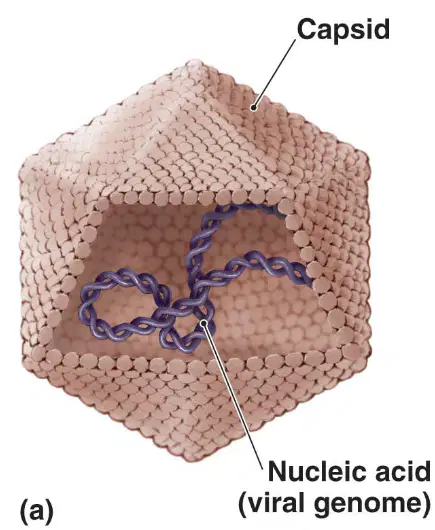
Label the parts of the virus shown in the diagram: (a) ______, (b) ______.
(a) Capsid, (b) Nucleic acid (viral genome)
(a) Envelope, (b) Tail fiber
(a) Nucleic acid (viral genome), (b) Capsid
(a) Tail fiber, (b) Envelope
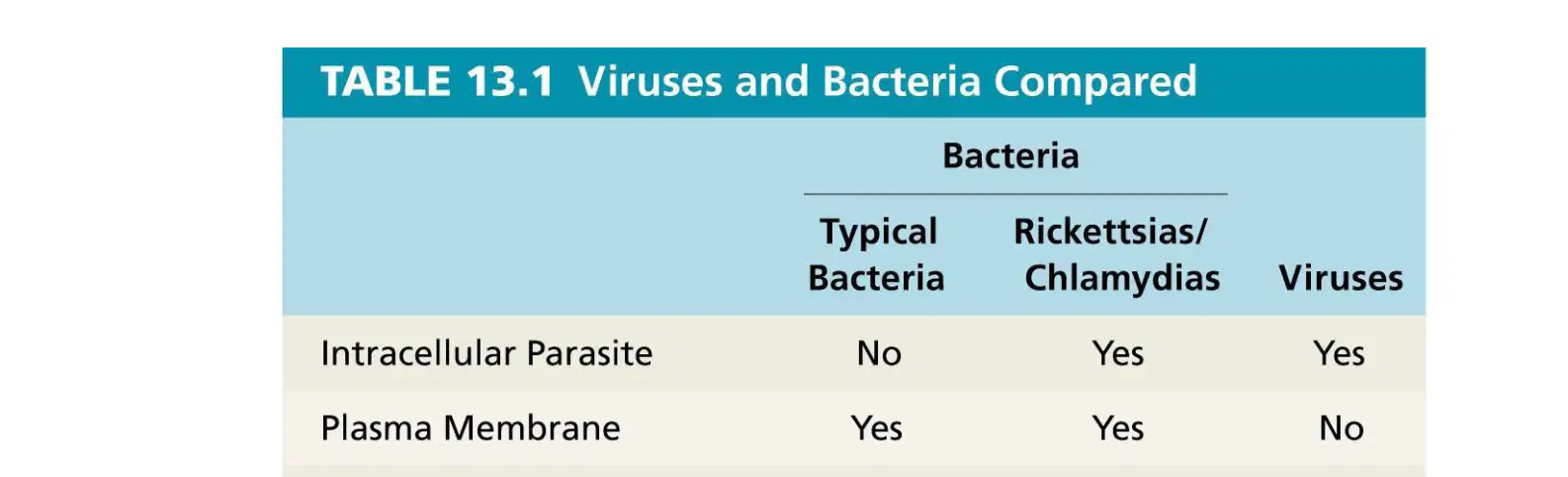
According to TABLE 13.1 Viruses and Bacteria Compared, which of the following are intracellular parasites?
Typical Bacteria
Rickettsias/Chlamydias
Viruses
Both B and C

According to TABLE 13.1 Viruses and Bacteria Compared, which of the following possess a plasma membrane?
Typical Bacteria
Rickettsias/Chlamydias
Viruses
Both A and B
According to TABLE 13.1 Viruses and Bacteria Compared, which of the following reproduce by binary fission?
Typical Bacteria
Rickettsias/Chlamydias
Viruses
Both A and B
According to TABLE 13.1 Viruses and Bacteria Compared, which of the following can pass through bacteriological filters?
Typical Bacteria
Rickettsias/Chlamydias
Viruses
Both B and C
According to TABLE 13.1 Viruses and Bacteria Compared, which of the following possess both DNA and RNA?
Typical Bacteria
Rickettsias/Chlamydias
Viruses
Both A and B
According to TABLE 13.1 Viruses and Bacteria Compared, which of the following have ATP-generating metabolism?
Typical Bacteria
Rickettsias/Chlamydias
Viruses
Both A and B
According to TABLE 13.1 Viruses and Bacteria Compared, which of the following have ribosomes?
Typical Bacteria
Rickettsias/Chlamydias
Viruses
Both A and B
According to TABLE 13.1 Viruses and Bacteria Compared, which of the following are sensitive to antibiotics?
Typical Bacteria
Rickettsias/Chlamydias
Viruses
Both A and B
According to TABLE 13.1 Viruses and Bacteria Compared, which of the following are sensitive to interferon?
Typical Bacteria
Rickettsias/Chlamydias
Viruses
Both A and B
Virus classification is based on which of the following criteria?
Nucleic acid
Presence of an envelope
Shape
Size
All of the above
Fill in the blank: Naked viruses are composed of ________ and ________.
nucleic acid, capsid
lipid, protein
RNA, envelope
DNA, carbohydrate
Fill in the blank: Enveloped viruses are composed of nucleic acid, capsid, and ________.
phospholipid layer
glycogen sheath
peptidoglycan wall
cellulose membrane
Fill in the blank: Bacteriophages are complex bacteria cell viruses composed of nucleic acid and ________.
protein head & tail fibers
lipid envelope
cell wall
ribosomal RNA

Identify the type of virus shown in the diagram labeled 'Naked virus: nucleic acid and protein coat'.
Naked virus
Enveloped virus
Bacteriophage
Retrovirus

Identify the type of virus shown in the diagram labeled 'Enveloped virus: nucleic acid, capsid, & lipid bilayer'.
Enveloped virus
Non-enveloped virus
Bacteriophage
Retrovirus
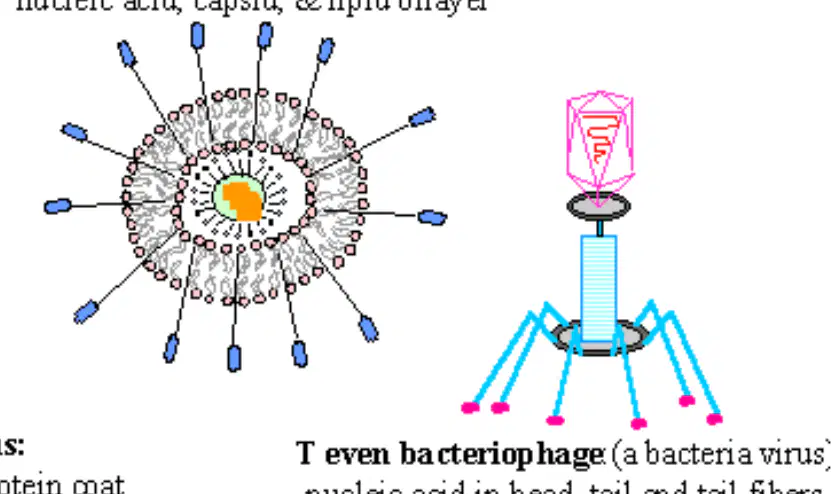
Identify the type of virus shown in the diagram labeled 'T even bacteriophage'.
Bacteriophage
Retrovirus
Adenovirus
Herpesvirus
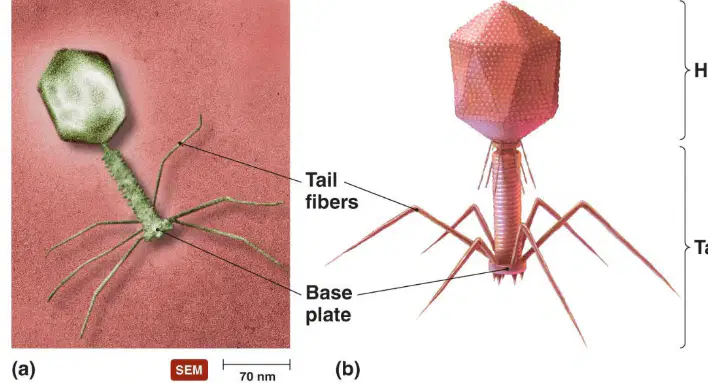
Refer to the diagrams of bacteriophages. Which part of the T4 bacteriophage is responsible for attaching to the bacterial surface?
Head
Tail fibers
Base plate
Tail
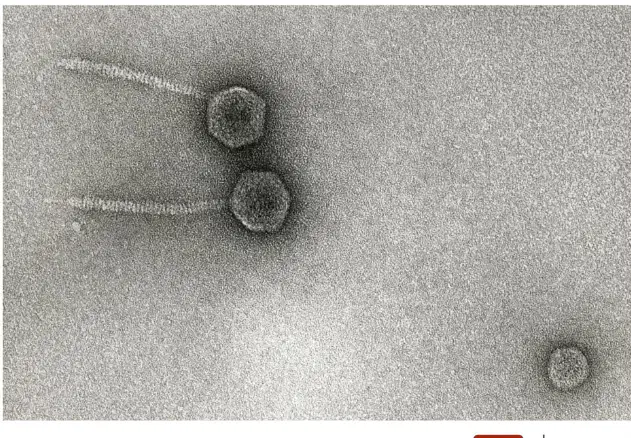
Based on the images, which bacteriophage lacks tail fibers?
T4 bacteriophage
Bacteriophage lambda
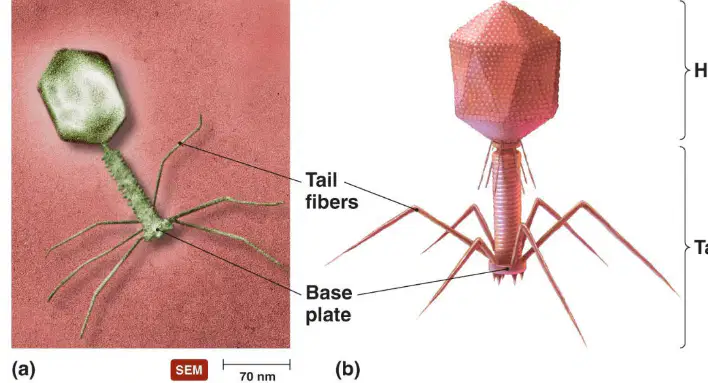
Fill in the blank: The T4 bacteriophage has a distinct _______ and _______ structure, while the bacteriophage lambda lacks _______.
head, tail, tail fibers
capsid, envelope, DNA
core, sheath, RNA
spike, matrix, lipid
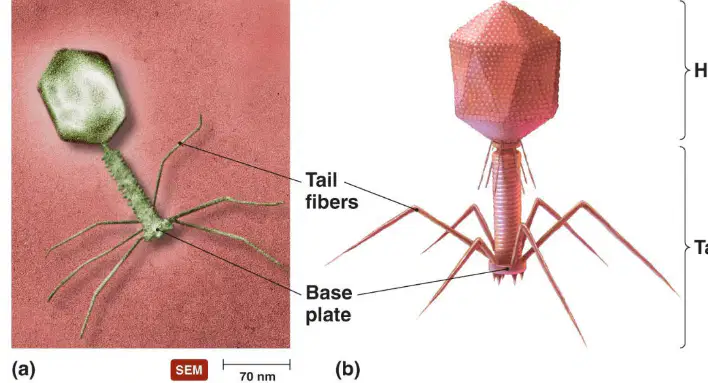
Which of the following is NOT a labeled part of the T4 bacteriophage in the diagram?
Head
Tail
Tail fibers
Capsid
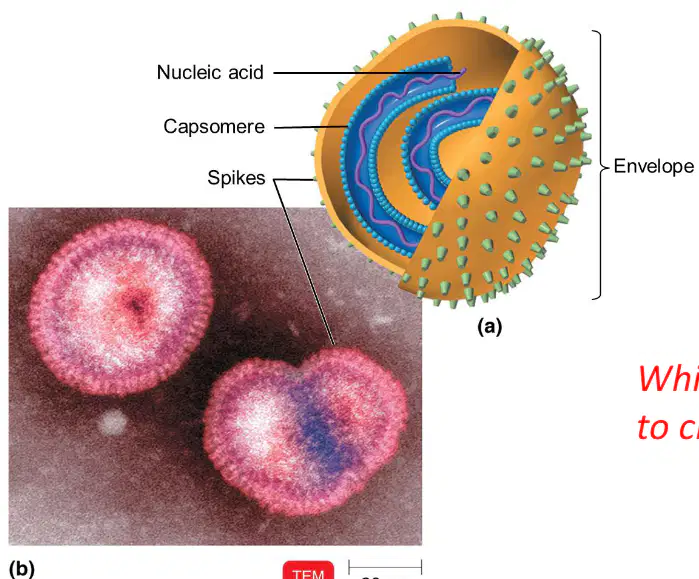
Which is more sensitive to chemical control?
Enveloped Virus
Nonenveloped (Naked) Virus
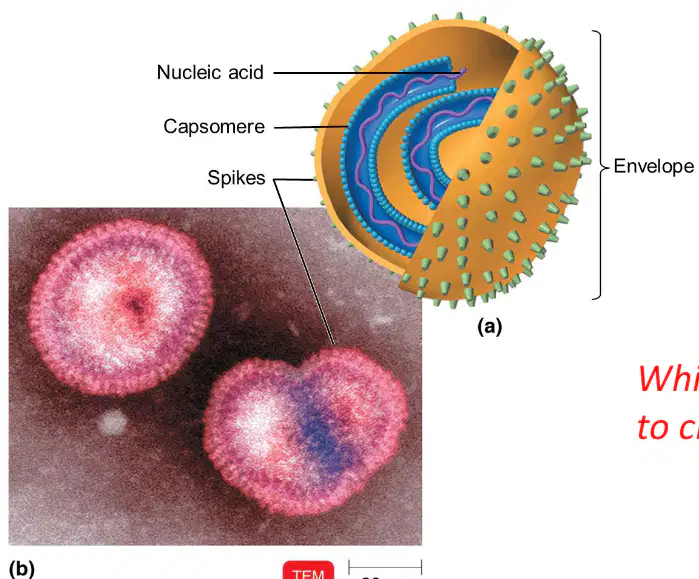
What surrounds the capsid in an enveloped virus?
A lipid layer (envelope) obtained from budding surrounds the capsid in an enveloped virus.
A protein shell surrounds the capsid in an enveloped virus.
A carbohydrate coat surrounds the capsid in an enveloped virus.
A nucleic acid strand surrounds the capsid in an enveloped virus.
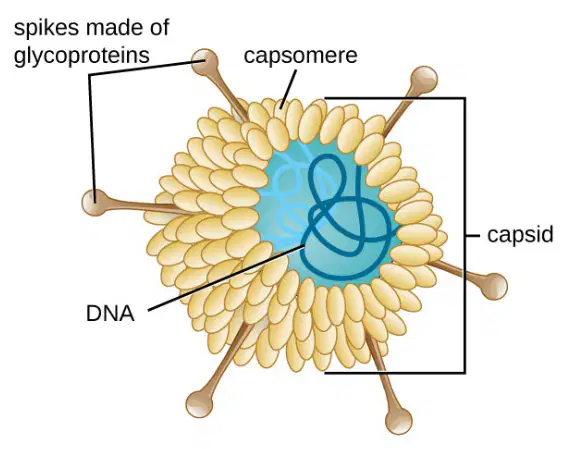
What are the main components of a nonenveloped (naked) virus?
Capsid and nucleic acid only
Envelope and nucleic acid
Capsid, envelope, and nucleic acid
Envelope and capsid only
Which of the following is NOT a component of an enveloped virus?
Lipid layer
Capsid
Nucleic acid
Glycoprotein spikes
Cell wall
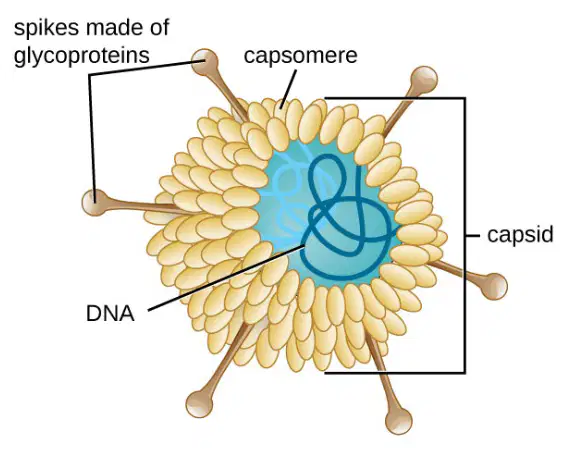
Fill in the blank: The spikes on a nonenveloped (naked) virus are made of ________.
glycoproteins
lipids
nucleic acids
phospholipids
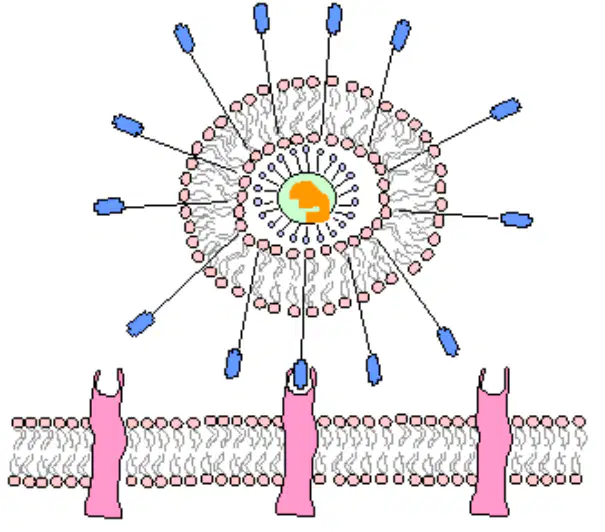
Where is the viral envelope acquired from during viral replication or release?
The viral envelope is acquired from the host cell during viral replication or release.
The viral envelope is synthesized de novo by viral enzymes.
The viral envelope is acquired from the extracellular matrix.
The viral envelope is formed from viral capsid proteins.
What is the viral envelope composed of?
The viral envelope is composed of a phospholipid bilayer and proteins.
The viral envelope is composed of nucleic acids and carbohydrates.
The viral envelope is composed of only proteins and DNA.
The viral envelope is composed of cellulose and lipids.
The spikes on the viral envelope are made of which type of molecules?
The spikes are virally coded glycoproteins.
The spikes are made of phospholipids.
The spikes are composed of nucleic acids.
The spikes are made of polysaccharides.
The Viral Envelope: Proteins and glycoproteins in the viral envelope often play a role in what process?
Proteins and glycoproteins often play a role in host recognition.
Proteins and glycoproteins often play a role in viral DNA replication.
Proteins and glycoproteins often play a role in energy production.
Proteins and glycoproteins often play a role in cell wall synthesis.
The envelope of a virus is a portion of the membrane system of the host.
True
False
What is the main function of capsids in viruses?
Provide energy for the virus
Provide protection for viral nucleic acid and means of attachment to host's cells
Help viruses reproduce
Destroy host cells
Capsid is composed of proteinaceous subunits called ________.
capsomeres
ribosomes
nucleosomes
peptones
Which type of virus has a hollow, cylindrical capsid?
Polyhedral virus
Helical virus
Complex virus
Icosahedral virus
Polyhedral viruses are also known as:
Many-sided viruses
Hollow viruses
Complicated structure viruses
Single type capsomere viruses
What is the primary way scientists categorize and classify viruses?
By their shape
By their genetic material (DNA or RNA)
By their size
By their host
Viruses may have which of the following types of genetic material?
dsDNA
ssDNA
dsRNA
ssRNA
Fill in the blank: The genome of viruses may be linear and composed of several segments or ______ & circular.
single
double
fragmented
branched
True or False: A virus can have both DNA and RNA as its genetic material at the same time.
True
False
What is the reason most viruses infect only specific types of cells in one host?
Due to the size of the virus
Due to affinity of viral surface proteins or glycoproteins for receptor on host cell surface
Due to the temperature of the host
Due to the color of the host cell
Fill in the blank: Viruses that infect bacteria are called _________.
Bacteriophages
Plasmids
Viroids
Prions
Generalists are viruses that infect many kinds of cells in many different hosts.
True
False
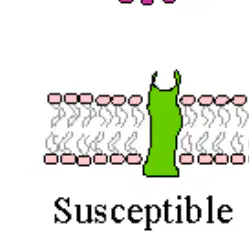
What is the viral target based on, according to the diagram?
Host cell size
Host cell recognition of viral glycoproteins (spikes)
Host cell temperature
Host cell color
Virus classification is based on which of the following criteria?
Type of nucleic acid
Presence of an envelope
Shape
Size
All of the above
Fill in the blank: The clinical feature associated with Simplexvirus is ________.
Cold sores, genital herpes, sexually transmitted disease
Chickenpox, shingles, respiratory infection
Measles, Koplik spots, subacute sclerosing panencephalitis
Mumps, parotitis, orchitis
Fill in the blank: The genome type of Papillomavirus is ________.
dsDNA, naked
ssRNA, enveloped
dsRNA, naked
ssDNA, enveloped
Fill in the blank: The clinical feature of Reovirus is ________.
Gastroenteritis severe diarrhea (stomach flu)
Rash with Koplik spots
Parotitis and orchitis
Hemorrhagic fever
The clinical feature of Adeno-associated dependoparvovirus A is ________.
Respiratory tract infection
Gastrointestinal bleeding
Skin rash
Joint pain
What enzyme do RNA viruses use to multiply in the host cell's cytoplasm?
DNA polymerase
RNA polymerase II
viral RNA-dependent RNA polymerase (RdRP)
Reverse transcriptase
Which of the following viruses is an example of a +ssRNA (sense) strand virus?
Influenza
SARS CoV2 enveloped virus
HIV
Herpes simplex virus
Fill in the blank: Viral RNA serves as ______ for direct protein synthesis.
mRNA
tRNA
DNA
rRNA
Which strand is transcribed to a + strand by RdRP to make mRNA for protein synthesis?
+ssRNA
dsRNA
-ssRNA
tRNA
What does dsRNA stand for?
double-stranded RNA
deoxyribonucleic acid
single-stranded DNA
dimeric sugar RNA
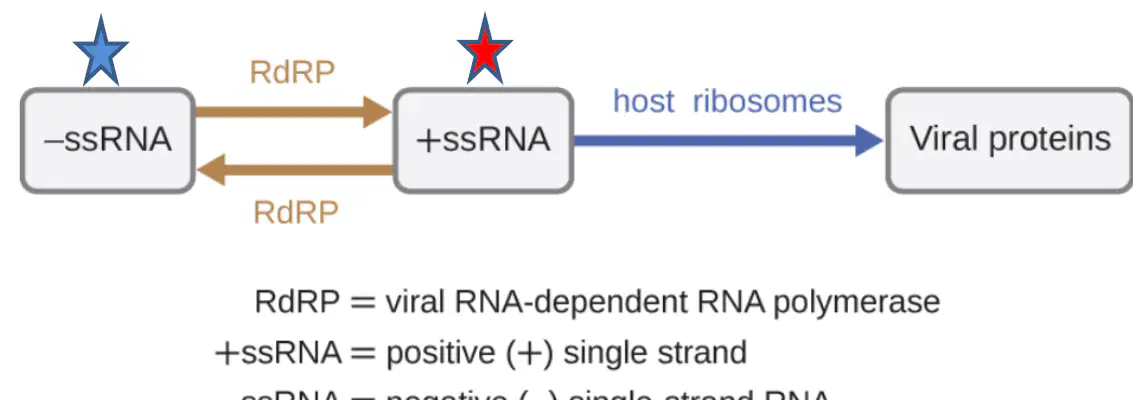
In the diagram, what is the role of host ribosomes in the biosynthesis of RNA viruses?
Host ribosomes translate +ssRNA into viral proteins.
Host ribosomes replicate the viral RNA genome.
Host ribosomes package viral RNA into new virions.
Host ribosomes degrade viral proteins.
What does RdRP stand for?
viral RNA-dependent RNA polymerase
Ribosomal DNA replication protein
Retroviral DNA repair polymerase
Ribonucleic DNA recombination protein

Is RNA-dependent RNA polymerase made from a viral gene or a host gene?
Viral gene
Host gene

