
Font size
 Worksheets
Chapter 14: Flatworms, mesozoans, ribbon worms
Total questions: 98
Worksheet time: 49mins
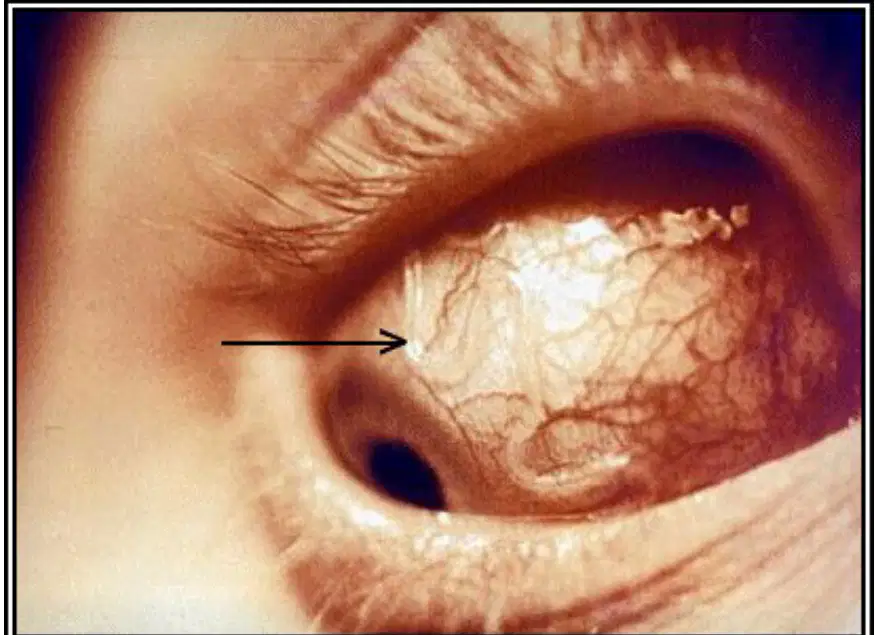
Based on the chapter title 'Flatworms, mesozoans, ribbon worms', what type of organism is likely causing the infection?
Flatworm
Bacterium
Virus
Fungus
What is the difference between diploblastic and triploblastic organisms?
Diploblastic organisms have two tissue layers, while triploblastic organisms have three tissue layers.
Diploblastic organisms have three tissue layers, while triploblastic organisms have two tissue layers.
Both diploblastic and triploblastic organisms have the same number of tissue layers.
Triploblastic organisms lack tissue layers, while diploblastic organisms have them.
Most animals with a basic body plan are:
Radially symmetrical
Bilaterally symmetrical
Asymmetrical
None of the above
Which of the following is true about Protostomia?
Blastopore forms anus
Blastopore forms mouth
No blastopore forms
Blastopore forms both mouth and anus
Which of the following is true about Deuterostomia?
Blastopore forms anus
Blastopore forms mouth
No blastopore forms
Blastopore forms both mouth and anus
Name the three types of body cavity organizations mentioned in the basic body plan: ________, ________, or ________.
Acoelomate, pseudocoelomate, or coelomate
Diploblastic, triploblastic, or monoblastic
Endoderm, mesoderm, or ectoderm
Protostome, deuterostome, or mesostome
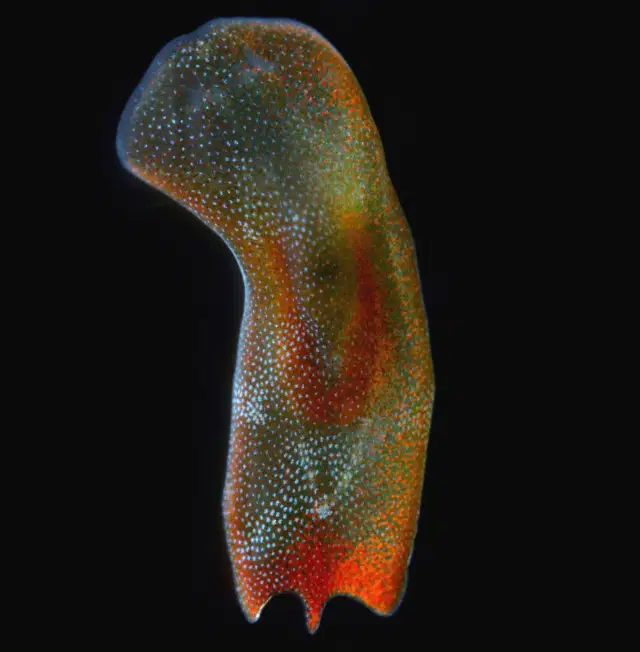
Phylum Acoelomorpha consists of small, _______ worms (not flatworms).
flat
round
segmented
spiny
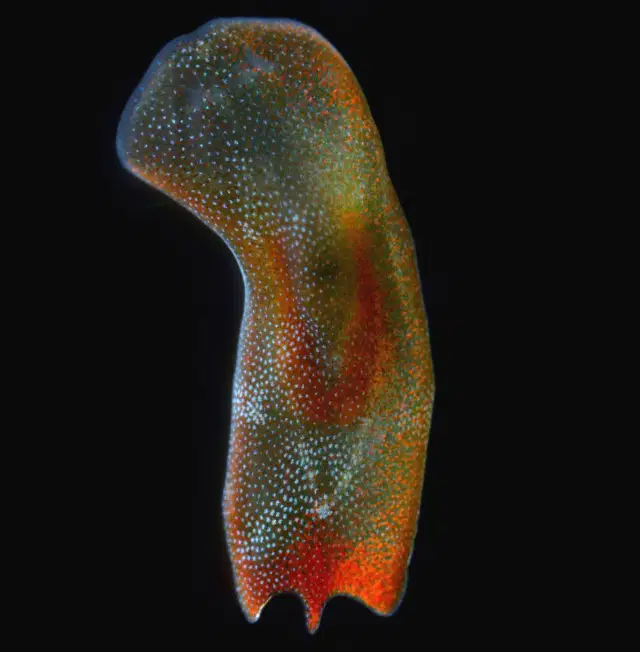
Where do most members of Phylum Acoelomorpha live?
In freshwater lakes
In marine sediments
On land
In trees
Fill in the blank: The rootlets of ________ cilia form an interconnecting network in Acoelomorpha.
epidermal
flagellar
neuronal
muscular
Fill in the blank: Most Acoelomorpha are ________ living, some commensal, and some parasitic.
free
terrestrial
arboreal
sessile
Fill in the blank: Acoelomorpha exhibit ________ symmetry, with the body flattened dorsoventrally and anterior concentration of nerve cells.
bilateral
radial
asymmetrical
pentamerous
Fill in the blank: The epidermis of Acoelomorpha is ________.
cellular
syncytial
glandular
ciliated
Fill in the blank: The gut of Acoelomorpha is either ________ or incomplete and saclike.
absent
segmented
branched
coiled
Fill in the blank: Mesodermal muscle cells in Acoelomorpha are longitudinal, circular, and ________.
diagonal
transverse
radial
oblique
Fill in the blank: Nerve cords in Acoelomorpha are arranged ________.
radially
bilaterally
longitudinally
circularly
Fill in the blank: Acoelomorpha can reproduce asexually by ________.
fragmentation
budding
binary fission
parthenogenesis
Fill in the blank: Monoecious sexual reproduction in Acoelomorpha occurs via ________ fertilization.
internal
external
cross
self
Fill in the blank: Acoelomorpha have no ________ or respiratory system.
excretory
digestive
nervous
circulatory
Identify the part labeled as 'frontal glands' in the diagram.
frontal glands
mandibular glands
salivary glands
hypopharyngeal glands
Identify the part labeled as 'cilia' in the diagram.
cilia
flagella
nucleus
mitochondria
Identify the part labeled as 'statocyst' in the diagram.
statocyst
tentacle
radula
mantle
Identify the part labeled as 'brain' in the diagram.
brain
heart
liver
stomach
Identify the part labeled as 'nerve cords' in the diagram.
nerve cords
digestive tract
blood vessel
excretory canal
Identify the part labeled as 'germative cells' in the diagram.
germative cells
epidermis
cuticle
cortex
Identify the part labeled as 'ovary' in the diagram.
ovary
stigma
anther
petal
Identify the part labeled as 'testes' in the diagram.
testes
ovaries
kidneys
lungs
Identify the part labeled as 'mouth' in the diagram.
mouth
eye
fin
tail
Identify the part labeled as 'syncytium' in the diagram.
syncytium
trophoblast
blastocoel
morula
Identify the part labeled as 'mature egg' in the diagram.
mature egg
zygote
follicle
sperm cell
Identify the part labeled as 'bursal mouthpiece' in the diagram.
bursal mouthpiece
cloaca
vas deferens
testis
Identify the part labeled as 'bursa' in the diagram.
bursa
ligament
tendon
cartilage
Identify the part labeled as 'female genital pore' in the diagram.
female genital pore
male genital pore
clitellum
spermathecal opening
Identify the part labeled as 'male genital pore' in the diagram.
male genital pore
female genital pore
clitellum
spermatheca
Identify the part labeled as 'copulatory organ' in the diagram.
copulatory organ
digestive gland
gizzard
antenna
Identify the part labeled as 'sperm' in the diagram.
sperm
egg cell
pollen grain
zygote
Identify the part labeled as 'rhabdoid glands' in the diagram.
rhabdoid glands
mucous glands
serous glands
sebaceous glands

What are real flatworms classified as?
Phylum Arthropoda
Phylum Platyhelminthes
Phylum Mollusca
Phylum Annelida
The name 'Platyhelminthes' comes from the Greek words 'platys' meaning (flat) and 'helmins' meaning (worm). Fill in the blanks: 'platys' means ______ and 'helmins' means ______.
platys means flat and helmins means worm
platys means round and helmins means fish
platys means long and helmins means insect
platys means soft and helmins means shell
Flatworms in the phylum Platyhelminthes can be:
Only free living
Only parasitic
Free living or parasitic
Only aquatic
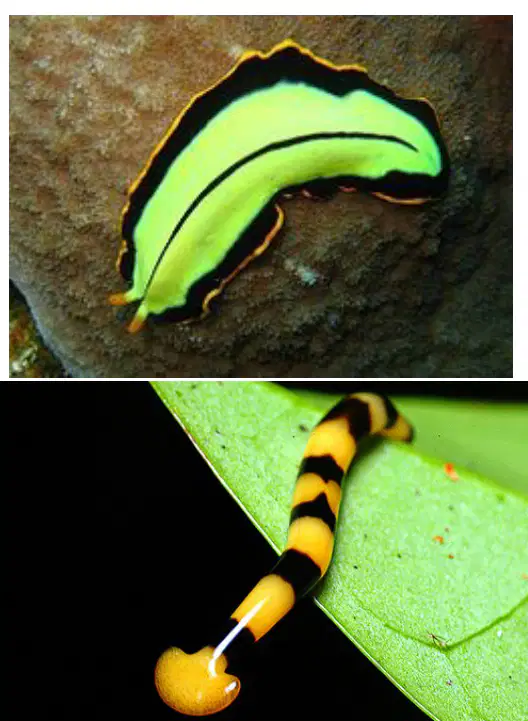
The images shown are examples of organisms from which phylum?
Phylum Arthropoda
Phylum Platyhelminthes
Phylum Mollusca
Phylum Nematoda
What type of epidermis do Turbellarians have?
Cellular, ciliated epidermis
Keratinized, non-ciliated epidermis
Glandular, non-ciliated epidermis
Multilayered, cornified epidermis
What is the function of rhabdites in Turbellarians?
They are rod shaped and fill with water for protection.
They aid in digestion of food.
They are used for locomotion only.
They function as sensory organs.
What do the dual gland adhesive organs in Turbellarians do?
They have glands for adhesion and glands for 'unsticking'.
They produce digestive enzymes for food breakdown.
They secrete toxins to paralyze prey.
They help in respiration by exchanging gases.
What type of covering do parasitic flatworms have?
Syncytial tegument
Ciliated epidermis
Keratinized cuticle
Chitinous exoskeleton
The syncytial tegument in parasitic flatworms contains many nuclei in a single cell membrane and is resistant to the immune system of the host.
True
False
What is a common feature found in both Turbellarians and parasitic flatworms?
Both groups have multiple types of muscle fibers under epidermis.
Both groups possess a complete digestive tract.
Both groups have a segmented body plan.
Both groups have jointed appendages.
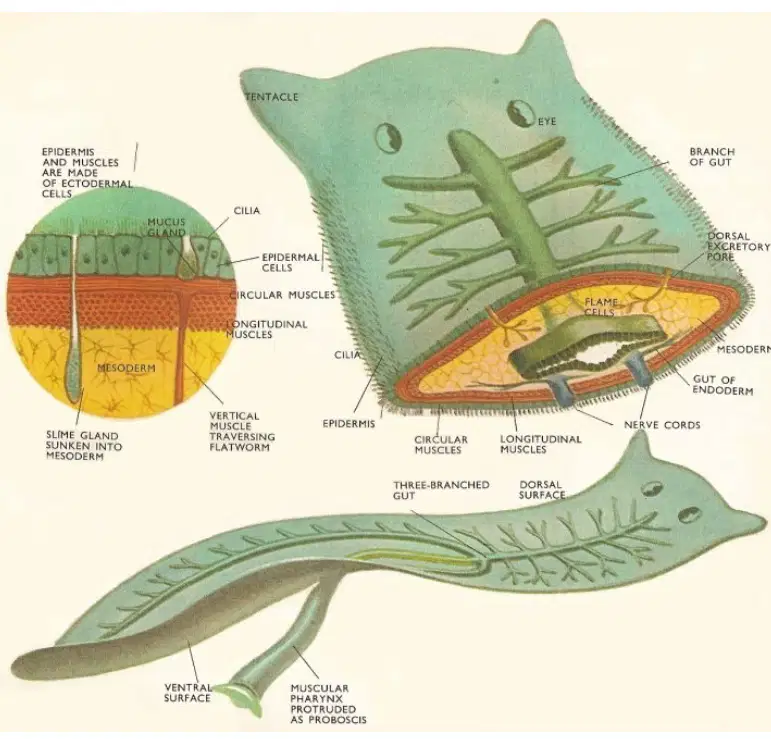
Identify the structure labeled as 'Flame cell' in the flatworm diagram.
Flame cell
Nerve cord
Pharynx
Eyespot
What is the function of the 'Microthrix' as shown in the cestode integument diagram?
Microthrix increases the surface area for absorption.
Microthrix aids in locomotion of the cestode.
Microthrix is responsible for reproduction in cestodes.
Microthrix secretes digestive enzymes.
Which muscle type is found in both the flatworm and cestode integument diagrams?
Circular muscle
Cardiac muscle
Skeletal muscle
Oblique muscle
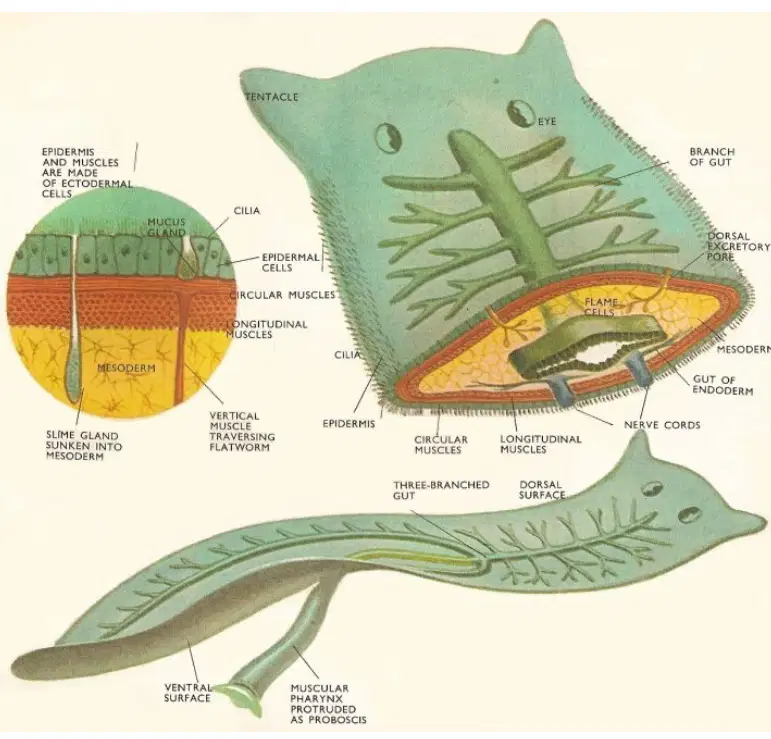
Fill in the blank: The three-branched gut is a characteristic feature of the ________ as shown in the flatworm diagram.
flatworm
earthworm
roundworm
leech
What is the function of the 'Slime gland' in the flatworm diagram?
The slime gland secretes mucus to aid in movement and protection.
The slime gland produces digestive enzymes for food breakdown.
The slime gland is responsible for sensory perception.
The slime gland helps in reproduction by producing gametes.
Which of the following is NOT labeled in the cestode integument diagram?
Nucleus
Vacuole
Chloroplast
Glycogen zone
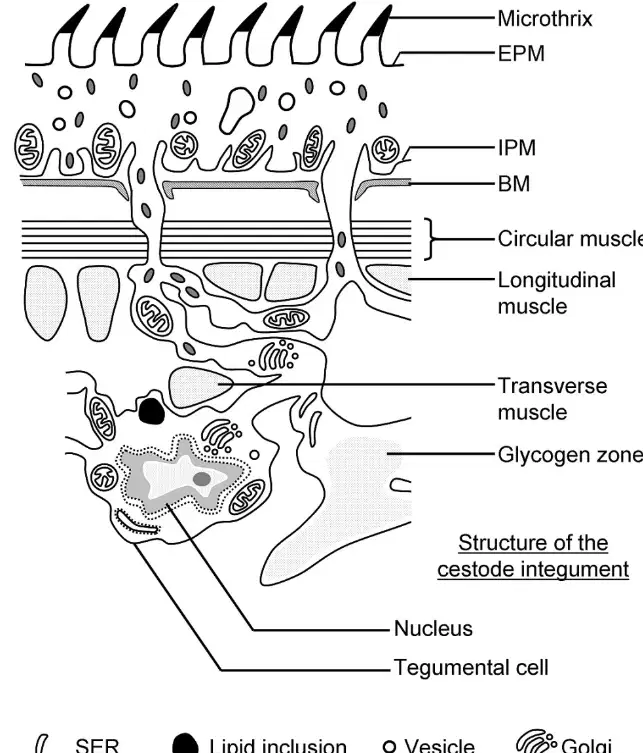
Fill in the blank: The 'Tegumental cell' is found in the ________ as shown in the cestode integument diagram.
cestode integument
mammalian liver
intestinal villi
skeletal muscle
Which of the following are parts of the digestive system mentioned in the slide?
Mouth, pharynx, and intestine
Heart, lungs, and liver
Stomach, pancreas, and spleen
Brain, spinal cord, and nerves
Digestion is ________ and ________ according to the slide.
extracellular and intracellular
intracellular and extracellular
mechanical and chemical
chemical and physical
Most parasitic forms have no digestive system.
True
False
Parasitic forms rely on the ________ to break down food.
host
environment
stomach
enzyme
Many parasitic forms have a(n) ________ ended intestine.
blind
open
double
spiral
Identify the part labeled 'Brain' in the first diagram (planarian).
Brain
Pharynx
Eyespot
Gastrovascular cavity
Identify the part labeled 'Pharynx' in the first diagram (planarian).
Pharynx
Eyespot
Auricle
Gastrovascular cavity
Identify the part labeled 'Intestine' in the first diagram (planarian).
Intestine
Pharynx
Eyespot
Auricle
Identify the part labeled 'Eye' in the first diagram (planarian).
Eye
Pharynx
Auricle
Tail
Identify the part labeled 'Scolex' in the second diagram (tapeworm).
Scolex
Proglottid
Strobila
Neck
Identify the part labeled 'Rostellum with hooks' in the second diagram (tapeworm).
Rostellum with hooks
Sucker
Neck
Proglottid
Identify the part labeled 'Testes' in the second diagram (tapeworm).
Testes
Ovary
Scolex
Vitelline gland
Identify the part labeled 'Ovaries' in the second diagram (tapeworm).
Ovaries
Testes
Scolex
Proglottid
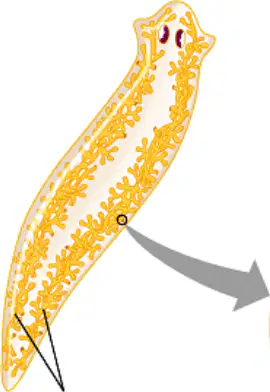
What is the function of protonephridia in osmoregulation and excretion?
Protonephridia are the simple waste excretion and osmoregulation organ.
Protonephridia are responsible for photosynthesis in plants.
Protonephridia help in the circulation of blood in animals.
Protonephridia are involved in the transmission of nerve impulses.
Most wastes in organisms with protonephridia are excreted across the body wall.
True
False
What unique cell do protonephridia have, and what is its shape?
Protonephridia have a unique cell called the flame cell, which is shaped like a cup with a tuft of flagella.
Protonephridia have a unique cell called the podocyte, which is shaped like a star with long processes.
Protonephridia have a unique cell called the goblet cell, which is shaped like a flask with microvilli.
Protonephridia have a unique cell called the parietal cell, which is shaped like a flat disc.
What is the role of flagella in the flame cell of protonephridia?
Flagella draw fluid through the weir, which acts as a collecting net for particles.
Flagella help in the absorption of nutrients from the surrounding tissue.
Flagella are responsible for the synthesis of metabolic waste products.
Flagella provide structural support to the flame cell membrane.
What are the three types of nerves organized in some animals with longitudinal nerve cords?
Sensory, Motor, Association
Cranial, Spinal, Peripheral
Afferent, Efferent, Mixed
Sympathetic, Parasympathetic, Enteric
Ocelli are ________.
photosensitive eyespots
chewing mouthparts
antennae segments
wing veins
Which of the following is NOT a type of nerve organized in some animals with longitudinal nerve cords?
Sensory
Motor
Digestive
Association
Some animals have statocysts for equilibrium and rheoreceptors for sensing water currents.
True
False
Which sense is much more developed in these animals compared to Cnidarians?
All senses (nervous and sensory systems) are much more developed than in Cnidarians.
Only the sense of smell is more developed than in Cnidarians.
Only the sense of taste is more developed than in Cnidarians.
Only the sense of touch is more developed than in Cnidarians.
What are well developed in the nervous and sensory systems described?
Tactile and chemoreception
Visual and auditory senses
Olfactory and gustatory senses
Thermoreception and magnetoreception
Which of the following is NOT a method of asexual reproduction mentioned in the slide?
Fission
Fragmentation
Budding
Both A and B
Fill in the blank: Most organisms that reproduce sexually are ________ but cross fertilizing.
monoecious
dioecious
asexual
parthenogenetic
Which type of reproduction involves free swimming larvae?
A) Asexual
B) Sexual
Which of the following statements is true according to the slide?
All organisms reproduce only sexually.
Many have very complex life cycles and reproductive systems.
Asexual reproduction does not involve regeneration.
Most organisms do not have free swimming larvae.
What process is being shown in the images under the title 'Asexual reproduction by planarians'?
Budding
Binary fission
Regeneration
Spore formation
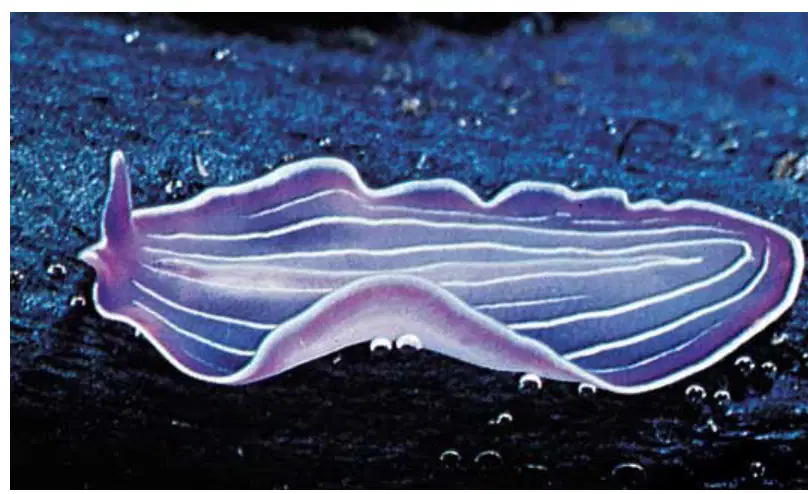
Which of the following best describes the lifestyle of organisms in the class Turbellaria?
Parasitic worms
Mostly free living worms
Aquatic plants
Flying insects
How do Turbellaria move?
By flying
By swimming with fins
By creeping along using muscles and cilia
By jumping
Which of the following statements is true about Class Trematoda (Subclass Digenea)?
All adults are free-living organisms
All parasitic flukes, almost all adults are vertebrate parasites
All species are of no medical importance
Adults inhabit only one organ system
Class Trematoda (Subclass Digenea) includes many species of ______ and economic importance.
medical
botanical
geological
astronomical
Class Trematoda (Subclass Digenea) usually has a simple life cycle.
True
False
Class Trematoda (Subclass Digenea) adults can inhabit which of the following organ systems?
Only the digestive system
Only the respiratory system
Digestive, respiratory, circulatory, urinary, reproductive systems
Only the reproductive system
In the life cycle of Class Trematoda (Subclass Digenea), what types of hosts are involved?
Intermediate and definitive hosts
Only intermediate hosts
Only definitive hosts
Paratenic and accidental hosts
What is excreted to water during the reproduction of Clonorchis?
Shelled embryo or larvae
Adult worm
Unfertilized egg
Cercaria
What is a miracidium in the life cycle of Clonorchis?
Free swimming larvae
Adult worm in the liver
Encysted metacercaria in fish
Egg in feces
What does the sporocyst do in the tissues of a mollusc during Clonorchis reproduction?
Penetrates tissues of a mollusc and encysts
Produces eggs that are released into water
Transforms into an adult worm inside the mollusc
Feeds on the blood of the mollusc
How do sporocysts reproduce in the Clonorchis life cycle?
Asexually to make more sporocysts or rediae
Sexually to produce eggs
By budding off adult flukes
By binary fission to form miracidia
What do rediae reproduce asexually to make in the Clonorchis life cycle?
Cercariae
Miracidia
Sporocysts
Metacercariae
What happens to juveniles in the Clonorchis life cycle?
Eaten by host, mature, repeat cycle
They become dormant and never mature
They immediately die after hatching
They turn into adult insects
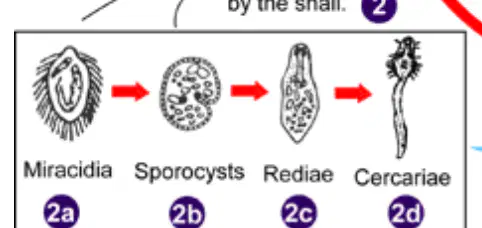
What is the first stage in the life cycle after the eggs are passed in feces?
Miracidia
Sporocysts
Rediae
Cercariae
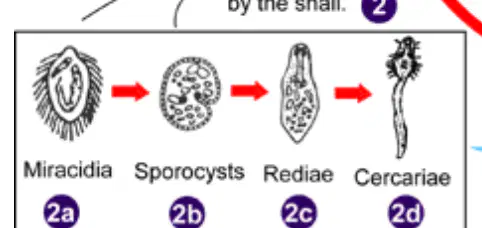
In which host do the eggs hatch into miracidia?
The eggs hatch into miracidia in the snail.
The eggs hatch into miracidia in the fish.
The eggs hatch into miracidia in the frog.
The eggs hatch into miracidia in the bird.
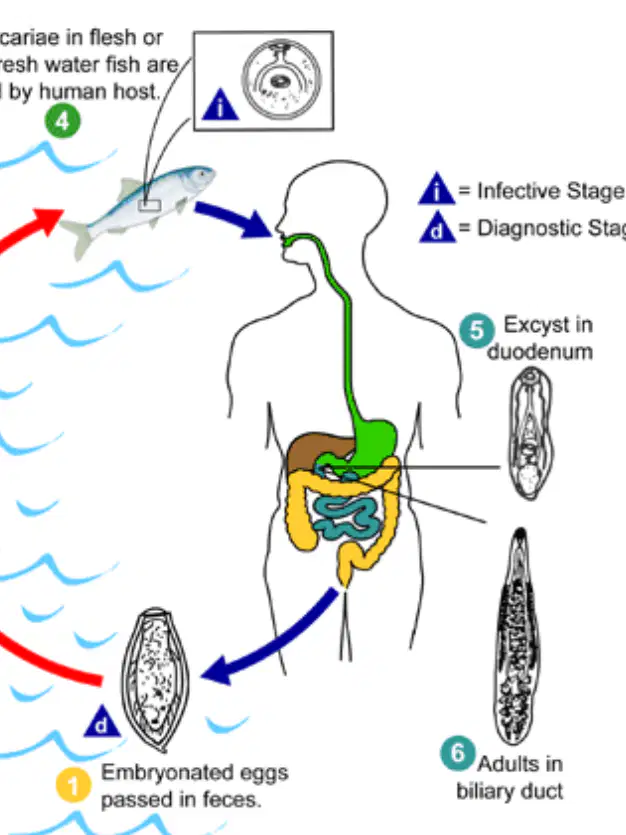
Refer to the diagram of the Clonorchis (human liver fluke) life cycle. What is the infective stage for humans?
Miracidia
Sporocysts
Metacercariae
Adults
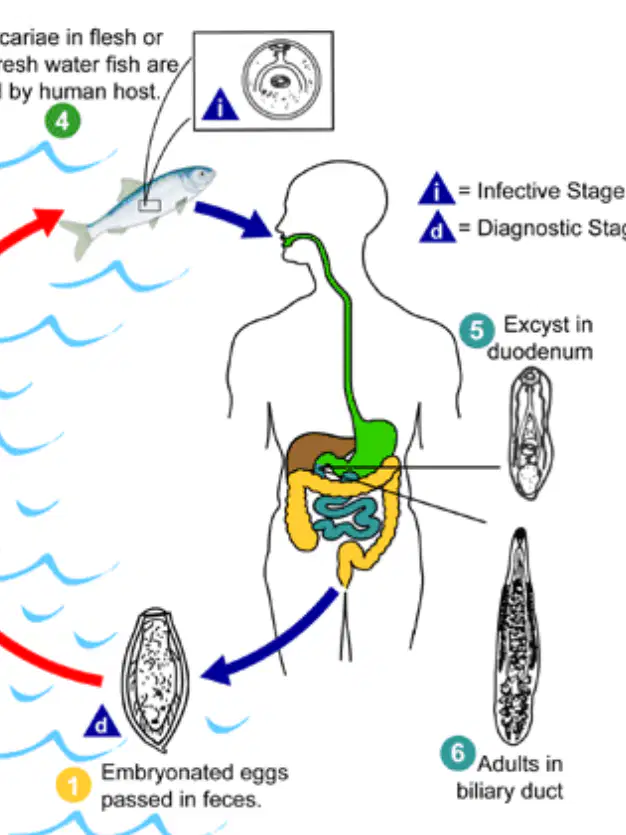
Where do the adult flukes reside in the human body?
The adult flukes reside in the biliary duct.
The adult flukes reside in the lungs.
The adult flukes reside in the small intestine.
The adult flukes reside in the urinary bladder.

