
 Worksheets
bio lab mid term review
Total questions: 94
Worksheet time: 1hrs 5mins
Why are certain techniques used in experiments?
To ensure accuracy and reliability
To make experiments more expensive
To confuse the results
To reduce the number of variables
Why did experiment three use the pGlo plasmid specifically?
Because it allows for antibiotic resistance selection.
Because it contains the gene for green fluorescent protein (GFP).
Because it is the only plasmid available in the lab.
Because it increases the rate of bacterial growth.
Why is reverse transcription and cDNA better than just using raw mRNA?
Because cDNA is more stable and can be easily amplified by PCR.
Because mRNA is more stable than cDNA.
Because cDNA cannot be used for cloning.
Because reverse transcription destroys the genetic information.
What is the purpose of PCR and what can PCR results tell us?
To amplify DNA and detect the presence or absence of specific genetic material
To sequence proteins in a sample
To measure the pH of a solution
To observe cell division under a microscope
Why is [insert] technique used for this experiment? Why are we diluting to a certain amount?
To ensure accurate results and maintain consistency
To speed up the experiment
To use less equipment
To avoid using chemicals
What is concentration?
A measurement of an amount of mass in an amount of volume
A measurement of temperature
A measurement of pressure
A measurement of time
Which of the following is an example of a Mass/Volume unit?
g/L
mol/L
mM
%
Molarity is denoted by which symbol?
m
M
X
%
mM stands for ________ (millimole/liter).
millimolarity
micromolarity
macromolarity
minormolarity
μM stands for ________.
micromolarity
millimolarity
macromolarity
nanomolarity
What does 'X'-fold mean in the context of concentration?
A type of temperature measurement
A type of working or stock solution (e.g., 2X MyTAQ stock, 1X working solution, 10X stock solution)
A type of pressure measurement
A type of time measurement
2% concentration is equal to what decimal value?
0.2
0.02
2.0
0.002
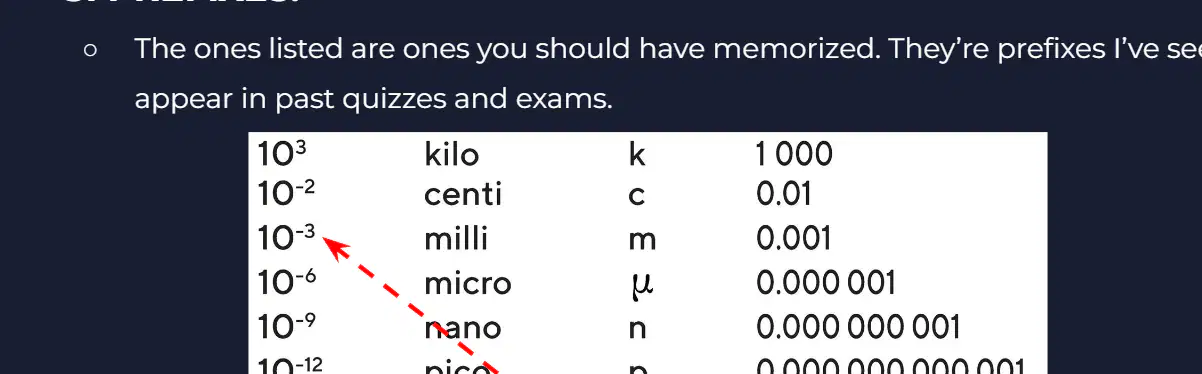
What is the symbol for the SI prefix 'micro'?
μ
m
u
mc

What is the value of the SI prefix 'nano'?
0.000 000 001
0.000 001
0.001
0.01
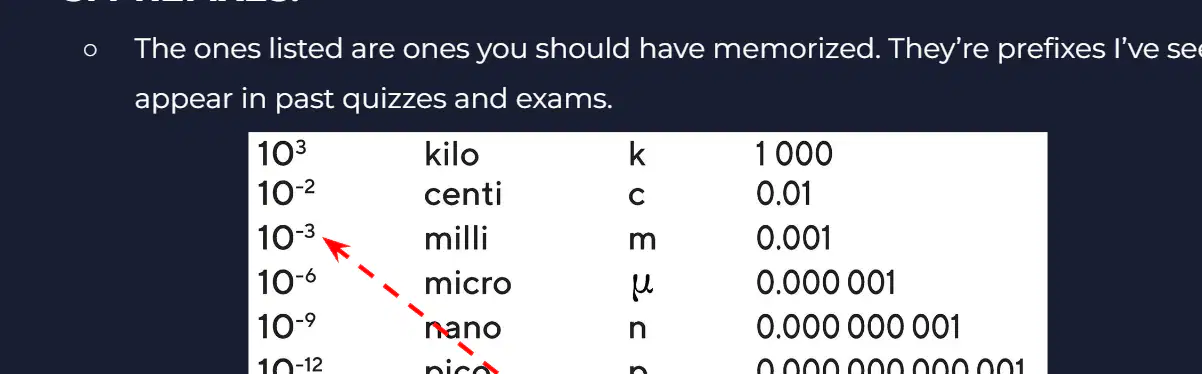
What is the SI prefix for 10−3 ?
milli
micro
nano
centi
Given 10 mL, convert to L. (Show your answer in L)
0.01 L
0.1 L
1 L
0.001 L
Given 50 mL, convert to L. (Show your answer in L)
0.05 L
0.5 L
5 L
0.005 L
What is the formula for dilution problems?
C1 in the dilution formula stands for:
Final concentration of the solution
Initial concentration of the solution you’re trying to dilute
Final volume of the diluted solution
Initial volume of solution you’re trying to dilute
V1 in the dilution formula stands for:
Initial volume of solution you’re trying to dilute
Final volume of the diluted solution
Initial concentration of the solution
Final concentration of the solution
C2 in the dilution formula stands for:
Final concentration of the solution you were trying to dilute
Initial concentration of the solution
Final volume of the diluted solution
Initial volume of solution you’re trying to dilute
V2 in the dilution formula stands for:
Final volume of the diluted solution
Initial volume of solution you’re trying to dilute
Initial concentration of the solution
Final concentration of the solution
What is an example of a complex dilution mentioned in the 'Experiment 0 Lecture: Complex Dilutions' slide?
Simple water dilution
PCR Tables
Serial dilution
Buffer preparation
According to the 'Experiment 0 Lecture: Complex Dilutions' slide, what are you determining when preparing a master mix for PCR?
The temperature of the reaction
The amount of many ingredients (H2O, 2X MyTAQ, primers) to put into an overall volume
The color of the solution
The type of DNA used
What is the volume range of the P2 micropipette?
0.5 μL - 2 μL
2 μL - 20 μL
20 μL - 200 μL
200 μL - 1000 μL
What is the volume range of the P20 micropipette?
0.5 μL - 2 μL
2 μL - 20 μL
20 μL - 200 μL
200 μL - 1000 μL
What is the volume range of the P200 micropipette?
0.5 μL - 2 μL
2 μL - 20 μL
20 μL - 200 μL
200 μL - 1000 μL
What is the volume range of the P1000 micropipette?
0.5 μL - 2 μL
2 μL - 20 μL
20 μL - 200 μL
200 μL - 1000 μL
What was one of the purposes of Experiment 0? Diluted ___ dyes to 1X.
10X
5X
100X
50X
What was another purpose of Experiment 0? Fill in the blank: Made complex solutions of dyes with your (a) dilutions.
Which of the following was practiced to solve the purpose of Experiment 0?
Micropipetting
Chromatography
Centrifugation
Gel electrophoresis
Which skill was practiced in Experiment 0? Practice calculating ___?
dilutions
temperatures
pressures
volumes
Which skill was practiced in Experiment 0? Practice making ___?
solutions
mixtures
compounds
reactions
DNA is ________ information.
genetic
chemical
historical
magnetic
What does PCR stand for?
Polymerase Chain Reaction
Protein Chain Reaction
Polymerase Code Reaction
Protein Code Reaction
The process that allows us to isolate and amplify specific sections of DNA is called ________.
Polymerase Chain Reaction
Gel Electrophoresis
DNA Sequencing
Southern Blotting
What does 'amplify' mean in the context of PCR?
To make a lot of copies of a specific sequence/gene/code
To destroy DNA
To sequence DNA
To mutate DNA
A piece of DNA that is the product of an amplification procedure (such as PCR) is called an ________.
amplicon
exon
plasmid
intron
Which of the following temperatures is used for the denaturing step in PCR?
55°C
65°C
72°C
95°C
During the annealing step of PCR, what attaches to the sequence complementary to them in the single strand?
DNA polymerase
Primers
Nucleotides
Ligase
The extension step in PCR occurs at _________.
72°C
37°C
95°C
50°C
What is a primer in the context of PCR?
During the denaturing step of PCR, double stranded DNA separates into single strands.
True
False
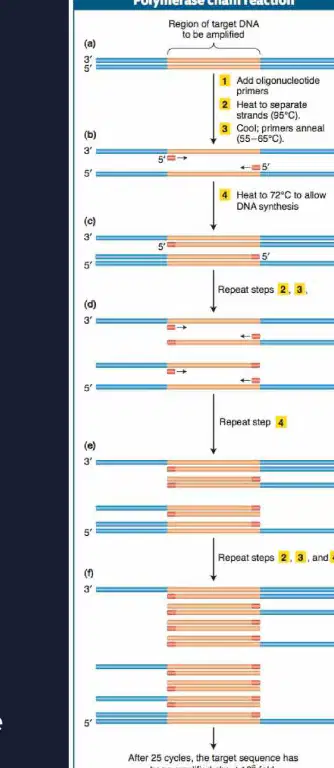
Which step involves the attachment of primers to single stranded DNA?
Step 3 in the diagram (cool, primers anneal 55-65°C)
Step 1 in the diagram (denature, 94-98°C)
Step 2 in the diagram (extend, 72°C)
Step 4 in the diagram (final elongation, 70-74°C)

According to the figure legend in 'Experiment 1 (PCR): Polymerase Chain Reaction', what does a long rectangle represent in the diagram?
A protein
A DNA strand
An RNA strand
A nucleotide

In the figure for 'Experiment 1 (PCR): Polymerase Chain Reaction', what do two long rectangles close together indicate?
Single-stranded DNA
Double-stranded DNA
RNA-DNA hybrid
Protein complex
Which step in the Polymerase Chain Reaction (PCR) involves heating to 95°C?
Add oligonucleotide primers
Heat to separate strands
Cool; primers anneal
DNA synthesis
In the PCR process, primers anneal to the DNA strands at a temperature of ________.
55–65°C
90–95°C
20–25°C
75–80°C
After 25 cycles of PCR, the target sequence has been amplified about ______-fold.
106
102
103
104
Which of the following is NOT a component of the 2x MyTAQ Master Mix used in PCR?
TAQ polymerase
Nucleotides
Buffer
Glucose
What is the function of a primer in PCR?
A primer is a short, single-stranded DNA sequence that primes the single-stranded DNA, so the DNA polymerase (TAQ) knows where to bind and start extending.
A primer is an enzyme that breaks down DNA during PCR.
A primer is a long, double-stranded RNA molecule that inhibits DNA synthesis.
A primer is a protein that signals the end of DNA replication.
ddH2O (double distilled water) is used in PCR to ensure that:
The reaction is heated
The water is pure enough not to degrade any of the other materials used in PCR
The DNA is colored
The buffer is acidic
Which of the following materials is required for PCR?
2x MyTAQ
Primer
ddH2O
All of the above
Which types of DNA samples can be used in PCR reactions?
gDNA only
cDNA only
Both gDNA and cDNA
Neither gDNA nor cDNA
In Experiment 1, which type of DNA is used?
All gDNA
All cDNA
Both gDNA and cDNA
No DNA
In Experiment 2, which types of DNA are used?
Only gDNA
Only cDNA
Both gDNA and cDNA
No DNA
What can determining band length in PCR help you find?
It can help compare two sequences together to find polymorphisms.
It can determine the exact nucleotide sequence of DNA.
It can identify the presence of all proteins in a sample.
It can measure the concentration of RNA in a cell.
If using both gDNA and cDNA in PCR, what can you determine about the gDNA?
What is the purpose of a negative control in a PCR experiment?
To make sure the master mix is not contaminated with DNA.
To increase the yield of PCR product.
To ensure the primers are specific to the target DNA.
To enhance the efficiency of the DNA polymerase.
Remember, PCR is an exponential procedure. What type of increase does the amount of DNA undergo as you go through more cycles of PCR?
Linear
Exponential
Logarithmic
Constant
If you start with 2 strands of DNA in PCR, after 15 cycles you'll end up with ______ strands.
32768
1024
16384
65536
If you start with 2 nanograms of DNA in PCR, after 15 cycles you'll end up with (a) ng.
What is the definition of Polymorphism? Polymorphism is defined as ""
two or more variant forms of a specific DNA sequence
the process of cell division in prokaryotes
the movement of genes between populations
the synthesis of proteins from amino acids
What does 'Poly' mean in the context of Polymorphism?
Many
One
Few
None
What does 'Morphism' mean in the context of Polymorphism?
Form
Shape
Type
Function
Which of the following is NOT a type of polymorphism?
SNPs
Indels
Transposable Elements
Chromosomes
Which of the following are subtypes of SNPs?
Sense/Missense/Nonsense SNPs
Indels
Transposable Elements
Chromosomes
What does SNP stand for in genetics?
Single Nucleotide Polymorphism
Simple Nucleotide Protein
Single Nucleus Polypeptide
Sequence Nucleotide Pair
A change in a nucleotide base in a DNA sequence is called a _________.
Single Nucleotide Polymorphism (SNP)
Gene Duplication
Chromosomal Translocation
Frameshift Mutation
Which of the following is true about SNPs?
They always lead to a deletion in the DNA sequence
They do not lead to a deletion or change in DNA band length
They always cause a gap in MUSCL alignment
They are not caused by errors during DNA replication
At which positions are SNPs present?
At which positions is a SNP (Single Nucleotide Polymorphism) present in all four strains?
Positions 1, 2, and 3
Positions 3, 10, and 11
Positions 5, 6, and 7
Positions 8, 9, and 10
A SNP is a position in a DNA sequence where ________ nucleotide(s) differ(s) between strains.
one
two
three
four
Refer to the example DNA sequences below: CTGAGTGGACCAGTG (Strain 1) CTAAGTGGACAATG (Strain 2) CTTAGTGGATAATG (Strain 3) CTCAGTGGACAATG (Strain 4) True or False: The nucleotide at position 3 is the same in all four strains.
True
False
What does SNP stand for in genetics?
Single Nucleotide Polymorphism
Simple Nuclear Protein
Small Nucleic Particle
Sodium Nitrite Phosphate
SNP refers more to the _______ of the polymorphism, than to a specific nucleotide that has been changed.
location
sequence
function
expression
Given the following DNA sequences, which of the following lists the positions and nucleotides that are different between Strain 1 and Strain 2? Strain 1: ATGTTACATTACGCGCCACAC Strain 2: ATGTAACATTCGCGCCACAG
Positions 5 (T/A), 11 (A/C), 21 (C/G)
Positions 5 (T/A), 11 (A/T), 21 (C/G)
Positions 5 (T/A), 11 (A/C), 21 (C/A)
Positions 5 (T/A), 11 (A/T), 21 (C/A)
What does SNP stand for in genetics?
Single Nucleotide Polymorphism
Simple Nucleotide Pair
Single Nucleus Protein
Sequence Nucleotide Polarity
What can changes to codon sequences lead to in a protein?
Changes to codon sequences can change the amino acid chain that makes up a protein.
Changes to codon sequences can increase the number of ribosomes in a cell.
Changes to codon sequences can cause the protein to dissolve in water.
Changes to codon sequences can make the protein glow under UV light.
Mutations caused by SNPs can affect gene expression greatly, or not at all.
True
False
DNA sequences are composed of ________.
nucleotides
amino acids
fatty acids
monosaccharides
Proteins are composed of ________.
amino acids
fatty acids
nucleotides
monosaccharides
What is a codon?
Mutations caused by SNPs are classified in two ways. What are they?
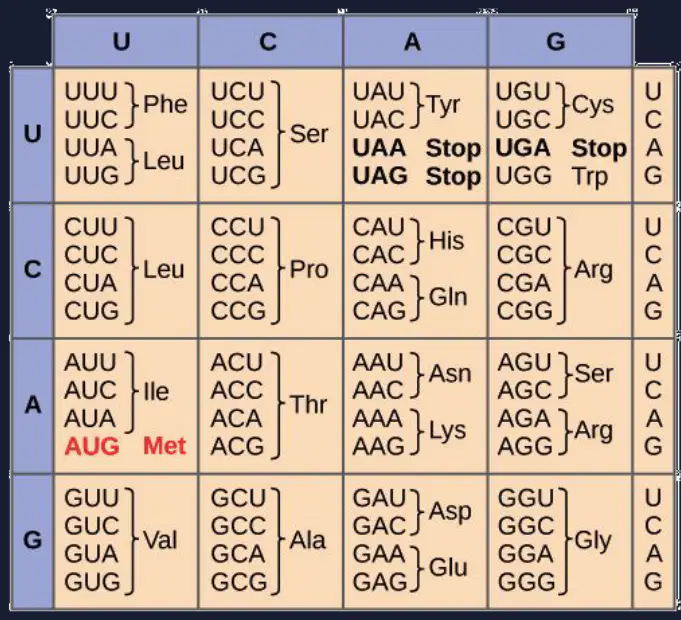
This codon table is how you can tell if a mutation in a codon will lead to a change in amino acid. Note: Because these codons are written in terms of RNA, uracil (U) takes the place of thymine (T). Which amino acid does the codon AUG code for?
Methionine (Met)
Leucine (Leu)
Valine (Val)
Serine (Ser)
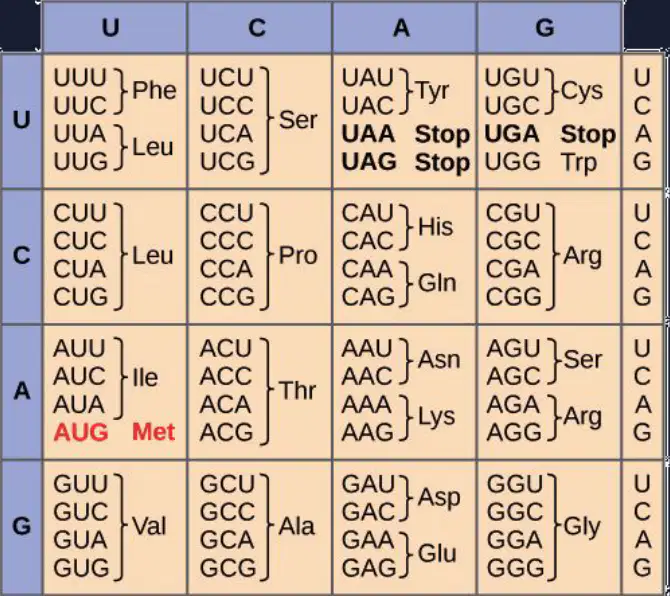
The codon UUU codes for _____?
Phenylalanine (Phe)
Leucine (Leu)
Valine (Val)
Methionine (Met)
What is a synonymous mutation?
A SNP mutation that changes the amino acid coded for in the codon
A SNP mutation that doesn’t change the amino acid coded for in the codon
A mutation that deletes a codon
A mutation that duplicates a codon
A synonymous mutation results in ________ gene function and an ________ protein.
Which of the following is an example of a synonymous mutation?
UUU → UUC; both code for phenylalanine
UUU (phenylalanine) → UUA (leucine)
UAC (tyrosine) → UAA (STOP)
UUA (leucine) → UUU (phenylalanine)
What is a nonsynonymous mutation?
A SNP mutation that does not change the amino acid sequence
A SNP mutation that DOES change the amino acid sequence
A mutation that deletes a codon
A mutation that duplicates a codon
A nonsynonymous mutation results in ________ gene function and a ________ protein.
altered; changed
unchanged; identical
lost; missing
enhanced; same
Which of the following is a type of nonsynonymous mutation that results in a STOP codon?
Missense mutation
Nonsense mutation
Silent mutation
Frameshift mutation
What is a sense mutation? A sense mutation is a mutation that DOESN'T change the ________ a codon codes for.
amino acid
nucleotide
gene
chromosome
Which of the following best describes the effect of a sense mutation on the resulting protein?
It causes a harmful change
It does nothing to affect the structure of the resulting protein
It always causes a stop codon
It deletes an amino acid

