
 Worksheets
Ten questions to ask when planning a course or curriculum
Total questions: 79
Worksheet time: 40mins
The needs in relation to the product of the training programme are:
To ensure the product meets the objectives of the training programme.
To increase the cost of the training programme.
To reduce the effectiveness of the training programme.
To ignore feedback from participants.
The aims and objectives are:
The intended goals and specific outcomes to be achieved.
The list of resources required for a project.
The timeline for completing a task.
The names of team members involved.
The content that should be included is:
Relevant information
Unrelated details
Personal opinions only
Irrelevant images
The content should be organized in which way?
Logically and clearly
Randomly and without order
With excessive repetition
By mixing unrelated topics
The following should be adopted as educational strategies:
Active learning methods
Ignoring student feedback
Rote memorization only
Discouraging collaboration
The following is an example of a teaching method that should be used:
Active learning
Ignoring student feedback
Discouraging questions
Rote memorization without understanding
Assessment should be carried out by:
using systematic and objective methods.
relying solely on personal opinions.
ignoring established criteria.
focusing only on outcomes, not processes.
Details of the curriculum should be communicated:
Clearly and effectively
Only to teachers
Through informal discussions
Only at the end of the year
The educational environment or climate that should be fostered is:
supportive and inclusive
competitive and exclusive
rigid and authoritarian
disengaged and indifferent
The process should be managed by:
following a structured approach
ignoring key steps
avoiding documentation
relying solely on intuition
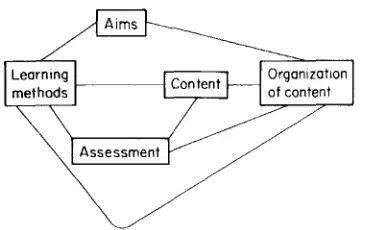
According to the passage and Figure 1, what are the five aspects of the wider curriculum that should all influence each other?
Aims, Learning methods, Content, Organization of content, Assessment
Aims, Resources, Content, Technology, Assessment
Aims, Learning methods, Technology, Organization of content, Feedback
Aims, Learning methods, Content, Technology, Assessment
The needs in relation to the product of the training programme are:
To ensure the product meets the objectives of the training programme.
To increase the cost of the training programme.
To reduce the number of participants in the training programme.
To make the training programme longer than necessary.
What is the Delphi technique and how is it used in curriculum planning?
The Delphi technique is a method relying on the judgement of an expert panel of 'wise men' to obtain a consensus opinion for curriculum planning.
The Delphi technique is a statistical method used to analyze student performance data for curriculum planning.
The Delphi technique is a classroom observation tool used to evaluate teaching methods in curriculum planning.
The Delphi technique is a computer-based simulation used to predict curriculum outcomes.
What does a study of errors in practice suggest about needs not met by existing curricula?
A study of errors in practice suggests that needs not met by existing curricula can be identified by analyzing errors, such as human error being a factor in anaesthetic deaths, to inform training changes.
A study of errors in practice suggests that existing curricula are always sufficient and do not require changes.
A study of errors in practice suggests that errors are unrelated to the effectiveness of curricula.
A study of errors in practice suggests that errors are only due to equipment failure and not related to training.
In the context of medical education, what are critical incident studies?
Critical incident studies involve qualified individuals describing medical incidents that happened to them or that they observed, which reflected good or bad medical practice.
Critical incident studies are surveys conducted to measure student satisfaction with medical courses.
Critical incident studies are laboratory experiments testing new medical devices on volunteers.
Critical incident studies are statistical analyses of patient outcomes in large hospitals.
What is task analysis of established practitioners?
Task analysis of established practitioners involves observing the work carried out by a doctor and recording the tasks performed by him or her.
Task analysis of established practitioners involves only interviewing patients about their experiences.
Task analysis of established practitioners is about reviewing medical textbooks for theoretical knowledge.
Task analysis of established practitioners means assigning random tasks to new doctors without observation.
How can analysis of morbidity and mortality statistics help identify needs in the community?
Analysis of morbidity and mortality statistics provides information about community needs by studying these statistics.
It helps in increasing the population growth rate.
It ensures that all individuals receive the same treatment.
It eliminates all diseases from the community.
What is the study of star performers in medical education?
The study of star performers involves analyzing the important skills and competencies needed in the profession as delineated by doctors identified as star performers.
It is the study of average performers to understand common mistakes in medical education.
It focuses on the financial aspects of medical education institutions.
It is the study of patient satisfaction surveys in hospitals.
How can analysis of existing curricula including syllabi and examinations provide information about current teaching?
Analysis of existing curricula, including syllabi and examinations, provides evidence about what is currently taught by studying the syllabi from a sample of medical schools.
It only provides information about the future plans of the institution, not current teaching.
It focuses solely on student feedback and does not consider the content being taught.
It is used to assess faculty performance rather than curriculum content.
How can the views of recent graduates be used in curriculum planning?
Views of recent graduates can be used by asking them to identify areas of practice covered or not adequately represented in the curriculum, often through surveys.
By only considering the opinions of current students and ignoring graduates.
By focusing solely on faculty feedback and disregarding graduate input.
By using graduate views exclusively to design extracurricular activities.
What are the aims and objectives in medical education curriculum planning?
The aims and objectives in medical education curriculum planning specify in detail what the student should be able to do after completing the course, similar to how a manufacturer decides the aims and objectives for a product.
They are general statements about the history of medicine without any relation to student outcomes.
They focus solely on the financial aspects of running a medical institution.
They are only concerned with the physical infrastructure of the medical college.

What does the area labeled 'A' represent in the general relationship between needs and objectives?
The area labeled 'A' represents the overlap between needs and objectives, i.e., the objectives that meet the identified needs.
The area labeled 'A' represents the needs that are not addressed by any objectives.
The area labeled 'A' represents the objectives that do not correspond to any needs.
The area labeled 'A' represents unrelated factors outside of both needs and objectives.
According to Table 1, which of the following is NOT an objective of the undergraduate medical programme at the University of Newcastle?
Ability to adopt a problem-solving approach to clinical situations
Ability to perform surgery independently
Ability to plan and interpret a programme of investigations appropriate to the clinical problem
Awareness of the role of the physician in health/welfare professional teams
According to Table 1, what is the importance of the doctor/patient relationship in the provision of medical care at all levels?
It is important for the doctor to understand the importance of the doctor/patient relationship in the provision of medical care at all levels.
It is not necessary for the doctor to consider the doctor/patient relationship in medical care.
The doctor/patient relationship is only important at the primary care level.
The doctor/patient relationship is irrelevant in the provision of medical care.
According to Table 1, what should a graduate demonstrate regarding medical education?
A graduate should accept medical education in its full sense as a lifelong activity and be prepared to invest time in the maintenance and further development of their own knowledge and skills, over and above the pursuit of higher professional qualifications.
A graduate should only focus on medical education during their university years and not after graduation.
A graduate should prioritize professional qualifications over continuous learning and skill development.
A graduate should delegate the responsibility of maintaining knowledge and skills to their employers.
According to Table 1, what is the significance of a critical appreciation of techniques, procedures, goals, and results of biomedical research for a medical graduate?
A critical appreciation of techniques, procedures, goals, and results of biomedical research is important for understanding the scientific method, the reliability and validity of observations, and the testing of hypotheses.
It is mainly useful for memorizing facts and figures without understanding their context.
It helps in focusing solely on clinical practice, ignoring research developments.
It is only relevant for those pursuing a career in laboratory research and not for general medical graduates.
According to Table 1, what is the role of a graduate in managing common acute and chronic clinical conditions?
A graduate should be willing and able to take responsibility, under supervision, for the management of a defined range of common acute and chronic clinical conditions.
A graduate should only observe the management of acute and chronic clinical conditions without participating.
A graduate should independently manage all acute and chronic clinical conditions without any supervision.
A graduate should avoid involvement in the management of acute and chronic clinical conditions until further training.
According to Table 1, what attitude should a graduate have towards patients?
A graduate should reflect the attitude that the person who is ill is more important than the illness from which he suffers.
A graduate should focus solely on the illness rather than the patient.
A graduate should prioritize administrative tasks over patient care.
A graduate should maintain a neutral attitude towards all patients regardless of their condition.
According to Table 1, what is the importance of understanding the role of the physician in health/welfare professional teams?
A graduate should be aware of the role of the physician in health/welfare professional teams and be willing to work co-operatively within such teams.
A graduate should only focus on individual work and avoid team collaboration.
A graduate should disregard the roles of other professionals in the team.
A graduate should prioritize administrative tasks over patient care in teams.
According to the text, what are the benefits of independent learning?
The benefits of independent learning include allowing students more choice in pace, timing, and method.
It requires students to work only in groups at all times.
It limits students to a fixed schedule and method.
It discourages students from taking responsibility for their own learning.
Which of the following is NOT mentioned as an educational tool in the text?
Audiotape
Videotape
Printed text
Laboratory animals
The choice of teaching method should reflect the course aims and objectives, the availability of local facilities, and staff experience in the various techniques.
True
False
List any three assessment techniques mentioned in the text.
Multiple choice questions, essay questions, oral examinations.
Group projects, field trips, laboratory experiments.
Attendance, seating arrangement, classroom decoration.
School uniforms, lunch menus, playground equipment.
What factors should be considered when selecting assessment methods, according to the text?
The course aims and objectives, the local facilities available, and the experience of local staff.
The number of students enrolled in the course.
The popularity of the assessment method in other institutions.
The personal preferences of the students.
The assessor for a course can be external or the person responsible for the course. What degree of self-assessment should be present?
The assessor can be external or the course instructor, and some degree of self-assessment should be present.
Only external assessors should be used, with no self-assessment.
Self-assessment should be the only method of evaluation.
Assessment should be done solely by the course instructor, with no self-assessment.
Details of the curriculum should be communicated:
clearly and effectively
only verbally
through informal discussions
without documentation
The educational environment or climate that should be fostered is:
supportive and inclusive
competitive and exclusive
rigid and authoritarian
disorganized and chaotic
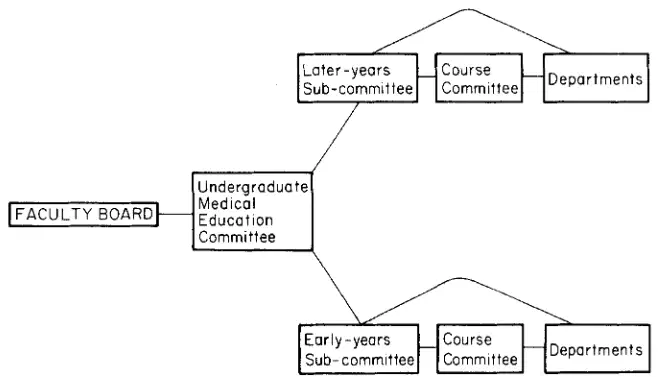
The role of the Undergraduate Medical Education Committee in the committee structure for a medical course is:
To oversee and coordinate the undergraduate medical curriculum.
To manage hospital finances.
To recruit new faculty members.
To provide student counseling services.
The needs in relation to the product of the training programme are:
To ensure the product meets the objectives of the training programme.
To increase the cost of the training programme.
To reduce the number of participants in the training programme.
To make the training programme longer than necessary.
The aims and objectives of the training programme are:
To provide specific skills and knowledge to participants
To increase entertainment value for attendees
To reduce the number of training sessions
To focus only on theoretical concepts
The curriculum should include which of the following contents?
Relevant subject matter and skills
Irrelevant topics only
Unrelated hobbies
Random facts
The content in the curriculum should be organized in which way?
Logically and sequentially
Randomly and without structure
Based on personal preferences
Without considering learning objectives
The curriculum should adopt which of the following educational strategies?
Active learning strategies
Ignoring student feedback
Rote memorization only
Eliminating group work
The curriculum should include which of the following teaching methods?
Interactive and student-centered methods
Only lecture-based methods
Methods that avoid student participation
Teaching without any structure
Assessment in the curriculum should be carried out:
Continuously and comprehensively
Only at the end of the course
Only through written exams
Without considering learning outcomes
Details of the curriculum should be communicated:
clearly and effectively
only to teachers
in a complex manner
occasionally
The curriculum should foster which type of educational environment or climate?
A supportive and inclusive environment
A competitive and exclusive environment
A rigid and authoritarian environment
An indifferent and passive environment
The process of planning, implementing, and monitoring the curriculum should be managed by:
a systematic and coordinated approach
random and unplanned activities
individual efforts without collaboration
ignoring feedback and evaluation
In educational management, the responsibility for planning, implementation, and monitoring lies with:
the school principal
the students
the parents
the local community
Change or innovation can be brought into the curriculum by:
Revising and updating course content regularly
Ignoring new teaching methods
Sticking strictly to traditional methods
Avoiding feedback from students and teachers
The role of the head of department, the course teachers, and any curriculum or course committee that has been established is:
to oversee and coordinate the development, delivery, and review of courses and curriculum.
to manage only the financial aspects of the department.
to handle only student admissions and records.
to supervise only extracurricular activities.
Different courses can relate in such a way that the overall objectives of the school or institution are achieved by:
Aligning course content and outcomes with institutional goals
Focusing only on individual course objectives
Ignoring the institution's mission and vision
Allowing each course to operate independently without coordination
Responsibility should lie with named individuals or with committees. Who should be represented on the committees?
Committees should include representatives from relevant stakeholders.
Committees should only include external consultants.
Committees should be made up of random individuals.
Committees should exclude all stakeholders.
The role of students in the management process includes being represented on course or curriculum committees.
True
False
Only faculty should be represented
Only administrators should be represented
Who is the author of 'How to plan a curriculum'?
Bandaranayake R.C.
Tyler R.W.
Bloom B.S.
Taba H.
What is the title of the work authored by Carter R. in 1985?
A taxonomy of objectives for professional education.
Principles of Adult Learning and Instructional Design.
The Reflective Practitioner: How Professionals Think in Action.
Learning in Adulthood: A Comprehensive Guide.
Which study discusses preventable anaesthesia mishaps?
Cooper J.B., Newbower R.S., Long Charlene D., & McPeek B. (1978) Preventable anaesthesia mishaps: a study of human factors.
Smith A.L., Jones B.C., & Patel R. (1985) Advances in surgical anaesthesia techniques.
Brown T.M., Green S.P., & White L.J. (1990) Anaesthesia safety in pediatric patients.
Williams D.R., Clark H.J., & Evans M.T. (1982) Innovations in anaesthesia monitoring.
Who are the authors of 'Techniques of identifying competencies needed by doctors'?
Dunn W.R., Hamilton D.D. & Harden R.M.
Miller G.E., Epstein R.M. & Norcini J.J.
Bloom B.S., Simpson J.S. & Harrow A.J.
Spencer J.A., Silverman J.D. & McManus I.C.
What is the main topic of Engel C.E.'s 1980 publication?
For use of objectives.
History of education.
Modern teaching methods.
Student assessment techniques.
Who wrote about the use of slides in teaching as a practical guide?
Evans Mary
John Dewey
Linda Smith
Robert Brown
What is the title of Flanagan's 1954 publication?
The critical incident technique.
Behavioral Anchored Rating Scales.
Job Analysis and Performance.
The Hawthorne Studies.
Who authored 'Curriculum evaluation in medical and health-care education'?
De Grant Janet & Coles C.R.
Harden R.M.
Bloom B.S.
Miller G.E.
What is the main focus of Genn J. & Harden R.M.'s 1986 publication?
What is medical education here really like? Suggestions for action research studies of climates of medical education environments.
The impact of technology on medical curriculum development.
Assessment methods in postgraduate medical training.
Strategies for improving patient-doctor communication.
Who designed a tape/slide programme according to the references?
Graves J. & Graves Valerie (1979)
Richards J. & Rodgers T. (1986)
Brown H. D. (2001)
Harmer J. (1998)
What is the subject of Harden R.M.'s 1979a publication?
How to assess students: an overview.
Principles of medical curriculum design.
The role of technology in medical education.
Assessment methods in postgraduate training.
Who wrote about constructing multiple choice questions of the multiple true/false type?
Harden R.M. (1979b)
Bloom B.S. (1956)
Miller G.E. (1990)
Biggs J. (2003)
What is the focus of Harden R.M.'s 1983 publication?
Preparation and presentation of patient-management problems (PMPs).
Development of new surgical techniques.
Advancements in medical imaging technology.
Analysis of healthcare policy reforms.
Who co-authored the 1979 publication on assessment of clinical competence using an objective structured clinical examination (OSCE)?
Harden R.M. & Gleeson F.
Miller G.E. & Epstein R.M.
Norman G.R. & Schmidt H.G.
Flexner A. & Osler W.
What is the topic of Harden R.M., Sowden Susette & Dunn W.R.'s 1984 publication?
Some educational strategies in curriculum development: the SPICES model.
The role of technology in medical education.
Assessment methods in clinical training.
History of problem-based learning.
Who authored 'The modified essay question'?
Knox J.D.E. (1975)
Miller G.E. (1990)
Bloom B.S. (1956)
Harden R.M. (1979)
What is the main subject of Lennox B.'s 1974 publication?
Hints on the setting and evaluation of multiple choice questions of the one from five type.
Principles of effective classroom management.
The history of standardized testing in education.
Techniques for qualitative research in psychology.
Who wrote about how to choose and use educational objectives in 1985?
McAvoy B.R.
John Dewey
Benjamin Bloom
Robert Gagné
What is the focus of Marshall J.R. & Fabb W.E.'s 1981 publication?
The construction of patient management problems.
The development of surgical techniques.
The history of medical ethics.
The pharmacology of antibiotics.
Who wrote about planning devices in 1974?
Miller L.R.
Simon H.A.
Taylor F.W.
Johnson P.R.
What is the topic of Pask G.'s 1976 publication?
Conversational techniques in the study and practice of education.
The development of artificial intelligence in robotics.
The history of educational psychology.
Methods of quantitative research in education.
Who authored 'The clinical examination' in 1974?
Stokes J.F.
Davidson S.I.
Harrison T.R.
Bates B.
What is the main subject of Van der Spuy H., Harden R.M. & Dunn W.R.'s 1982 publication?
Concept mapping: a new approach to curriculum planning.
The evaluation of medical students' clinical skills.
Innovations in distance learning for higher education.
A review of problem-based learning in medical education.
Who wrote about small group methods in medical education in 1973?
Walton H.J.
Abraham Flexner
William Osler
Howard S. Barrows
John Dewey
What is the focus of Wright V., Hopkins R. & Burton K.E.'s 1979 publication?
What shall we teach undergraduates?
How to assess postgraduate research?
The impact of technology on education
Methods for evaluating faculty performance

