
Font size
 Worksheets
Chapter 36 - Care of Patients with Pituitary, Thyroid, Parathyro
Total questions: 88
Worksheet time: 44mins
Identify four major problems associated with hyposecretion of pituitary hormones and select the set of three appropriate nursing interventions for each problem.
Growth retardation, diabetes insipidus, hypothyroidism, adrenal insufficiency; interventions: hormone replacement, fluid balance monitoring, patient education
Hypertension, hyperglycemia, acromegaly, Cushing's syndrome; interventions: insulin therapy, blood pressure monitoring, dietary restrictions
Hyperthyroidism, gigantism, polycythemia, Addison's disease; interventions: chemotherapy, radiation therapy, surgical intervention
Obesity, hypercalcemia, Graves' disease, pheochromocytoma; interventions: weight loss programs, calcium supplements, beta-blockers
Which of the following is an appropriate nursing problem statement and intervention for a patient with diabetes insipidus?
Risk for deficient fluid volume; monitor intake and output closely
Risk for impaired skin integrity; apply heat packs to the skin
Risk for excess fluid volume; restrict fluid intake
Risk for constipation; encourage low-fiber diet
Select the most appropriate nursing assessments and interventions for a patient who might experience complications of a thyroidectomy.
Monitor for signs of hypocalcemia, assess airway patency, and keep emergency tracheostomy equipment at bedside.
Encourage high-protein diet, restrict fluid intake, and provide heat packs to the neck area.
Administer insulin regularly, monitor for signs of dehydration, and encourage early ambulation.
Apply ice packs to the incision site, restrict all oral intake, and elevate the head of the bed to 90 degrees.
The symptoms of hypoparathyroidism and hyperparathyroidism can be compared and contrasted as follows:
Hypoparathyroidism causes muscle cramps and tetany, while hyperparathyroidism causes bone pain and kidney stones.
Both conditions cause high blood calcium levels.
Hypoparathyroidism leads to increased bone resorption, while hyperparathyroidism leads to muscle spasms.
Hyperparathyroidism causes low blood calcium, while hypoparathyroidism causes high blood calcium.
Which of the following lists includes six signs and symptoms of adrenocortical insufficiency (Addison disease)?
Fatigue, weight loss, hyperpigmentation, hypotension, nausea, and salt craving
Hypertension, weight gain, moon face, buffalo hump, and acne
Polyuria, polydipsia, blurred vision, and slow wound healing
Tremor, palpitations, heat intolerance, and exophthalmos
Four major causes of Cushing syndrome include which of the following?
Pituitary adenoma, ectopic ACTH production, adrenal adenoma, prolonged corticosteroid therapy
Diabetes mellitus, hypothyroidism, Addison's disease, Graves' disease
Hyperparathyroidism, pheochromocytoma, acromegaly, insulinoma
Renal failure, liver cirrhosis, anemia, polycythemia vera
Individualizing care for a patient with a pituitary disorder involves choosing patient problem statements appropriate to the patient.
Assessing the patient's specific symptoms and needs to select relevant problem statements.
Using the same care plan for all patients with pituitary disorders.
Ignoring the patient's unique medical history.
Focusing only on medication management without considering other factors.
Appropriate nursing interventions for a patient with adrenal insufficiency include which of the following?
Monitoring vital signs and administering prescribed corticosteroids
Restricting fluid intake and encouraging high potassium diet
Withholding all medications until lab results are confirmed
Encouraging strenuous physical activity to improve adrenal function
Patient teaching for a patient with hypothyroidism should include which of the following?
The importance of taking thyroid medication at the same time every day
Increasing iodine intake without consulting a doctor
Discontinuing medication once symptoms improve
Avoiding all physical activity
Plan postoperative assessment and nursing care for a patient who has had a hypophysectomy.
Monitor for signs of diabetes insipidus and assess neurological status regularly.
Encourage early ambulation and high-protein diet immediately after surgery.
Restrict fluid intake and avoid monitoring urine output.
Focus only on wound care and ignore hormonal changes.
Nursing care of a patient who has had a thyroidectomy includes which of the following?
Monitoring for signs of hypocalcemia
Encouraging a high-protein diet only
Restricting fluid intake completely
Avoiding all physical activity
Select the appropriate nursing problem statement and intervention for a patient with diabetes insipidus.
Risk for deficient fluid volume; monitor intake and output closely.
Risk for impaired skin integrity; apply heat packs to the skin.
Risk for excess fluid volume; restrict fluid intake.
Risk for constipation; encourage low-fiber diet.
A teaching plan for a patient taking a corticosteroid should include which of the following instructions?
Monitor for signs of infection regularly.
Discontinue the medication abruptly if you feel better.
Take the medication on an empty stomach.
Avoid all physical activity while on the medication.
What is the usual nature of a pituitary tumor according to the etiology and pathophysiology section?
Malignant pituitary adenoma
Benign pituitary adenoma
Metastatic tumor
Inflammatory lesion
Which of the following is a local symptom of a pituitary tumor?
Personality changes
Headache from the pressure of the tumor and visual disturbance—with possible blindness
Weakness
Fatigue
Which of the following is NOT a systemic symptom of a pituitary tumor?
Personality changes
Weakness
Headache
Vague abdominal pain
Fill in the blank: Systemic symptoms of a pituitary tumor include personality changes, weakness, fatigue, and _________
vague abdominal pain
blurred vision
joint swelling
skin rash
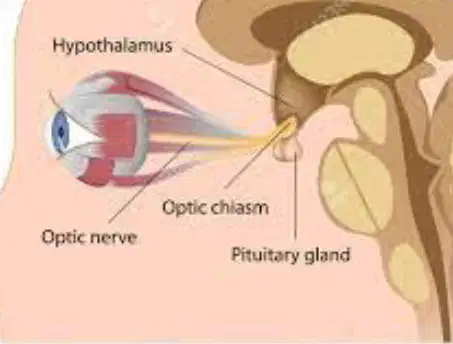
Which structure is directly affected by a pituitary tumor and may cause visual disturbances?
Hypothalamus
Optic chiasm
Optic nerve
Pituitary gland
Which of the following is NOT a method used for the diagnosis of pituitary tumors?
Complete history and physical examination
Magnetic resonance imaging (MRI)
High-resolution computed tomography (CT) with contrast media
Blood glucose test
Fill in the blank: One of the diagnostic methods for pituitary tumors is ________ resonance imaging (MRI).
magnetic
mechanical
molecular
manual
Which of the following is a treatment option for pituitary tumors?
Hormone therapy
Antibiotics
Physical therapy
Blood transfusion
Fill in the blank: Surgery for pituitary tumors is called ________.
hypophysectomy
thyroidectomy
adrenalectomy
nephrectomy
Which imaging technique is used with contrast media for diagnosing pituitary tumors?
X-ray
High-resolution computed tomography (CT)
Ultrasound
PET scan
Which of the following is NOT a treatment for pituitary tumors?
Irradiation
Hormone therapy
Surgery—hypophysectomy
Chemotherapy
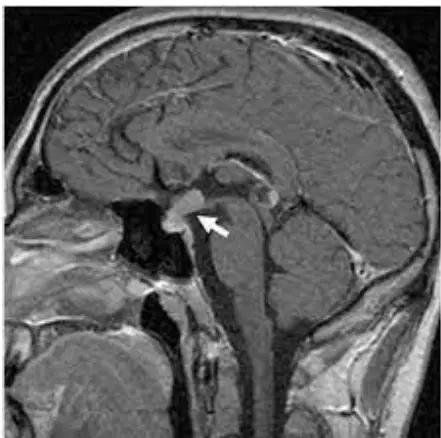
What does the MRI image shown in the slide likely represent?
The MRI image shows a pituitary tumor in the brain.
The MRI image shows a herniated lumbar disc.
The MRI image shows a meningioma in the spinal cord.
The MRI image shows a cerebral aneurysm.
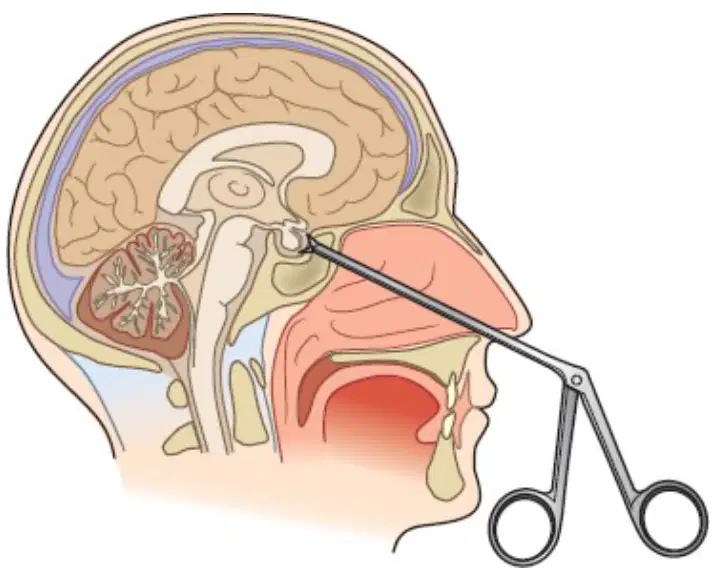
What is the surgical approach shown in the diagram for accessing the pituitary gland?
Transsphenoidal surgical approach
Transcranial surgical approach
Suboccipital surgical approach
Pterional surgical approach
Following a hypophysectomy, what finding must be communicated promptly to the provider?
Large amounts of diluted urine
Alteration in level of consciousness
Vision changes
Change in mental status
Watery drainage from the nose
What is the recommended patient position after a hypophysectomy?
Semi-Fowler position
Supine position
Prone position
Trendelenburg position
For how many days should nasal packing be maintained postoperatively after a hypophysectomy?
2-3 days
5-7 days
10-12 days
1 day
How often should the nasal drip pad be changed after a hypophysectomy?
PRN
Every 24 hours
Every 8 hours
Once a week
Which of the following activities should be avoided by the patient after a hypophysectomy?
Brushing teeth
Bending forward
Coughing, sneezing, blowing nose
All of the above
After a hypophysectomy, how will the patient have to breathe?
Through the mouth, since nasal activities are restricted
Through the nose, as usual
Through a tracheostomy tube
With the help of a ventilator
What may increase the release of hormones in hyperfunction of the pituitary gland?
Removal of pituitary adenoma
Pituitary adenoma
Gigantism
Acromegaly
Which of the following are other causes of increased hormone release in hyperfunction of the pituitary gland?
A) Stress and pregnancy
B) Gigantism and acromegaly
C) Removal of pituitary adenoma
D) Diabetes
Fill in the blank: Gigantism in children is a sign of ________ of the pituitary gland.
hyperfunction
hypofunction
atrophy
calcification
Fill in the blank: Acromegaly in adults is a sign of ________ of the pituitary gland.
hyperfunction
hypofunction
atrophy
calcification
What is the treatment for hyperfunction of the pituitary gland caused by pituitary adenoma?
Removal of pituitary adenoma
Administration of insulin
Physical therapy
Antibiotics
What is the etiology of Acromegaly?
Over secretion of growth hormone starting after the 20yr old
Deficiency of thyroid hormone in childhood
Over secretion of insulin in adulthood
Deficiency of parathyroid hormone after puberty
What is the etiology of Gigantism?
Over secretion of growth hormone starting before the fusion of the growth plates. Puberty is delayed
Deficiency of thyroid hormone during childhood
Over secretion of insulin after puberty
Deficiency of parathyroid hormone in adults
What are the facial features of Acromegaly?
Thick lips, tongue changes shape, jaw protrudes
Sunken cheeks, thin lips, small nose
Pale skin, thin eyebrows, small chin
Pointed nose, thin tongue, receding jaw
What are the facial features of Gigantism?
Prominent forehead, protruding jaw
Sunken cheeks, thin lips
Small nose, narrow eyes
Flat face, receding chin
How is height affected in Acromegaly?
Unaffected
Increased
Decreased
Fluctuates
How is height affected in Gigantism?
Increases for the age of the child
Decreases for the age of the child
Remains unchanged for the age of the child
Fluctuates irregularly for the age of the child
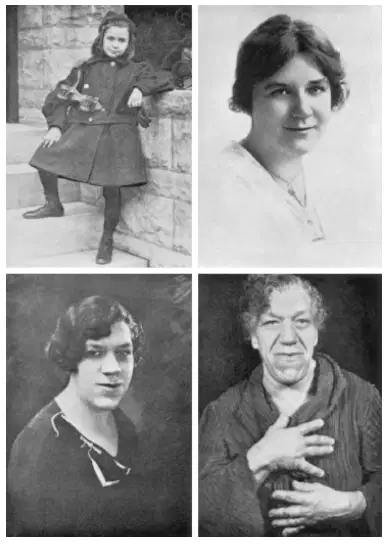
The images show the progression of which medical condition over time?
Diabetes Mellitus
Acromegaly
Osteoporosis
Hypothyroidism
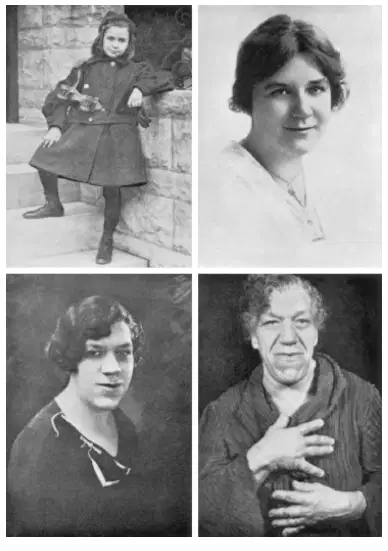
Fill in the blank: The series of images demonstrates the physical changes that occur in a person with ________ over time.
acromegaly
diabetes mellitus
asthma
osteoporosis
What is the most common cause of hypo function of the pituitary gland?
A tumor
Excessive exercise
High salt intake
Vitamin C deficiency
Which of the following is NOT a cause of hypo function of the pituitary gland?
Autoimmune disorders
Infections
Excessive exercise
Destruction of the pituitary gland
Sheehan syndrome due to postpartum hemorrhage is associated with which gland's hypo function?
Pituitary gland
Thyroid gland
Adrenal gland
Pineal gland
A decrease in which hormones is associated with hypo function of the pituitary gland?
Growth hormone and gonadotropins
Insulin and glucagon
Thyroxine and calcitonin
Adrenaline and noradrenaline
Which symptom is associated with a tumor in the pituitary gland?
Headaches
Visual changes
Anosmia
Seizures
All of the above
Other symptoms of hypo function of the pituitary gland depend on what?
The hormone involved
The age of the patient
The blood pressure level
The amount of calcium in the diet
Which of the following is NOT a method used in the diagnosis of hypo function of the pituitary gland?
History and physical examination
Levels of pituitary hormones
MRI and CT
Blood sugar test
History and physical examination are part of the diagnosis for which gland's hypo function?
Pituitary gland
Thyroid gland
Adrenal gland
Pineal gland
Levels of which hormones are checked in the diagnosis of hypo function of the pituitary gland?
Pituitary hormones
Thyroid hormones
Adrenal hormones
Pancreatic hormones
MRI and CT are imaging techniques used in the diagnosis of hypo function of the pituitary gland.
True
False
Which of the following is a treatment for hypo function of the pituitary gland?
Hormone replacement
Surgery and radiation
Patient teaching
All of the above
Patient teaching is an important part of the nursing management for hypo function of the pituitary gland.
True
False
Neurogenic DI is associated with defects in the _______ or _______ gland.
hypothalamus; pituitary
thyroid; adrenal
parathyroid; pineal
ovary; pancreas
Nephrogenic DI is characterized by renal tubules not reacting to ADH. Can this condition be inherited or caused by adverse effects of drug therapy (such as lithium) or kidney damage/disease?
True
False
Dispogenic DI is caused by excessive water intake and is sometimes associated with which mental health condition?
Depression
Schizophrenia
Bipolar disorder
Anxiety
Fill in the blank: One of the signs of Diabetes Insipidus is diuresis, with an output of ___ to ___ L/day.
5 to 20
1 to 2
0.5 to 1
20 to 30
Which of the following is a symptom of Diabetes Insipidus?
Thirst (polydipsia), weakness, and fatigue, often from nocturia (urination at night)
High blood pressure
Weight gain
Decreased urination
Fill in the blank: A sign of Diabetes Insipidus is deficient ___ volume.
fluid
sugar
oxygen
protein
Signs of shock and CNS manifestations are associated with Diabetes Insipidus.
True
False
Fill in the blank: Polyuria is a sign of _____________.
Diabetes Insipidus
Hypertension
Asthma
Appendicitis
Which of the following is a symptom found during the complete history and physical examination for Diabetes Insipidus?
Tachycardia
Hypertension
Edema
Bradycardia
Loss of ________ turgor is a sign found in the physical examination for Diabetes Insipidus.
skin
muscle
bone
nerve
Which of the following is NOT a symptom found in the complete history and physical examination for Diabetes Insipidus?
Nocturia
Constipation
Fatigue
Hypertension
Fill in the blank: Poor ________ pulses may be found during the physical examination for Diabetes Insipidus.
peripheral
central
radial
jugular
Decreased cognition is a possible finding in the physical examination for Diabetes Insipidus.
True
False
Which of the following findings is associated with urine in Diabetes Insipidus?
Increased specific gravity
Decreased specific gravity
Increased osmolality
Increased pH
Fill in the blank: In Diabetes Insipidus, urine is usually ________.
dilute
concentrated
bloody
foamy
In Diabetes Insipidus, blood is concentrated with increased osmolality and increased Na & K.
True
False
What is induced by withholding fluids during the water deprivation test for Diabetes Insipidus?
Dehydration
Hypertension
Hyperglycemia
Bradycardia
Fill in the blank: Subq vasopressin produces urine with increased specific gravity and ________ in Diabetes Insipidus.
osmolality
volume
pH
glucose
An increase in osmolality of 9% during the water deprivation test indicates nephrogenic Diabetes Insipidus.
True
False
Which of the following is a treatment for Diabetes Insipidus?
Replacement of fluid and electrolytes
Antibiotic therapy
Chemotherapy
Radiation therapy
Fill in the blank: ________ therapy is a treatment option for Diabetes Insipidus.
Hormone
Antibiotic
Chemotherapy
Radiation
Which type of care is important for patients with Diabetes Insipidus?
Skin & Mouth care
Eye care
Hair care
Foot care
Fill in the blank: Early detection, maintenance of ________ and electrolyte balance, and patient education are important in the management of Diabetes Insipidus.
fluid
glucose
protein
lipid
Baseline vital signs and weight are to be accurately documented and monitored throughout therapy for Diabetes Insipidus.
True
False
Strict (hourly) intake and output monitoring are essential in the management of Diabetes Insipidus.
True
False
Fill in the blank: Excessive amounts of ______ are produced in SIADH, resulting in fluid retention.
ADH
Aldosterone
Insulin
Cortisol
Which of the following is NOT a sign or symptom of SIADH?
Confusion
Seizure
Weight loss
Edema
Fill in the blank: Hyponatremia, muscle cramps, and ______ are signs and symptoms of SIADH.
weakness
hypertension
polyuria
hyperglycemia
Which test is used in the diagnosis of SIADH?
Urine and serum osmolality tests
Blood glucose test
Liver function test
Electrocardiogram
Fill in the blank: Diminished ______ output is a sign of SIADH.
urine
blood
saliva
sweat
Which of the following is included in the diagnosis of SIADH?
Blood urea nitrogen (BUN)
Hemoglobin
Hematocrit
All of the above

