
 Worksheets
Transport in animals
Total questions: 150
Worksheet time: 2hrs 2mins

Observe the image well. Then choose the correct statement.
A is an artery since it has the biggest lumen to carry more blood.
A is a vein since it is very elastic.
B is an artery because it has thick muscular and elastic walls.
B is a vein since all veins have a small lumen
Arteries have a thick elastic wall to:
Carry oxygenated and deoxygenated blood to all parts of body.
Pump the blood to rest of body.
Withstand the high pressure exerted by the blood.
Capillaries are the link between arteries and veins. Capillaries are efficient because: (Tick all the right answers)
1 cell thick for a short diffusion distance
Blood in them travels at a very high speed to ensure diffusion
Blood in them travels at a very low speed to ensure diffusion
The network of capillaries creates a large SA for efficient diffusion.
Name the main artery of the human body.
Pulmonary Artery
Hepatic Artery
Aorta
The vein that is rich in digested nutrients such as glucose and AA is:
Hepatic Vein
Renal Vein
Vena Cava
Hepatic Portal Vein
The blood vessel with high levels of urea is the
Renal Vein
Hepatic Vein
Hepatic Artery
In the heart which ventricle has the thickest wall?
left ventricle
right ventricle
In the elderly persons, the pulse rate tends to fall with age. This means that:
They would have enough oxygen circulating around their body.
They can feel fatigued due to less oxygen circulating around their body.
They are more prone to diseases.

Graph A shows the heartbeat of:
A trained person because the heart is beating faster at each level of exercise.
An untrained person because the heart is beating faster at each level of exercise.
An untrained person because it shows the smallest recovery time.
A trained person because trained persons always experience a long recovery period after exercise.

The recovery time after strenuous exercise is important to:
pay off the oxygen debt experienced during exercise
to ensure anaerobic respiration occurs
have a stronger pulse
The blood vessel that carries deoxygenated blood to the lungs is the:
Pulmonary artery
Pulmonary vein
Vena cava
Aorta
Athletes with high cholesterol levels in their blood may experience fatigue because:
Enough oxygen is reaching their muscles.
Less oxygen is available for anaerobic respiration.
Less oxygen is available for aerobic respiration.
An athlete training for the Olympic games was told it is better if he trains at high altitudes. This is because:
The body will build more white blood cells to fight off pathogens
The body will build more platelets to avoid loss of blood in case of injury during the games.
The body will build more red blood cells to carry more oxygen molecules.
A blood sample showed that the white blood cell count was very high. Explain this result.
The body needed to build more energy
The body needed to carry nutrients around the body
The body was healthy, and no signs of infections were visible.
The body was fighting off pathogens.
The presence of valves in the heart prevents
Oxygenated blood from mixing with deoxygenated blood
Backflow of blood
A rise in the blood pressure
The liquid part of the blood is known as:
blood
tissue fluid
plasma
Platelets are necessary:
To avoid entry of pathogens
To avoid loss of WBC
To avoid loss of blood
To avoid entry of pathogens and to avoid loss of blood.
Tick all the substances that may be carried by the plasma
dissolved nutrients
carbon dioxide
oxygen
urea
nitrogen
Tissue fluid is:
The fluid found around organs
A link between body cells and blood and consists of plasma without any plasma proteins
The fluid found in all cells
Mammals have a double circulatory system. This means that
Oxygenated blood passes twice through the heart
Deoxygenated blood passes twice through the heart
The heart pumps deoxygenated blood to lungs and oxygenated blood to rest of body
a mixture of oxygenated and deoxygenated blood is pumped out of heart to the rest of body
If a doctor needs to take a sample of blood from a patient, the blood vessel he would use is the:
artery
vein
Observe the image well. Then choose the correct statement.
A is an artery since it has the biggest lumen to carry more blood.
A is a vein since it is very elastic.
B is an artery because it has thick muscular and elastic walls.
B is a vein since all veins have a small lumen
Capillaries are the link between arteries and veins. Capillaries are efficient because: (Tick all the right answers)
1 cell thick for a short diffusion distance
Blood in them travels at a very high speed to ensure diffusion
Blood in them travels at a very low speed to ensure diffusion
The network of capillaries creates a large SA for efficient diffusion.
A blood sample showed that the white blood cell count was very high. Explain this result.
The body needed to build more energy
The body needed to carry nutrients around the body
The body was healthy, and no signs of infections were visible.
The body was fighting off pathogens.
Mammals have a double circulatory system. This means that
Oxygenated blood passes twice through the heart
Deoxygenated blood passes twice through the heart
The heart pumps deoxygenated blood to lungs and oxygenated blood to rest of body
a mixture of oxygenated and deoxygenated blood is pumped out of heart to the rest of body
What is the function of lymphocytes?
Transport oxygen around the body
Engulf and digest pathogens
Produce antibodies which destroy pathogens
Clot together to prevent bleeding
Which of the following statements is true regarding the lymphatic system?
It destroys the immunological defence in body.
It transports interstitial fluids back to the blood.
It transports plasma cells to the site of infection in the body.
It filters the antigen that enters the body from respiratory system.

The diagram shows part of the human circulatory system. Which part carries oxygenated blood at low pressure?
A
B
C
D
What part of the heart delivers unoxygenated blood to the lungs?
Pulmonary artery
Pulmonary vein
Aorta
Left Ventricle
Pulmonary veins take unoxygenated blood away from the heart.
True
False
Which substances are dissolved in human blood plasma?
carbon dioxide, haemoglobin and glucose
carbon dioxide, oxygen and haemoglobin
glucose, hormones and urea
oxygen, urea and starch

Which statement is correct for most veins in the human body?
They carry blood at high pressure.
They have a pulse.
They have valves.
They take blood away from the heart.

The diagrams show some components of the blood of a mammal. Which component causes the blood to start clotting?
A
B
C
D
What is the correct sequence for blood being pumped from the heart to the lungs?
left atrium → left ventricle → pulmonary artery
left atrium → left ventricle → pulmonary vein
right atrium → right ventricle → pulmonary artery
right atrium → right ventricle → pulmonary vein
Why do arteries have a thick muscle layer?
To provide energy for the blood vessel.
To prevent the blood flowing backwards.
To help withstand the high pressure blood and to control blood flow.
To facilitate diffusion.
What blood vessel provides the heart with its own blood supply?
Vena Cava
Aorta
Coronary Artery
Pulmonary Artery
Which substances are dissolved in human blood plasma?
carbon dioxide, haemoglobin and glucose
carbon dioxide, oxygen and haemoglobin
glucose, hormones and urea
oxygen, urea and starch
The diagrams show some components of the blood of a mammal.
Which component causes the blood to start clotting?


The diagram shows the human heart and some of the blood vessels connected to it.
Before blood in W reaches Z it must
gain glucose.
give up heat to the skin.
pass through capillaries.
travel to the head.
Which blood vessel has a high carbon dioxide concentration, a low oxygen concentration and a
high blood pressure?
aorta
pulmonary artery
pulmonary vein
vena cava

The diagram shows a section through the heart.
Which part pumps blood to the aorta?
A
B
C
D
Where does haemoglobin become oxyhaemoglobin?
heart
kidney
liver
lungs
What is the correct sequence for blood being pumped from the heart to the lungs?
left atrium → left ventricle → pulmonary artery
left atrium → left ventricle → pulmonary vein
right atrium → right ventricle → pulmonary artery
right atrium → right ventricle → pulmonary vein
In which list do all three blood vessels carry oxygenated blood?
aorta, pulmonary artery, renal artery
aorta, pulmonary vein, renal artery
vena cava, pulmonary artery, renal vein
vena cava, pulmonary vein, renal vein
Which heart valves are open and which are closed when blood passes out of the right ventricle
towards the lungs?
bicuspid (mitral) valve closed, tricuspid valve open
bicuspid (mitral) valve open, semi-lunar valve closed
tricuspid valve closed, semi-lunar valve open
tricuspid valve open, bicuspid (mitral) valve open

The graph shows the effect of several minutes of vigorous (hard) exercise on heart rate.
Which letter on the graph is at a time when the person is doing this exercise?
A
B
C
D
How often must a blood cell in the renal artery pass through the heart before it again reaches the
renal artery?
once
twice
3 times
4 times

The diagram shows a section through a blood vessel in the leg.
Which type of blood vessel is shown, and in which direction does the blood flow?
vein - flow from Q to P
artery - flow from Q to P
vein - flow from P to Q
artery - flow from P to Q
In a person with a low platelet level, which process is slower than normal?
blood clotting
antibody formation
oxygen carriage
phagocytosis
What describes the aortic (semi-lunar) and bicuspid (mitral) heart valves when the left ventricle is
relaxing?
aortic valve closed, bicuspid valve closed
aortic valve closed, bicuspid valve opened
aortic valve opened, bicuspid valve opened
aortic valve opened, bicuspid valve closed

The diagram shows the human heart.
Which two chambers contract at the same time?
W and X
W and Z
X and Y
Z and Y

The diagram shows an external view of the human heart.
What is the name of the blood vessel labelled X?
coronary artery
hepatic artery
pulmonary artery
renal artery
Which substances are dissolved in human blood plasma?
carbon dioxide, haemoglobin and glucose
carbon dioxide, oxygen and haemoglobin
glucose, hormones and urea
oxygen, urea and starch
The diagrams show some components of the blood of a mammal.
Which component causes the blood to start clotting?
The diagram shows the human heart and some of the blood vessels connected to it.
Before blood in W reaches Z it must
gain glucose.
give up heat to the skin.
pass through capillaries.
travel to the head.
Which blood vessel has a high carbon dioxide concentration, a low oxygen concentration and a
high blood pressure?
aorta
pulmonary artery
pulmonary vein
vena cava
The diagram shows a section through the heart.
Which part pumps blood to the aorta?
A
B
C
D
Where does haemoglobin become oxyhaemoglobin?
heart
kidney
liver
lungs
What is the correct sequence for blood being pumped from the heart to the lungs?
left atrium → left ventricle → pulmonary artery
left atrium → left ventricle → pulmonary vein
right atrium → right ventricle → pulmonary artery
right atrium → right ventricle → pulmonary vein
In which list do all three blood vessels carry oxygenated blood?
aorta, pulmonary artery, renal artery
aorta, pulmonary vein, renal artery
vena cava, pulmonary artery, renal vein
vena cava, pulmonary vein, renal vein
Which heart valves are open and which are closed when blood passes out of the right ventricle
towards the lungs?
bicuspid (mitral) valve closed, tricuspid valve open
bicuspid (mitral) valve open, semi-lunar valve closed
tricuspid valve closed, semi-lunar valve open
tricuspid valve open, bicuspid (mitral) valve open
The graph shows the effect of several minutes of vigorous (hard) exercise on heart rate.
Which letter on the graph is at a time when the person is doing this exercise?
A
B
C
D
How often must a blood cell in the renal artery pass through the heart before it again reaches the
renal artery?
once
twice
3 times
4 times
The diagram shows a section through a blood vessel in the leg.
Which type of blood vessel is shown, and in which direction does the blood flow?
vein - flow from Q to P
artery - flow from Q to P
vein - flow from P to Q
artery - flow from P to Q
In a person with a low platelet level, which process is slower than normal?
blood clotting
antibody formation
oxygen carriage
phagocytosis
What describes the aortic (semi-lunar) and bicuspid (mitral) heart valves when the left ventricle is
relaxing?
aortic valve closed, bicuspid valve closed
aortic valve closed, bicuspid valve opened
aortic valve opened, bicuspid valve opened
aortic valve opened, bicuspid valve closed
The diagram shows the human heart.
Which two chambers contract at the same time?
W and X
W and Z
X and Y
Z and Y
The diagram shows an external view of the human heart.
What is the name of the blood vessel labelled X?
coronary artery
hepatic artery
pulmonary artery
renal artery
Which type of cell is found in the greatest numbers in blood?
Red blood cell
White blood cell
Platelets
What is the name of the liquid part of the blood?
Platelets
Plasma
Red blood cells
What do platelets do?
They stick together and make fibres that make scabs (blood clots) that stop pathogens entering the blood or stop you bleeding to death.
They form your immune system and destroy pathogens.
They carry oxygen around the body attached to haemoglobin.
What other names are given to red blood cells and also white blood cells?
Lymphocytes (red blood cells) and phagocytes and erythrocytes (white blood cells).
Erythrocytes (red blood cells) and phagocytes and lymphocytes (white blood cells).
Phagocyctes (red blood cells) and lymphocytes and erythrocytes (white blood cells).
What do phagocytes do?
Engulf (surround) microbes and digest them.
Produce antibodies.
Release a toxin that kills pathogens.
Why do arteries have a thick muscle layer?
To provide energy for the blood vessel.
To prevent the blood flowing backwards.
To help withstand the high pressure blood, also to contract to control blood flow.
List the structures in the circulatory system the blood travels through from vena cava to aorta.
Vena cava, lungs, pulmonary vein, left atrium, left ventricle, aorta, right atrium, right ventricle, pulmonary artery,
Vena cava, left atrium, right ventricle, pulmonary vein lungs, pulmonary artery, right atrium, left ventricle, aorta
Vena cava, right atrium, right ventricle, pulmonary artery, lungs, pulmonary vein, left atrium, left ventricle, aorta
Why do veins and the heart have valves?
To stop the backflow of blood
To contract to push the blood under high pressure
To cause the pulse
What type of blood vessel surround alveoli and other tissues in the body?
Capillaries
Arteries
Veins
What is a open circulatory system?
It is when there is no distinction between blood and interstitial fluid.
It is when there is only one type of vessel through out the whole body.
It is when your heart only has a single circuit two-chambers heart, and therefore doesn't separate the low oxygen blood from the high oxygen blood.
It occurs when animals don't have hearts, and it flow around the system naturally. (Particularly common in aquatic organisms.)
Both A and E.

Which artery is directly connected to the heart and travels down the chest and torso? (highlighted in green)
Carotid
Aorta
Renal
Femoral

Which artery is connected directly to the kidneys? (Highlighted in green).
Renal Artery
Femoral Artery
Anterior Tibial Artery
Aorta


Where are platelets made?
plasma
hemoglobin
bone marrow
Pottery Barn

Which substances are dissolved in human blood plasma?
A
B
C
D

Which chamber of the heart has the thickest muscle wall?
A
B
C
D

Before blood in W reaches Z it must
A
B
C
D

Which blood vessel has a high carbon dioxide concentration, a low oxygen concentration and a high blood pressure?
A
B
C
D

Which part pumps blood to the aorta?
A
B
C
D

Which statement is correct for most veins in the human body?
A
B
C
D

Which component causes the blood to start clotting?
A
B
C
D

What is the correct order for the stages after stage P?
A
B
C
D

What is the correct sequence for blood being pumped from the heart to the lungs?
A
B
C
D

Why is the circulatory system of mammals described as a double circulation?
A
B
C
D

Which substance is transported by haemoglobin?
A
B
C
D

Which component of the blood is not functioning properly?
A
B
C
D

In which list do all three blood vessels carry oxygenated blood?
A
B
C
D

In a person with a low platelet level, which process is slower than normal?
A
B
C
D

Which blood vessel contains valves?
A
B
C
D

When blood is flowing through a vena cava, which main blood vessel will it flow through next?
A
B
C
D

Which heart valves are open and which are closed when blood passes out of the right ventricles towards the lungs?
A
B
C
D

Which letter on the graph is at a time when the person is doing this exercise?
A
B
C
D

Which diagram shows the human double circulatory system?
A
B
C
D

Which section shows the heart cut through line P-Q?
A
B
C
D

Which two vessels carry blood at the highest pressure?
A
B
C
D

What is the name of the blood vessel labelled X?
A
B
C
D

Which identifies parts P, Q, R and S of the blood?
A
B
C
D

What is a function of the human blood system?
A
B
C
D

Which blood vessel, if it becomes blocked, could lead directly to a heart attack?
A
B
C
D
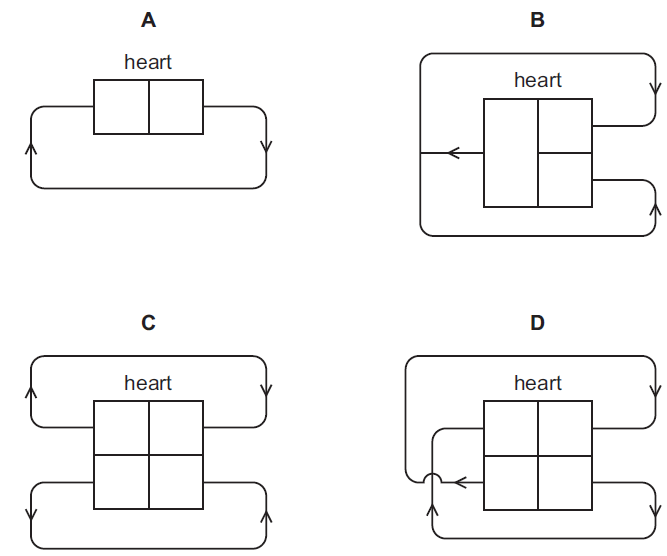
Which diagram shows the human double circulatory system?
A
B
C
D
How often must a blood cell in the renal artery pass through the heart before it again reaches the renal artery?
once
twice
three times
four times
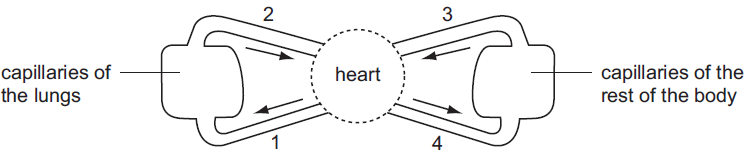
The diagram shows a double circulatory system. Which vessels carry oxygenated blood?
1 and 2
1 and 4
2 and 3
2 and 4

The diagram shows some parts from the blood of a mammal.
Which part would contain the breakdown products of bacterial cells?
A
B
C
D
Which describe the structure and function of a red blood cell?
structure: cell contents are dead
function: transport of water
structure: has a nucleus
function: produces antibodies
structure: has cilia
function: moves particles in the respiratory tract
structure: has no nucleus
function: transport of substances
Which group contains substances that are all carried in the blood?
Amino acids, carbon dioxide and cellulose
Glucose, glycogen and lactic acid
Oestrogen, oxygen and starch
Salts, testosterone and urea

The photograph shows human blood cells as seen under a microscope at high power.
Which are red cells?
P and Q
Q and R
R and S
S and P

The diagram represents some human organs and their blood vessels.
Immediately after taking an alcoholic drink, how would the levels of alcohol compare in blood vessels P, Q and R?
P: high
Q: medium
R: high
P: medium
Q: high
R: low
P: low
Q: low
R: medium
P: high
Q: low
R: low

The photograph shows two blood cells, X and Y.
What are the functions of cells X and Y?
cell X: carries out phagocytosis
cell Y: carries oxygen
cell X: carries oxygen
cell Y: produces antibodies
cell X: carries oxygen
cell Y: carries carbon dioxide
cell X: produces antibodies
cell Y: carries oxygen
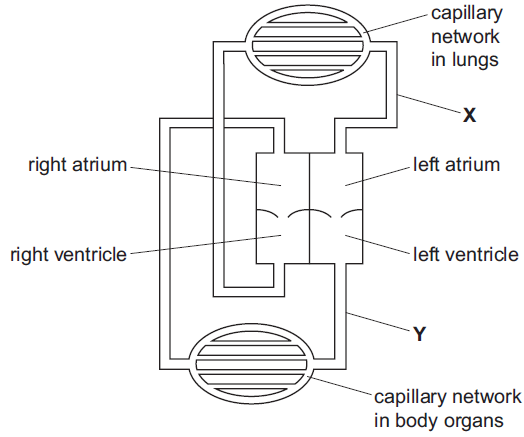
The diagram shows the circulatory system of a mammal.
What describes the blood in vessels X and Y?
X: deoxygenated
Y: deoxygenated
X: deoxygenated
Y:oxygenated
X:oxygenated
Y: deoxygenated
X: oxygenated
Y: oxygenated

The diagram shows human blood as seen through a light microscope.
A person’s blood is unable to clot.
Which component of the blood is not functioning properly?
A
B
C
D
Which chamber of the heart has the most muscular wall?
left atrium
left ventricle
right atrium
right ventricle
A deficiency in which of the following may result in a person’s blood failing to clot properly?
antibodies
fibrinogen
haemoglobin
protease
Which is a function of some white blood cells?
to carry glucose
to carry oxygen
to produce antibiotics
to produce antibodies

The diagram shows the vessels associated with the flow of fluids to and from body cells.
Which is the lymph vessel?
A
B
C
D
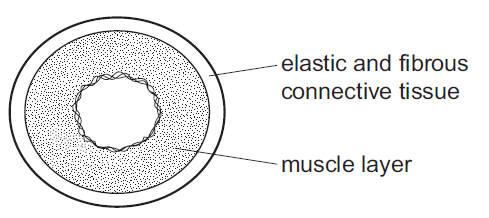
The diagram shows a cross-section through a human blood vessel.
Which type of blood vessel does the diagram show?
an artery
a capillary
a vein
a ventricle
What happens when the left ventricle contracts?
atrioventricular valves: closed
semilunar valves: closed
atrioventricular valves: closed
semilunar valves: open
atrioventricular valves: open
semilunar valves: closed
atrioventricular valves: open
semilunar valves: open

The diagram shows human blood cells, as seen under a microscope.
What is the function of cell X?
to carry glucose
to carry oxygen
to defend against disease
to make the blood clot

The diagrams show some components of the blood of a mammal.
Which component causes the blood to start clotting?
A
B
C
D
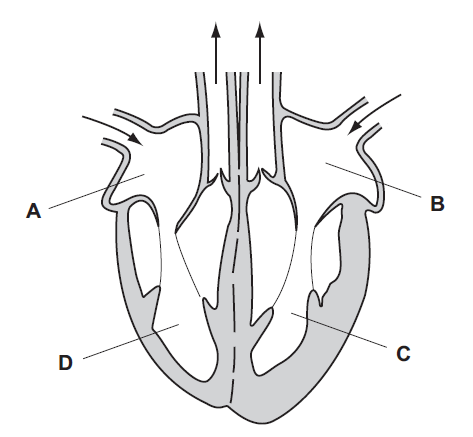
The diagram shows the directions of blood flow through a heart.
Which chamber of the heart receives blood directly from the lungs?
A
B
C
D
A student read out about various systems of the human body and claimed that the digestive system alone can pass nutrients to every cell of the body. Is the claim made by the student correct?
Yes; the stomach of the digestive systems helps in the delivery of nutrients to all body cells.
Yes; the small intestine of the digestive system absorbs the nutrients from the food and delivers to it all cells.
No; the digestive system passes nutrients into the blood, which is then delivered to body cells through the circulatory system.
No; the heart is a component of the circulatory system, which directly absorbs nutrients from the stomach and delivers to all body cells.

The table list some characteristic features of a blood vessel. Which of the following will have all these characteristics features?
Only pulmonary vein
Only pulmonary artery
All veins except the pulmonary vein
All arteries except the pulmonary artery
A student observed the cross-section of two blood vessels A and B with the help of a microscope.
The table lists the observations made by the student.
A- THICK AND ELASTIC
B- THIN
What conclusion can be made about the type of blood carried out by blood vessels A and B
A –oxygen-rich; B- oxygen-rich
A –carbon-dioxide rich; B- oxygen-rich
A –oxygen-rich; B- carbon-dioxide rich
A –carbon-dioxide rich; B- carbon-dioxide rich


View the image attached and identify the correct blood type of the blood sample.
Type A
Type B
Type AB
Type O

View the image attached and identify the correct blood type of the blood sample.
Type B
Type B-
Type B+
Type A+

View the image attached and identify the correct blood type of the blood sample.
Type A-
Type B+
Type A+
Type B-
Why is there a limit to cell size in multicellular organisms?
As size of cells increase, their surface area to volume ratio also increases meaning substances would diffuse too slowly into the cell.
As size of cells increase, their volume decreases meaning substances would diffuse too slowly into the cell.
As size of cells increase, their surface area to volume ratio decreases meaning substances would diffuse too slowly into the cell.
Why do veins and the heart have valves?
To stop the backflow of blood
To contract to push the blood under high pressure
To cause the pulse
The blood vessel with high levels of urea is the
Renal Vein
Hepatic Vein
Hepatic Artery
A deficiency in which of the following may result in a person’s blood failing to clot properly?
antibodies
fibrinogen
haemoglobin
protease
List the structures in the circulatory system the blood travels through from vena cava to aorta.
Vena cava, lungs, pulmonary vein, left atrium, left ventricle, aorta, right atrium, right ventricle, pulmonary artery,
Vena cava, left atrium, right ventricle, pulmonary vein lungs, pulmonary artery, right atrium, left ventricle, aorta
Vena cava, right atrium, right ventricle, pulmonary artery, lungs, pulmonary vein, left atrium, left ventricle, aorta
Rh factor is concerned with blood grouping. It derives its name from–
Man
Chimpanzee
Monkey
Rat
Which statements about arteries are correct?1.All arteries carry oxygenated blood.
2. Arteries carry blood at high pressure.
3. All arteries carry blood away from the heart
1 & 2
1& 3
2 & 3
1, 2 & 3

Which row shows the type of nutrient in plasma and in the tissue fluid and the method of transfer between a capillary and tissue cells.
A
B
C
D

How do veins differ from arteries?
A
B
C
D

Which statements apply to a vein in the human forearm?
A
B
C
D

The diagram shows the movement of blood through a tissue.Which labelled point is the pressure highest?
A
B
C
D
The diagram shows the movement of blood through a tissue.Which labelled point is the pressure highest?
A
B
C
D

