
Font size
 Worksheets
Economic Fundamentals
Total questions: 58
Worksheet time: 45mins
Brett wants to buy a new pair of Nike tennis shoes. This is best described as a...
a need.
a want.
physical capital.
entrepreneurial risk-taking.
Mike is a landscaper. What factor of production is he?
physical capital
land
labor
entrepreneur
What is the first step an entrepreneur should take when launching a business?
secure financial backing
locate a business site
identify a need or problem in the market
analyze competitors' products
Which statement best describes the concept of scarcity?
Resources are limited and wants/needs are unlimited.
Scarcity only applies to luxury goods.
Scarcity is not a concern in developed countries.
Scarcity results in all goods being free.
Which method of resource allocation is used to determine the winners in a marathon race?
lottery
competition
first-come-first-served
personal characteristic
Jordan chose to work extra hours instead of going to a movie with friends. What was the opportunity cost of Jordan's decision?
earning more money
spending time with friends at the movie
getting more work experience
having less free time
What is the opportunity cost of choosing to work instead of attending college?
earning a degree
paying tuition
getting a scholarship
having free time
After looking at several choices, Olivia chooses to buy low-fat yogurt. What is the benefit?
a snack that is high in sugar
a snack that is high in fat
a snack that is somewhat healthy and low in fat
a snack that is relatively low in fat
Zoe is preparing for her final exams. She is deciding whether to study for two hours or three hours tonight. What is the marginal cost of Zoe changing from two hours of studying to three hours of studying?
losing an hour of sleep
losing two hours of sleep
changing from a B to a B+
changing from a C to a B
What is the intended outcome of receiving a parking fine for parking in a no-parking zone?
You will look for hidden parking spots.
You will be more careful about where you park in the future.
You will only park in that area at night.
You will try to dispute every parking ticket you receive.
Suppose Nora reallocates more resources from producing watermelons to producing strawberries on her farm. What happens to the cost of producing additional shoes?
The cost of producing additional strawberries decreases.
The cost of producing additional strawberries increases.
The cost of producing additional strawberries remains the same.
The cost of producing additional strawberries is not affected.
Which of the following would most likely cause a production possibilities frontier to shift to the left?
A decrease in available resources.
An increase in technology.
An improvement in education.
A rise in labor productivity.
What does a point inside the production possibilities frontier indicate?
Resources are not being used efficiently.
The economy is producing at maximum capacity.
All resources are fully employed.
Economic growth has occurred.
What is one effect of technological advancements?
They reduce the importance of natural resources.
They lead to a decrease in economic activity.
They contribute to increased economic development.
They make traditional skills more valuable.
Because resources are limited and human wants are unlimited, what must individuals and societies do?
Ignore their needs.
Use resources without planning.
Make decisions about how to use resources.
Increase their wants.
What is a key difference between socialism and communism in terms of political structure?
Socialism always abolishes private property, while communism allows it.
Socialism can operate within a democratic system, while communism typically involves a single-party state.
Socialism requires no government, while communism depends on strong government control.
Socialism is based on class struggle, while communism is not.
Which statement best describes a difference between the economic systems of North Korea and Canada?
North Korea’s economy is more market-oriented than Canada’s economy.
Canada’s economy is more centrally planned than North Korea’s economy.
North Korea’s government plays a larger role in the economy than Canada’s government does.
Canada’s government controls more of the economy than North Korea’s government does.
Which statement BEST explains a key feature of the U.S. economic system?
Businesses and individuals are free to own and control property and resources
The government owns most major industries
All goods and services are provided by the government
Trade with other countries is strictly prohibited
What would President Reagan's economic policy MOST LIKELY be concerning regulations?
to propose many new regulations
to encourage private regulation of business
to cut back on the number of regulations
to preserve the existing level of government regulation
Which word is most closely related in meaning to "entrepreneur"?
"innovator"
"tenant"
"customer"
"teacher"
The best example of a traditional economy would be...
an ancient tribe
communist China
a Scandinavian democratic-socialist nation
early colonial America
What does a point on the production possibilities frontier represent?
Economic decline.
Unemployment in the economy.
Overproduction of goods.
Efficient use of all available resources.
Which of the following is an example of an opportunity cost?
Finding money on the street.
Receiving a gift from a friend.
Winning a lottery prize.
Buying a new phone instead of saving the money.
Which factor of production is represented by a factory building?
Labor
Entrepreneurship
Land
Physical capital

In the context of the PPC, what does a point inside the curve represent?
Efficient use of resources
Inefficient use of resources
Unattainable production level
Maximum production capacity
What does a shift outward of the Production Possibilities Curve indicate?
A decrease in available resources.
An increase in the efficiency of resource use.
Economic growth and an increase in resources.
A reduction in the production of goods.
Which of the following best describes labour as a factor of production?
The natural resources used in production.
The human effort used in the creation of goods and services.
The machinery and tools used in production.
The financial capital invested in a business.
Which of the following best describes the Production Possibilities Curve (PPC)?
A graph that shows the maximum possible output of two goods.
A curve that shows the relationship between price and quantity demanded.
A line that represents the supply of a single good.
A chart that lists all possible production combinations.
Which of the following is NOT considered a type of resource in economics?
Land
Labour
Money
Capital
What is the primary reason for the existence of scarcity?
Unlimited human wants and limited resources.
Limited human wants and unlimited resources.
Equal distribution of resources.
Overproduction of goods and services.
What does the concept of opportunity cost refer to?
The cost of producing one more unit of a good.
The value of the next best alternative foregone.
The total cost of all resources used in production.
The financial cost of an investment.
Which of the following is NOT a factor of production?
Land
Labour
Technology
Capital

Match the following terms
Unaltered gifts of nature, such as soil, land, minerals, timber, and fresh water, used in the production of goods and services.
Natural resources
Physical and mental efforts of people used to create goods and services.
Human labor
Buildings, tools, and machines used to produce other goods and services.
Capital resources
Imagination, innovative thinking, and the ability to see opportunities and lower costs in the production process. It involves the skills and drive needed to start and run a business.
Entrepreneurial talent

Should you eat an apple or a candy bar?
Identify and match the benefits and costs of the two options.
Benefits of eating the apple
You get to have a healthy snack
Costs of eating the apple
You won't get any delicious chocolate
Benefits of eating the candy bar
Chocolate tastes good
Costs of eating the candy bar
You won't get a serving of fruit
What is a disadvantage of a market economy?
It can lead to economic inequalities.
It discourages competition.
It limits consumer choice.
It restricts personal freedom.
Which of the following is an advantage of a market economy?
It ensures economic equality among citizens.
It allows for a high degree of economic freedom and consumer choice.
It guarantees employment for all citizens.
It prevents any form of economic downturn.
In which economic system do supply and demand determine the prices of goods and services?
Socialism
Command Economy
Market Economy
Mixed Economy
All of these are characteristics of a ___ economy.
· Decision making based on supply and demand.
· Adjusts to changes in the market place.
· Producers and consumers have control of the economy.
command
market
socialist
traditional
which country in the world has the closest market economy?
North Korea
The United States
Brazil
Germany

What best describes a mixed economy?
An economy that incorporates elements of both market and command economies.
An economy that relies solely on government control.
An economy that is entirely based on free market principles.
An economy that has no regulation or oversight.

Which of the following is a characteristic of a market economy?
Central planning
Price controls
Voluntary exchange
Production quotas
Which economic system relies most heavily on customs and traditions to make decisions?
Traditional economy
Mixed economy
Market economy
Command economy
What is the main function of the production possibilities curve (PPC)?
To compare the profits of different companies.
To show the maximum combinations of two goods that can be produced with available resources.
To display the prices of goods in a market.
To indicate the level of unemployment in an economy.
What three economic questions are asked when studying the similarities of traditional, command, market, and mixed economies among nations of the world?
What to produce, why to produce, when to produce?
What is your opportunity cost, what economic resources are needed, why should these resources be used?
What is produced, how is it produced, and for whom is it produced?
What is your opportunity cost, why are economic resources needed, when should these resources be used?
In a command economic system or planned economy, the government controls the economy. The state decides how to use and distribute resources. The government regulates prices and wages; it may even determine what sorts of work individuals do. Socialism is a type of command economic system. Historically, the government has assumed varying degrees of control over the economy in socialist countries. In some, only major industries have been subjected to government management; in others, the government has exercised far more extensive control over the economy. The classic (failed) example of a command economy was the communist Soviet Union. The collapse of the communist bloc in the late 1980's led to the demise of many command economies around the world.
According to the passage, why is it unusual for a country to have a command market in today’s society?
A command market allows too much freedom for private businesses.
A command economy depends on bartering and most societies do not barter anymore.
The failure of the Soviet Union proved to the world that command markets do not work.
Government distributions of resources allowed for too much competition between businesses.
Native Americans used to barter for goods. They did not use currency. Economic decisions were based on customs. What economic system would an indigenous group like the Native Americans most likely have?
market economy
free enterprise economy
traditional economy
command economy
Which country is closest to pure command?
North Korea
United States
United Kingdom
Germany


The table shows the production possibilities for a country. Based on the table, which of the following production combinations is a possibility?
28 pizzas and 5 pairs of shoes
3 pairs of shoes and 23 pizzas
2 pairs of shoes and 20 pizzas
4 pairs of shoes and 15 pizzas
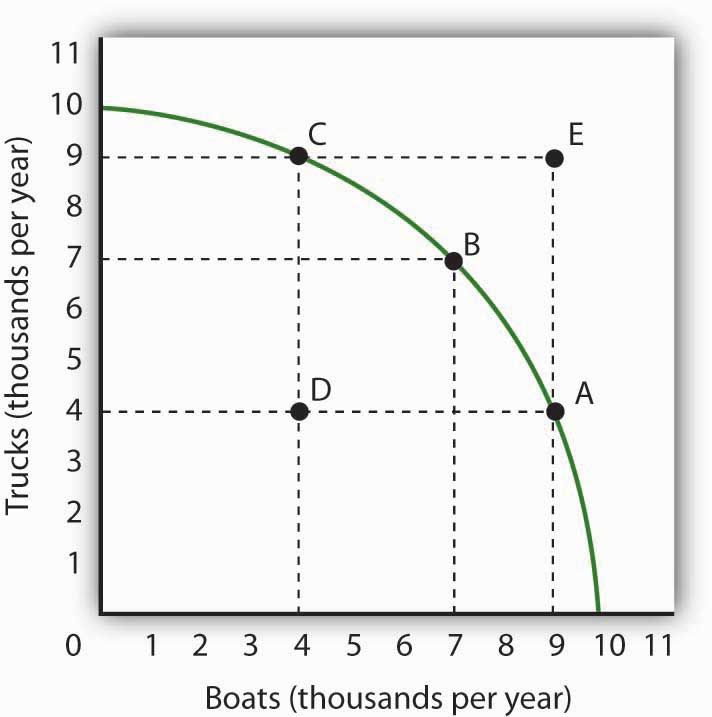

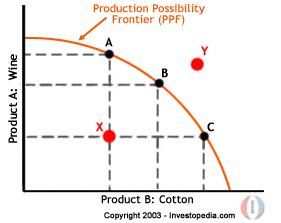

Point A inside this Production Possibilities Curve represents:
Resources are being inefficiently used
Production is not attainable
Production is possible if there is an increase in resources
Production possibilities are going to decrease

George earns a $250 bonus at his job for increasing his output by an additional 50% two weeks in a row. He makes a list of what he wants to buy with his bonus: 1: the latest model of Adidas athletic shoes; 2: Air Pods; 3: a new coat. He buys Adidas. What is his opportunity cost?
the Air Pods
the shoes
the coat
the cash

