
 Worksheets
Review in Science 8
Total questions: 50
Worksheet time: 27mins
Where does mechanical digestion in man start?
mouth
esophagus
stomach
small intestine
What part of the digestive system connects the mouth to the stomach?
pharynx
esophagus
small intestine
large intestine
How do these villi help the digestive process?
They protect the intestine from acid
They break food into smaller pieces
They move food faster through the intestines
They increase the surface area for nutrient absorption
Which part of the digestive system is the doctor talking about?
Esophagus
Small intestine
Stomach
Large intestine
Which pair correctly matches each with its principal function?
Small intestine - elimination; Large intestine - nutrient absorption
Small intestine - mechanical digestion; Large intestine - chemical digestion
Small intestine - nutrient absorption; Large intestine - water absorption and waste formation
Small intestine - acid production; Large intestine - bile storage
Which strategy should be prioritized to address the most common issue for diarrhea?
Educate students about chewing food thoroughly to prevent GERD.
Increase fiber intake in the school menu to reduce constipation.
Promote proper handwashing and food safety to prevent diarrhea.
Encourage more caffeinated drinks to improve digestion
Which two systems work together to handle food and waste?
Circulatory and muscular
Digestive and excretory
Respiratory and skeletal
Nervous and reproductive
How do the digestive and circulatory systems work together to make this happen?
The circulatory system absorbs nutrients, and the digestive system carries oxygen
The digestive system breaks down food and the circulatory system delivers nutrients to body cells
The circulatory system digests fats and the digestive system moves blood
Both systems remove solid waste from the body
What role does the stem primarily play in the plant's transport system?
It absorbs minerals from the soil
It produces food through photosynthesis
It carries water and nutrients between roots and leaves
It stores food and water
Why are the leaves of the broken-stem plant turning yellow?
The roots are absorbing too much sunlight
Water and nutrients can't reach the leaves through the damaged stem
The leaves are not exposed to enough air
The roots are no longer attached to the soil
Which tissue is most likely malfunctioning if the leaves of the plants becomes color yellow?
Xylem, because it moves sugars
Phloem, because it transports nutrients
Guard cells, because they photosynthesize
Stomata, because they store minerals
Which advice would be MOST helpful if you want to take care of your plant?
Water only the leaves, not the soil
Keep the plant in a dark area to avoid water loss
Make sure the roots have access to water and the plant gets enough sunlight
Cut the stem to allow faster transport
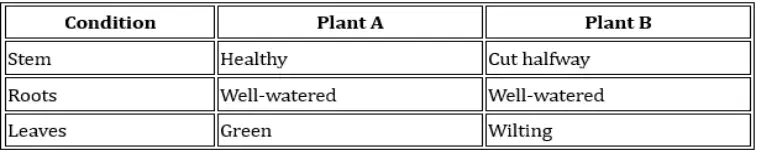
What conclusion can be drawn from the comparison?
The leaves are not responsible for photosynthesis
A cut stem can prevent water from reaching the leaves
Well-watered roots guarantee healthy leaves
The stem has no role in water transport
Which of the following best describes how the transport system contributes to this process?
The stem blocks minerals from entering the plant
Leaves store the minerals from the soil
Water and minerals are transported from roots to leaves through the stem
Roots produce the food needed for the leaves
Which term best describes an individual who has two identical alleles for a particular trait?
Heterozygous
Homozygous
Dominant
Recessive
Who is known as the father of genetics for his work on inheritance using pea plants?
Charles Darwin
Gregor Mendel
James Watson
Francis Crick
Why do offspring inherit traits from both parents?
Both parents supply an equal portion of chromosomes to their child
Only the father's DNA determines the characteristics of the child
Traits are determined by random environmental factors alone
The child's features depend only on the dominant genes from one parent
If brown is dominant, how can you explain the presence of students with blue eyes?
Blue eyes are dominant
Eye color is not inherited
Both parents must carry blue eye allele
They all got their eye color from one parent
Jessa and Mark can both roll their tongues, a dominant trait. They are surprised when their son, Carlo, cannot roll his tongue.
What does this suggest about Jessa and Mark's genetic makeup?
Carlo has a speech disorder that affects his tongue movement
Jessa and Mark both carry the recessive allele for tongue rolling
Tongue rolling is not inherited but learned through practice
Jessa and Mark both passed on dominant alleles to their child
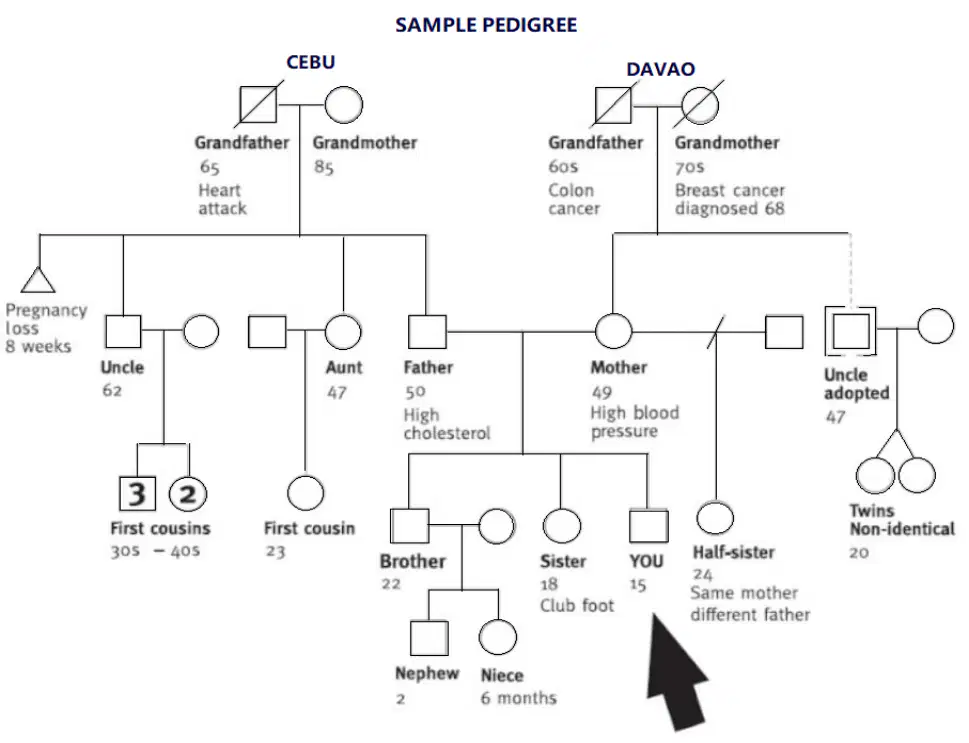
Which side shows a greater prevalence of cardiovascular-related conditions, and what evidence from the chart supports your conclusion?
Maternal side, because both the mother and her father had heart-related conditions
Paternal side, because the father has high cholesterol and the maternal grandfather had colon cancer
Paternal side, because the father has high cholesterol and the paternal grandfather died of a heart attack
Maternal side, because the maternal grandmother had breast cancer and high blood pressure
In a Punnett square, what does each box represent?
The genetic material of an individual
A possible genetic combination in offspring
The number of alleles in a population
The dominant genes only
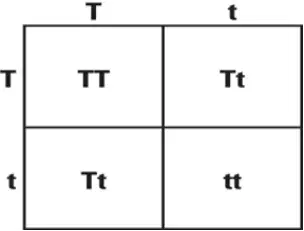
What is the reason why three out of four plants are tall?
Tall is a recessive trait
There are more T alleles than t alleles
Tall is a dominant trait, so TT and Tt are both tall
Only TT is tall, so there should only be one tall plant
If the technician crossbreeds two heterozygous eggplants (RrLl × RrLl), which of the following best explains how the results of the dihybrid cross can be used in improving eggplant production?
All offspring will be pest-resistant and have large fruits, making selection unnecessary.
The offspring will show all possible combinations of traits, allowing selection of the best-performing plants for future planting.
The offspring will all be weak because mixing traits causes mutation.
The offspring will be identical to the parent plants, maintaining the same yield as before.
Carlos noticed that both his parents have dimples, a dominant trait. However, his younger sister, Andrea, has no dimples. Curious, Carlos researched that dimples (D) are dominant, and no dimples (d) are recessive. To understand how Andrea inherited her trait, Carlos created a Punnett square using cut-up index cards labeled D and d to represent alleles from each parent. He assigned the genotypes Dd × Dd to his parents, since both show dimples but still produced a child without dimples.
Based on the Punnett square created by Carlos, what is the probability that a child in their family would not have dimples?
0%
25%
50%
75%
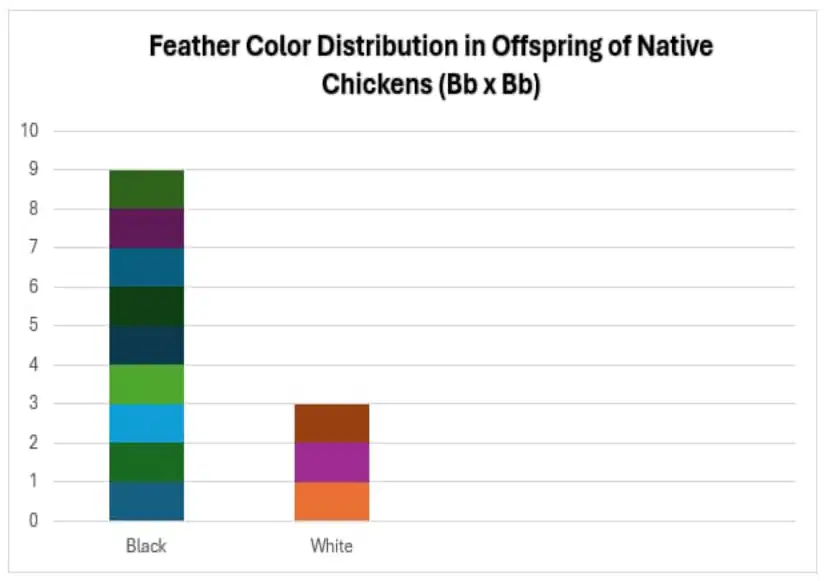
In an science-agri fair in GFLMNHS, a group of junior high school students conducted a science investigation on the inheritance of feather color in native chickens. They discovered that black feathers (B) are dominant over white feathers (b). They crossed two heterozygous, black-feathered chickens (Bb × Bb) and recorded the number of offspring with each feather color. Below is the bar graph showing the results of their breeding experiment:
Based on the bar graph and the genetic cross performed, which conclusion best explains the observed feather color distribution in the offspring?
The parent chickens were both homozygous dominant, so all chicks should have black feathers.
The white feather trait is dominant and appears in 25% of the offspring.
The cross resulted in a 3:1 phenotypic ratio, confirming that both parents were heterozygous for feather color.
Half of the chicks should have white feathers because one parent carried the white gene.
Students in Barangay High School in Batangas Province are debating about the use of genetic crosses in agriculture as an effective way to improve the quality of crops and livestock in their barangay. Statement: "Genetic crosses are a reliable way to improve traits such as disease resistance and yield in crops and animals commonly raised in rural communities like Nonong Casto." How should you evaluate this statement?
Agree - Because genetic crosses follow predictable patterns of inheritance that can help produce offspring with desired traits.
Disagree - Because genetic crosses are too random and cannot guarantee better traits in the next generation.
Agree - Because crossing any two organisms always produces perfect offspring with no negative traits.
Disagree - Because it is illegal to apply genetic crosses to local crops and animals in the Philippines.
Which domain contains organisms that can survive in extreme environments like hot springs or salt lakes?
Bacteria
Eukarya
Archaea
Protista
Which of the following correctly lists the six kingdoms in the current biological classification system?
Animalia, Plantae, Fungi, Protista, Monera, Algae
Animalia, Plantae, Fungi, Protista, Bacteria, Archaea
Animalia, Plantae, Fungi, Protista, Eubacteria, Archaebacteria
Animalia, Plantae, Protista, Algae, Virus, Monera
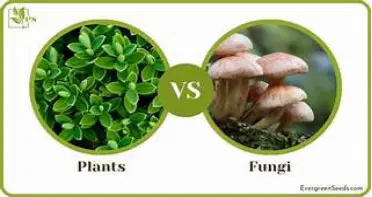
Based on the illustration, why is the plant green and the fungus not?
The plant uses chlorophyll to capture sunlight for photosynthesis, while the fungus does not.
The plant is more evolved than the fungus, so it has chlorophyll.
The plant absorbs nutrients from the soil, which gives it a green color, while the fungus absorbs nutrients from air.
The plant's green color is due to its lack of sunlight, unlike the fungus, which thrives in the shade.
During a class field trip to the La Mesa Eco Park in Quezon City, students observed different organisms in the forest area, such as the Philippine tarsier, narra tree, and a variety of insects. The group was tasked to classify the Philippine tarsier which is a primate, using the hierarchical biological classification system. The scientific name of the Philippine tarsier is Tarsius syrichta. Based on their observations and research, which of the following best describes the classification of the Philippine tarsier from broadest to most specific?
Animalia → Chordata → Mammalia → Primates → Tarsiidae → Tarsius → Tarsius syrichta
Mammalia → Chordata → Animalia → Tarsiidae → Tarsius → Primates → Tarsius syrichta
Animalia → Mammalia → Chordata → Tarsius → Primates → Tarsiidae → Tarsius syrichta
Animalia → Chordata → Primates → Mammalia → Tarsius → Tarsiidae → Tarsius syrichta

Which classification is most accurate for these organisms?
A and C belong to the same domain.
A is in Domain Archaea; C is in Domain Bacteria.
B and C belong to Kingdom Protista.
All three are from the same domain.

How does the table indicate that a cat is more closely related to bobcat than a ferret?
The cat and bobcat both belong to the order Carnivora, but the ferret does not.
The cat and bobcat are both mammals, while the ferret is classified as a reptile.
The cat and bobcat share the same genus, while the ferret belongs to a different genus.
The cat and bobcat share the same family, while the ferret belongs to a different family.
Which of the following characteristics is most commonly found in all mammals?
Lays eggs in water
Feathers for insulation
Produces milk for their young
Scales covering the body
Why are humans, like other mammals, warm-blooded?
Their body temperature changes with the environment.
They only live in warm places.
They can maintain a constant internal body temperature.
They need to stay in direct sunlight to stay warm.
Humans are classified under the order Primates. Why?
They are the only animals that walk on two legs
They are intelligent and live in large groups
They have forward-facing eyes, grasping hands, and large brains relative to body size
They eat both plants and animals
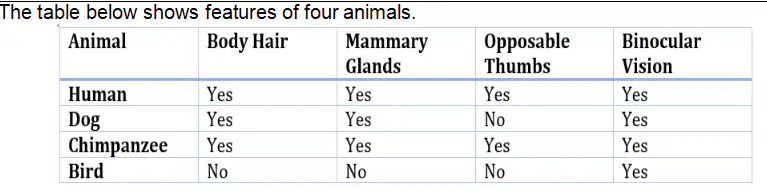
Based on the table, which two animals are most closely related in classification?
Human and Dog
Dog and Bird
Human and Chimpanzee
Chimpanzee and Bird
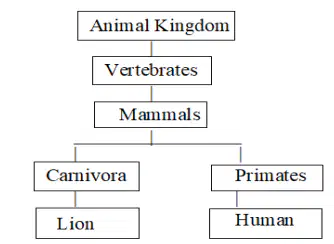
Examine the diagram of a simple classification tree. Which feature below best supports placing humans under "Primates" and not "Carnivora"?
Humans hunt animals for food
Humans have claws for defense
Humans have opposable thumbs and flexible limbs
Humans live in groups or families
A learner claims that humans should not be grouped with primates because "we are more intelligent and civilized." How would you respond using scientific classification?
Agree, because intelligence makes humans a separate class.
Disagree, because classification is based on physical and genetic traits, not behavior or intelligence.
Agree, because primates are not capable of advanced thinking.
Disagree, because humans are classified by cultural behavior.
Why are both plants and animals important in natural cycles like the carbon and oxygen cycles?
They keep water from evaporating too quickly.
They balance the gases in the atmosphere by exchanging oxygen and carbon dioxide.
They stop each other from overproducing oxygen.
They remove all carbon from the environment to keep the air clean.
Which of the following best describes the role of plants in the oxygen cycle?
Plants take in oxygen during the day and release carbon dioxide at night.
Plants produce oxygen during photosynthesis, which animals use for breathing.
Plants absorb oxygen from the air and store it in their roots.
Plants release oxygen only when animals are nearby to use it.
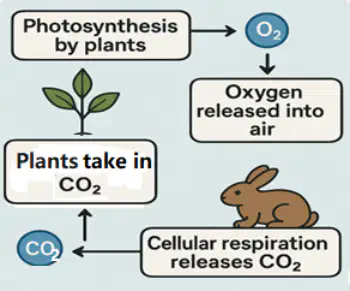
Based on the diagram below, what would most likely happen to the oxygen level in the atmosphere if a large number of trees were cut down?
The oxygen level would remain the same because animals also produce oxygen.
The oxygen level would increase due to the decrease in CO2.
The oxygen level would decrease because fewer plants would be available to produce oxygen.
The oxygen level would stay high because animals would breathe more to compensate.

Compare the roles of plants and animals in the carbon and water cycles using the table below: Which conclusion can be drawn from the comparison?
Plants and animals both add carbon and water to the environment in equal amounts.
Only animals participate in the carbon and water cycles.
Plants remove carbon while animals release it, but both release water vapor.
Plants have no role in the water cycle, only the carbon cycle.
Which of the following is the main raw material needed for photosynthesis?
Oxygen
Glucose
Carbon dioxide
ATP
What are the two main products of photosynthesis?
Oxygen and Glucose
Carbon dioxide and Water
ATP and Heat
Glucose and Lactic acid
Which of the following best describes the relationship between photosynthesis and respiration?
Both processes produce glucose as a product.
The products of photosynthesis are the raw materials for respiration.
Photosynthesis occurs in mitochondria while respiration occurs in chloroplasts.
Both processes occur only in plant cells.
Which statement best describes the role of cellular respiration in living organisms?
It captures light energy from the sun.
It produces glucose molecules for food storage.
It converts oxygen into glucose for energy storage.
It breaks down glucose to release usable energy (ATP) for cell activities.
Why does photosynthesis stop at night in most plants?
Plants rest during the night.
The air is cooler at night, stopping photosynthesis.
Plants close their leaves and stop absorbing water.
Photosynthesis requires sunlight to convert carbon dioxide and water into glucose and oxygen.
Which organelle is responsible for carrying out photosynthesis in plant cells?
Mitochondria
Nucleus
Ribosome
Chloroplast
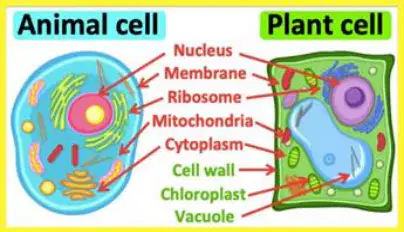
Why does photosynthesis happen only in plant cells and not in animal cells?
Animal cells have more mitochondria
Animal cells store light energy in vacuoles
Only plant cells have chloroplasts to trap sunlight
Animal cells don't need energy to survive
Two students wanted to find out if water is really needed for plants to make their own food through photosynthesis. They designed the following experiments: Student A placed a plant in a dark room and also stopped watering it. Student B placed a plant in sunlight and allowed it to receive air (carbon dioxide) but did not give it water. Which student planned a better investigation, and why?
Student A, because removing more materials shows stronger results.
Student B, because plants can make food using just sunlight and air.
Student A, because sunlight and water work together, so both should be removed.
Student B, because only water was removed, making it easier to test its specific role in photosynthesis.

