
 Worksheets
Plastic and Reconstructive Surgery - review
Total questions: 64
Worksheet time: 32mins
Adriana was born just a few minutes ago and has been diagnosed with cheiloschisis. How was the diagnosis made?
By physical examination at birth
By genetic testing before birth
By blood test after birth
By ultrasound during pregnancy
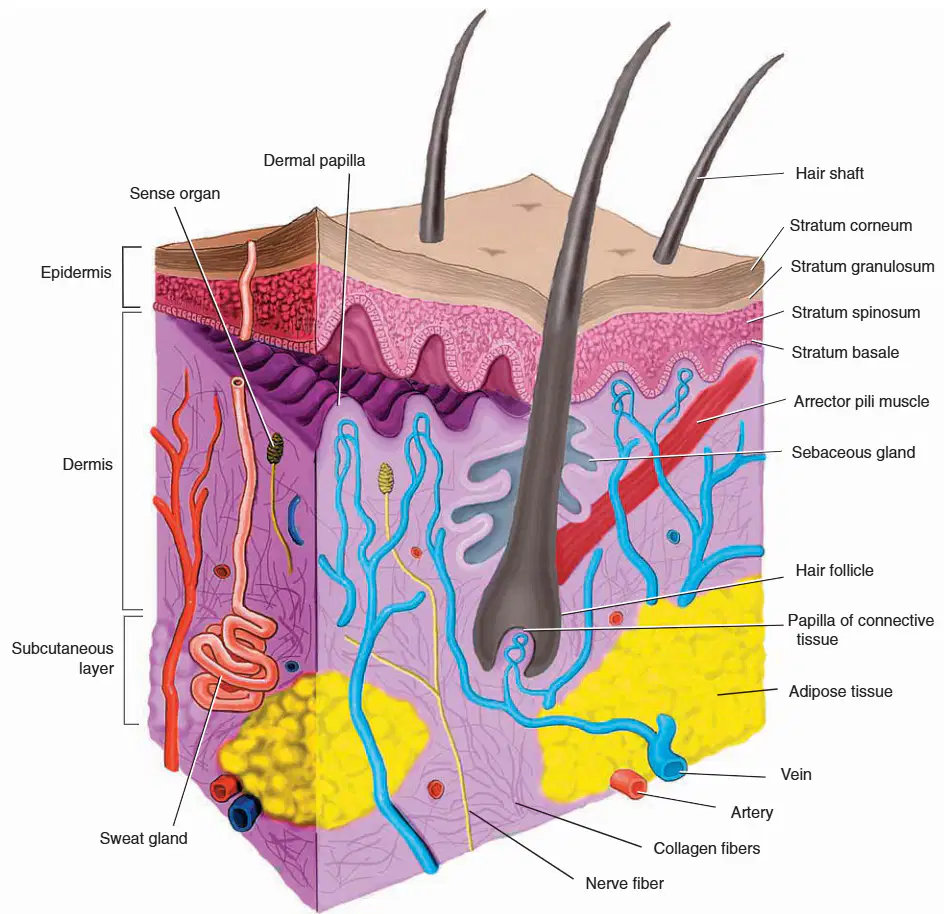
Which layer is responsible for providing strength and elasticity to the skin?
Epidermis
Reticular layer of the dermis
Subcutaneous layer
Stratum corneum
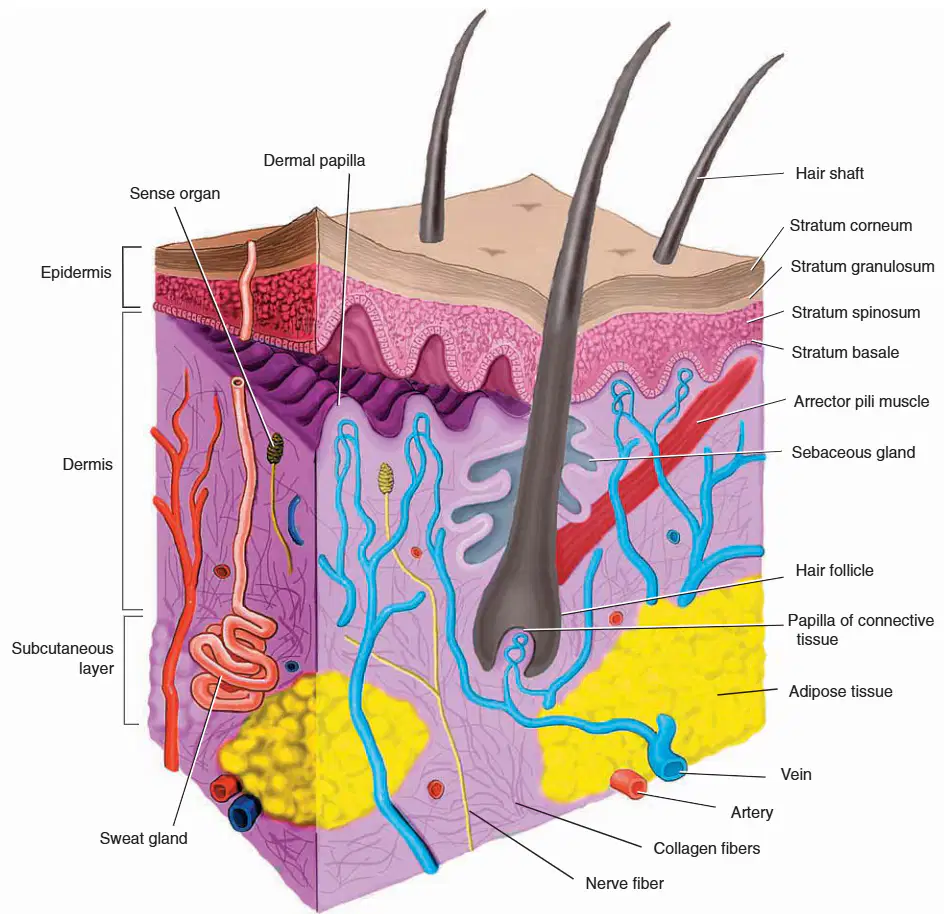
Refer to the diagram of the structure of the skin. The process of keratinization begins in which layer?
Stratum corneum
Stratum granulosum
Stratum lucidum
Stratum basale

The stratum lucidum is present only in which areas of the body?
(a)
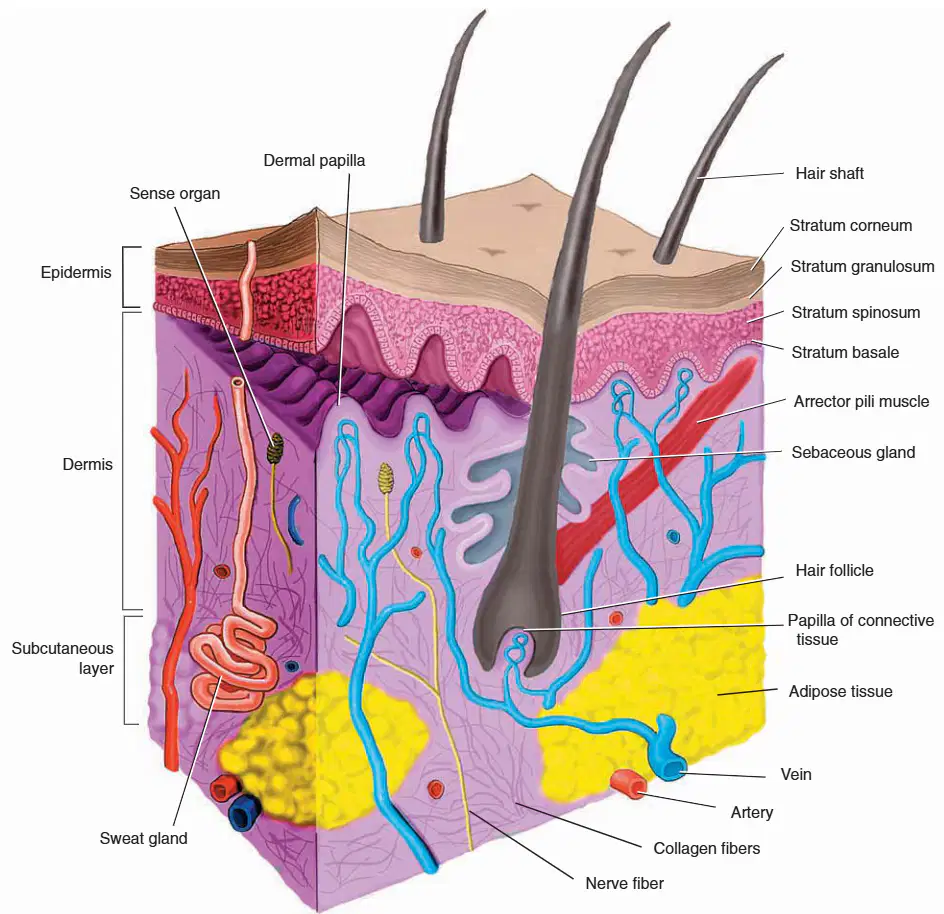
What is the main function of the stratum corneum?
(a)

Refer to the diagram of the structure of the skin. The papillary layer of the dermis is responsible for which of the following?
Providing collagen for strength
Groundwork for fingerprints
Producing sweat
Storing fat
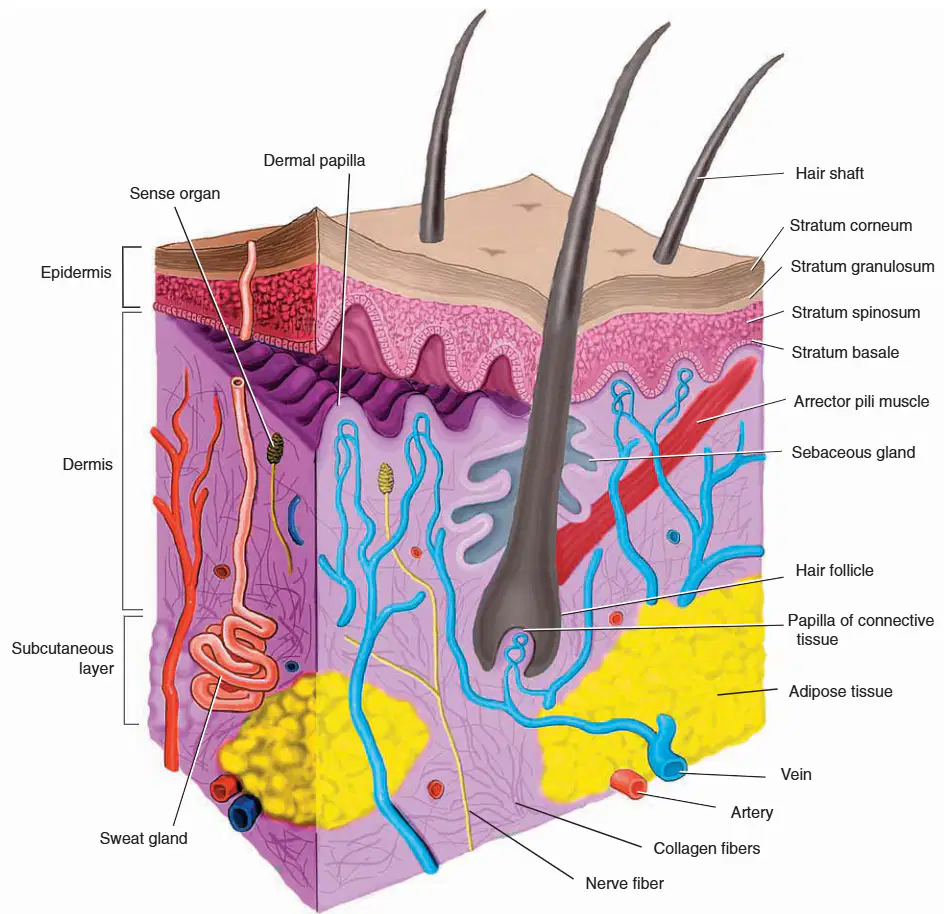
Refer to the diagram of the structure of the skin. What is the function of the sebaceous gland?
(a)
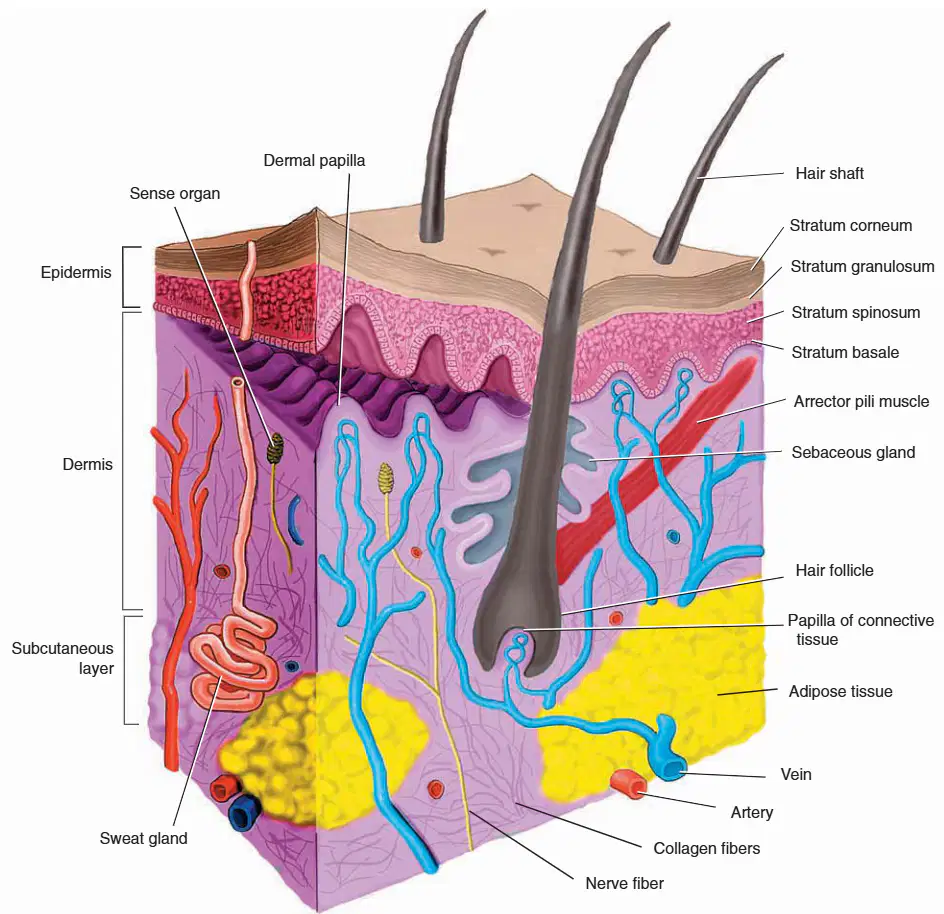
Refer to the diagram of the structure of the skin. How long does it take for newly formed epithelial cells to reach the body surface and be shed?
(a)
What is the subcutaneous layer also known as?
(a)
Which of the following is NOT considered an accessory structure to the integumentary system?
Hair
Nails
Sweat glands
Bones
What is the main function of sebum produced by sebaceous glands?
(a)
Which type of sweat gland is larger and located in the external genitalia and axillae?
(a)
How many carpal bones are present in each wrist?
(a)

Figure 19-2 shows the development of which part of the body?
(a)
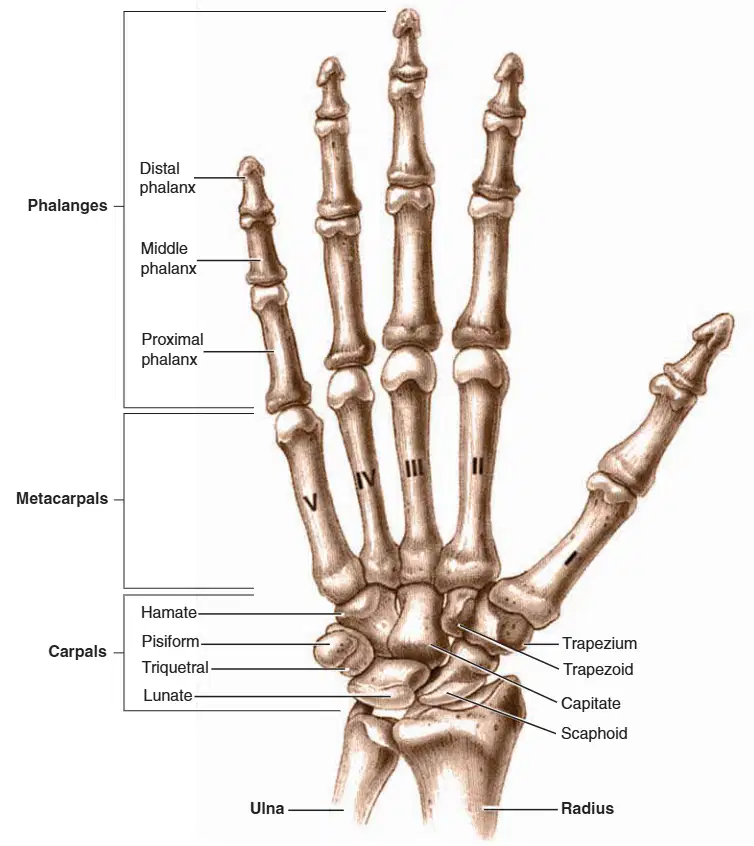
Refer to the diagram of the bones of the hand. Which bone is labeled as the most distal bone in each finger?
Proximal phalanx
Middle phalanx
Distal phalanx
Metacarpal
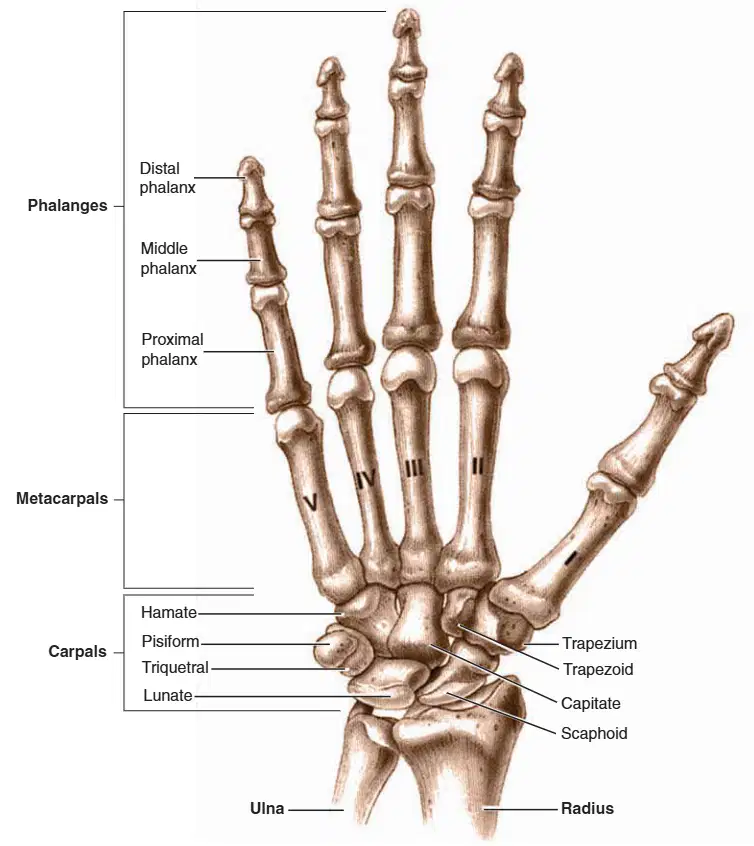
Refer to the diagram of the bones of the hand. The bone that articulates with the distal radius and forms part of the wrist is the (a) .
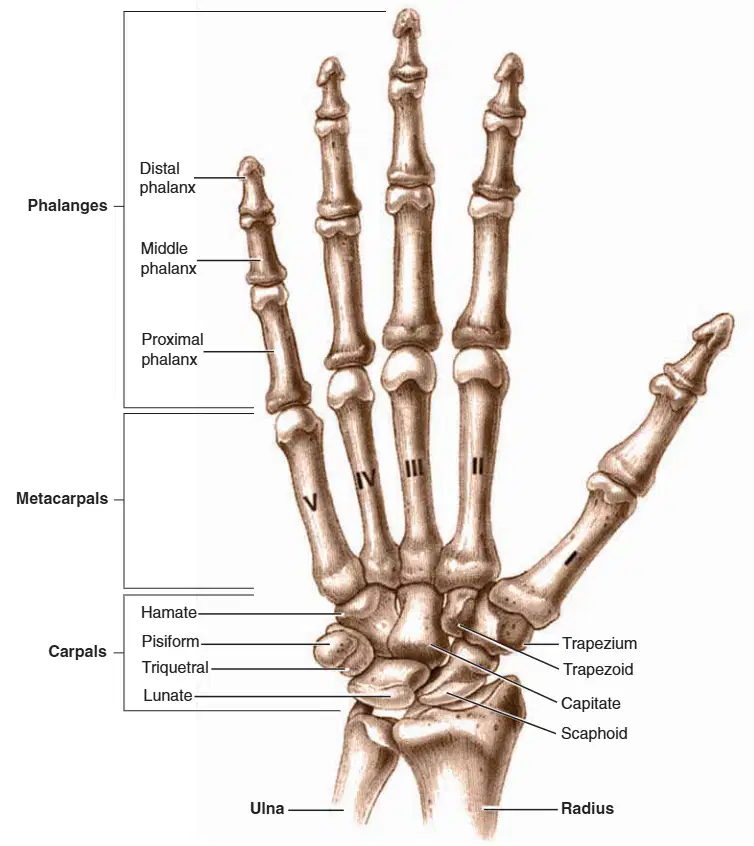
Refer to the diagram of the bones of the hand. The phalanx closest to the metacarpal is called the (a) phalanx.
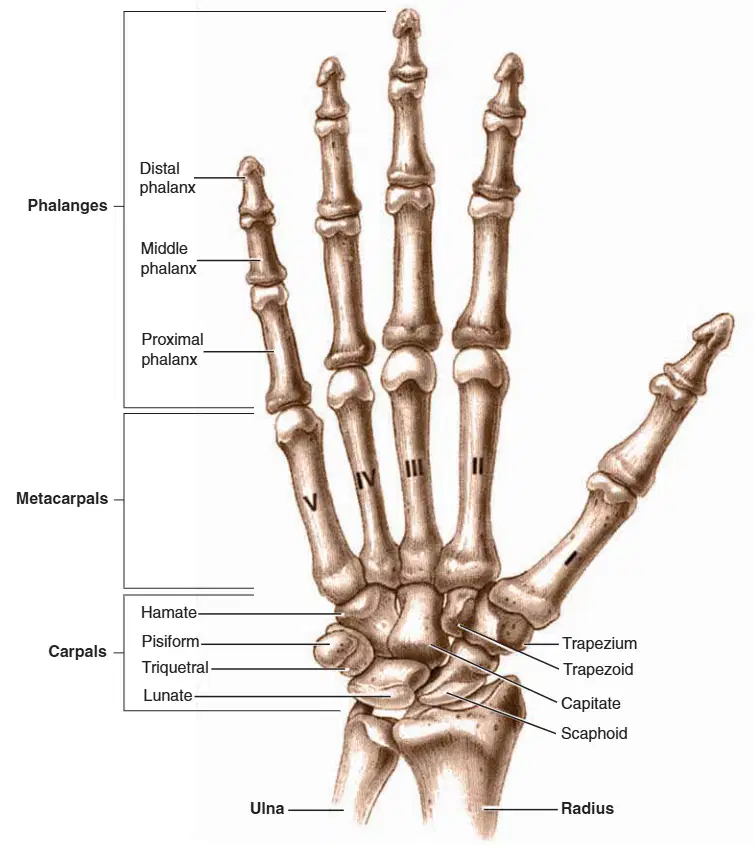
Refer to the diagram of the bones of the hand. Which bone is NOT a carpal bone?
Lunate
Capitate
Radius
Trapezoid
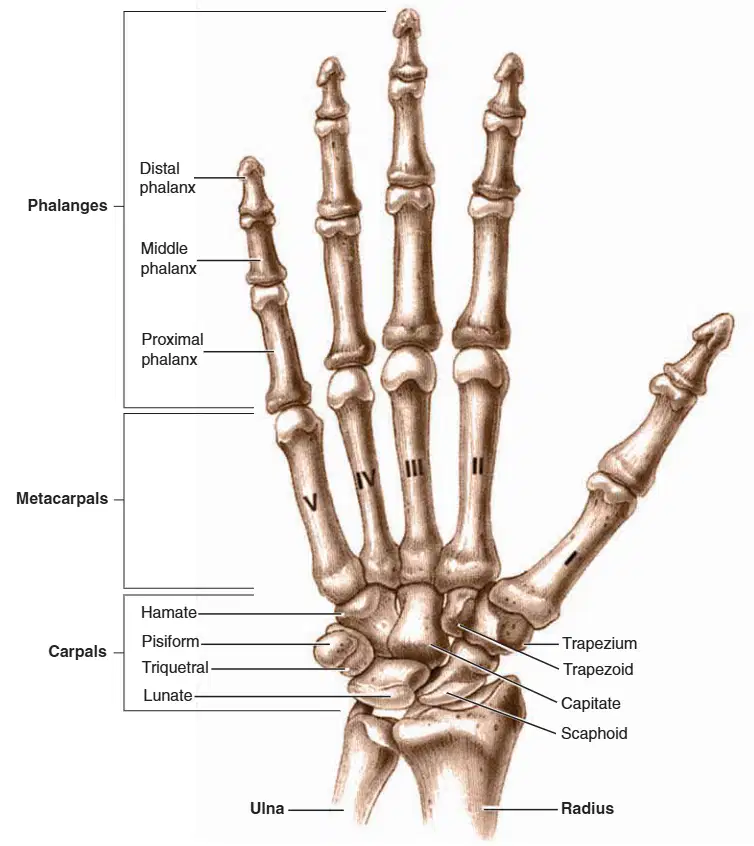
The thumb has how many phalanges?
(a)
The bone that is located on the lateral side of the forearm and articulates with the carpal bones is the (a) .
The joint between the metacarpal and phalanx is called the (a) joint.
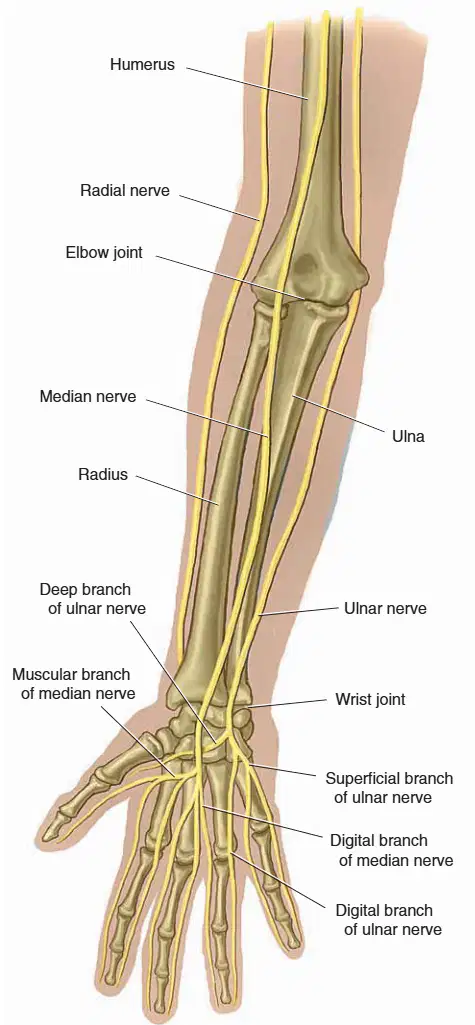
Which nerve is responsible for feeling in the skin of the medial third of the hand and some of the flexor muscles of the hand and wrist?
Radial nerve
Median nerve
Ulnar nerve
Deep branch of ulnar nerve
What is the main function of the tendon sheaths in the fingers and thumbs?
To provide blood supply
To protect the bones
To hold the tendons in approximation to the bones they pass over
To generate movement
Fill in the blank: The (a) artery divides to form the radial and ulnar arteries just distal to the elbow joint.
The purpose of the synovium in the compartments of the hand is to:
produce synovial fluid for lubrication
attach muscles to bones
transmit nerve signals
store calcium for bone growth
Which ligament covers the compartments on the dorsal side of the hand?
Transverse carpal ligament
Dorsal carpal ligament
Annular ligament
Palmar ligament
Burns can be caused by several sources. Select two sources mentioned in the text.
Heat and chemicals
Water and wind
Light and sound
Friction and cold

Refer to the diagram labeled 'A' (Anterior view) of the muscles of the forearm and hand. Which muscle is located on the lateral side of the forearm and is responsible for flexing the wrist?
Flexor carpi radialis
Extensor digitorum
Dorsal interossei
Extensor carpi ulnaris

Refer to the diagram labeled 'B' (Dorsal view) of the muscles of the forearm and hand. Which muscle is responsible for extending the fingers?
Flexor digitorum superficialis
Extensor digitorum
Lumbrical (1st)
Palmaris longus

In the diagram labeled 'C' (Posteromedial view), which muscle is indicated as being responsible for thumb movement and is located near the base of the thumb?
(a)
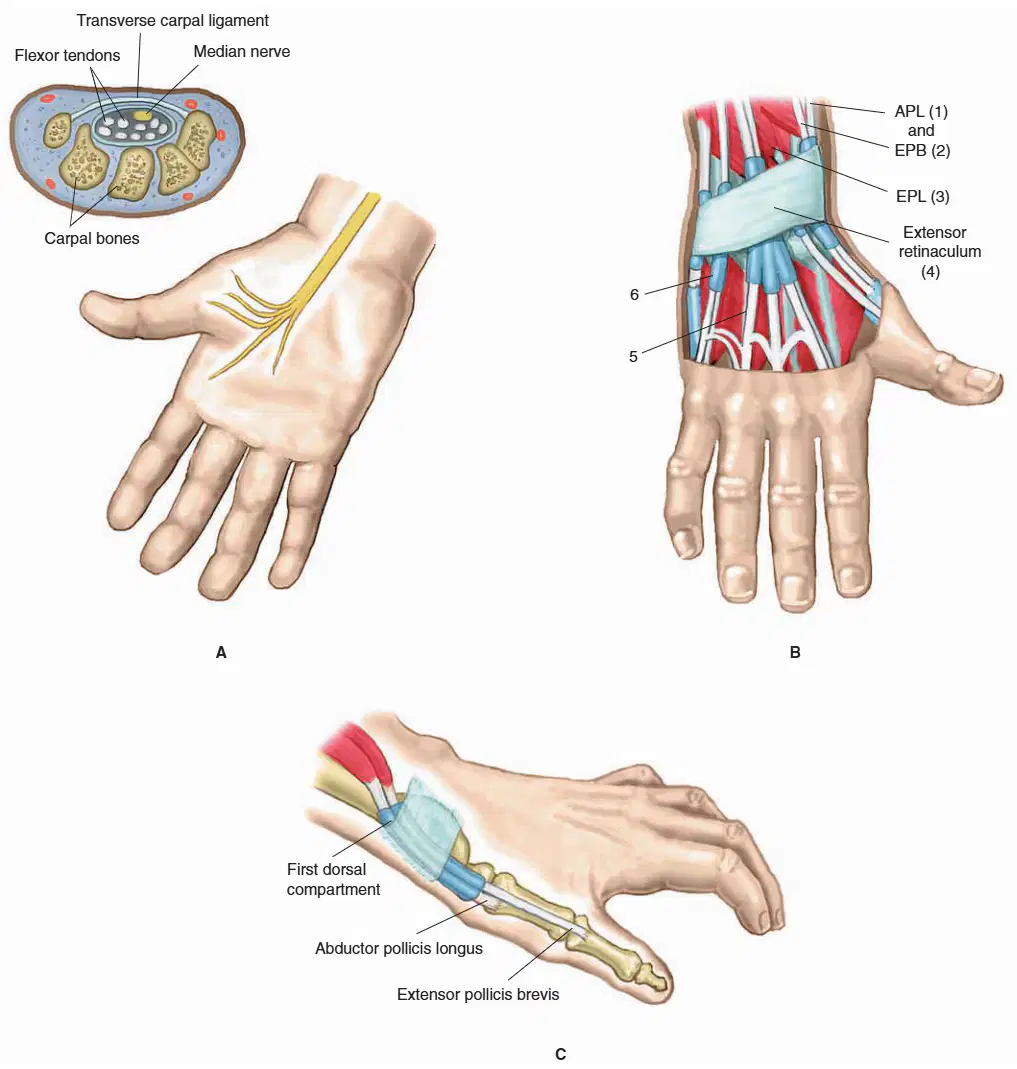
Which structure is indicated as running through the carpal tunnel along with the flexor tendons?
Abductor pollicis longus
Median nerve
Extensor retinaculum
Extensor pollicis brevis

In the diagram labeled 'B' in Figure 19-6, which structure is labeled as number 4?
Extensor retinaculum
EPL
APL
EPB

Fill in the blank: The first dorsal compartment, as shown in diagram 'C' of Figure 19-6, contains the ______ and ______.
(a)

Which of the following is NOT found in the carpal tunnel as shown in diagram 'A'?
Flexor tendons
Median nerve
Carpal bones
Extensor retinaculum
Third-degree burns completely penetrate the full thickness of the skin and often affect the underlying structures.
True
False
Fill in the blank: Superficial second-degree burns generally heal within (a) and do not leave a scar.
Which term is used to refer to the charred or pearly white appearance of third-degree burns?
Eschar
Scar
Graft
Retinaculum
What are fourth-degree burns referred to as?
(a)
Which of the following is NOT a criterion for the Abbreviated Burn Severity Index (ABSI)?
A) Age of the patient
B) Sex of the patient
C) Blood pressure of the patient
D) Depth of the burn
Fill in the blank: The Lund-Browder method uses a chart with variables according to (a) to estimate body surface area (BSA) affected by burns.
Patients with severe burns will require immediate intensive therapy to sustain life.
True
False
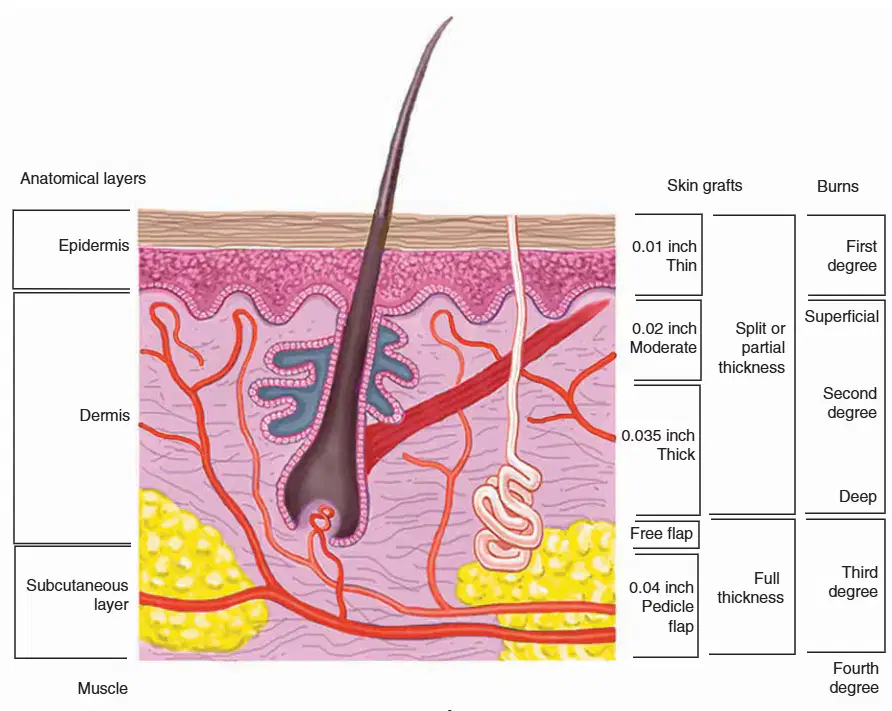
Which layer is located directly below the dermis?
Epidermis
Dermis
Subcutaneous layer
Hypodermis
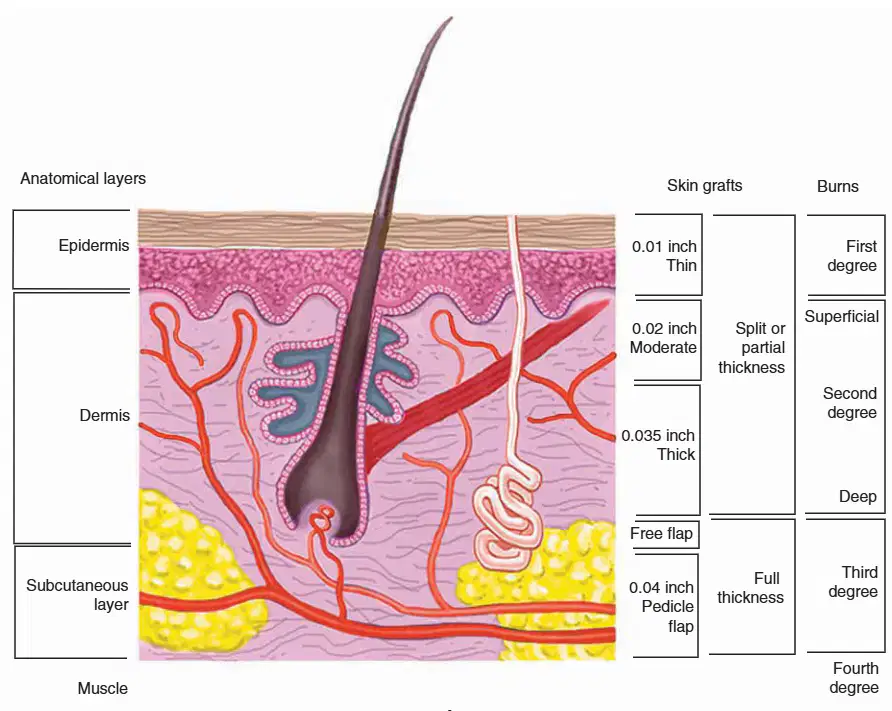
According to the diagram, what degree of burn is associated with damage only to the epidermis?
First degree
Second degree
Third degree
Fourth degree
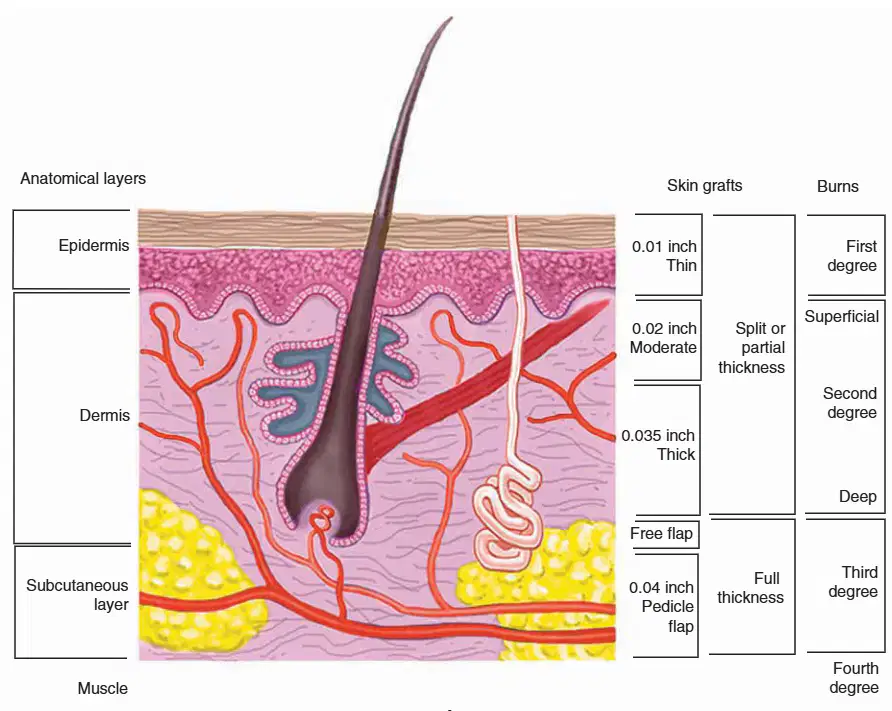
Fill in the blank: A burn that extends through the epidermis and dermis, affecting the subcutaneous layer, is classified as a (a) degree burn.
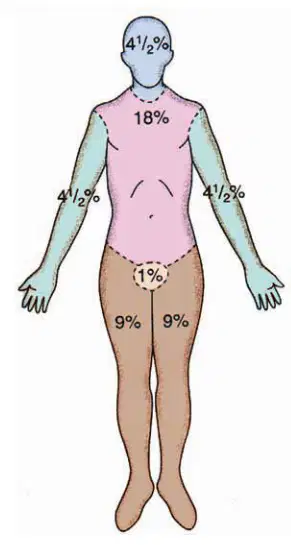
According to the rule of nines diagram, what percentage of the total body surface area does each leg represent in an adult?
9%
18%
12%
15%
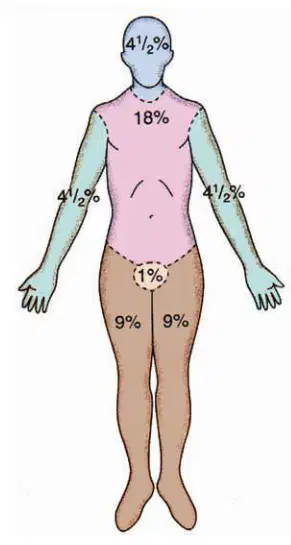
According to the rule of nines, the anterior trunk accounts for 18% of the total body surface area.
True
False
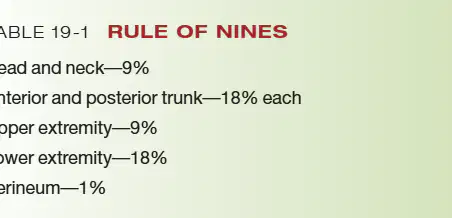
According to the Rule of Nines, what percentage of the total body surface area does the head and neck represent?
9%
18%
1%
27%
Name the three main causative agents of acne
(a)
Which of the following is NOT a sign of aging skin as described in the text?
A) Loss of skin elasticity
B) Increased glandular production
C) Slower healing
D) Decreased collagen fibers
What are the three types or bands of ultraviolet (UV) radiation?
(a)
Type B (UVB 290-320 nm) is associated with sunburn and skin cancer.
True
False
What is a cleft lip or palate?
(a)
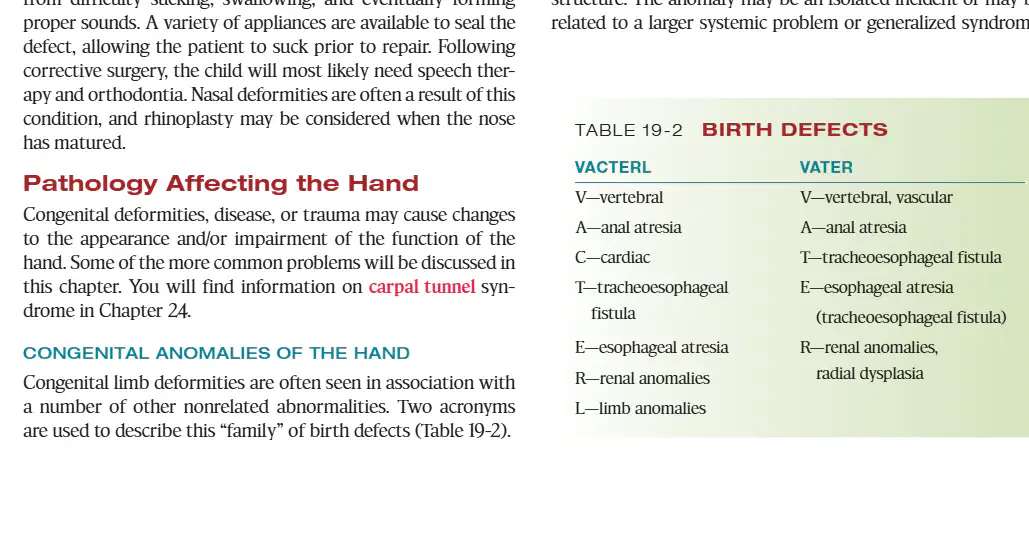
What does the 'V' in the VACTERL acronym stand for in the context of birth defects?
(a)
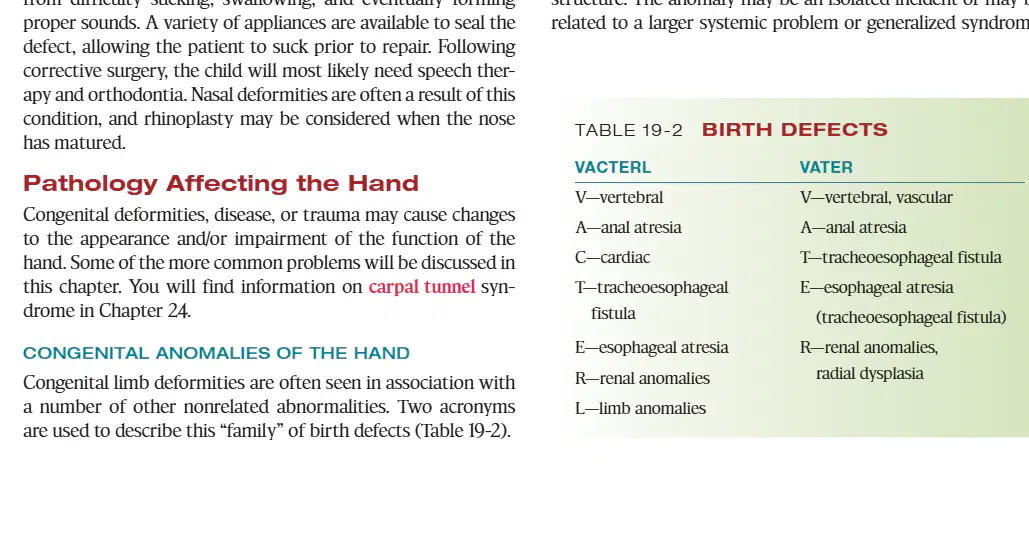
What does the 'A' in the VACTERL acronym stand for in the context of birth defects?
(a)
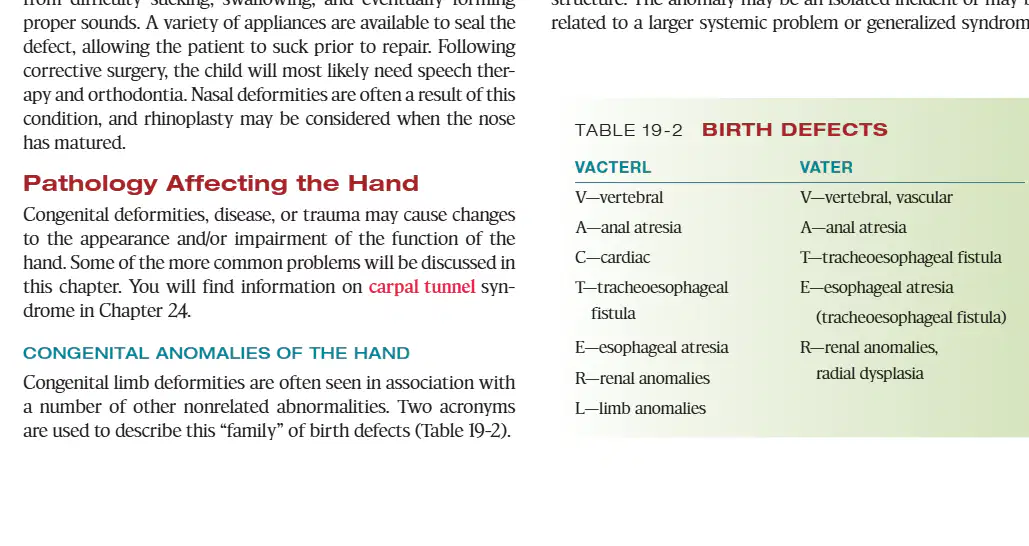
What does the 'C' in the VACTERL acronym stand for in the context of birth defects?
(a)
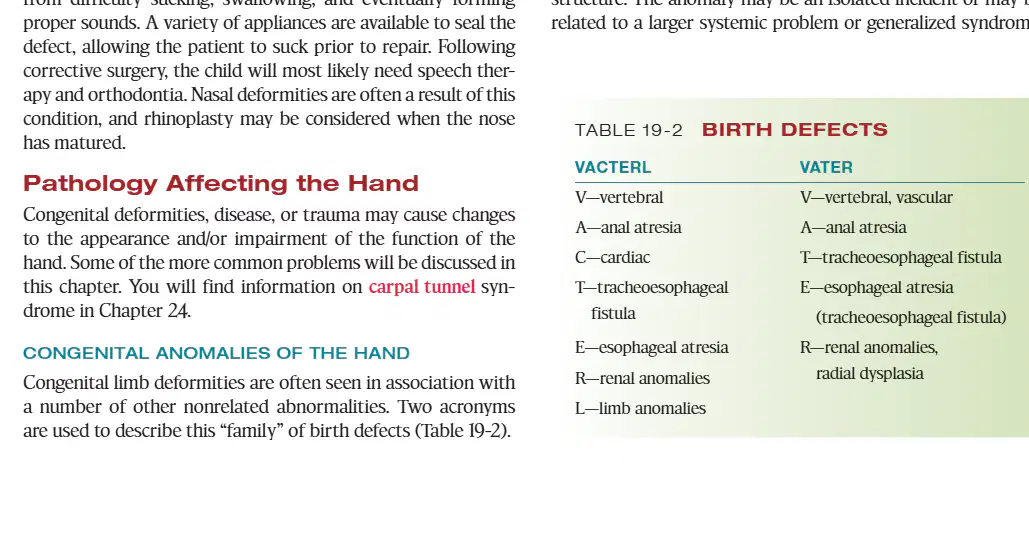
What does the 'T' in the VACTERL acronym stand for in the context of birth defects?
(a)
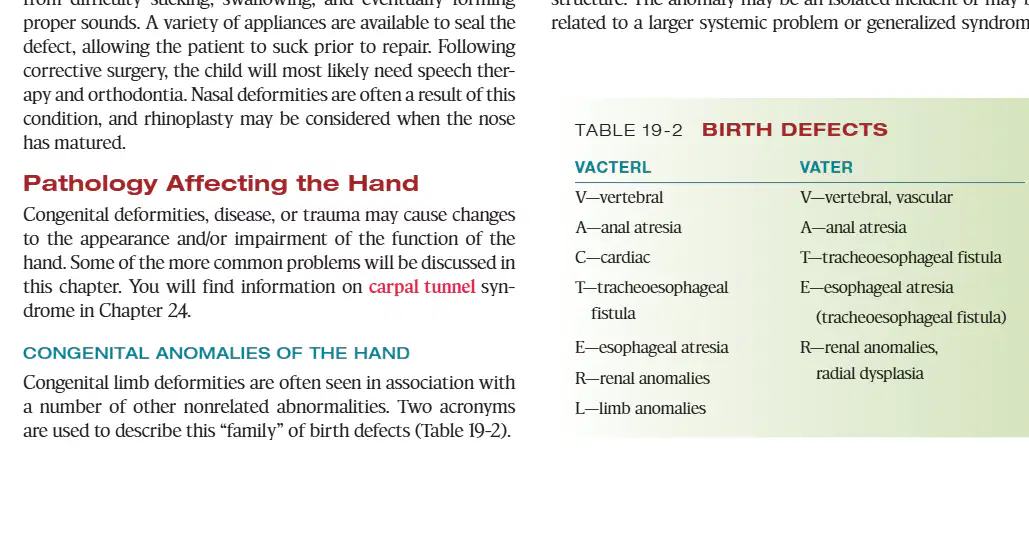
What does the 'E' in the VACTERL acronym stand for in the context of birth defects?
(a)
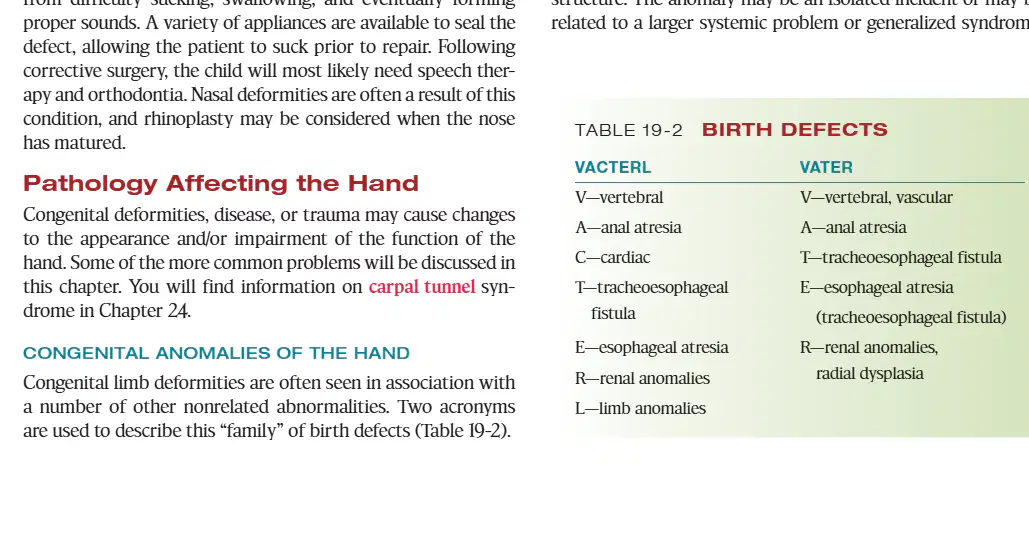
What does the 'R' in the VACTERL acronym stand for in the context of birth defects?
(a)
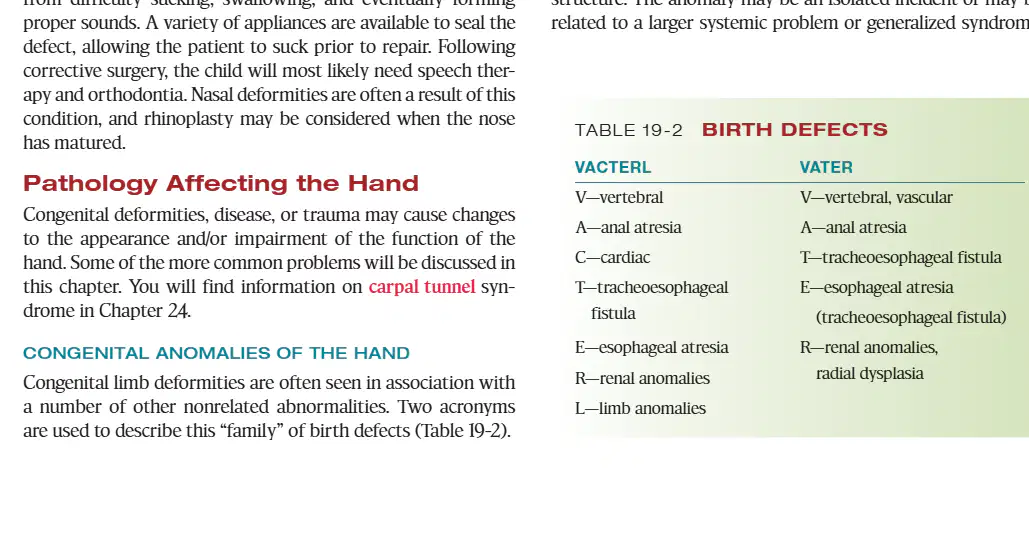
What does the 'L' in the VACTERL acronym stand for in the context of birth defects?
(a)
According to the International Federation of Hand Societies, which of the following is NOT a classified congenital upper limb deformity?
Failure of formation of parts
Overgrowth (gigantism or hyperplasia)
Loss of sensation in the hand
Duplication of parts
Fill in the blank: The failure of the radius and adjacent soft tissues to fully develop, resulting in a deranged hand, is known as (a)
Which environmental factor is mentioned as a possible cause of congenital hand deformities?
Excessive exercise during pregnancy
Maternal exposure to rubella
High protein diet
Lack of sleep
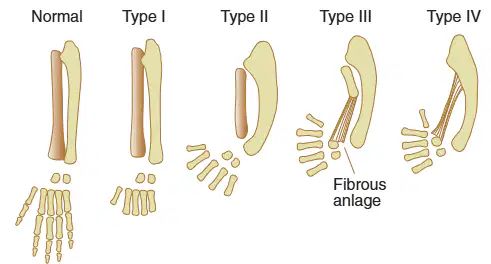
Which type of radial dysplasia is characterized by the absence of the radius and the presence of only the fibrous anlage?
Type I
Type II
Type III
Type IV
Syndactyly is best described as:
Overgrowth of the digits
Webbed or joined digits due to failure to separate
Absence of the hand
Duplication of the thumb

