
 Worksheets
Unit 1 Test Properties of Matter Test Review
Total questions: 50
Worksheet time: 25mins
What is matter?
According to Charles's Law, what happens to the volume of a gas when its temperature increases at constant pressure?
The volume remains the same
The volume decreases
The volume increases
The volume becomes zero
If the pressure on a gas is doubled while the temperature remains constant, what happens to the volume according to Boyle's Law?
It is halved
It doubles
It becomes zero
It remains unchanged
Which of the following best describes the relationship between pressure and volume in Boyle's Law?
Unrelated
Exponentially proportional
Directly proportional
Inversely proportional
Which of the following is an example of a physical change?
Burning wood
Rusting iron
Melting ice
Baking a cake
What happens to the particles in a substance as it is heated?
They stop moving
They move more slowly
They become larger
They move faster
Which method would best separate a mixture of sand and salt?
Distillation
Filtration
Evaporation
Chromatography
Which of the following best describes a pure substance?
It has variable composition.
It contains only one type of particle throughout.
It is always a mixture of elements and compounds.
It can be separated by physical means.
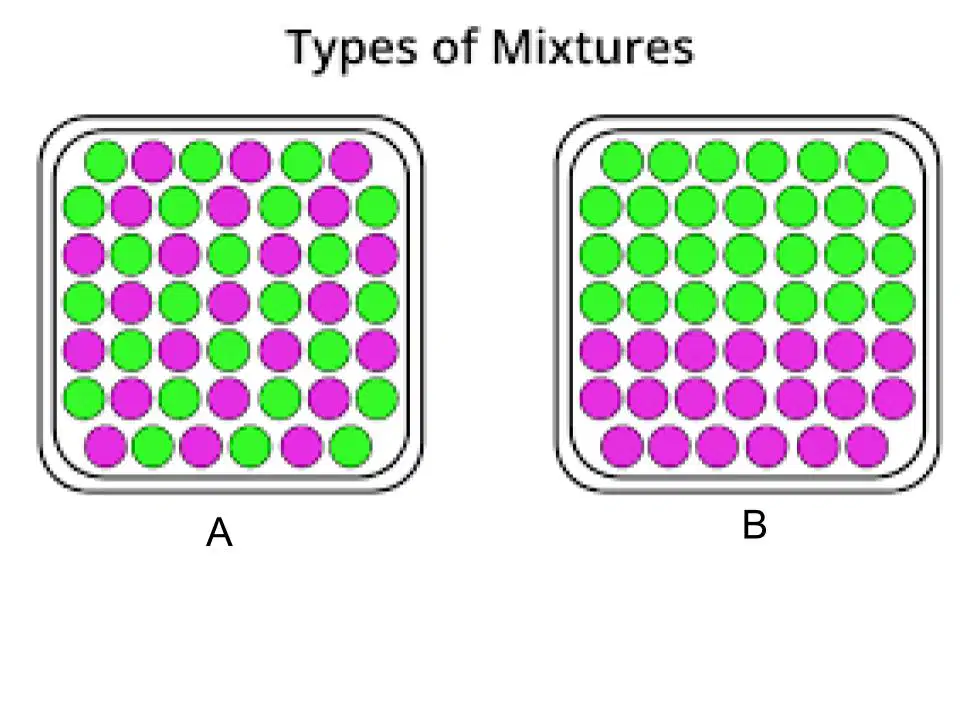
Which of the following is an example of a mixture?
Table salt (NaCl)
Distilled water
Oxygen gas
Air
How can you distinguish a mixture from a pure substance?
A mixture can have varying properties, while a pure substance has consistent properties throughout.
A pure substance can be separated by physical means, but a mixture cannot.
Both mixtures and pure substances have variable composition.
A mixture has a fixed composition, while a pure substance does not.
Which of the following is NOT a physical property of matter?
Density
Boiling point
Flammability
Viscosity
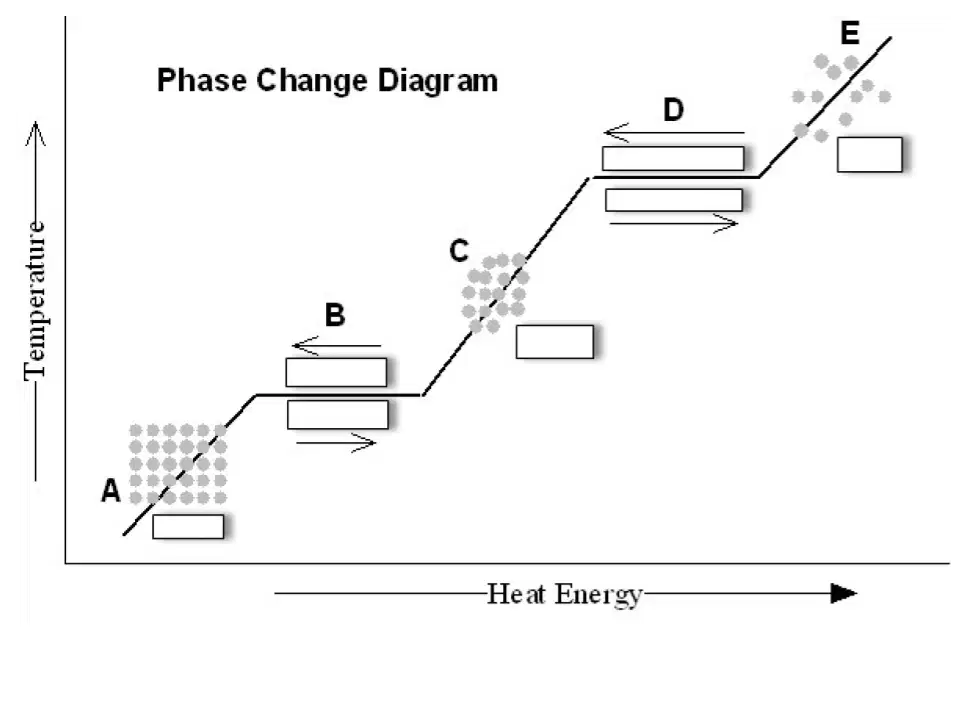
Which phase change occurs when a gas turns directly into a solid?
Condensation
Deposition
Sublimation
Melting
What happens to the temperature of a substance during a phase change?
It fluctuates randomly
It remains constant
It decreases rapidly
It increases rapidly
Which of the following best describes a solvent?
A substance that is dissolved in a solution
A substance that dissolves another substance
A gas that forms bubbles in a liquid
A solid that cannot dissolve in water
When table salt is dissolved in water, which is the solute?
Neither water nor salt
Both water and salt
Salt
Water
Which of the following would most likely increase the rate at which a solute dissolves in a solvent?
Stirring the solution
Using larger solute particles
Decreasing the temperature
Leaving the solution undisturbed
Which formula is used to calculate the density of an object?
Density = Mass × Volume
Density = Mass + Volume
Density = Mass ÷ Volume
Density = Volume ÷ Mass
An object has a mass of 250 g and a volume of 50 cm3. What is its density?
5 g/cm3
0.2 g/cm3
200 g/cm3
300 g/cm3
If two objects have the same volume but different masses, which statement is true about their densities?
The object with greater mass has lower density.
The object with greater mass has higher density.
Density does not depend on mass.
Both objects have the same density.

