
Font size
 Worksheets
11 Bio Tissues Revision
Total questions: 43
Worksheet time: 25mins
Name the three types of muscle tissue found in the human body: _____, _____, and _____.
(a)
Where would you NOT find epithelial tissue?
skin
glands
heart
lining of hollow organs
Match each type of tissue with its primary function.
muscle tissue
Responsible for movement
epithelial
Forms protective layers and linings
Nervous
Transmits signals
Connective
Supports and binds other tissues
How are epithelial tissue classified?
by shape
by size
by number of layers
by shape and number of layers.

Identify the following tissue
Elastic cartilage
Dense connective
Loose connective
Epithelial
What type of Connective Tissue are TENDONS and LIGAMENTS
Dense Connective Tissue
Osseous Tissue
Loose connective Tissue
Cartilage
Match the following biological structures with what they are made up of.
Tissues
Made up of cells
Organs
Made up of tissues
Organ systems
Made up of organs
More cells
Made up of one cell dividing
The four main tissues found in the body are (a) .
Which tissue type is responsible for covering, protection, absorption, & secretion?
Epithelial
Muscular
Connective
Nervous
When an epithelial tissue has 2 or more layers of cells it is said to be...
simple
stratified
pseudostratified
columnar
The type of tissue containing cells within an extracellular matrix of protein fibers and ground substance is
epithelial tissue
connective tissue
muscle
nervous
Muscle tissue, containing skeletal, cardiac and smooth muscle, is responsible for movement due to its ability to
stretch
contract
secrete hormones
absorb mucous

What tissue type is this?
Skeletal muscle
Nervous tissue
Adipose tissue
'Specialised' connective tissue
The contractile unit of a muscle is (a) .
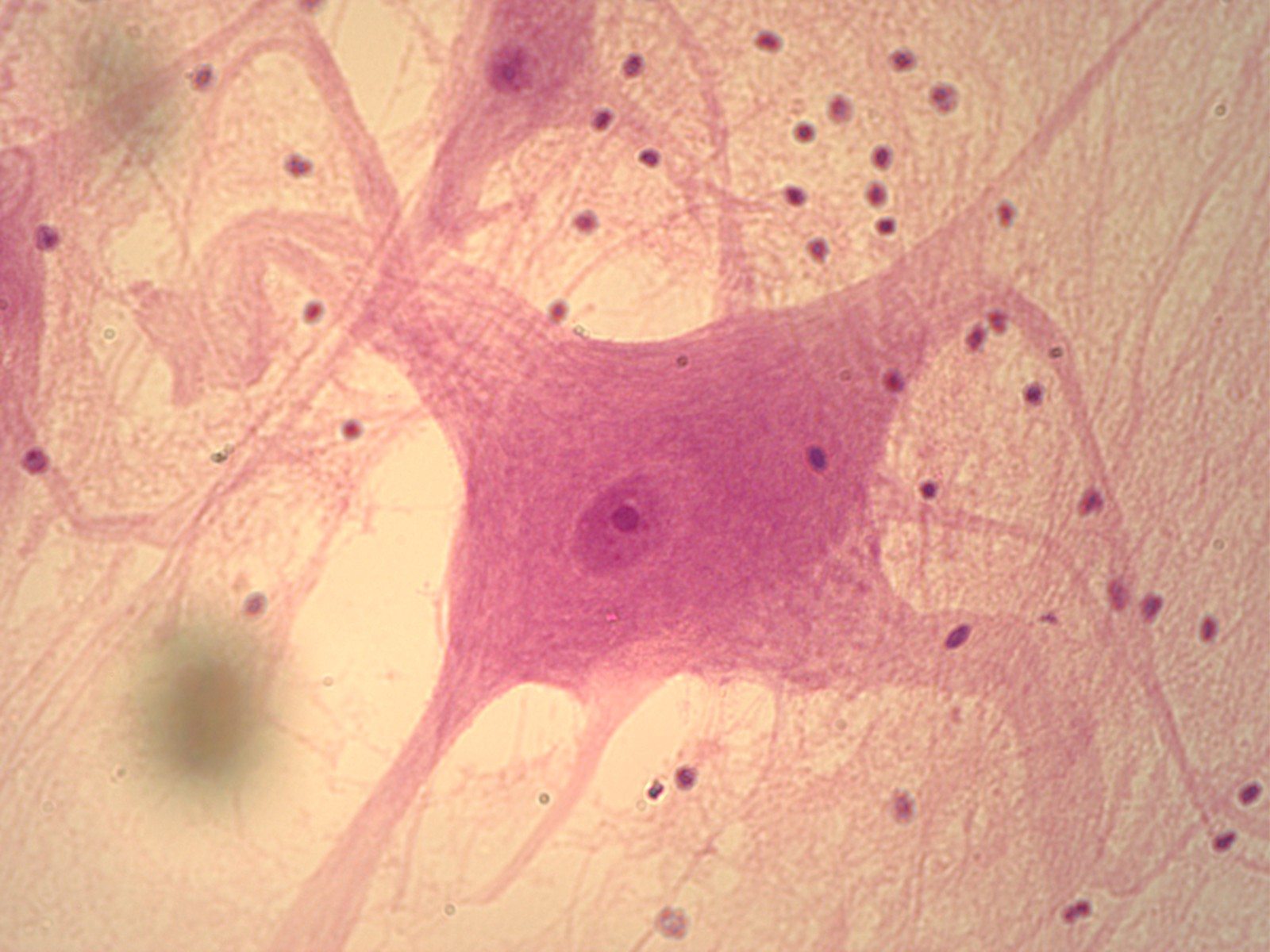
What tissue type is this?
Nervous tissue
Cardiac muscle
Smooth muscle
Connective tissue proper
Ribbon like organelle found in muscle cells that have a banded appearance
sarcomere
myofibril
fascicle
actin
Thick filaments are in a myofibril are
ATPase
Sarcoplasmic reticulum
Actin
Myosin
Thin filaments in a myofibril are
Sarcomeres
Sarcoplasm
Actin
Myosin
The two chemicals necessary for muscle contraction to occur are (a) .
What is a crossbridge?
Where myosin binds to actin
Where the calcium crosses into the cytoplasm
Where calcium binds with troponin
None of the answers are correct.
The energy needed to perform a muscle contraction comes directly from
ATP
Oxygen
Glucose
Calcium
What layer of connective tissue covers the muscle fiber?
epimysium
endomysium
perimysium
(a) slides inward during muscle contraction.
Skeletal Muscle contraction is initiated when the (a) sends a message to the muscle cell.
Muscle cell
Neuron
Gland
None of the above
The energy needed to perform a muscle contraction comes directly from
ATP
Oxygen
Glucose
Calcium
the neuron that transmit impulse from central nervous system to muscle effector is called
sensory neuron
motor neuron
Calcium binds to ___of the troponin-tropomyosin complex.
troponin
tropomyosin
actin
myosin
Which is voluntary?
cardiac
skeletal
smooth
The correct sequence of the following events is (a) :
A) Your arm moves
B) An impulse travels along a nerve
C) You decide you want to move your arm.
A B C
C B A
C A B
A C B
Which of the following best describes the power stoke?
actin's troponin pulls on the myosin filament
myosin heads pull on binding sites of the actin filament
At what point does a muscle contraction occur?
At the same moment sodium (Na) depolarizes the cell.
As the action potential travels down the axon of a neuron.
As soon as myosin binds to actin and pulls it towards the center of the sarcomere.
As soon as calcium binds too troponin on an actin molecule.
Why is calcium absolutely essential for muscle contraction?
Calcium makes bones stronger, which means muscles also get stronger.
Calcium binds to troponin, simply exposing the myosin binding site for actin.
Calcium inhibits muscle contraction because it depolarizes the cell.
Calcium is needed in order for ATP to attach to myosin heads, which causes contraction.

What is the purpose of a neuromuscular junction?
To destroy the muscle cell in order to end muscle contraction
It is a crossroad for action potential (signals) to cross from neuron to muscle.
To slow down action potentials so that the muscle doesn't receive as many signals.
The Process of Muscular Contraction
Muscular contraction begins at the neuromuscular junction, where a motor neuron releases the neurotransmitter acetylcholine. This chemical binds to receptors on the muscle cell membrane, triggering an electrical impulse. The impulse travels along the muscle fiber, reaching the sarcoplasmic reticulum. Here, calcium ions are released into the cytoplasm of the muscle cell. This release of calcium is crucial for the next steps in muscle contraction.
Once calcium ions are present, they bind to troponin, a regulatory protein on the actin filaments. This binding causes a conformational change, exposing binding sites for myosin on the actin filaments. Myosin heads, energized by ATP, attach to these exposed sites, forming cross-bridges. This attachment is a key step in the contraction process. The cross-bridge formation is essential for the subsequent power stroke.
During the power stroke, the myosin heads pivot, pulling the actin filaments toward the center of the sarcomere. This action shortens the muscle fiber, producing contraction. After the power stroke, ATP binds to the myosin heads, causing them to detach from the actin. The cycle of attachment, pivoting, and detachment continues as long as calcium ions and ATP are available. This repetitive cycle is what allows muscles to contract efficiently.
Muscle relaxation occurs when the calcium ions are actively transported back into the sarcoplasmic reticulum. This removal of calcium causes the troponin-tropomyosin complex to cover the binding sites on actin again. Without available binding sites, myosin heads cannot attach, and the muscle fiber returns to its resting state. The energy for muscle contraction primarily comes from ATP, which is regenerated through cellular respiration and other metabolic pathways. Understanding these steps provides insight into the complex process of muscle contraction and relaxation.
What initiates the process of muscular contraction at the neuromuscular junction?
Release of acetylcholine by a motor neuron
Binding of calcium ions to troponin
Formation of cross-bridges
Detachment of myosin heads from actin
What role do calcium ions play in muscle contraction?
They bind to troponin, causing a conformational change
They provide energy for the power stroke
They detach myosin heads from actin
They transport ATP to the myosin heads
What happens during the power stroke in muscle contraction?
Myosin heads pivot, pulling actin filaments toward the center of the sarcomere
Calcium ions are released into the cytoplasm
ATP binds to myosin heads, causing detachment from actin
Troponin-tropomyosin complex covers the binding sites on actin
How are multi-celled and single-celled organisms different?
Multi-celled organisms need energy to survive, while single-celled organisms need no energy to survive.
Single-celled organisms can be seen without using a microscope, while multi-celled organisms are microscopic.
Multi-celled organisms have large numbers of specialized cells to perform a variety of life functions, while single-celled organisms complete life functions with one cell.
Single-celled organisms have large numbers of identical cells that all perform the same function, while multi-celled organisms have cells that are all different and perform different life functions.
The somatic nervous system is --- and composed of ---
Voluntary --- skeletal muscle
Involuntary --- skeletal muscle
Voluntary --- smooth muscle
Involuntary --- smooth muscle

What muscle type is this?
cardiac
skeletal
smooth
An axon conducts nerve impulses (a) the cell body.
______ send signals away from neurons whereas ______ receive signals from other neurons.
Axons; Dendrites
Synapses; dendrites
Dendrites; axons
Axons; synapses
What is the most abundant type of tissue in the body
nervous
connective
skeletal
epithelial
Which of the following is a function of epithelial tissue?
protection
absorption
secretion
all of the above
Which protein directly blocks the myosin binding sites on actin in a resting muscle?
Troponin
Tropomyosin
Actin
Myosin
(a) is the type of tissue specialized for transmitting electrical impulses.

