wayground logo

Free Printable Worksheets

Font size

S
M
L
XL
Worksheets

Unit 2 Review Fall 2025

Total questions: 89

Worksheet time: 1hrs 27mins
Name
Class
Date
1.
Which is a quality that only gasses display
a)
Spread out to fill all available space
b)
Take the shape of their container
c)
Can't be compressed
d)
All of these
2.
If you increase the pressure of a constant volume of gas, what will happen to the temperature?
a)
Increase
b)
Decrease
c)
Stay the same
d)
It will Blow Up
3.
What will happen to the volume of a gas under constant temperature if the pressure increases?
a)
Increase
b)
Decrease
c)
Nothing
d)
Explosion!
4.
How are pressure and volume related?
a)
Directly
b)
Indirectly
c)
They aren't related
5.
If a balloon is cooled what will happen to the volume?
a)
Volume will increase
b)
Volume will decrease
c)
Volume will not change
6.
Gas molecules can easily be compressed  because ___________. 
a)
gas molecules are soft
b)
gas molecules are far apart
c)
gas molecules follow the shape of the container
7.
Which container will have lower pressure?
a)
left
b)
right
c)
they both have the same pressure
8.
You decide to make a balloon animal. As the balloon is being twisted, it increases the pressure inside of the balloon. What happens to the volume?
a)
It increases
b)
It decreases
c)
It stays the same
9.
You go camping and roast marshmallows over a campfire. What happens to the volume of the air bubbles inside the marshmallows? 
a)
It increased
b)
It decreased
c)
It stayed the same
10.
A balloon will pop in the atmosphere because..
a)
Pressure goes down volume goes up
b)
Pressure goes up volume goes down
c)
temperature goes down volume goes up
d)
volume goes down temperature goes down
11.
Which of the following would increase the (gas) pressure of a system? 
a)
Increase the Temperature 
b)
Decrease the volume 
c)
Pump in more gas 
d)
All of these
12.
How could you make the stopper pop out of the flask?
a)
Decrease pressure
b)
Decrease temperature
c)
Increase volume
d)
Increase temperature
13.
How could you "re-inflate" the balloon?
a)
Heat the balloon up 
b)
Cool the balloon down
c)
Remove some helium
d)
Ask the balloon to re-inflate
14.
Pick the best answer to explain all properties of gases....
a)
They're fluids 
Can be compressed
Little space between particles 
b)
They're solids 
Can be compressed
Lots of space between particles 
c)
They're fluids 
Cannot be compressed
Lots of space between particles 
d)
They're fluids 
Can be compressed
Lots of space between particles 
15.
What 2 variables are used in a Hot Air Balloon? 
[Hint:  Space and Heat]
a)
Pressure and Volume
b)
Volume and Temperature
c)
Temperature and Pressure
d)
Pressure, Temperature and Volume 
16.
What happens to the average kinetic energy of matter when it is heated?
a)
It increases
b)
It decreases 
c)
It doesn't change
d)
It cannot be determined
17.

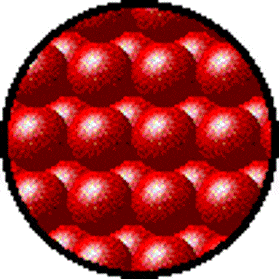
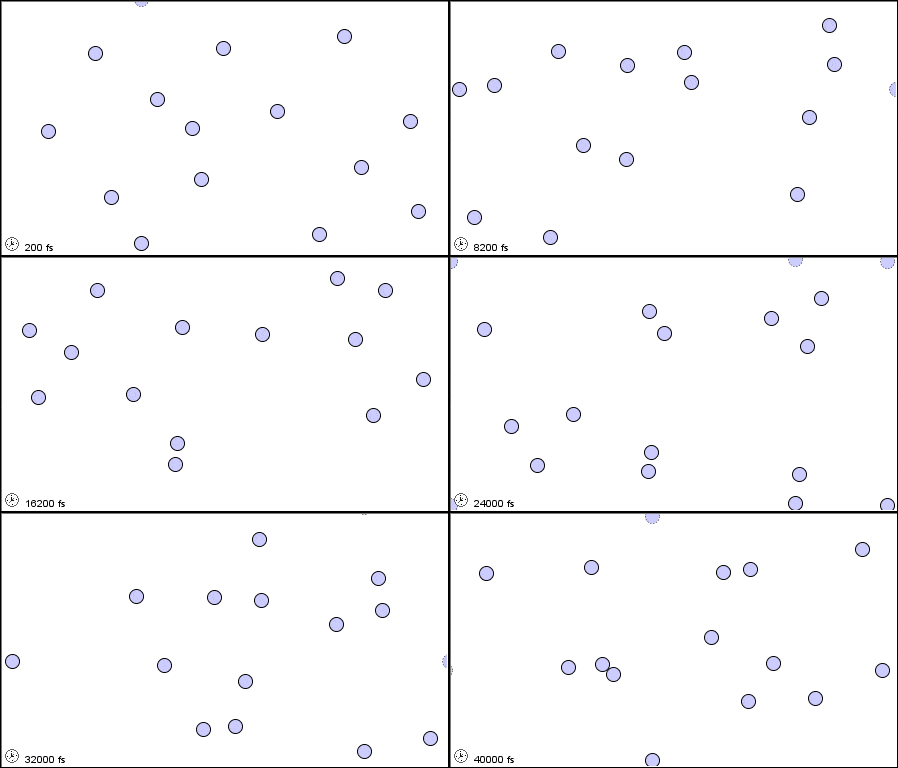
What state of matter does the picture below represent?

a)

solid

b)

liquid

c)

gas

18.

What is a Solid?

a)

Matter that has a fixed shape and size.

b)

Matter that has no fixed shape or size

c)

Matter that has a fixed size and no fixed shape

d)

Matter that has no fixed shape and size
19.

Define a liquid.

a)

Matter that has fixed volume, but no fixed shape

b)

Matter that has fixed shape but no fixed volume

c)

Matter that has fixed shape and fixed volume

d)

Matter that has no fixed shape and size

20.

What state is represented in the gif?

a)

solid

b)

liquid

c)

gas

21.

In which state of matter will there be the LARGEST space between molecules?

a)

solid

b)

liquid

c)

gas

22.

In which state of matter will there be the LARGEST space between molecules?

a)

solid

b)

liquid

c)

gas

23.

What phase change takes place when a liquid turns into a gas?

a)

melting

b)

sublimation

c)

condensation

d)

evaporation

24.

What phase change takes place when a liquid turns into a solid?

a)

melting

b)

freezing

c)

condensation

d)

deposition

25.

When you see drops of liquid water on your cold soda can caused by cooling of the water vapor in the air, ______________ has occurred.

a)

melting

b)

freezing

c)

condensation

d)

sublimation

26.


Sublimation is

a)

when solid turns into gas

b)

when liquid turns into gas

c)

when gas turns into plasma

d)

when gas turns into solid

27.


Change from Gas to Solid is called........

a)

Sublimation

b)

Fusion

c)

precipitation

d)

Deposition

28.

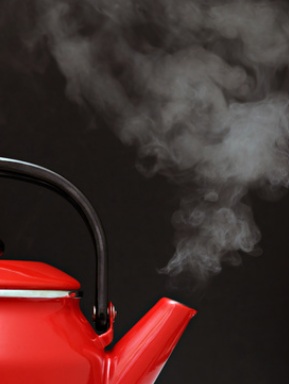
What change of state is taking place in this photograph?

a)

Condensation

b)

Freezing

c)

Vaporization

d)

Melting

29.
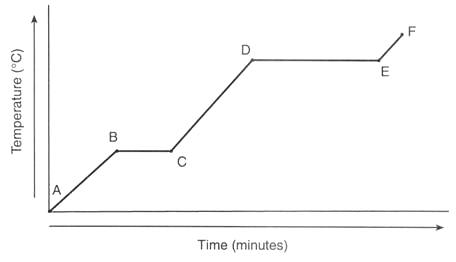
Describe the substance between letters D and E. 
a)
Gas
b)
Liquid
c)
Melting
d)
Evaporating
30.
Between which points is the temperature of the substance remaining constant?
a)
A-B only. 
b)
A-B, C-D, E-F
c)
B-C only. 
d)
B-C, D-E
31.

The melting point of the sample is

a)

-60 ºC

b)

-100 ºC

c)

60 ºC

d)

100 ºC

32.

Given the heating curve of a solid being heated at a constant rate, what is the boiling point of this substance?

a)

20°C

b)

50°C

c)

110°C

d)

170°C

33.

Given the heating curve of a solid being heated at a constant rate, how much total time was required to boil this substance after it reached its melting point?

a)

3 minutes

b)

4 minutes

c)

10 minutes

d)

14 minutes

34.

NaCl(s) was heated up starting at an initial temperature of 0°C. The heating curve is shown in the picture. What is the melting point of this substance?

a)

0°C

b)

801°C

c)

1000°C

d)

1465°C

35.

Given the heating curve of water, what is happening to potential and kinetic energy during segment CD?

a)

the potential energy and kinetic energy both increase

b)

the potential energy increases while the kinetic energy decreases

c)

the potential energy is constant while the kinetic energy increases

d)

the potential energy increases while the kinetic energy is constant

36.

Given the heating curve for water, during which line segment could I find water in both the solid and liquid phase at the same time?

a)

AB

b)

BC

c)

CD

d)

DE

e)

EF

37.
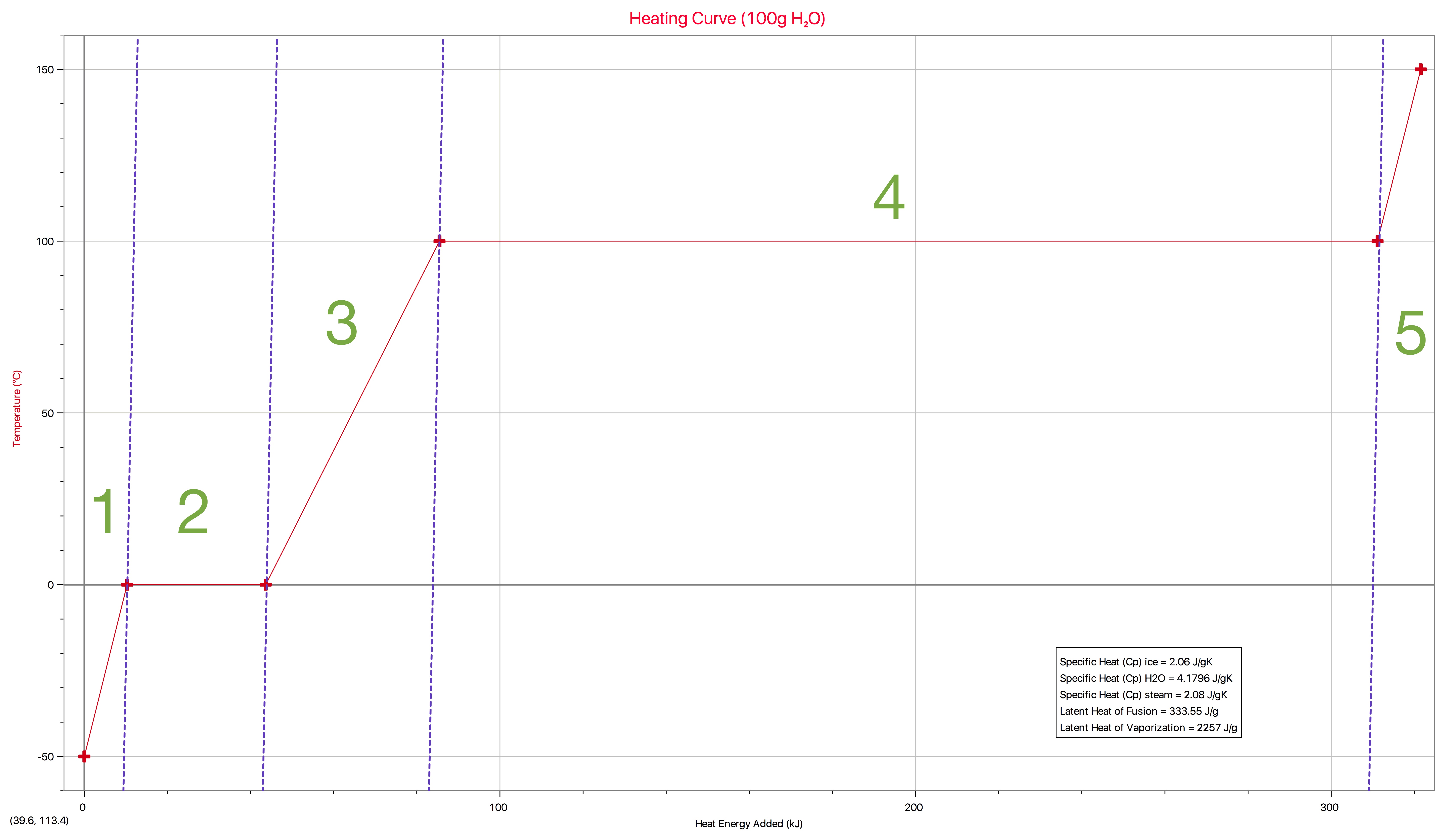
In which region(s) does temperature remain constant?
a)
Region 1, 3, & 5
b)
Region 2 & 4
c)
Region 1 only
d)
Region 1 & 2
38.
In which region(s) does temperature increase?
a)
Region 1, 3, & 5
b)
Region 2 & 4
c)
Region 1 only
d)
Region 1 & 2
39.

This curve indicates what about the heat energy?

a)

Heat energy is being added or absorbed

b)

Heat energy is being released

40.

In which region(s) of the graph would the substance be a liquid and a gas at the same time?

a)

Region 1

b)

Region 2

c)

Region 3

d)

Region 4

e)

Region 5

41.

In which region(s) of the graph would the substance be melting?

a)

No melting occurs on this graph

b)

Region C-E

c)

Region E-G

d)

Region G-I

e)

Region I-K

42.

What is the freezing point of the substance?

a)

0oC

b)

60oC

c)

120oC

d)

180oC

43.

From point A to point F, the sample is going through an __________ process by __________.

a)

exothermic, releasing heat to the surroundings

b)

exothermic, absorbing heat from the surroundings

c)

endothermic, releasing heat to the surroundings

d)

endothermic, absorbing heat from the surroundings

44.

What happens to the particles in a substance when heat is applied to it?

a)

they slow down

b)

they speed up

c)

they stay the same

d)

they stop moving

45.
Plasma occurs at
a)
high temperatures
b)
low temperatures
46.

WHAT STATE OF MATTER IS C?

a)

SOLID

b)

LIQUID

c)

GAS

d)

SUPER FLUID

47.

WHAT STATE OF MATTER IS A?

a)

SOLID

b)

LIQUID

c)

GAS

d)

SUPER FLUID

48.

WHAT IS THE PRESSURE FOR THE TRIPLE POINT?

a)

1

b)

6

c)

-105

d)

300

49.

WHAT IS THE TEMPERATURE FOR THE TRIPLE POINT?

a)

200

b)

-15

c)

-105

d)

50

50.

WHAT IS THE PHASE CHANGE FROM C TO B?

a)

MELTING

b)

FREEZING

c)

VAPORIZATION

d)

CONDENSATION

51.

WHAT IS THE PHASE CHANGE FROM B TO C?

a)

MELTING

b)

FREEZING

c)

VAPORIZATION

d)

CONDENSATION

52.

WHAT IS THE PHASE CHANGE FROM B TO A?

a)

MELTING

b)

FREEZING

c)

VAPORIZATION

d)

CONDENSATION

53.

WHAT IS THE PHASE CHANGE FROM A TO B?

a)

MELTING

b)

FREEZING

c)

VAPORIZATION

d)

CONDENSATION

54.

WHAT IS THE PHASE CHANGE FROM C TO A?

a)

MELTING

b)

SUBLIMATION

c)

DEPOSITION

d)

CONDENSATION

55.

WHAT IS THE PHASE CHANGE FROM A TO C?

a)

MELTING

b)

SUBLIMATION

c)

DEPOSITION

d)

CONDENSATION

56.

If the temperature of the substance is held constant at -15 ºC, the phase change that would occur with a pressure increase from 1 atmosphere to 30 atmospheres is:

a)

MELTING

b)

SUBLIMATION

c)

DEPOSITION

d)

CONDENSATION

57.

At 30 atmospheres pressure, the boiling point of this substance is:

a)

-105

b)

0

c)

50

d)

200

58.

FREEZING OCCURS THROUGH WHICH PROCESS?

a)

ENDOTHERMIC

b)

EXOTHERMIC

59.

MELTING OCCURS THROUGH WHICH PROCESS?

a)

ENDOTHERMIC

b)

EXOTHERMIC

60.

CONDENSATION OCCURS THROUGH WHICH PROCESS?

a)

ENDOTHERMIC

b)

EXOTHERMIC

61.

VAPORIZATION OCCURS THROUGH WHICH PROCESS?

a)

ENDOTHERMIC

b)

EXOTHERMIC

62.

SUBLIMATION OCCURS THROUGH WHICH PROCESS?

a)

ENDOTHERMIC

b)

EXOTHERMIC

63.

DEPOSITION OCCURS THROUGH WHICH PROCESS?

a)

ENDOTHERMIC

b)

EXOTHERMIC

64.

ABSORBING ENERGY OCCURS THROUGH WHICH PROCESS?

a)

ENDOTHERMIC

b)

EXOTHERMIC

65.

RELEASING ENERGY OCCURS THROUGH WHICH PROCESS?

a)

ENDOTHERMIC

b)

EXOTHERMIC

66.
Water exists as a _____________ at 700 mmHg and 50 °C.
a)
solid
b)
liquid
c)
gas
d)
supercritical fluid
67.
Water exists as a _____________ at 3 mmHg and 50 °C.
a)
solid
b)
liquid
c)
gas
d)
supercritical fluid
68.
Water exists as a _____________ at 3 mmHg and 50 °C.
a)
solid
b)
liquid
c)
gas
d)
supercritical fluid
69.
The pressure is increased on a sample of water at 0 °C from 0 mmHg to 800 mmHg.  In order, what changes occur?
a)
deposition, melting
b)
sublimation, melting
c)
condensation, freezing
d)
deposition, freezing
70.
The pressure is increased on a sample of water at 0 °C from 0 mmHg to 800 mmHg.  In order, what changes occur?
a)
deposition, melting
b)
sublimation, melting
c)
condensation, freezing
d)
deposition, freezing
71.

What is a physical property of these strawberries?

a)

Red

b)

Rotten

c)

Flammable

72.

What is a chemical property?

a)

A property that describes the state of a system

b)

A property observed during a reaction

73.

What is a chemical property of paper?

a)

Flammable

b)

White

c)

Light

74.

Is an ice cream cone melting a physical or chemical change?

a)

Physical

b)

Chemical

75.

Is toasting bread a physical or chemical change?

a)

Physical

b)

Chemical

76.

Is crumpling a piece of paper a physical or chemical change?

a)

Physical

b)

Chemical

77.
Which one of these is a chemical property?
a)
melting point
b)
boiling point
c)
color
d)
flammability
78.
Which of the following is not a chemical property? 
a)
rusting 
b)
boiling 
c)
rotting 
d)
burning 
79.
Ability to rust is this type of property:
a)
Physical property
b)
Chemical property
80.
Evidence of a chemical reactions is anything that shows - 
a)
a new substance has formed
b)
a solid dissolved in a liquid
c)
interaction between 2 gases
d)
a change in the state of matter
81.
One of the signs of a chemical reaction taking place is:
a)
Bubbles are produced 
b)
Reactants are not combining
c)
Products are not forming
d)
Color is not changing
82.
Which of the following describes a precipitate?
a)
a liquid forms when a block of metal is heated
b)
a solid forms when one liquid is poured into another
c)
a gas forms when a solid is placed in a liquid
d)
bubbles form when an acid is poured on a rock
83.
Which is NOT an indication of a chemical change?
a)
temperature change
b)
formation of a precipitate
c)
shape change
d)
production of light
84.
You know you a chemical reaction has occurred if 
a)
there is a precipitate.
b)
there is a color change.
c)
there is a temperature change.
d)
All of these answers are evidence.
85.
A clear liquid from a flask is poured into another clear liquid in a beaker. Which of the following results of this procedure would indicate a new substance was formed?
a)
The level of the substance in the beaker is higher after the other liquid is added.
b)
A yellow solid forms and then settles to the bottom of the beaker.
c)
Small white crystals are left behind in the flask that held the first liquid.
d)
The mass of the combined liquids is greater than either original liquid.
86.
Which of the following is an example that includes evidence of a chemical reaction?
a)
A sample of zinc is placed in water and it settles to the bottom
b)
A solid block of ice is heated and it completely melts into a liquid. 
c)
Sugar that is burned gives off an odor and turns brown and then black.
d)
A tomato is placed into a blender and chopped up into smaller pieces.
87.
Four students performed four different investigations by combining different substances. Which of the observations is most indicative of a chemical reaction?
a)
investigation 1
b)
investigation 2
c)
investigation 3
d)
investigation 4
88.
A student places a piece of a potato into a container of hydrogen peroxide. One observation the student makes is that bubbles form around the potato. The presence of bubbles might indicate the formation of a new substance because bubbles - 
a)
could show that a gas is forming.
b)
always rise to the top of a liquid. 
c)
are almost always perfectly spherical.
d)
usually burst after a few minutes.
89.
In a container, a solid consisting of clear crystals is combined with a blue liquid and the following observations are obtained: How many of the listed observations indicate a new substance was formed?
a)
1
b)
2
c)
3
d)
4