wayground logo

Free Printable Worksheets

Font size

S
M
L
XL
Worksheets

21 Unit 7: Evolution

Total questions: 85

Worksheet time: 54mins

Name
Class
Date
1.
What type of evolution where there is a sudden, rapid change then no change for a long time?
a)
Co-Evolution
b)
Punctuated Equilibrium
c)
Divergent Evolution
d)
Convergent Evolution
2.

Evolution occurring gradually and slowly over long periods of time

a)

Homeostasis

b)

Stasis

c)

Punctuated Equilibrium

d)

Gradualism

3.

Evolution occurring quickly due to catastrophic events

a)

Homeostasis

b)

Gradualism

c)

Statsis

d)

Punctuated Equilibrim

4.

Gradualism occurs when geologic and climatic conditions are _______________.

a)

stable

b)

unstable

c)

long

d)

short

5.

A group of many living things of the same species living together in the same environment makes up a...

a)

individual

b)

population

c)

community

6.
Which layer is the oldest
a)
B
b)
A
c)
E
d)
C
7.

Which of the following is the collection of life's remains found in sedimentary rock?

a)

natural selection

b)

homologous structures

c)

Charles Darwin

d)

the fossil record

8.

Similar structures with different purposes found in different species are known as _____

a)

vestigial structures

b)

DNA

c)

homologous structures

d)

the fossil record

9.

The picture shows a/an ___________

a)

homologous structure

b)

vestigial structure

10.
Which is not evidence for evolution?
a)
many animals have homologous structures due to common ancestry
b)
Many animals have vestigial structures from an ancestor
c)
We can observe changes in life forms by observing the fossil record
d)
All of these are evidence for evolution
11.
A change in the inherited characteristics of an organism over time is ________
a)
evolution.
b)
development.
c)
growth.
d)
ancestry.
12.
If two organisms have similar traits of DNA they are probably
a)
share a common ancestor
b)
share a common environment
c)
share a common population
d)
speciation
13.
Two organisms that are closely related would have
a)
very similar DNA sequence
b)
exactly the same DNA sequences
c)
no proteins in common
d)
completely different DNA sequence
14.
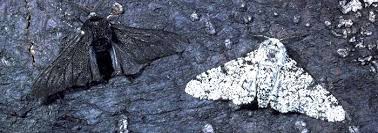
Predict which moth would increase in population
a)
light 
b)
dark
15.

Which IS NOT used as evidence for evolution?

a)

Fossils

b)

Natural Selection

c)

Early Development/Embryos

d)

Body Structure/Anatomy

e)

DNA/Proteins

16.
Which species’ DNA is most similar to the DNA of the toothed whale? 
a)
Hippopotamus 
b)
Baleen Whale
c)
Grazing Mammals
d)
Camels
17.
The similarities of organisms in which two areas numbered in the picture provide the best evidence for common ancestry?
a)
1 and 2
b)
3 and 4
c)
5 and 6
d)
7 and 8
18.

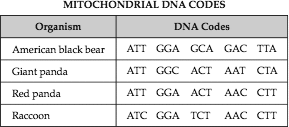
What conclusions can be made based on this table shown?

a)

the American black bear and the giant panda are most closely related

b)

the giant panda and the red panda are most closely related

c)

the red panda and the racoon are the most closely related

d)

the giant panda and the racoon are most closely related

19.
When you compare DNA or proteins to support evolution, you are using what kind of evidence?
a)
anatomical evidence
b)
molecular evidence
c)
fossil evidence
20.
What kind of evidence for evolution is shown in this image?
a)
fossil evidence
b)
anatomical evidence
c)
molecular evidence
21.
What kind of evidence is shown in this image?
a)
anatomical evidence
b)
fossil evidence
c)
molecular evidence
22.

A physical trait favored by an environmental change can be called an

a)

adaptation

b)

extinction

c)

possibility

d)

mutation

23.

After a long time in isolation, Island fruit flies and mainland fruit flies meet. They do not produce viable eggs due to genetic differences. The flies have resulted in two seperate lineages due to:

a)

Gene Pool

b)

Genetic Drift

c)

Gene Frequency

d)

Speciation

24.

All of these finches have different shaped beaks, they are an adaptation to gain access of

a)

Water

b)

Food

c)

Shelter

d)

Mates

25.

According to the theory of natural selection, why are some individuals more likely than others to survive and reproduce?

a)

Some individuals pass on to their offspring new characteristics they have acquired during their lifetimes.

b)

Some individuals are better adapted to exist in their environment than others are.

c)

Some individuals do not pass on to their offspring new characteristics they have acquired during their lifetimes.

d)

Some individuals tend to produce fewer offspring than others in the same environment.

26.
In natural selection, the selective agent is the
a)
humans
b)
mutations
c)
breeders
d)
environment
27.

Mutations are important because they bring about

a)

death of the organism in which they develop

b)

genetic variation needed for a population to evolve

c)

benefits for the individual, not for the population

d)

Hardey-Weinberg equilibrium within a population

28.
Which of the following is a term for a group of similar organisms that can reproduce fertile offspring?
a)
individual
b)
population
c)
species
d)
fossil
29.

Why has antibiotic resistance evolved in bacteria?

a)

Bacteria reproduce quickly

b)

Bacteria with a resistance to the antibiotic, passed that trait to offspring

c)

Bacteria that are resistant reproduce faster than non resistant strains

d)

Bacteria exposed to antibiotics develop a resistance to them

30.

Genetic drift is change in the allele frequency of a population due to...

a)

random chance

b)

natural selection

c)

non-random mating (sexual selection)

d)

artificial selection

31.

A(n)________ is a measure of how common a certain allele is in a population.

a)

Allele Frequency

b)

Gene Pool

c)

Genotypical Number

d)

Genetic Drift

32.

Which word means the formation of new species?

a)

speciation

b)

specialization

c)

founder effect

d)

sexual selection

33.

A type of genetic drift in which small groups of organisms separate from a larger population and form new small colonies.

a)

Gene Flow

b)

Founder Effect

c)

Natural Selection

d)

Artificial Selection

34.

The exchange of genes between two populations.

a)

Genetic Drift

b)

Founder Effect

c)

Gene Flow

d)

Genetic Recombination

35.

This term refers to the total genetic information found in a population; the complete collection of all the alleles found in a population

a)

Gene library

b)

Genome

c)

Gene pool

d)

Allele pool

36.

This is one of the mechanisms of evolution; it is a continuous process in which organisms with traits that make them better-adapted to their environment are more likely to survive and reproduce than organisms without such adaptations

a)

Directional selection

b)

Microevolution

c)

Gene flow / genetic drift

d)

Natural selection

37.

This is a pattern of natural selection where one extreme form of a trait is more advantageous than the average or the opposite extreme; as a result, this trait in the population tends to evolve towards that one extreme

a)

Directional selection

b)

Disruptive selection

c)

Stabilizing selection

d)

Forward selection

38.

This is the pattern of natural selection where BOTH of the extreme versions of a trait are more advantageous than the average, so a population evolves in both directions away from the average

a)

Directional Selection

b)

Disruptive Selection

c)

Stabilizing Selection

d)

Radical Selection

39.

This occurs when a large population is drastically reduced by an event such as a natural disaster; the population's new gene pool only contains alleles from the survivors

a)

Founder effect

b)

Bottleneck effect

c)

Meteor effect

d)

Natural selection

40.

This is the process that ultimately creates new variations and changes in DNA; leads to the creation of new alleles

a)

Mutation

b)

Microevolution

c)

Natural selection

d)

Gene flow / genetic drift

41.

This is a pattern of natural selection in which the average (or intermediate) form of a trait is the most advantageous, and so a population evolves away from the extremes and toward the average

a)

Disruptive selection

b)

Directional selection

c)

Stabilizing selection

d)

Middle selection

42.

The rock pocket mouse is a species of mouse that lives among the rocky outcroppings in the deserts of the Southwestern US. Researchers have observed that it is advantageous for these mice to have either a very dark or a very light fur color; this is because the very light color allows them to hide among light-colored rocks, and the very dark color allows them to hide among darker, volcanic rocks. The intermediate-colored mice cannot hide as well on either type of rock, and so are at a disadvantage. What type/pattern of natural selection would you expect to occur here?

a)

Stabilizing selection

b)

Disruptive selection

c)

Directional selection

d)

None of these are correct

43.
Mutations are important because they bring about
a)
death of the organism in which they develop
b)
genetic variation needed for a population to evolve
c)
benefits for the individual, not for the population
d)
Hardey-Weinberg equilibrium within a population
44.
Survival of the fittest or when favorable adaptations reproduce faster is called what?
a)
Evolution
b)
Adaptation
c)
Natural selection
d)
Fossilization
45.

What do we call a change in the genome over time?

a)

Evolution

b)

Adaptation

c)

Extinction

d)

Environmental influences

46.
What does the picture represent?
a)
Founder Effect
b)
Mutations
c)
Bottleneck effect
d)
Gene Flow
47.
Since the 1800s humans have stopped burning coal, and the trees have returned to their original color. Which moth will be more successful in this environment?
a)
Dark moth
b)
Light moth
c)
Both will be equally successful
d)
Neither will be successful
48.

What mechanism of evolution occurs when allele frequencies change over generations due to random chance?

a)

Genetic Drift

b)

Mutation

c)

Natural Selection

d)

Gene Flow

49.

A small group of squirrels gets separates them from the rest of the population due to a large flood. These squirrels, now confined to this new island, begin to start a new population. This is an example of which of the following?

a)

Founder effect

b)

Bottleneck effect

c)

Natural Selection

d)

Gene Flow

50.
Wolves from the Arizona mesa were transferred to the Colorado Rockies after a forest fire destroyed their habitat. They quickly became part of the local pack and had offspring.
a)
Mutation
b)
Natural Selection
c)
Genetic Drift
d)
Gene Flow
51.
Five hundred years after the deer had established a flourishing population in the park, a few of them venture back to their original woods and have babies with the deer there.
a)
Genetic Drift
b)
Mutations
c)
Non-random mating
d)
Gene flow
52.
During gestation (pregnancy), a developing male pig had a change in his genetic code. The result was that he was able to walk and do karate.
a)
Genetic Drift
b)
Non-random mating
c)
Mutation
d)
Natural Selection
53.
7 Wild Mustangs were taken from the prairies of Iowa after a Texan Rancher purchased them and provided them with their own pasture. Those 7 Mustangs eventually became 122.
a)
Genetic Drift (small popultaion)
b)
Non-random mating
c)
Gene flow
d)
Mutations
54.
What does the image represent?
a)
Gene flow
b)
Gene drift
c)
Mutation
d)
Adaptation
55.
Yellow toucan birds seek out one another to make babies together and tend to avoid the green toucan birds.
a)
Genetic Drift
b)
Non-random mating
c)
Gene flow
d)
Mutation
56.
A few deer wander out of their native woods into a completely new park where no deer had ever been before. They go on to create an entirely new population.
a)
Genetic Drift
b)
Natural Selection
c)
Non-random mating
d)
Mutation
57.
During gestation (pregnancy), a developing male pig had a change in his genetic code. The result was that he was able to walk and do karate.
a)
Genetic Drift
b)
Non-random mating
c)
Mutation
d)
Natural Selection
58.
Five hundred years after the deer had established a flourishing population in the park, a few of them venture back to their original woods and have babies with the deer there.
a)
Genetic Drift
b)
Mutations
c)
Non-random mating
d)
Gene flow
59.
Two track stars fell in love and after marriage had 5 children that became record-setting athletes.
a)
Non-random mating
b)
Gene flow
c)
Genetic drift
d)
Mutation
60.
The chimpanzees have developed an ability to use simple tools, thanks to their opposable thumb. This has allowed them to thrive in their habitat.
a)
Thumbs up 
b)
Middle finger
c)
Pointer finger
d)
PInky finger
61.
Which mechanism of evolution is represented by the pinky finger?
a)
non-random mating
b)
natural selection
c)
population shrinks
d)
mutation
62.
Which mechanism of evolution is represented by the ring finger?
a)
non-random mating
b)
natural selection
c)
population shrinks
d)
mutation
63.
Which mechanism of evolution is represented by the middle finger?
a)
non-random mating
b)
natural selection
c)
population shrinks
d)
mutations
64.
Which mechanism of evolution is represented by the pointer finger?
a)
non-random mating
b)
natural selection
c)
population shrinks
d)
gene flow
65.
Which mechanism of evolution is represented by the thumb?
a)
non-random mating
b)
natural selection
c)
population shrinks
d)
gene flow
66.
What is a mechanism?
a)
a piece of metal in a machine
b)
a punnet square showing a cross between two parents
c)
a cladogram showing evolutionary relationships
d)
 process by which something takes place or is brought about
67.
What is a gene pool?
a)
a place where genes can swim
b)
change in a species
c)
all the genes in a population
d)
the opposite of natural selection
68.
What is non-random mating?
a)
proof of common ancestry
b)
when things don't go well on a date
c)
randomly mating with others
d)
choosing who you mate with
69.
Why is the ring finger used to represent "non-random" mating?
a)
Because in most marriages, couples choose each other.  They are not randomly mating.  Wedding rings go  on the ring finger.
b)
Because the ring finger is bigger than the pinky.
c)
There is not a reason, it was randomly chosen
d)
Because the ring finger proves birds evolved from dinosaurs.
70.
How does the pinky finger represent a population is shrinking?
a)
it doesn't
b)
because it is larger than the other fingers
c)
because it is the opposite of the pointer finger
d)
The pinky finger is the smallest and that is what happens when 
71.
How does the middle finger represent mutations?
a)
it has an "m" within the fingerprint and that "m" stands for mutations
b)
it doesn't
c)
because it is closest to the pointer finger
d)
because it doesn't like the thumb
72.
Which mechanism get's the "thumbs up" in the video?
a)
mutations
b)
non-random mating
c)
natural selection
d)
gene flow
73.
Which mechanism shows genes leaving (immigration) or coming into (emigration) a gene pool?
a)
mutations
b)
natural selection
c)
gene flow
d)
non-random mating
74.

Cyanobacteria photosynthesize and created waste gases which led to what???

a)

The great nitration event

b)

The great oxygenation event

c)

The great carbon dioxide event

d)

The great ozonification bifurcation event

75.
In convergent evolution, organisms share physical similarities because they 
a)
have a common ancestor
b)
live in similar environments
c)
develop homologous structures
d)
are closely related 
76.
Two species are in different environments and look very similar.  However, that are not closely related.  Their resemblance is most likely an example of.
a)
sexual selection
b)
temporal isolation
c)
convergent evolution
d)
Coevolution
77.
A bumble bee has just enough weight to open up the snapdragon flower and get the nectar/pollen inside.  Other insects cannot do this. This adaption is an example of........
a)
convergent evolution
b)
co-evolution
c)
divergent evolution
d)
speciation
78.
What type of evolution is demonstrated in this photo?  (Hint: the bee and the flower have evolved in response to each other)
a)
Coevolution
b)
Convergent evolution
c)
Punctuated evolution
d)
Gradualistic evolution
79.
What is convergent evolution?
a)
evolution toward similar traits in unrelated species
b)
evolution toward different traits in closely related species
c)
elimination of a species from Earth
d)
the rise of two or more species from one existing species
80.

The three species pictured share a common ancestor and have adapted so that each lives in a different environment. This is an example of

a)

Law of Superposition

b)

Evolutionary Arms Race

c)

Divergent Evolution

d)

Convergent Evolution

81.

One problem with selective breeding is

a)

creating a new species

b)

gene variety is lost

c)

new food sources

82.
In recent years "SuperBugs" (bacteria that aren't effected by antibiotics) are becoming more and more common. How could natural selection explain this?
a)
Superbugs survive antibiotics and reproduce
b)
Antibiotics cause bacteria to become superbugs
c)
We have always had the same amount of superbugs; modern media just discusses them more.
d)
There is no reliable data on the origin of super bugs.
83.

Label the natural selection graphs correctly...

a)

1 Stabilizing, 2 Directional, 3 Disruptive

b)

1 Disruptive, 2 Stabilizing, 3 Directional

c)

1 Directional, 2 Stabilizing, 3 Disruptive

84.

Who is most closely related to Taxidea taxus?

a)

Lutra lutra

b)

Panthera pardus

c)

Canis latrans

d)

Canis lupus

85.

What is the name for the "trait" shown on these tree, such as "egg shells" and "four limbs"?

a)

Derived characteristics

b)

Trait nodes

c)

Branching elements

d)

Harmonious changes