
 Worksheets
Year 10 Chemistry Quiz
Total questions: 103
Worksheet time: 1hrs 10mins
In an exothermic reaction...
energy is taken in and the surroundings get colder.
energy is taken in and the surroundings get warmer.
energy is given out and the surroundings get warmer.
energy is given out and the surroundings get colder.
To break a chemical bond...
energy must be supplied.
energy must be released.
Calorimetry can be used to measure the energy given off when a substance burns.
True
False
Which of these can be used to measure the energy change when a chemical reaction takes place?
Change in colour.
Change in mass.
Change in temperature.
In an exothermic reaction, the products are at...
a lower energy than the reactants.
a higher energy than the reactants.
In an endothermic reaction, the energy released when bonds are formed is...
less than the energy used in breaking old bonds.
greater than the energy used in breaking old bonds.

The same reaction is carried out with and without a catalyst. Which line on the graph shows the reaction with a catalyst?
Line 1
Line 2
If a reaction mixture increases in temperature during a reaction...
the reaction is endothermic.
the reaction is exothermic.
no new chemical bonds have formed.
Energy is needed in a chemical reaction to...
break bonds.
form new bonds.
In an endothermic reaction, the products are at...
a lower energy than the reactants.
a higher energy than the reactants.
When a chemical bond forms...
energy must be supplied.
energy is released.
What effect does adding a catalyst have on the overall energy change of a reaction?
It increases it.
It decreases it.
It has no effect.
In an exothermic reaction the energy required to break old bonds is...
less than the energy released when new bonds form.
greater than the energy released when new bonds form.
Which of these is an endothermic reaction?
Hand warmer
Self-heating can
Photosynthesis
Combustion
Two solutions are added together and the temperature changes from 19°C to 27°C. Is the reaction exothermic or endothermic?
Exothermic
Endothermic

This symbol indicates that a reaction is _____
reversible
irreversible
Unsure which direction it should go

Around what time does the reaction reach equilibrium?
25 min
70 min
45 min
80 min
Changes in pressure will only affect substances that are in the ______ state.
solid
gas
liquid
What are the two factors that help determine that equilibrium is reached?
Forward reaction rate is faster than the reverse and the concentrations are equal
Forward and reverse reaction rates are equal and concentrations are equal
Forward and reverse reaction rates are equal and concentrations are constant
When the rate of the forward reaction is equal to the rate of the backward reaction, the system is said to be in _____
Chemical Balance
Chemical Constant
Chemical Reaction
Chemical Equilibrium

Which of the two graphs reaches equilibrium?
Neither
The left
Both
The right
For the reaction...
SO2 + O2 ⇌ SO3
If the concentration of SO2 is increased, the equilibrium of the reaction will shift ___________.
left
right
left and right
neither left or right
Which of the following is NOT true at equilibrium?
The concentrations of reactants and products do not change.
The forward and reverse reactions proceed at the same rate.
The concentration of the reactants is equal to the concentration of the products.
The forward and reverse reactions continue to occur.
For the reaction...
SO2 + O2 <−> SO3
If the equilibrium shifts to the right, the concentration of O2 will ___________.
increase
decrease
double
stay the same
The following factors affect the position of equilibrium EXCEPT
Concentration
State of Matter
Temperature
Pressure
Le Chatelier's Principle states that if a chemical system at equilibrium is stressed,
the system will adjust to increase the stress
the system will adjust to reduce the stress
the system will not adjust
What happens to the equilibrium if the concentration of reactants is increased?
The equilibrium shifts to the left
The equilibrium shifts to the right
The equilibrium remains unchanged
How does a decrease in temperature affect the position of equilibrium in a chemical reaction?
Increasing temperature always shifts the equilibrium to the left
Increasing temperature always shifts the equilibrium to the right
Shifts in exothermic direction
Shifts in endothermic direction

All 3 substances in this reaction are gases. Which stresses would not cause a shift to the right? Select all that apply
Decreasing the temperature
Increasing the temperature
Increasing the pressure
Adding a catalyst
Increasing the concentration of ammonia
When pink crystals of cobalt(II) chloride are heated, steam is given off and the colour of the solid changes to blue.
CoCl2.6H2O <=> CoCl2 + 6H2O
What happens when water is added to the blue solid?
Changes to pink, heat is absorbed
Changes to pink, heat is released
Remains blue, heat is absorbed
Remains blue, heat is released
This ion produces a crimson red flame
Na+
Li+
Ca2+
K+
This ion produces a lilac flame
Na+
Ca2+
K+
Ba2+
This ion produces a blue-green flame
(a)
This ion produces a yellow flame
(a)
This ion produces a red flame
Ca2+
Na+
Ba2+
Cu2+
This ion produces an apple-green flame
Cu2+
K+
Ca2+
Ba2+
This gas turns limewater (calcium hydroxide) cloudy/milky
Sulphur dioxide
Hydrogen
Carbon dioxide
Oxygen
This halide produces a white precipitate when silver nitrate is added
chloride
bromide
iodide
This halide produces a cream precipitate when silver nitrate is added
chloride
bromide
iodide
This halide produces a yellow precipitate when silver nitrate is added
chloride
bromide
iodide
After acidifying with nitric acid a few drops of barium nitrate solution is added...
A white precipitate is produced - barium sulfite
A white precipitate is produced - barium sulfate
A white precipitate is produced - barium carbonate
A white precipitate is produced - barium hydroxide
When dilute acid is added to a sulfite solution, and the mixture is warmed gently, a gas is produced which
Turns potassium manganate (VI) solution from colorless to purple
Turns potassium manganate (VI) solution from purple to colorless
Turns potassium manganate (VII) solution from colorless to purple
Turns potassium manganate (VII) solution from purple to colorless
To test for this anion sodium hydroxide and aluminium foil is added. The solution is warmed over a bunsen flame. This test is for the _____ ion, _____ gas is produced, which turns ___ litmus paper ___.
Nitrate, ammonia, blue, red
Nitrate, ammonium, blue, red
Nitrate, ammonia, red, blue
Nitrate, ammonium, red, blue
This gas bleaches damp blue litmus paper
carbon dioxide
sulphur dioxide
chlorine
hydrogen

Which positive test result is shown?
Squeaky pop - oxygen gas
Squeaky pop - hydrogen gas
Squeaky pop - chlorine gas
The positive test results for oxygen gas is...
(a)
This cation can be identified by warming a solution containing the ions with sodium hydroxide solution.
Ammonia
Sodium
Potassium
Ammonium
These cations form a white precipitate when a few drops of sodium hydroxide or ammonia solution is added
Aluminium
Calcium
Zinc
Chromium
When excess sodium hydroxide solution is this white precipitate it dissolves
Calcium hydroxide
Aluminium hydroxide
Zinc hydroxide
Chromium hydroxide
This cation forms a blue precipitate that dissolves in excess ammonia
Ca2+
Fe2+
Fe3+
Cu2+
This cation forms a green precipitate which dissolves in excess sodium hydroxide
(a)
This ion forms a brown precipitate that does not dissolve in excess sodium hydroxide or ammonia
(a)
Conducts electricity (electrolyte) when molten state or when dissolved in water.
ionic compound
covalent compound
Does NOT conduct electricity when molten state or when dissolved in water. Not an electrolyte.
ionic compound
covalent compound
Compounds composed of a ______________ and _____________ like the compound CaCl2 , are ionic compounds.
metal ... metal
nonmetal ... nonmetal
metal ... nonmetal
Which of the following describes covalent bonds?
Bonds form because of opposite charges
electrons are shared to fill outer electron shells
Electrons are transferred between atoms
Covalent bonds are magical
Is the following compound ionic or covalent?
A material that LOSES and GAINS electrons
Ionic
Covalent
What two types of atoms make a covalent bond?
2 Nonmetals
1 Nonmetal and 1 Metal
2 Metals
2 Noble Gases
Which of the following is TRUE about ionic compounds?
They have low melting and boiling points.
They can conduct electricity in the solid state.
They are stronger than covalent bonds.
They are usually formed from 2 metals.

The following properties are all characteristics of ionic compounds EXCEPT
high melting and boiling points
soft
crystal lattice structure
conduct electricity when dissolved in water
Form a very organized crystal lattice as a solid
Ionic
Covalent
Both
Neither
Satisfy the octet rule (8 electrons in outer shell) to be stable.
Ionic
Covalent
Both
Neither
Weak interparticle forces
Ionic
Covalent
Both
Neither
When formed have properties that are completely different than the properties of the individual atoms that make them up.
Ionic
Covalent
Both
Neither
Typically flammable
Ionic
Covalent
Both
Neither
Formed by the attraction of opposite charges
Ionic
Covalent
Both
Neither
Very stable
Ionic
Covalent
Both
Neither
Usually soluble in water
Ionic
Covalent
Both
Neither
Polar compounds with poles or dipoles
Ionic
Covalant
Both
Neither

Valence electrons are transferred
Ionic bonds
Covalent bonds
Valence electrons are shared
Ionic bonds
Covalent bonds
The chemical bond between a non-metal and another non-metal will be a ________ bond.
metal
ionic
covalent
polar
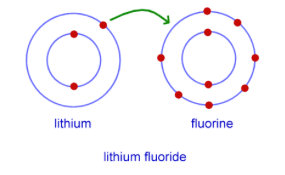


What type of bond involves the sharing of electrons between atoms?
covalent bond
ionic bond
metallic bond
transfer bond

This could be the dot diagram of
Mg
Cl
C
O
What is the goal of the Lewis Dot Structure?
To determine the electron position.
To show the element's valence electrons & bonding capabilities.
To find the atomic mass of an element.
To search for the number of electrons in an individual atom.
How many valence electrons should Lithium have in its Lewis dot model?
1
2
3
4
How many valence electrons should Oxygen have in its Lewis dot model?
5
6
7
8
How many valence electrons should Magnesium have in its Lewis dot model?
1
2
3
4

Which is the correct molecular structure for carbon dioxide CO2?



