
Font size
 Worksheets
Heat and Temperature Worksheet
Total questions: 100
Worksheet time: 50mins
What is temperature a measure of in a system?
The total mass of the particles
The average kinetic energy of the particles
The number of particles present
The potential energy of the particles
Which of the following best describes heat in the context of thermal energy?
A property of the system
The process of transferring thermal energy
The total number of particles in a system
The color of the substance
What happens to the kinetic energy of particles when you heat a substance (with no phase change)?
It decreases
It stays the same
It increases
It disappears
Which statement is true about the boiling of 100 mL and 200 mL of water when heated to 100°C?
The larger volume boils at a lower temperature
The average kinetic energy of molecules is the same in both beakers at boiling
The smaller volume needs more heat to boil
The average kinetic energy is higher in the larger volume at boiling
A common misconception is that heat and temperature are the same. According to the text, how do they differ?
Heat is a property, temperature is a process
Heat is the process of transferring thermal energy, temperature is a property of the system
Heat and temperature are both properties of the system
Temperature is the process of transferring thermal energy, heat is a property
What causes a change in temperature in a system?
Addition or removal of energy
Change in color
Increase in mass
Decrease in volume

What does the image of perfume molecules being sprayed demonstrate about gas particles?
Gas particles move slower when heated
Gas particles travel quickly, and the hotter they are, the faster they travel
Gas particles do not move at all
Gas particles only move in liquids
What does the Greek word "kinema" mean in the context of gas particles?
Energy
Motion
Heat
Speed
Why do gas particles not travel in a straight line from one place to another in a room?
They are too heavy to move straight
They collide with each other and the air about them
They are attracted to the walls
They are pulled by gravity
What happens to the speed of gas particles as you heat up a gas?
The speed decreases
The speed remains the same
The speed of the particles increases
The speed becomes zero
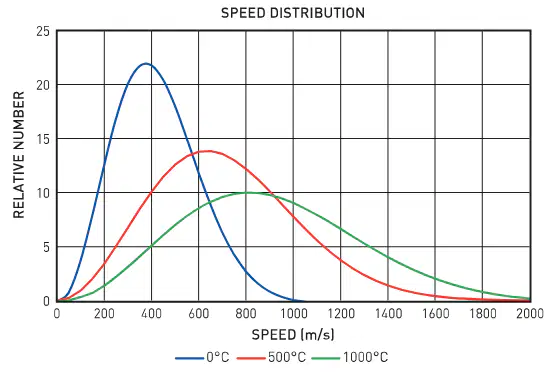
According to the graph in Figure 2, what is the most common speed for oxygen molecules at 0°C?
200 m/s
400 m/s
650 m/s
800 m/s
At a temperature of 1000°C, what is the most common speed for oxygen molecules?
400 m/s
500 m/s
650 m/s
800 m/s
Why is it impossible to measure the motion of all particles within a substance?
The particles are too large
There are too few particles
There is a great variation in the speeds of the particles and their number is very large
The particles are stationary
What happens when a fast and a slow molecule collide?
They both stop moving
They lose energy
They swap speeds, with the fast one becoming slow and the slow one becoming fast
They merge into one molecule
Which formula represents the kinetic energy (KE) of an object in terms of its mass and velocity?
KE = mgh
KE = 1/2 mv²
KE = Fd
KE = qV
According to the text, what is kinetic energy directly related to in a system of gas particles?
The color of the gas
The temperature of the system
The volume of the container
The pressure of the gas
What is the value of Boltzmann’s constant (k) as given in the text?
6.02 × 10²³ J K⁻¹
1.38 × 10⁻²³ J K⁻¹
9.81 m s⁻²
3.00 × 10⁸ m s⁻¹
If the temperature in a laboratory is 22°C, what is the average translational kinetic energy of a molecule of a gas, according to the worked example?
6.1 × 10⁻²¹ J
1.38 × 10⁻²³ J
3.0 × 10⁸ J
2.2 × 10⁻²² J
Why do space capsules get hot when they re-enter Earth’s atmosphere, according to the text?
Because of air friction only
Because of adiabatic compression of air
Because of chemical reactions with the atmosphere
Because of solar radiation
If you want to convert a temperature from Celsius to Kelvin, what should you do?
Subtract 273 from the Celsius temperature
Add 273 to the Celsius temperature
Multiply the Celsius temperature by 273
Divide the Celsius temperature by 273
Design an experiment to demonstrate that the heating of a bicycle pump during use is not due to air friction but due to adiabatic compression.
Measure the temperature of the pump before and after use, and compare it to a control pump not used.
Use a thermometer to measure the air temperature inside the pump and outside, and observe if the temperature rises only when air is compressed.
Pump air slowly and quickly, and observe if the temperature rise is greater with faster compression, indicating compression rather than friction.
All of the above
Explain the meaning of temperature in terms of kinetic energy.
Temperature is the amount of heat in a substance.
Temperature is the measure of the average kinetic energy of the particles in a substance.
Temperature is the total energy of all particles in a substance.
Temperature is the speed at which particles move.
If a nitrogen atom is travelling at 400 m/s, how long will it take to travel 100 m?
0.25 s
0.5 s
0.4 s
1 s
At 1200°C, which of the following has the higher average kinetic energy?
Argon atoms
Nitrogen molecules
Both have the same average kinetic energy
It depends on the mass of the atoms
If the average kinetic energy of neon atoms is 1.2 × 10⁻²⁰ J, what does this value represent?
The total energy of all neon atoms
The average kinetic energy per neon atom
The potential energy of neon atoms
The energy required to ionize neon atoms
If you suddenly increase the speed of every molecule in a gas by a factor of 2, by what factor does the temperature of the gas increase?
2
4
√2
8
Why doesn't nitrogen settle out near the floor and oxygen up near the ceiling, given that air is mostly nitrogen and oxygen, and nitrogen is lighter than oxygen?
Because nitrogen is heavier than oxygen
Because air is constantly mixing due to molecular motion
Because oxygen is more reactive
Because nitrogen is a noble gas
Evaluate the claim: "Eating ice helps you lose weight because your body uses energy to melt the ice and warm it up to body temperature."
The claim is completely true and leads to significant weight loss.
The claim is false; the energy used is negligible compared to daily caloric intake.
The claim is true only if you eat large amounts of ice.
The claim is false because the body does not use energy to melt ice.
What is temperature defined as in the context of a system?
The total mass of the particles in a system
The average kinetic energy of the particles within a system
The total volume of the system
The number of particles in a system
Which of the following is most commonly used in schools to measure temperature?
Digital thermometer
Alcohol-in-glass thermometer
Infrared thermometer
Thermocouple
Why is mercury sometimes used in thermometers instead of alcohol?
Mercury is less expensive than alcohol
Mercury is suitable over a much larger range of temperatures
Mercury is safer than alcohol
Mercury changes color with temperature

What happens to the liquid in a liquid-in-glass thermometer as the temperature increases?
The liquid contracts and moves down the tube
The liquid evaporates completely
The liquid expands and moves up the tube
The liquid changes color
Sir Isaac Newton created a temperature scale where the freezing point of water was set at what value?
0 degrees
12 degrees
32 degrees
100 degrees
Why do the markings on a thermometer depend on the scale used?
Because different scales use different substances in the thermometer
Because the scale determines the reference points for temperature measurement
Because the markings are only for decoration
Because the thermometer size changes with the scale
Who developed the Fahrenheit scale and what was it originally based on?
Anders Celsius; based on the freezing and boiling points of water
Daniel Gabriel Fahrenheit; based on the freezing point of an ice and salt mixture and his body temperature
William Thomson; based on absolute zero
Lord Kelvin; based on the triple point of water
What is the formula to convert a temperature from Fahrenheit (°F) to Celsius (°C)?
°C = (°F + 32) × 5/9
°C = (°F - 32) × 5/9
°C = (°F - 32) × 9/5
°C = (°F + 32) × 9/5
Which of the following statements about the Celsius scale is correct?
The freezing point of water is 100°C and the boiling point is 0°C
The freezing point of water is 0°C and the boiling point is 100°C
The freezing point of water is 32°C and the boiling point is 212°C
The freezing point of water is -273.15°C and the boiling point is 0°C
Why is the Kelvin scale considered an absolute scale?
Because it is based on the freezing and boiling points of water
Because it starts at the temperature where all particle motion stops, known as absolute zero
Because it uses the human body temperature as a reference
Because it is only used in the United States
Explain why 0°C does not represent the lowest possible temperature, and identify the temperature that does.
0°C is the lowest possible temperature; there is no lower temperature
0°C is the average kinetic energy of particles, but absolute zero (−273.15°C) is the lowest possible temperature where all motion stops
0°C is the boiling point of water, but −100°C is the lowest possible temperature
0°C is the freezing point of water, but −32°C is the lowest possible temperature
Which countries still use the Fahrenheit scale as mentioned in the text?
Australia, Sweden, and France
United States, Burma, and Liberia
United Kingdom, Canada, and India
Japan, China, and Russia
What was the main reason most countries stopped using the Fahrenheit scale?
It was too easy to use
The freezing and boiling points of water were awkward and not practical
It was based on the Celsius scale
It was only used in scientific work
What does the diagram of the Celsius thermometer illustrate?
The relationship between Fahrenheit and Kelvin
The key reference points on the Celsius scale: freezing point of water, human body temperature, and boiling point of water
The average temperature of the Earth
The boiling point of salt water
What is the value of absolute zero on the Kelvin scale?
0 K
273 K
-273 K
100 K
Which of the following best describes the Kelvin scale?
A temperature scale that takes absolute zero as 0 K and the triple point of water as 273.15 K
A temperature scale that starts at the freezing point of water
A temperature scale based on the boiling point of water
A temperature scale that uses Fahrenheit degrees
What is the formula to convert Celsius temperature to Kelvin temperature?
Kelvin temperature = Celsius temperature + 273
Kelvin temperature = Celsius temperature - 273
Kelvin temperature = Celsius temperature × 273
Kelvin temperature = Celsius temperature ÷ 273
If a sample of gas at constant volume is heated, how does its pressure change with temperature?
Pressure increases with increasing Celsius temperature
Pressure decreases with increasing Celsius temperature
Pressure remains constant with increasing Celsius temperature
Pressure decreases with decreasing Celsius temperature
What happens to the motion of particles at absolute zero?
The motion of particles is minimal and pressure becomes zero
The motion of particles is at its maximum
The motion of particles is unchanged
The motion of particles increases
A temperature of 50°C is equivalent to how many Kelvin?
323 K
273 K
223 K
373 K
Convert 486 K to degrees Celsius.
213°C
273°C
486°C
-213°C

What does the graph in Figure 3 demonstrate about the relationship between temperature and pressure for a gas at constant volume?
Pressure becomes zero at -273°C, indicating absolute zero
Pressure is highest at -273°C
Pressure is unrelated to temperature
Pressure decreases as temperature increases
Why is there said to be some residual potential energy in particles at 0 K?
Due to quantum mechanics, there is some zero-point energy left
Because particles stop moving completely
Because temperature cannot be measured at 0 K
Because pressure is maximum at 0 K
Who is the person after whom the Fahrenheit temperature scale is named?
Daniel Gabriel Fahrenheit
Anders Celsius
Lord Kelvin
William Thomson
What is the unit symbol for the Celsius temperature scale?
C
F
K
D
Which of the following is the correct description for 301 K?
301 kelvin (note the lowercase 'k')
301 Kelvin (uppercase 'K')
301 degrees Kelvin
301 degrees Celsius
What is the lowest possible temperature on the Kelvin scale commonly called?
Absolute zero
Freezing point
Boiling point
Triple point
If a temperature is given as 42°F, which scale is being used?
Fahrenheit
Celsius
Kelvin
Rankine
Why does the Fahrenheit scale allow for more precise communication of measurements compared to the Celsius scale?
A Fahrenheit degree is only 10/17 the size of a Celsius degree.
A Fahrenheit degree is larger than a Celsius degree.
Fahrenheit uses decimals.
Celsius is not used for scientific measurements.
Which temperature scale is most commonly used in scientific contexts in Australia, according to the text?
Celsius and Kelvin
Fahrenheit and Celsius
Kelvin and Fahrenheit
Celsius and Rankine
What is the main reason for using defined points based on phase transitions in temperature scales?
They provide reproducible reference points.
They are easier to remember.
They are based on weather conditions.
They are used only in the United States.
Which scientist is credited with adding a numerical scale to the thermoscope in 1612?
Santorio Santorio
Galileo Galilei
Daniel Gabriel Fahrenheit
Anders Celsius
What was the main limitation of early thermoscopes, such as those invented by Galileo Galilei?
They could not show exact temperature degrees.
They were too expensive to produce.
They used dangerous chemicals.
They were only used in hospitals.
Who developed the first enclosed thermometer, and in what year?
Ferdinando II de’ Medici, 1654
Ole Roemer, 1701
William Thomson, 1848
Anders Celsius, 1742
Which temperature scale was based on the concept of 'absolute zero' and who developed it?
Kelvin scale, William Thomson (Lord Kelvin)
Celsius scale, Anders Celsius
Fahrenheit scale, Daniel Gabriel Fahrenheit
Roemer scale, Ole Roemer
What were the freezing and boiling points of water on Ole Roemer’s scale?
7.5 degrees (freezing), 60 degrees (boiling)
0 degrees (freezing), 100 degrees (boiling)
32 degrees (freezing), 212 degrees (boiling)
273.15 K (freezing), 373.15 K (boiling)
How did Anders Celsius originally define the boiling and freezing points on his temperature scale?
Boiling point was 0 degrees, freezing point was 100 degrees.
Boiling point was 100 degrees, freezing point was 0 degrees.
Boiling point was 60 degrees, freezing point was 7.5 degrees.
Boiling point was 212 degrees, freezing point was 32 degrees.

Timeline of the development of different temperature scales, showing key inventors and their contributions from 1500 to 1900.
This is a placeholder for the timeline diagram.
This is a placeholder for a bar graph.
This is a placeholder for a pie chart.
This is a placeholder for a map.
Why was the development of temperature scales important for science and medicine?
It allowed for more precise measurement and understanding of heat and temperature.
It made thermometers cheaper to produce.
It helped people cook food more efficiently.
It allowed for the invention of the light bulb.
Which of the following is a common definition of temperature?
The total mass of a substance
The average kinetic energy of the particles within a sample of matter
The color of a substance
The volume of a substance
What does the zeroth law of thermodynamics state?
Energy cannot be created or destroyed
When two bodies have the same temperature as a third body, they also have the same temperature as each other
The entropy of a system always increases
Heat flows from cold to hot objects
According to the text, what do thermometers tell us?
The color and shape of an object
If an object has the same temperature as another object and the direction of thermal energy flow
The mass and density of an object
The chemical composition of an object
Why is it important for a thermometer to reach thermal equilibrium with the substance it is measuring?
To ensure the thermometer does not break
To ensure the reading reflects the true temperature of the substance
To change the color of the substance
To increase the pressure inside the thermometer
If two objects of different temperatures are brought into contact, what will happen according to the second law mentioned?
Thermal energy will flow from the colder object to the hotter object
Thermal energy will flow from the hotter object to the colder object
No energy will flow between them
Both objects will instantly freeze
What does the image of the thermometer dial most likely represent in the context of the text?
The measurement of mass
The measurement of temperature
The measurement of speed
The measurement of volume
Which of the following is a limitation of liquid-in-glass thermometers?
They are not affected by temperature changes
The liquid inside never freezes or boils
The liquids are uneven in their expansion
They can measure all temperatures without restriction
What is the main principle behind the operation of gas thermometers?
Change in color of gas
Expansion of gas with temperature
Melting of gas at high temperature
Freezing of gas at low temperature
Which material is commonly used in resistance temperature detectors (RTDs) due to its accurate resistance–temperature relationship?
Iron
Platinum
Aluminum
Lead
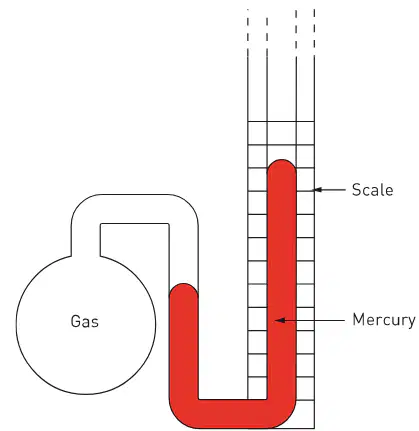
What does the constant volume gas thermometer rely on to measure temperature?
Relationship between color and temperature
Relationship between temperature and pressure
Relationship between sound and temperature
Relationship between mass and temperature
How does a thermocouple measure temperature?
By measuring the expansion of a liquid
By measuring the change in resistance of a single metal
By measuring the voltage produced by two different metals at different temperatures
By measuring the color change of a metal
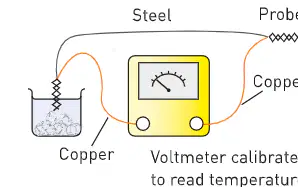
What is the function of the voltmeter in a thermocouple?
To heat the metals
To measure the resistance of the metals
To measure the voltage difference caused by temperature difference
To cool the metals
Why do resistance thermometers often have a protective casing?
Because they are very large
Because RTD components are very delicate
Because they are used in water
Because they are magnetic
Explain why mercury-in-glass thermometers are considered hazardous to the environment and human health.
Mercury is non-toxic and safe for all uses
Mercury is toxic to the body and the environment
Mercury is only dangerous at high temperatures
Mercury is not used in thermometers
Which principle do bimetallic strips rely on to measure temperature?
The different expansion rates of two different metals.
The melting point of metals.
The electrical conductivity of metals.
The color change of metals.
What happens to a bimetallic strip when it is heated?
One metal expands more than the other, causing bending and movement of a pointer.
Both metals contract, causing the strip to shrink.
The strip changes color to indicate temperature.
The strip emits radiation to measure temperature.
What is a limitation of liquid crystal thermometers?
They are not very accurate.
They require physical contact with the object.
They can only measure extremely high temperatures.
They are very expensive.
How do liquid crystal thermometers indicate temperature changes?
By changing color as the crystalline structure of chemicals changes.
By emitting a beep sound.
By moving a pointer across a scale.
By producing an electric current.
What do pyrometers measure to determine temperature?
The radiation given off by objects.
The expansion of metals.
The color change of chemicals.
The movement of a pointer.
Which of the following is a typical use of infrared pyrometers in clinical settings?
Measuring body temperature with ear thermometers.
Measuring the boiling point of water.
Measuring the temperature of molten metals.
Measuring the temperature of the sun.
Why is a protective sleeve used with infrared ear thermometers?
To protect the ear and ensure accurate measurement.
To cool down the thermometer.
To change the color of the thermometer.
To increase the expansion rate of metals.
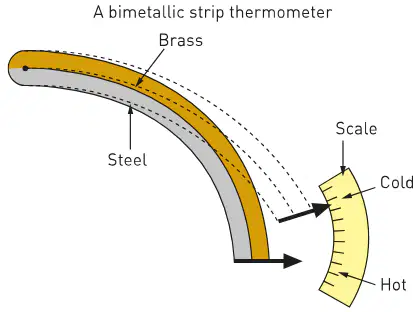
What does the movement of the pointer in a bimetallic strip thermometer indicate?
The temperature, based on the difference in expansion rates of the two metals.
The color of the metals.
The amount of radiation emitted.
The electrical resistance of the metals.
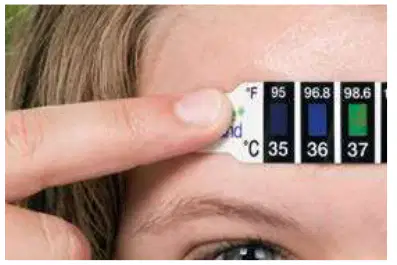
How does a liquid crystal thermometer strip display temperature?
By changing the color of squares as temperature increases.
By moving a pointer.
By emitting a sound.
By displaying numbers on a digital screen.
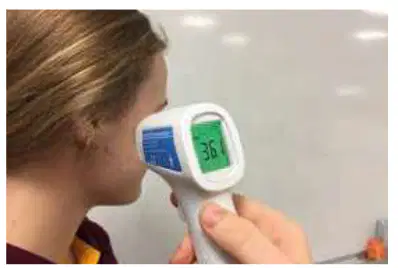
What is an advantage of using an infrared pyrometer for measuring body temperature?
It allows temperature measurement without physical contact.
It requires the use of chemicals.
It is less accurate than other methods.
It can only measure temperatures below 0°C.
Which of the following best describes a thermistor?
A device that changes its resistance with change in temperature
A device that measures pressure
A device that generates electricity from heat
A device that stores electrical energy
What happens to the resistance of a thermistor when it is heated?
The resistance increases
The resistance decreases
The resistance stays the same
The resistance fluctuates randomly
Which instrument is used to measure the current flowing through a thermistor?
Voltmeter
Ammeter
Barometer
Hygrometer
Identify and describe two methods of measuring heat that do not involve a liquid-in-glass thermometer.
Thermistors and pyrometers
Barometers and voltmeters
Hygrometers and ammeters
Calorimeters and anemometers
Why might someone choose not to use a liquid-in-glass thermometer?
It is less accurate at high temperatures
It is more expensive than digital thermometers
It can break easily and may contain hazardous substances
It requires a power source to operate
According to Table 1, what is the effect when body temperature drops to 30°C?
Shivering
Hallucinations
Unconsciousness
Appears dead
At what body temperature does shivering stop, according to the table?
37.0°C
35°C
32°C
26°C
Deduce why people who freeze to death in cold water often do not seem to be in pain as they die.
The body produces more endorphins at low temperatures
The nervous system slows down and stops transmitting pain signals
The heart rate increases, masking pain
The muscles become too stiff to feel pain
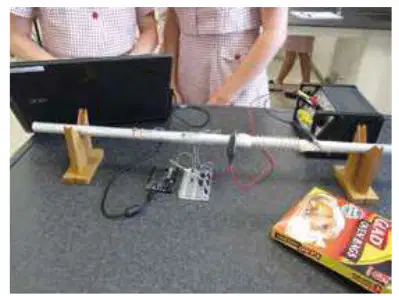
What is the purpose of using thermistors attached to a heated metal rod in a science experiment?
To measure the pressure in the rod
To log temperature changes in the rod
To generate electricity from the rod
To measure the rod's length

