
 Worksheets
WEEK 4 EXAM 1 STUDY GUIDE
Total questions: 98
Worksheet time: 49mins
What is the main focus of behavioral therapy?
Changing maladaptive behaviors
Providing medication
Ignoring abnormal behavior
Promoting physical health
Behavioral therapy is based on the theory that behavior is ______ and has consequences.
learned
innate
random
unpredictable
Which of the following is true about abnormal behavior according to behavioral therapy?
It is due to avoiding feelings
It is always genetic
It cannot be changed
It is unrelated to consequences
Behavioral therapies teach ways to lower anxiety and avoidant behaviors using which of the following methods?
Relaxation training and modeling
Medication only
Ignoring the behavior
Physical punishment
Behavioral therapy has been successful in treating which of the following?
Phobias
Heart disease
Diabetes
Broken bones
Classic conditioning links neutral stimuli to a response. Which of the following is an example?
Dog learning to associate a bell with food
Student studying for exams
Child learning to ride a bike
Adult going to work
Operant conditioning associates behaviors with ______ or ______ consequences.
good; bad
short; long
internal; external
expected; unexpected
Who are typically included in group therapy?
Multiple clients with common goals
Only one client
Only therapists
Only family members
Which of the following is NOT a component of group therapy?
Psychosocial therapy
Peer support
Common goals
Individual therapy only
A safe milieu or milieu therapy is an environment that is ______, therapeutic, and safe.
supportive
hostile
isolated
chaotic
Managing the environment in milieu therapy is important so it is psychosocially and physically safe for whom?
Staff and clients
Only clients
Only staff
Visitors
While in a therapeutic environment, clients learn coping skills to interact better and improve what?
Relationship skills
Cooking skills
Financial skills
Athletic skills
What is the nurse responsible for implementing in a therapeutic milieu?
Administering medication
Implementing therapeutic milieu such as community meetings, daily routine, supportive environment
Diagnosing mental illness
Prescribing therapy
Which of the following is NOT a role of the nurse in a mental healthcare/psychiatric facility?
A) Develop a therapeutic relationship
B) Implement therapy
C) Advocacy
D) Teaching
Fill in the blank: The nurse's role is to implement things included in the patient's therapy to support the patient and utilize ______ skills, usually with certifications.
coping
cooking
driving
painting
Which of the following is NOT part of holistic, client-centered care?
Manage illness
Promote health and well-being
Prevent further illness
Prescribe medication
What are the three phases of Peplau’s therapeutic relationship?
Orientation, working, resolution
Diagnosis, treatment, discharge
Planning, implementation, evaluation
Assessment, intervention, follow-up
What is psychoanalytic therapy primarily focused on?
Assessing unconscious thoughts and feelings and how they affect today
Administering medication
Teaching coping skills
Promoting physical health
Fill in the blank: ______ is the feeling from the client that develops toward the therapist similar to feeling from a significant person in childhood.
Transference
Projection
Countertransference
Displacement
Fill in the blank: ______ is the unconscious feeling from a healthcare worker to the client that reminds them of someone good or bad.
Countertransference
Empathy
Projection
Transference
Which of the following is a warning sign of suicide?
Increased use of drugs or alcohol
Improved mood
Making new friends
Starting a new hobby
Which of the following is NOT a warning sign of suicide?
Extreme and sudden mood swings
Developing a plan (collecting pills, buying gun)
Complaining about feeling great guilt or shame
Regular exercise
What are some warning signs that someone may be at risk for suicide? Fill in the blank with at least three signs.
Taking dangerous risks, saying goodbye, making a will, giving away important items, extreme mood swings, eating or sleeping more or less, expressing hopelessness, feeling like a burden, talking about having no reason to live, withdrawing from family, friends, or things that they like to do, increased use of alcohol and drugs, searching for means to die, sudden improvement in mood, extreme mood swings, feeling trapped, and intense sadness.
Eating healthy foods, exercising regularly, and spending time with friends.
Getting enough sleep, practicing mindfulness, and setting goals for the future.
Learning a new language, traveling to new places, and joining a sports team.
Cognitive therapy focuses on thoughts and behaviors to solve current problems. What is the main goal of cognitive therapy?
To recognize unhealthy thoughts and learn new ways of thinking (coping) to develop healthy thoughts and behaviors.
To focus only on past experiences without addressing current issues.
To encourage patients to avoid thinking about their problems.
To rely solely on medication for treatment.
Why is mental health promotion important? Choose the correct answer.
To treat mental illness only
To strengthen well-being, prevent mental illness, promote resilience, encourage healthy lifestyle behaviors, build stronger communities, and improve quality of life
To ignore unhealthy coping mechanisms
To focus only on medication
Who would benefit from Cognitive Behavioral Therapy (CBT)? Fill in the blank with at least two groups or conditions.
Clients with anxiety management, depression, neurodevelopmental disorders, PTSD.
People with no mental health concerns at all.
Individuals seeking only physical fitness training.
Clients interested in learning a new language.
Unhealthy thinking and thoughts lead to ________ behaviors and patterns of living.
unhealthy
positive
neutral
productive
What is one of the goals of therapy?
Ignore unhealthy thought patterns
Recognize unhealthy thought patterns
Encourage unhealthy behaviors
Avoid communication
What is the nursing role in building relationships? Fill in the blank: The nursing role in building relationships is to ________.
build relationships
administer medication
perform surgery
diagnose diseases
The client really just wants you to listen, not give solutions.
True
False
How should you treat a client to provide client-centered care?
Like everyone else
Like a person
Like a problem
Like a diagnosis
Therapeutic communication involves ________, eye contact, and reflecting back.
soft presence
loud laughter
aggressive tone
distracted gestures
Which of the following is NOT a risk factor for ADHD?
Genetic factors
Hereditary factors
Environmental toxins
Regular exercise
Inattention, hyperactivity, and impulsivity are behaviors associated with which disorder? Fill in the blank: ________ is associated with inattention, hyperactivity, and impulsivity.
ADHD
Autism Spectrum Disorder
Obsessive-Compulsive Disorder
Generalized Anxiety Disorder
Intellectual disabilities are a part of which disorder?
ADHD
Intellectual developmental disorder
Anxiety disorder
Depression
Fill in the blank: Intellectual disability is a disorder with onset during the developmental period that includes both ______ and adaptive functioning deficits in the conceptual, social, and practical domains.
intellectual
physical
emotional
behavioral
Fill in the blank: Intellectual disability may be mild, moderate, severe, or ______.
profound
temporary
reversible
transient
acute
Which of the following is NOT a difficulty associated with learning disabilities in children?
Pronunciation of words
Understanding the meaning of what is read
Mastering number sense
Excellent memory for numbers
Fill in the blank: Academic skills are below those expected for age or grade level and interfere with ______ or occupational performance or with activities of daily living.
academic
physical
recreational
emotional
Learning difficulties in children with learning disabilities always become fully apparent during preschool years.
True
False
Fill in the blank: No evidence of intellectual disabilities, uncorrected visual/auditory acuity, other mental/neurological disorders, psychosocial adversity, or lack of proficiency in the language of ______ instruction, or inadequate educational instruction.
academic
physical
musical
technical
Which of the following is a significant risk factor for ASD?
Genetics 40-80%
De novo mutation (not inherited)
Environmental advanced parental age
All of the above
Fill in the blank: Manifestations of ASD may include rocking, ______ hands, and spinning.
flapping
clapping
washing
drawing
ASD level 1 is characterized by:
Needs no support
Needs some support
Needs substantial support
Needs very substantial support
Children with ASD level 1 sometimes appear just awkward or anti-social.
True
False
Fill in the blank: Change is difficult for children with ASD level 1, but they thrive with a good ______.
routine
surprise
punishment
argument
Which of the following is a characteristic of ASD level 2?
Needs more support
Fidgets and can be seen as annoying to others
Sometimes perceived as lazy or insecure
Reading at grade level
Which of the following is a characteristic of ASD level 3?
Needs more support
Needs the most support
Spelling rules and letter placement
Recognizing letters and sounds
Most people can tell there is a disability in individuals with ASD level 2.
True
False
Everyone can tell there is a disability in individuals with ASD level 3.
True
False
Fill in the blank: Individuals with ASD level 2 often do not engage ________.
socially
physically
verbally
emotionally
Fill in the blank: Individuals with ASD level 3 do not ________ except when necessary.
communicate
eat
sleep
walk
Which of the following is a comorbidity of Down Syndrome?
Heart defects
Spelling rules and letter placement
Fidgets and can be seen as annoying to others
Reading at grade level
Which of the following is NOT a comorbidity of Down Syndrome?
Diabetes
GERD
Recognizing letters and sounds
Thrombocytopenia
Dyslexia is a manifestation/characteristic/behavior of which syndrome?
Dyslexia/Tourette Syndrome
Down Syndrome
Turner Syndrome
Klinefelter Syndrome
At preschool age, a child with dyslexia may have difficulty with:
Reading at grade level
Spelling rules and letter placement
Recognizing letters and sounds
Heart defects
At school age, a child with dyslexia may have difficulty with:
Spelling rules and letter placement
Reading at grade level
Recognizing letters and sounds
Diabetes
At adolescent and adult age, a person with dyslexia may have difficulty with:
Reading at grade level
Spelling rules and letter placement
Recognizing letters and sounds
Heart defects
Which of the following is a skill related to word pronunciation?
Learning new vocabulary
Remembering facts or numbers
Understanding jokes, idioms, or expressions
Word pronunciation
Which skill involves organizing and time management?
Handwriting
Organizing and time management
Learning the alphabet
Rhyming
Fill in the blank: Tourette’s-tic disorder is a movement disorder characterized by unexpected movement or vocalization. The most severe tic disorder involves multiple motor tics and a vocal tic persisting for ___ year(s) before age 18.
1
2
3
5
Which disorder is described as difficulty understanding languages and hard to comprehend what others say, follow direction, or participate in conversations?
Tourette’s-tic disorder
Receptive language disorder
Stereotypical motor disorder
Cultural competence
Stereotypical motor disorder involves purposeful movements such as rocking back and forth, nail biting, and grinding teeth for a period of 4 weeks or longer.
True
False
What is cultural competence?
A) A movement disorder
B) A skill that involves gaining knowledge about another person’s culture
C) A type of language disorder
D) A repetitive motor disorder
Fill in the blank: Culturally sensitive nursing care means nurses practice with cultural ___.
humility
ignorance
superiority
resistance
Which of the following is NOT a component of culturally sensitive nursing care?
Client-centered: sensitive, respectful, responsive, holistic
Recognition of power imbalance
Promotes the client-nurse relationship
Ignoring clients' cultural practices and values
Which disorder is associated with difficulty understanding conversation flow and interrupting?
Receptive language disorder
Social communication disorder
Stereotypical motor disorder
Cultural competence
Fill in the blank: ________ is the obligation that health care providers must act in a manner of doing good for a client and preventing harm.
Beneficence
Autonomy
Nonmaleficence
Justice
Fill in the blank: ________ is the concept that clients should have the ability to make rational decisions related to their care.
Autonomy
Beneficence
Nonmaleficence
Justice
Fill in the blank: ________ allows a client to refuse treatment, which includes medications.
Self-Determination
Informed Consent
Confidentiality
Beneficence
Fill in the blank: ________ is the concept of doing no harm to the client or avoiding causing pain or suffering to the client.
Nonmaleficence
Autonomy
Justice
Veracity
Fill in the blank: ________ is the fair and equal care and treatment for all clients, regardless of the client’s background or culture.
Justice
Empathy
Autonomy
Confidentiality
Fill in the blank: ________ is ensuring the confidentiality and privacy of the client’s information.
Confidentiality
Transparency
Accountability
Accessibility
Fill in the blank: ________ stigma refers to negative attitudes/actions from the public.
Public
Self
Structural
Perceived
Fill in the blank: ________ stigma refers to internal shame and decreased self-esteem.
Self
Public
Structural
Enacted
Fill in the blank: ________ stigma refers to policies limiting opportunities.
Institutional
Personal
Cultural
Interpersonal

Based on the diagram, which of the following is NOT a zone in the mental health care continuum?
Thriving
Surviving
Struggling
Recovering
What is the peak of well-being, fully realizing potential and achieving goals called?
Excelling
Stagnation
Regression
Complacency
Which mental health state is described as being able to function without difficulty on a daily basis and fostering relationships?
Excelling
Thriving
Surviving
Struggling
Fill in the blank: An unsettled state of mind where problems may worsen and a person may become socially withdrawn is called ________.
Surviving
Thriving
Celebrating
Relaxing
Which mental health state involves trouble in mental health, hopelessness, and trouble at work?
Excelling
Struggling
Crisis
Injured
Crisis in mental health is characterized by which of the following?
Suicidal ideation
Anxiety
Depression
Social isolation
Lack of self-care
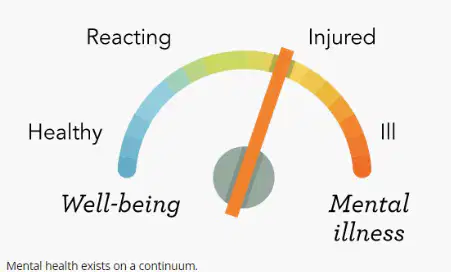
According to the diagram, mental health exists on a continuum from Well-being to Mental illness.
True
False
What does the mental health self-check tool provide a way to consider?
Healthy functioning and mental well-being
Physical fitness and exercise routines
Nutritional habits and diet plans
Financial planning and budgeting
Which of the following is a sign of being in the 'Healthy' mental health state?
Coping mechanisms for stressors
Difficulty coping with stressor
Ability to perform functions of daily living is impaired
Emergency attention needed
Fill in the blank: In the 'Injured' mental health state, the ability to perform functions of daily living is ________.
impaired
enhanced
unchanged
improved
Fill in the blank: The inability to cope with stress characterized by extreme changes in thoughts, behaviors, and actions is known as _________.
a change in mood/emotions
a physical injury
a nutritional deficiency
an improvement in memory
What is the primary role of a case manager?
Diagnose mental health conditions
Help the client coordinate their mental health treatment, such as medications, appointments, or arrange transportation, advocacy, support and education, review treatment plans and evaluate effectiveness
Prescribe medication
Provide legal advice
How can you build trust/rapport with a patient using ethical principles?
Transparency
Consistency
Empathy
Treat them like they are a person not an illness
Humor to establish rapport
Which of the following are behaviors indicating a change in mood/emotions?
Irritability
Substance abuse
Withdrawing from people and things they like
Changes in sex drive
Changes in eating habits
Which of the following is NOT a therapeutic communication technique?
Open ended questions
Interrupting the client
Affirmations
Reflections
Summaries
Fill in the blank: ________ are used to keep the conversation moving during a therapeutic interview.
Open ended questions
Closed ended questions
Leading questions
Rhetorical questions
Fill in the blank: ________ are sincere and make the client feel encouraged during a therapeutic interview.
Affirmations
Criticisms
Interruptions
Judgments
Fill in the blank: ________ help to understand the statement made by the client during a therapeutic interview.
Reflections
Interruptions
Judgments
Instructions
Fill in the blank: Nonverbal aspects of communication are used to convey ______ in what someone is saying.
interest
confusion
distance
distraction
Fill in the blank: ______, depending on culture, is an important aspect of communication.
Eye contact
Handwriting
Footwear
Weather
Fill in the blank: Good ______ and posture are important for effective communication.
body language
handwriting
singing
dancing
Fill in the blank: Vocal quality and ______ tracking are important in communication.
verbal
visual
audio
motion

