
 Worksheets
C24 Industrial and Commercial practices
Total questions: 81
Worksheet time: 41mins
Fill in the blank: ________ is a crucial aspect of research.
Data collection and analysis
Ignoring evidence
Guesswork
Procrastination
Fill in the blank: The interpretation and application of ________ is an important step in research.
conclusions
hypotheses
variables
statistics
Fill in the blank: Research should be used to justify the decisions made in the ________.
MDP
PDP
SDP
LDP
Fill in the blank: The development of the ________ and ________ has changed the way we communicate and access information dramatically.
internet; internet
car; airplane
television; radio
train; ship
Fill in the blank: Research and recording resources for the innovation report and the MDP include libraries, the internet, retail outlets, experts, and ________.
friends and family
weather reports
sports teams
musical instruments
Fill in the blank: The communication of ________ and ________ plays an important role in the presentation of the major design project.
ideas; processes
colors; textures
tools; machines
rules; regulations
Fill in the blank: ________ can assist in effective communication.
Visual aids
Loud noises
Irrelevant jokes
Complex jargon
Students learn about practices in industrial and commercial settings as they relate to the major design project including: safe work practices using selected resources. Fill in the blank: Students learn about safe work practices using selected ________.
resources
machines
chemicals
tools
Students learn about practices in industrial and commercial settings as they relate to the major design project including: production techniques. Fill in the blank: Students learn about ________ techniques.
production
marketing
safety
financial
Students learn about selection of processes appropriate to an identified ________ or opportunity.
need
tool
machine
location
Students learn about practices in industrial and commercial settings as they relate to the major design project including: collaborative designing and design ________.
teams
machines
budgets
offices
Students learn to identify design and production processes used in domestic, community, ________ and commercial settings.
industrial
culinary
medical
artistic
Students learn to implement safe work practices using selected materials and techniques in ________ and production of the major design project.
design
marketing
distribution
evaluation
Students learn to explain the principles underlying safe working practices and ________.
environments
machines
tools
chemicals
According to the passage, what do successful Design and Technology students use to inform their decision-making?
Only their own ideas
Skill and expertise in school and home environments, and understanding of commercial and industrial practices
Only industrial practices
Only commercial practices
Fill in the blank: The end result of the design and production process is an appropriate mix of techniques that efficiently produce the ________ result.
desired
random
incomplete
temporary
In an industrial or commercial setting, the process is usually less accurate than in a school or home environment.
True
False
One major difference between producing a major design project in a school setting versus an industrial/commercial setting is:
School projects often have less real-world constraints compared to industrial/commercial projects.
Industrial/commercial projects are usually less complex than school projects.
School projects typically have higher budgets than industrial/commercial projects.
Industrial/commercial projects are generally completed in a shorter time frame than school projects.
According to the passage, why do students often not use industrial/commercial practices in their projects?
Because they don’t have access to the equipment or the methods used in industry to produce large numbers of items.
Because they prefer to use only traditional hand tools for all projects.
Because industrial practices are too easy for students to learn.
Because their teachers discourage the use of any modern techniques.
In case study 24.1, what equipment did the student use to manufacture parts for the MDP?
A lathe
A 3D printer
A milling machine
A laser cutter
The cost of accessing machinery for producing a single part would have been prohibitive, according to the passage.
True
False
According to the slide 'Processes Used in Design and Production', what is the second aspect the student describes about the industrial/commercial process?
The industrial/commercial process is similar to the methods used in the realisation of the MDP.
The industrial/commercial process is unrelated to the methods used in the realisation of the MDP.
The industrial/commercial process is only theoretical and not applied in practice.
The industrial/commercial process is focused solely on manual craftsmanship.
According to the slide 'Processes Used in Design and Production', what did the student do when comparing the industrial/commercial practice to the process used in the MDP?
Described both processes in detail
Explained only the differences instead of describing the same process twice
Ignored the differences
Did not compare the processes
According to the passage, what is a key difference between student clothing design projects and mass-produced garments in the fashion industry?
A) Student projects are mass-produced
B) Student projects are one-off creations
C) Mass-produced garments are unique
D) Student projects use large-scale production methods
Large-scale production and specialised machines used in industry are usually an option for students.
True
False
Fill in the blank: Exclusive designers often use very ______ methods to students when manufacturing their products in smaller numbers.
similar
dangerous
expensive
random
In Year 11, you identified two production tasks and compared how these processes would be carried out in an industrial or commercial setting.
Compare two production tasks from Year 11 with their industrial or commercial equivalents.
List all production tasks performed in Year 11.
Describe only one production task from Year 11.
Explain why production tasks are not needed in industry.
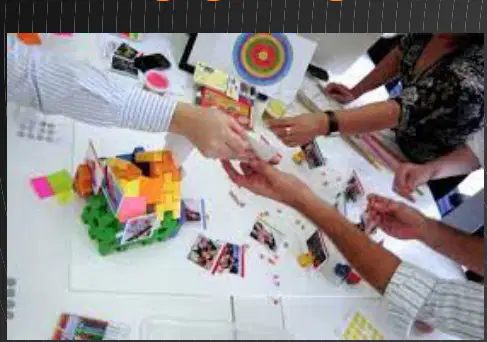
Collaborative designing in the context of commercial and industrial settings refers to:
A process where multiple stakeholders work together to develop design solutions.
A method where only one designer is responsible for all decisions.
A system that excludes client input in the design process.
A technique focused solely on reducing production costs.
Which of the following teams is NOT mentioned as part of the collaborative designing process for developing a new range of beachwear?
Graphic designers
Production team
Marketing team
Legal team
Fill in the blank: A company such as Billabong will have access to many ______ when it decides to develop a new range of beachwear.
resources
customers
locations
colors
All groups involved in collaborative designing are carefully managed to ensure cooperation and collaboration.
True
False
Which company developed a battery operated bionic limb that can lift six times more weight, move three times faster, and is 25% lighter than other bionic arms?
Otto Bock
Siemens
General Electric
Sony
Electronic communication has enhanced the concept of team design, with people from across the globe collaborating on projects. The German specialists developed the ______, while the prosthesis specialists at Melbourne’s Caulfield General Medical Centre developed the arm and hand.
elbow
knee
foot
shoulder
Electronic communication has enhanced the concept of team design, with people from across the globe collaborating on projects. Teamwork was essential to the success of the bionic limb project.
True
False
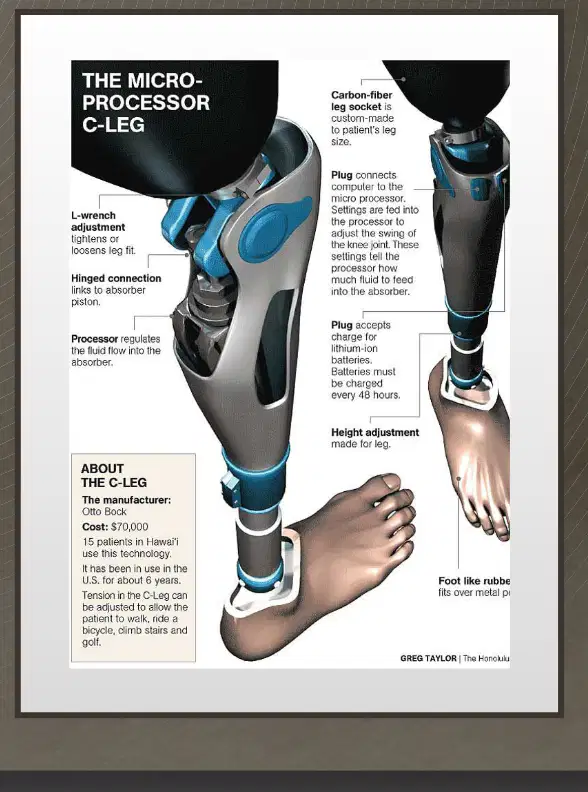
Refer to the diagram of the micro-processor C-Leg. What does the processor in the C-Leg regulate?
The height of the leg
The fluid flow into the absorber
The battery life
The foot movement
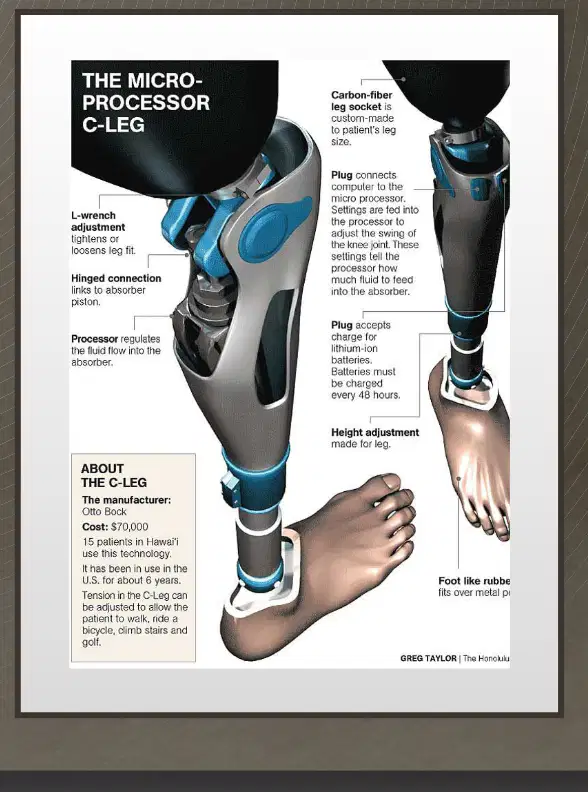
Refer to the diagram of the micro-processor C-Leg. What material is the leg socket made from?
Plastic
Carbon-fiber
Steel
Aluminum
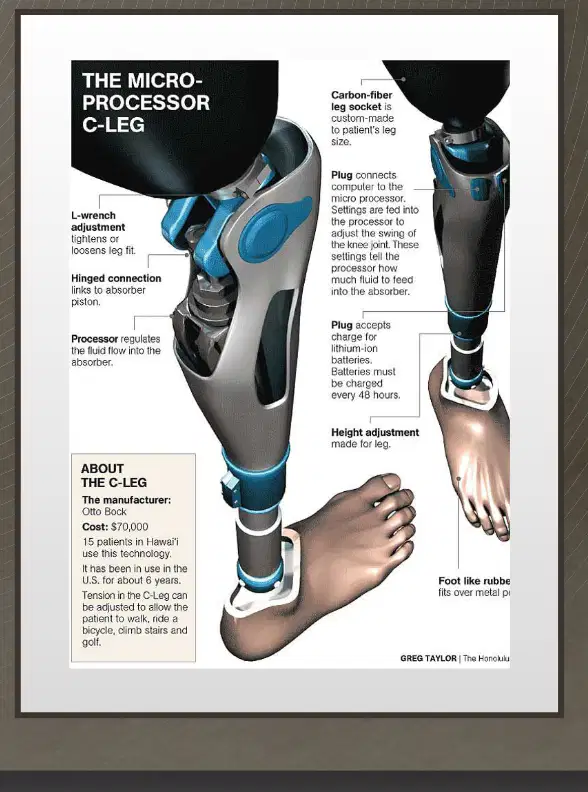
Refer to the diagram of the micro-processor C-Leg. How often do the lithium-ion batteries need to be charged?
Every 12 hours
Every 24 hours
Every 48 hours
Every week
According to the passage, what is one of the most important aspects of any design and production process?
Cost
Safety
Speed
Appearance
Recent changes in safety laws and improvements in attitude have brought about many changes in our culture and in the expectations placed on designers and those who produce and sell goods to the public.
True
False
What is the responsibility of a student as a designer, according to the passage?
To be aware of safety aspects of their design in all phases of its life cycle from design through manufacture and use to disposal.
To focus only on the aesthetics of the design.
To ignore the environmental impact of the design.
To delegate all safety concerns to the manufacturer.
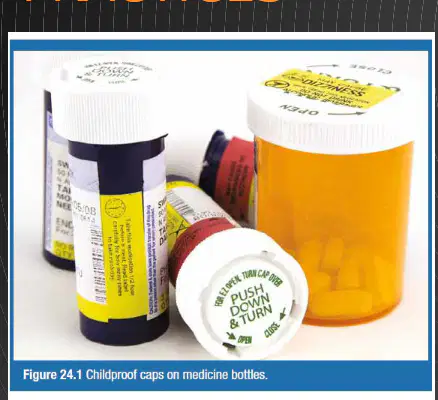
What is the purpose of these caps?
To prevent children from easily opening medicine bottles and accidentally ingesting the contents, thereby improving safety.
To make the bottles look more attractive on shelves.
To keep the medicine fresh for a longer period.
To reduce the cost of manufacturing bottles.

Fill in the blank: Risk is ___ .
the faith and trust required to suspend uncertainty to take an action
a guaranteed outcome of every decision
the avoidance of all possible dangers
the process of eliminating uncertainty
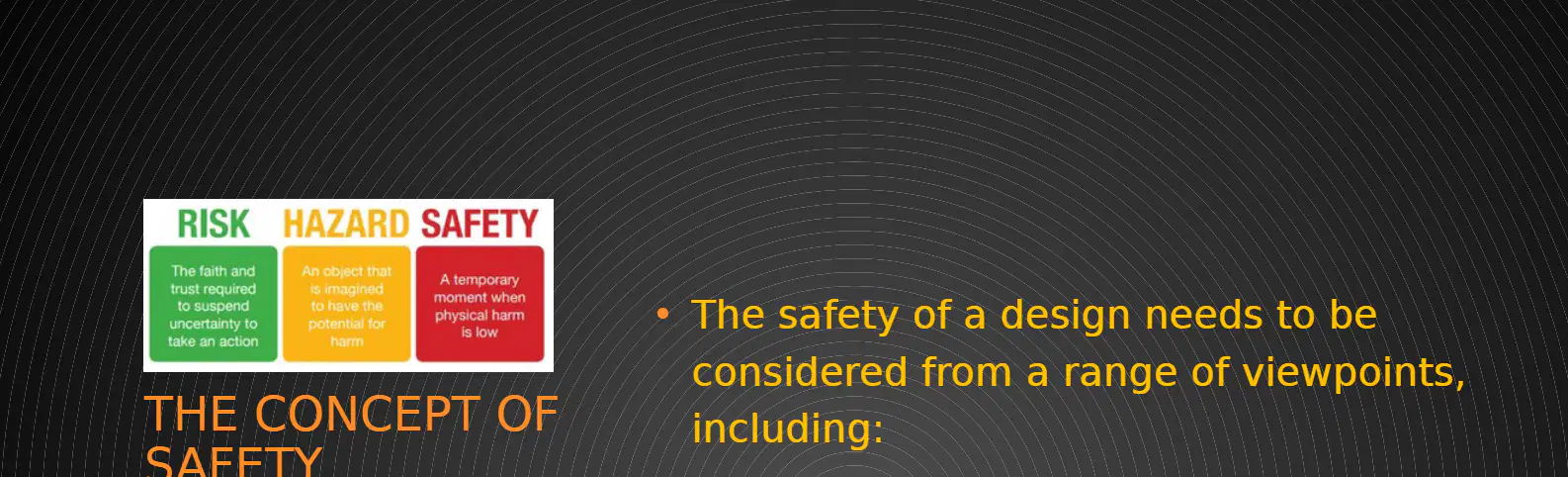
Fill in the blank: Hazard is _________.
an object that is imagined to have the potential for harm
a guarantee of safety in all situations
a process for eliminating risks
a tool used for measuring temperature
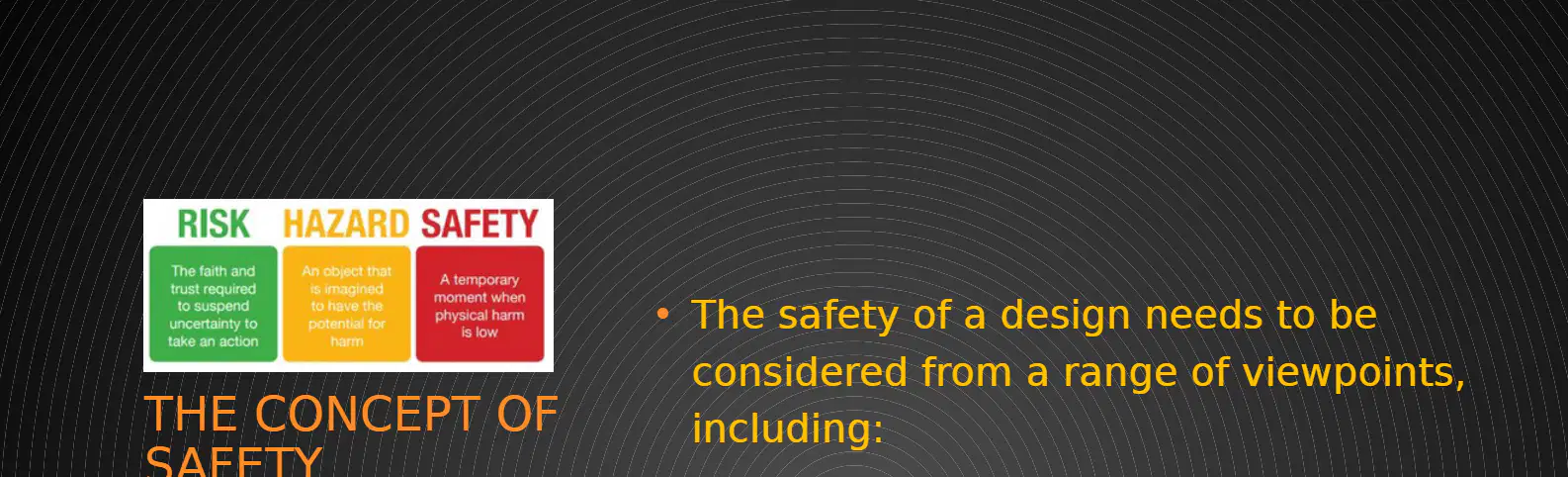
Fill in the blank: Safety is ___ .
a temporary moment when physical harm is low
something that can never be achieved
only important in dangerous jobs
not necessary in daily life
The concept of safety is one that needs to be considered from the very outset and addressed at all stages of the design process.
True
False
Which of the following is NOT a viewpoint from which the safety of a design needs to be considered?
Ethical, moral and professional perspectives
Legal responsibilities
Environmental issues
Financial profit only
Two viewpoints that need to be considered for the safety of a design are:
User safety and environmental impact
Aesthetic appeal and cost
Market trends and brand image
Production speed and advertising
Which activity involves collecting four products from your home or school, examining them for hazards, and making design suggestions to address any problems found?
Collecting and analyzing products for hazards and suggesting design improvements
Writing a story about household products
Drawing pictures of products without analysis
Ignoring product safety issues
When considering a design project, which group requires the strictest health and safety regulations for clothing?
Baby and toddler clothing
Teen clothing
Adult clothing
Senior clothing
According to the Occupational Health and Safety (OHS) laws in New South Wales, what is the main purpose of these laws?
To increase company profits
To protect the health and safety of all people in the workplace, including visitors
To reduce working hours
To promote competition among employees
Employees in New South Wales have the right to take action if they identify a potential hazard in the workplace according to OHS laws.
True
False
Fill in the blank: In New South Wales, the OHS legislation and associate regulations are the legal basis for setting and enforcing rules in workplaces to protect the ______ and ______ of all people in the workplace, including visitors.
health, safety
rights, responsibilities
income, employment
training, skills
Who is responsible for the safety of each other in a business premises according to OHS laws?
Only the employer
Only the employees
Both employees and employers as well as visitors
Only visitors
General safety rules in school exist to:
Ensure the safety and well-being of students and staff
Make school life more difficult
Allow students to break rules safely
Encourage students to ignore instructions
Evaluating the rules for safe work in your Design and Technology workspace helps identify potential improvements to the current policy.
True
False
Only if there is an accident
Only teachers should evaluate
According to the passage, what Act replaced the Occupational Health and Safety Act 2000?
The Work Health and Safety Act 2011
The Safe Work Act 2010
The Workplace Safety Reform Act 2012
The Employee Protection Act 2009
What is the main role of the OHS committee as described in the passage?
To engage in consultation as a means of improving safety and avoiding potential health and safety problems.
To enforce disciplinary actions against employees.
To manage company finances and budgets.
To oversee employee recruitment and training.
Which of the following is NOT a role of the OHS committee?
A) Develop OHS and related policies
B) Establish a hazard identification and workplace assessment strategy
C) Develop and implement risk-control procedures
D) Increase company profits
Fill in the blank: The OHS committee is responsible for ______ OHS and related policies.
developing
ignoring
delaying
opposing
Fill in the blank: The OHS committee must establish a hazard identification and ______ assessment strategy.
workplace
financial
nutritional
emotional
Fill in the blank: One of the roles of the OHS committee is to carry out ______ inspections.
workplace
financial
medical
environmental
What is a hazard according to the information provided in the slide?
A hazard is anything that can potentially cause harm or loss. A hazard could be as obvious as an unguarded blade that could kill instantly or as subtle as a chemical that could take years to cause death or noise from a machine that will, over time, cause hearing loss.
A hazard is a safety rule that must always be followed in the workplace.
A hazard is a type of equipment used to prevent accidents.
A hazard is a report filed after an incident has occurred.
Which of the following is NOT a category of hazard listed by WorkCover?
Physical
Chemical
Financial
Biological
Fill in the blank: WorkCover categorises hazards as physical, chemical, biological, mechanical/electrical, radiation, and ________.
psychological
nutritional
climatic
ergonomic
Which of the following is an example of a chemical hazard?
Noise
Inhalation of chemicals
Needle-stick injury
Electrocution
A hazard can be something as subtle as a chemical that could take years to cause harm.
True
False
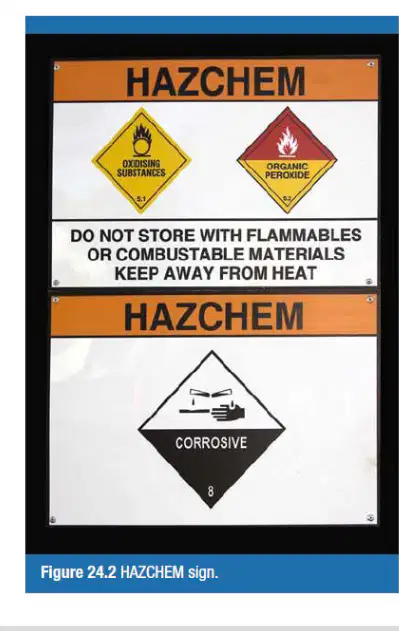
According to the HAZCHEM sign, should you store flammables or combustible materials with the substances indicated?
Yes
No
Match the following hazard categories with their examples:
Physical
Noise
Biological
Infections from bacteria
Mechanical/Electrical
Electrocution
According to TABLE 24.1, what is the importance number for a hazard that could kill or cause permanent disability or ill health and is very likely to happen (++ very likely)?
1
2
3
4
According to TABLE 24.1, what is the importance number for a hazard that could cause long term illness or serious injury and is unlikely to happen but could happen very rarely (- unlikely)?
3
1
2
4
According to TABLE 24.1, what is the importance number for a hazard that requires medical attention and several days off work and is very unlikely to happen (-- very unlikely)?
5
2
7
3
According to TABLE 24.1, what is the importance number for a hazard where only first aid is needed and it is likely to happen (+ likely)?
4
2
6
8
According to TABLE 24.1, what does the number 1 mean in terms of hazard importance?
It is extremely important to do something about this hazard as soon as possible.
It is not necessary to address this hazard immediately.
It means the hazard can be ignored safely.
It indicates the hazard is of minor importance.
According to TABLE 24.1, what does the number 6 mean in terms of hazard importance?
This hazard may not need your immediate attention.
This hazard requires immediate evacuation.
This hazard is the most dangerous.
This hazard should be ignored.
What is the first step in the hierarchy of controls for managing workplace hazards? (Fill in the blank)
Eliminate the risk. This can be done by removing the hazard, by stopping the hazardous procedure or removing the hazardous plant or material.
Substitute the hazard with a less dangerous one.
Implement administrative controls such as training and procedures.
Provide personal protective equipment (PPE) to workers.
Which control method involves substituting the hazard creating the risk with one that presents a smaller risk? (Fill in the blank)
Substitution.
Elimination.
Isolation.
Personal Protective Equipment (PPE).
What does 'Isolate the hazard' mean in the hierarchy of controls? (Fill in the blank)
Isolate the hazard means separating the person from the source of the problem, such as using fume cupboards in schools to isolate dangerous chemicals from students.
Isolate the hazard means removing all hazards from the workplace entirely.
Isolate the hazard means providing personal protective equipment to workers.
Isolate the hazard means training employees on emergency procedures.
Which step in the hierarchy of controls involves making physical changes to equipment or the environment to reduce risk? (Fill in the blank)
Minimise (remove or reduce) the risk through engineering means. This includes adding machine guards, changing lighting, or installing exhaust fans.
Eliminate the hazard completely from the workplace.
Provide personal protective equipment (PPE) to workers.
Implement administrative controls such as training or job rotation.
What does 'Implement change through administrative means' refer to in the hierarchy of controls? (Fill in the blank)
It refers to changing work methods to reduce injuries and incidents, such as following written work procedures or changing routines.
It refers to eliminating the hazard entirely from the workplace.
It refers to using personal protective equipment to minimize exposure to hazards.
It refers to substituting a hazardous material with a less hazardous one.
When should personal protective equipment (PPE) be used according to the hierarchy of controls?
PPE should be used for some tasks or while you find better ways of dealing with the hazard. PPE is only useful when it is in good condition and worn correctly.
PPE should be used as the first and only method to control all hazards.
PPE should be used only when there are no hazards present in the workplace.
PPE should be used at all times, regardless of the task or hazard.
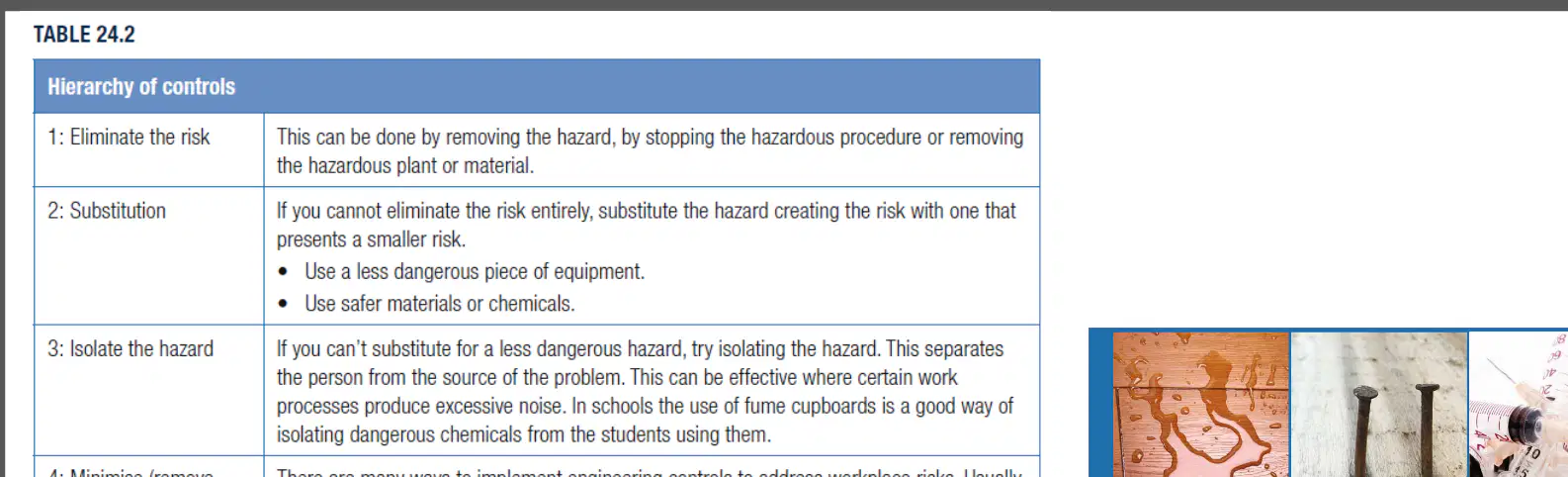
Figure 24.3 shows examples of work hazards. Which of the following is NOT a work hazard shown in the figure?
Spilled liquid
Rusty nails
Syringe
Flower pot

