
 Worksheets
Physiology - End of MP 1 Exam (2025/2026)
Total questions: 50
Worksheet time: 1hrs 15mins
What is a function of the muscular system?
Enables movement
Produces hormones
Protects against infection
Filters waste
Which organ is part of the nervous system?
Stomach
Bladder
Brain
Liver
What is the main function of the respiratory system?
Produce blood cells
Store minerals
Exchange oxygen and carbon dioxide
Break down food
Which organ is part of the digestive system?
Thymus
Lungs
Stomach
Heart
Which organ is part of the cardiovascular system?
Heart
Uterus
Liver
Pancreas
What does the term "medial" refer to in anatomical directional terms?
Toward the side of the body.
Away from the midline of the body.
Toward the midline or middle of the body.
Below or away from the head.

What does the term "inferior" mean when describing anatomical locations?
Above or toward the head.
Toward the front of the body.
Below or away from the head.
Closer to the point of attachment.
Which term describes a position toward the front of the body?
Anterior
Posterior
Dorsal
Ventral
Which term describes a position further away from the trunk or point of attachment?
Proximal
Distal
Medial
Lateral
What is one of the main functions of the digestive system?
To produce hormones
To break down foods
To circulate blood
To store oxygen
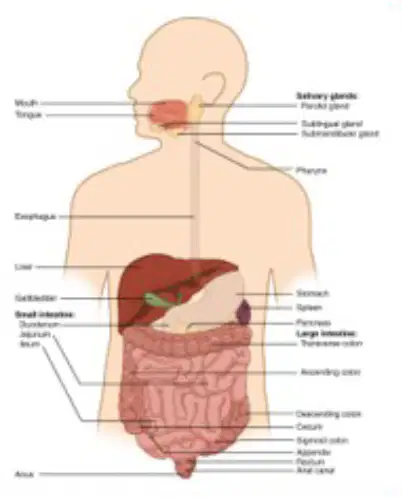
What is another name for the alimentary canal?
Respiratory tract
Gastrointestinal (GI) tract
Circulatory system
Nervous system
Which organs are considered accessory structures in the digestive system?
Heart and lungs
Kidneys and bladder
Teeth and tongue
Bones and muscles
Where is the esophagus?
Where is the liver?
Which of these structures is the rectum?
Identify the stomach.
Where does carbohydrate digestion begin?
liver
mouth
oesophagus
stomach
Where does protein digestion begin?
large intestine
mouth
small intestine
stomach
This is a tube about 12cm long with c-shaped rings of cartilage to keep it open
Nasal cavity
Trachea
Mouth Cavity
Pharynx
Two short tubes that carry air into the lungs are called (a)
When alveoli in the lungs enlarge and cant push oxygen to the blood
Bronchitis
Lung cancer
Asthma
Emphysema
Muscular structure that helps to expand and contract the lungs, forcing air in and out
Pharynx
Nasal cavity
Alveoli
Diaphragm
Smaller tubes within the lungs
Bronchioles
Bronchi
Lungs
Alveoli
Passage way that moistens the air and has hairs to trap dust and particles
Nasal cavity
Bronchi
Mouth cavity
Larynx
What is the function of the respiratory system
Remove CO2 only
Take in O2 ad remove CO2
Make sugar
Made up of spongy, elastic tissue that stretches as you breathe
Alveoli
Lungs
Nasal Cavity
Pharynx
Bronchial tubes contract quickly causing shortness of breath, coughing, and wheezing
Bronchitis
Emphysema
Lung cancer
Asthma
Caused by inhaling tar in cigarrette smoke
Bronchitis
Lung cancer
Asthma
Respiratory infections
Illness of the lungs where the alveoli become inflamed and filled with fluid
Lung cancer
Bronchitis
Pneumonia
Emphysema
Which part of the respiratory system is responsible for voice production?
Larynx
Pharynx
Bronchi
Alveoli
What is the role of the epiglottis in the respiratory system?
To produce sound
To filter dust particles
To prevent food from entering the trachea
To exchange gases
What is the primary function of the skeletal system?
To circulate blood
To provide structural support
To produce hormones
To digest food
How many bones are in the adult human skeleton?
198
210
220
206
Which cells are responsible for building new bone tissue?
Chondrocytes
Osteocytes
Osteoclasts
Osteoblasts
Which part of the skeleton includes the skull and vertebral column?
Central skeleton
Peripheral skeleton
Appendicular skeleton
Axial skeleton
What mineral is primarily stored in bones?
Sodium
Calcium
Potassium
Iron
Which bone structure protects the brain?
Femur
Pelvis
Rib cage
Cranium
Which part of the skeleton is responsible for movement and includes the limbs?
Central skeleton
Axial skeleton
Peripheral skeleton
Appendicular skeleton
What is the function of the thoracic cage?
Protects the heart and lungs
Supports the brain
Stores minerals
Produces blood cells
What is the primary component of the bone matrix that provides hardness?
Magnesium
Iron
Collagen fibers
Calcium phosphate
Which part of the skeleton includes the pectoral and pelvic girdles?
Appendicular skeleton
Axial skeleton
Central skeleton
Peripheral skeleton
What is the main function of the vertebral column?
Provides flexibility and shock absorption
Stores minerals
Produces blood cells
Protects the brain
Which of the following is NOT a function of the skeletal system?
Blood cell formation
Protection
Support
Digestion
What is the function of the rib cage?
Produces blood cells
Protects the heart and lungs
Supports the brain
Stores minerals
Which part of the skeleton includes the skull?
Axial skeleton
Appendicular skeleton
Peripheral skeleton
Central skeleton
What is the role of the pelvic girdle?
Produces blood cells
Protects the brain
Attaches the lower limbs to the axial skeleton
Stores minerals
What is the function of the pectoral girdle?
Produces blood cells
Stores minerals
Protects the heart
Attaches the upper limbs to the axial skeleton
Which part of the skeleton includes the limbs?
Appendicular skeleton
Central skeleton
Axial skeleton
Peripheral skeleton

