
 Worksheets
Unit 2 Test Review
Total questions: 63
Worksheet time: 53mins
Fill in the blank: According to Newton's First Law of Motion, an object at rest will stay at _____, and an object in motion will stay in _____ unless an unbalanced force acts on the object.
rest; motion
motion; rest
rest; rest
motion; motion
When forces on an object combine and form a net force that is equal to zero, what happens to the motion of the object?
The object speeds up
The object slows down
There is no change in the motion of the object
The object changes direction
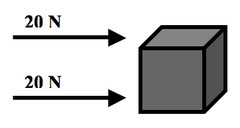
In the example shown, the force of the ground pushing upward on the ball is F1 = 10 N, and the force of gravity pulling downward on the ball is F2 = 10 N. What is the net force acting on the ball?
0 N
5 N upward
20 N downward
10 N upward
If the net force on an object is zero, the object will experience no change in its motion.
True
False
Newton's Second Law of Motion states that the ______ of an object is equal to the net force acting on the object divided by the object's mass.
acceleration
velocity
momentum
displacement
What is the formula for acceleration according to Newton's Second Law of Motion?
a = F + m
a = F / m
a = m / F
a = F - m
In the formula a = F / m, what does 'F' stand for?
Force of friction
Net force
Final velocity
Mass
In the formula a = F / m, what does 'm' represent?
mass
momentum
meter
motion
In the formula a = F / m, what does 'a' represent?
acceleration
force
mass
velocity
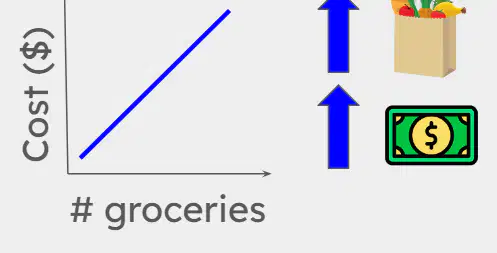
According to the information provided, what happens in a directly proportional relationship?
When one variable increases, the other variable decreases.
When one variable increases, the other variable also increases.
When one variable decreases, the other variable stays the same.
When one variable increases, the other variable disappears.
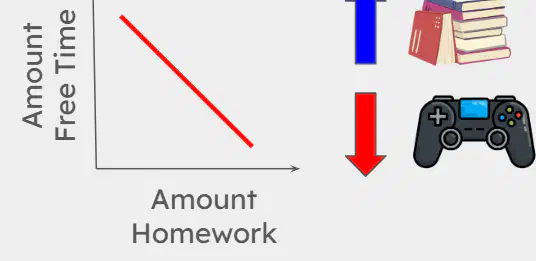
According to the information provided, what happens in an inversely proportional relationship?
When one variable increases, the other variable also increases.
When one variable increases, the other variable decreases and vice versa.
When one variable decreases, the other variable stays the same.
When one variable increases, the other variable disappears.
Acceleration is directly proportional to the net force acting on the object.
True
False
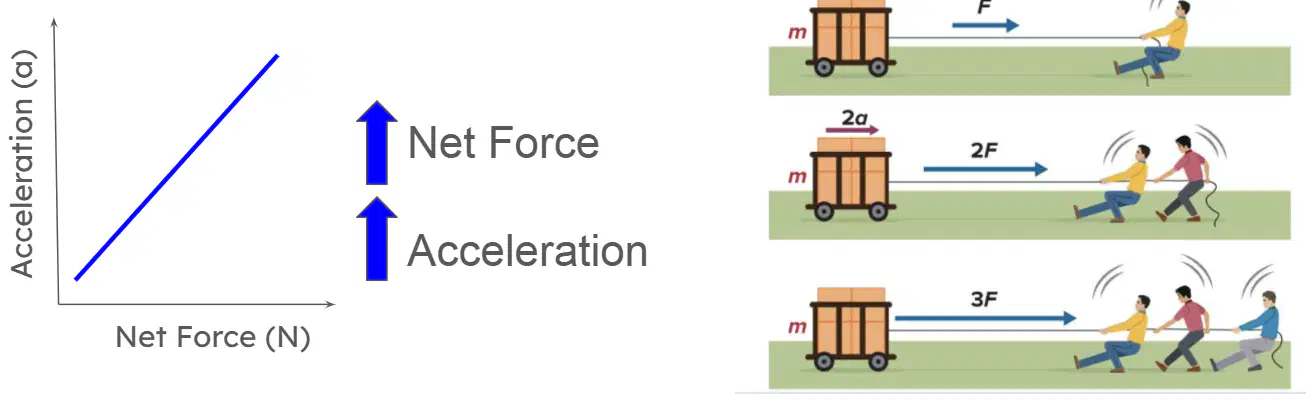
In the diagram, if the net force applied to the cart is doubled, what happens to the acceleration?
It is halved
It stays the same
It is doubled
It is tripled
What is inertia? Inertia is the tendency for objects in motion to ______ changes in their speed or direction.
resist
accelerate
welcome
encourage

According to the diagram, if the mass of the object increases while the force remains the same, what happens to the acceleration?
It increases
It decreases
It stays the same
It becomes zero
Heavier objects have more inertia.
True
False
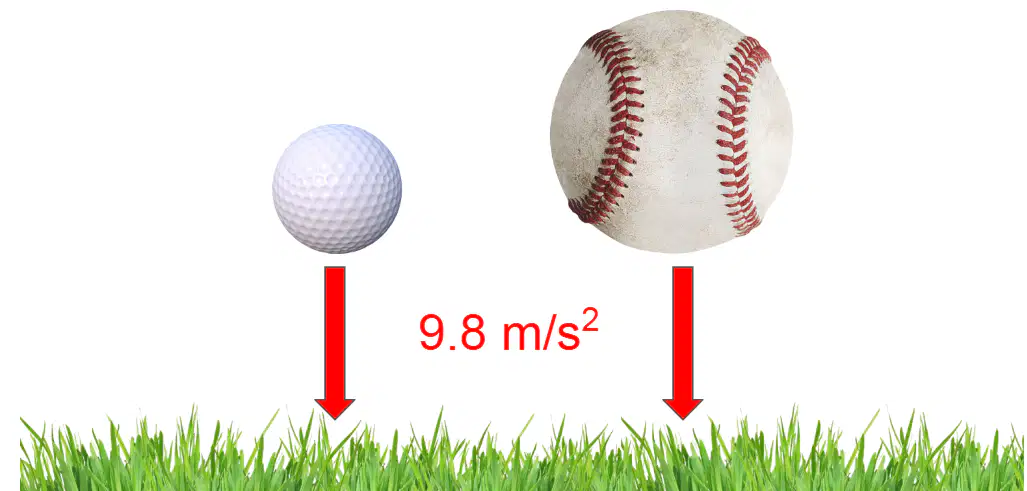
Two objects with different masses experience the same acceleration due to gravity and hit the ground at the same time, assuming no air resistance. True or False: Heavier objects fall faster than lighter objects in the absence of air resistance.
True
False
What are the units of acceleration?
m/s^2 (meters per second squared)
m/s (meters per second)
kg (kilogram)
N (newton)
What are the units of force?
Newtons (N)
Joules (J)
Watts (W)
Pascals (Pa)
What are the units of mass?
Kilograms (kg)
Meters (m)
Seconds (s)
Liters (L)
According to Newton's second law, what is the formula to solve for net force?
F = m x a
F = m + a
F = m / a
F = a - m
An object of mass 10 kg is accelerated upward at 2 m/s2. What force is required?
20 N
2 N
5 N
0 N
How much force is needed to move a 10 kg watermelon to an acceleration of 4 m/s/s?
2.5 N
40 N
.4 N
10 N

According to Newton's second Law, which would take more force to slow down?
The silver car
The green car
They would both take the same force
What Unit do we Measure Force in?
Newtons
Joules
Volts
Lumens
A force of 200 N is exerted on an object of mass 40 kg that is located on a sheet of perfectly smooth ice.Calculate the acceleration of the object.

Jenny applies a 60 N force to a 20 Kg cart, what is the acceleration of the cart if friction can be neglected?
1200 m/s2
0.33 m/s2
20 m/s2
3 m/s2
Jenny applies a 60 N force to a 20 Kg cart, what is the acceleration of the cart if friction can be neglected?
1200 m/s2
0.33 m/s2
20 m/s2
3 m/s2
Which of the following scenarios shows an unbalanced force?
A book resting on a table, not moving.
A car cruising at a constant speed on a straight road.
A soccer ball accelerating after being kicked.
Two people pushing a box from opposite sides with equal force.
Which of the following scenarios shows a balanced force?
A skateboard speeding up as it goes down a hill.
A ball rolling to a stop because of friction.
A picture hanging still on a wall.
A rocket lifting off the ground.
Which of the following situations involves balanced forces acting on an object?
A parachute slowing down a skydiver as they fall.
A person holding a heavy box still in their hands.
A basketball bouncing off the floor.
A cyclist speeding up after turning a corner.
A student is pushing a cart with a constant force. According to Newton’s Second Law (F = ma), what happens to the cart’s acceleration if the mass of the cart is doubled, but the force stays the same?
The acceleration doubles
The acceleration stays the same
The acceleration is cut in half
The force increases to match the new mass
If you push a wagon with more force, and the mass of the wagon stays the same, what will happen to the acceleration?
It will decrease
It will stay the same
It will increase
It will stop moving
According to Newton's second law, what is the formula to solve for net force?
F = m x a
F = m + a
F = m / a
F = a - m
Why is it important to investigate and describe how Newton’s three laws of motion act within systems like rocket launches and amusement park rides?
To understand how forces and motion interact in real-world scenarios
To learn about animal habitats
To memorize historical dates
To study the properties of water
What is another name for Newton's First Law of Motion?
Law of Gravity
Law of Inertia
Law of Acceleration
Law of Energy
According to Newton's First Law of Motion, what will happen to an object at rest if no unbalanced force acts on it?
It will start moving
It will stay at rest
It will speed up
It will change direction
What must act on an object in motion to change its state according to Newton's First Law?
Balanced force
Unbalanced force
Gravity only
Friction only
Why is Newton's First Law sometimes called the "Law of Inertia"?
Because it explains how objects gain speed
Because it describes how objects resist changes in their motion
Because it only applies to objects in space
Because it is about energy transfer
Which formula represents Newton's Second Law of Motion?
a = F / m
F = m + a
m = F / a
a = m / F
According to the mnemonic "Fast Movers," what happens when you push harder on an object?
It moves faster (greater acceleration)
It becomes heavier
It stops moving
Its mass increases
What is the mnemonic mentioned in the material to remember Newton's Third Law of Motion?
Push Back
Pull Forward
Jump High
Move Fast
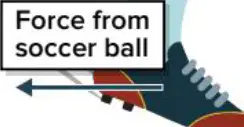
If a soccer player kicks a ball, which direction does the ball push back on the player's foot?
In the opposite direction of the kick
In the same direction as the kick
Upwards
Downwards
What is a system according to Newton's laws of motion?
A collection of objects that interact with each other.
A single object moving in space.
A force acting on an object.
A type of energy.
What does it mean if the net force on an object is zero?
The forces are balanced.
The object is accelerating.
The object is moving in a circle.
The forces are unbalanced.
When a basketball player jumps, what does Newton’s third law state about the forces involved?
The player pushes down and the floor pushes up with an equal force.
The player floats in the air.
The floor pulls the player down with more force.
The player pushes up and the floor pushes down with an equal force.
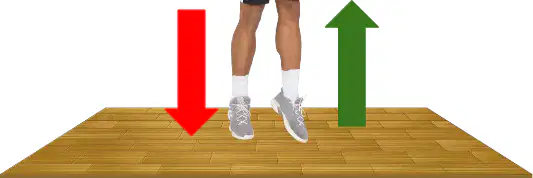
What do the red and green arrows in the diagram represent?
The red arrow shows the player pushing down, and the green arrow shows the floor pushing up.
The red arrow shows the player moving up, and the green arrow shows the player moving down.
The red arrow shows gravity, and the green arrow shows air resistance.
The red arrow shows the floor moving, and the green arrow shows the player standing still.
Which of Newton’s laws explains why a player accelerates upward when jumping?
Newton’s First Law
Newton’s Second Law
Newton’s Third Law
Newton’s Law of Gravity
According to Newton’s Second Law, why does the player accelerate upward?
The force of gravity is stronger than the net force
The net force is greater than gravity pulling them down
The player is weightless
The player is standing still
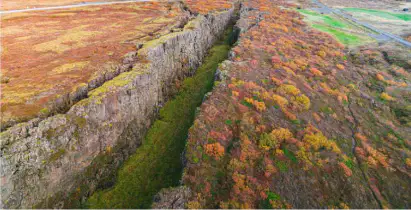
Which of the following is an example of how Newton's Laws are applied in Earth Science?
Plate Tectonics
Bridge Design
Rocket Launches
Airbags & Helmets
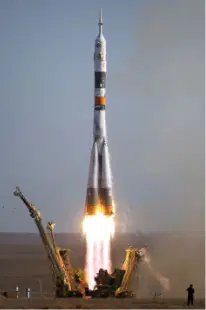
Which of the following best explains why Newton's Laws are important for rocket launches?
They help understand how tectonic plates move.
They explain the forces and motion involved in launching rockets.
They are used to design safer cars.
They are used to build stronger bridges.
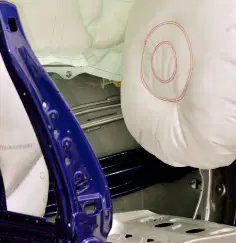
A student wants to design a safer bicycle helmet. Which scientific principle should they consider based on the applications shown?
Newton's Laws
Theory of Evolution
Law of Conservation of Mass
Photosynthesis
Which law is related to the idea of "Push back"?
3rd Law
1st Law
2nd Law
4th Law
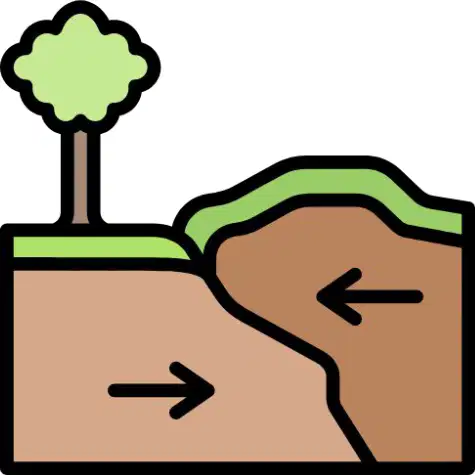
What does the diagram illustrate about tectonic plates?
They can move in different directions
They always stay still
They are made of water
They are only found in the ocean
What does it mean when the net force on an object is balanced?
The object will accelerate
The object will change direction
The object will move at a constant speed or stay at rest
The object will stop moving immediately
Which law explains why your body wants to keep moving forward when a car stops suddenly?
Newton's 1st Law
Newton's 2nd Law
Newton's 3rd Law
Law of Gravity

According to Newton's Second Law, what does acceleration depend on?
The object's color and shape
The force and the object's mass
The object's temperature
The object's volume


A rocket is able to accelerate in the vacuum of space when it fires its engines. The force that propels the rocket is the force
of the rocket on the exhaust gases.
of the exhaust gases on the rocket.
neither A nor B

