
 Worksheets
Unit 3 Test Review
Total questions: 41
Worksheet time: 46mins
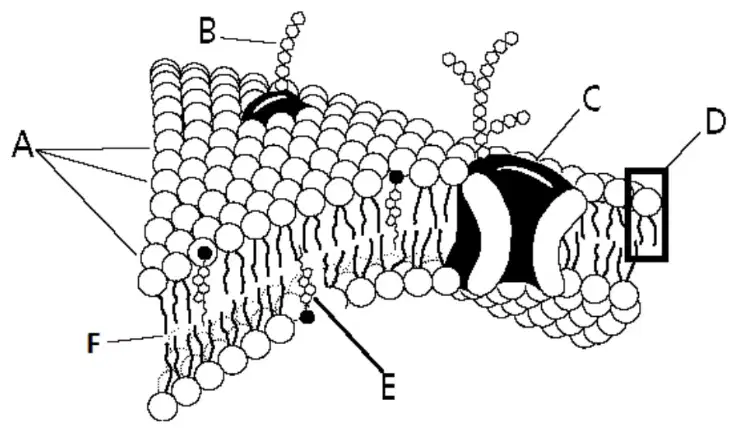
Where are you least likely to find water in this structure?
A
B
C
F
Which structure is a carbohydrate chain labels the marker protein?
A
B
C
F
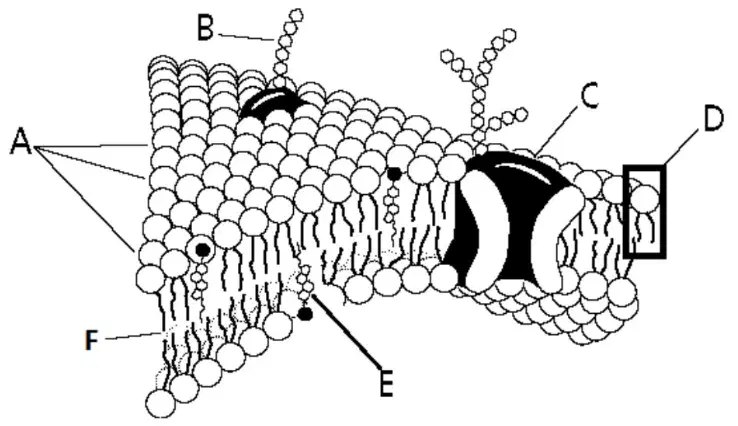
What structure allows large molecules in and out of the cell?
A
B
C
D
What structure is has a Hydrophillic head & Hydrophobic tails?
A
B
C
D
What is the name for structure “E”?
Cholesterol
Phospholipid
Protein Channel
Glycoprotein
What is the name for structure “F”?
Cholesterol
Phospholipid Bilayer
Protein Channel
Glycoprotein
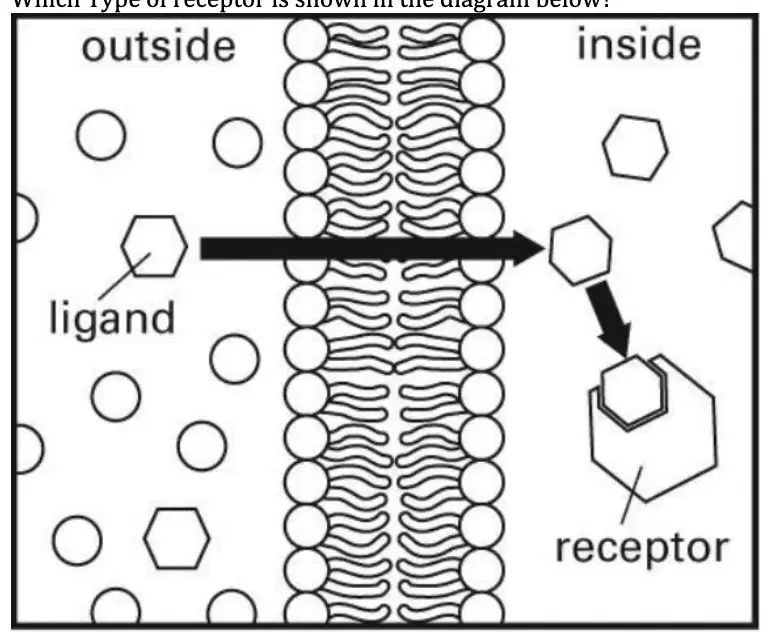
Which Type of receptor is shown in the diagram below?
cytoplasmic receptor
membrane receptor
extracellular receptor
intracellular receptor
When a cell uses a Channel Protein to pass a particle through the cell membrane, without ATP, this is called __.
facilitated diffusion
osmosis
diffusion
active transport
What would happen if you place a plant cell in an isotonic solution?
the plant cell will take in water and burst
the water will go out of the plant cell and it will shrink.
the water will travel into and out of the plant cell equally
nothing would move
Which biomolecule is used as a channel or pump to assist certain solutes to pass through the cell membrane?
Lipids
Carbohydrates
Nucleic Acids
Proteins
Which statement describes the process of osmosis in an animal cell?
sugar molecules move across the plasma membrane until the cell has enough energy to grow in size and divide.
water molecules move across the plasma membrane until solute concentrations are equal on both sides of the membrane.
Ions move across the plasma membrane until the inside of the cell has a higher concentration of positive charges.
Enzymes move across the plasma membrane until the cell has completed charges.
What organelle does both Prokaryotes & Eukaryotes have because it is NOT membrane bound?
A. mitochondria
B. a nucleus
C. rough endoplasmic reticulum
D. ribosomes
Which structure synthesizes protein molecules?
mitochondria
vacuole
smooth endoplasmic reticulum
ribosome
Which organelles help provide cells with energy?
mitochondria
vacuoles
smooth endoplasmic reticulum
ribosomes
When looking at a prokaryote and eukaryote what characteristic best demonstrates a difference in the two cells?
The organization of the genetic material
The location of the cytoplasm
The role of the cell membrane
The function of the flagella
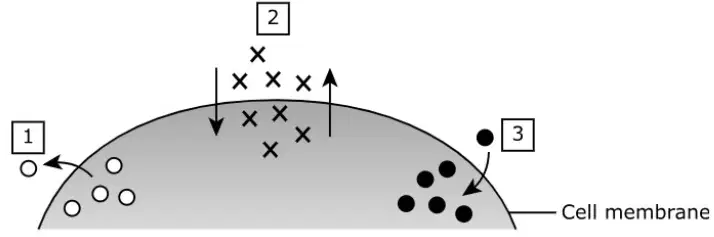
The diagram represents the movement of three different substances across a cell membrane. Moving which of these substances across the cell membrane requires energy from ATP?
2 only
3 only
1 and 2
1 and 3
Which of the following is not a component of the cell theory?
The cell is the basic unit of living things.
All cells contain a nucleus that controls cell division.
All organisms are made of at least one cell.
All cells come from preexisting cells.
Who was the scientist who first gave cells their name?
Hooke
Schwann
Van Leeuwenhoek
Schleiden
Which of the organelles do plant cells have and animal cells do not have?
Mitochondria
Cell Wall
Ribosomes
Cell Membrane
Which one is the definition of active transport?
movement of particles through the cell membrane from a region of lower concentration to a region of higher concentration using energy in the form of ATP.
passage of water molecules from a region of their higher concentration to a region of their lower concentration through a partially permeable membrane
net movement of molecule from a region of higher concentration to region of lower concentration. Molecule down a concentration gradient
net movement of molecule from a region of lower concentration to region of higher concentration. Molecule down a concentration gradient

Active Transport
A signal molecule that binds to a receptor is a
What is DIFFUSION?


If something goes down its concentration gradient it goes from
an area of low concentration to an area of high concentration
an area of high concentration to an area of low concentration


Which type of passive transport uses proteins to help molecules pass through the membrane?
Cell membranes are described as selectively permeable.
Four students were asked to explain what this means. Which one is correct?
Student 1: Cell membranes prevent all materials from entering the cell.
Student 2: Cell membranes only provide structural support for the cell.
Student 3: Cell membranes regulate which substances can enter and exit the cell.
Student 4: Cell membranes allow water and water-soluble substances to enter the cell.

In the cell pictured, which way would water move?
Into the cell, causing the cell to swell
Out of the cell, causing the cell to shrink
In and out of the cell equally, keeping the shape the same

In the cell pictured, which way would water move?
Into the cell, causing the cell to swell
Out of the cell, causing the cell to shrink
In and out of the cell equally, keeping the shape the same

In the cell pictured, which way would water move?
Into the cell, causing the cell to swell
Out of the cell, causing the cell to shrink
In and out of the cell equally, keeping the shape the same

The 3 parts of the Cell Theory are...?
All living things are composed of cells
Cells are the basic units of structure and function in living things
All cells are produced from other cells
All living things are composed of cells
Cells are the basic units of dance and vibes in living things
All cells are destroyed from other aliens
All living things are composed of Jell-O
Cells are the basic units of structure and function in living things
All cells are produced from factories in Canada
All living things are composed of cells
Cells do karate and practice eating whole pies in their free time
All cells are produced from other cells
Which of the following provides evidence for the hypothesis that prokaryotes evolved before eukaryotes.
prokaryotes are more complex
prokaryotes have no nucleus
eukaryotes are multicellular which makes them simpler
prokaryotes grow into eukaryotes
PROKARYOTIC cells do NOT have
membrane bound organelles
cell membrane
DNA
ribosomes



